Alex Wiltschko is a neuroscientist and founder of Osmo. At Google Research, he led a digital-olfaction group that used machine learning to predict odor descriptions from molecular structures and develop the Principal Odor Map. Osmo is applying that work to fragrance design and exploring longer-term possibilities for sensing and reproducing smells. — Building a Map of Odor.
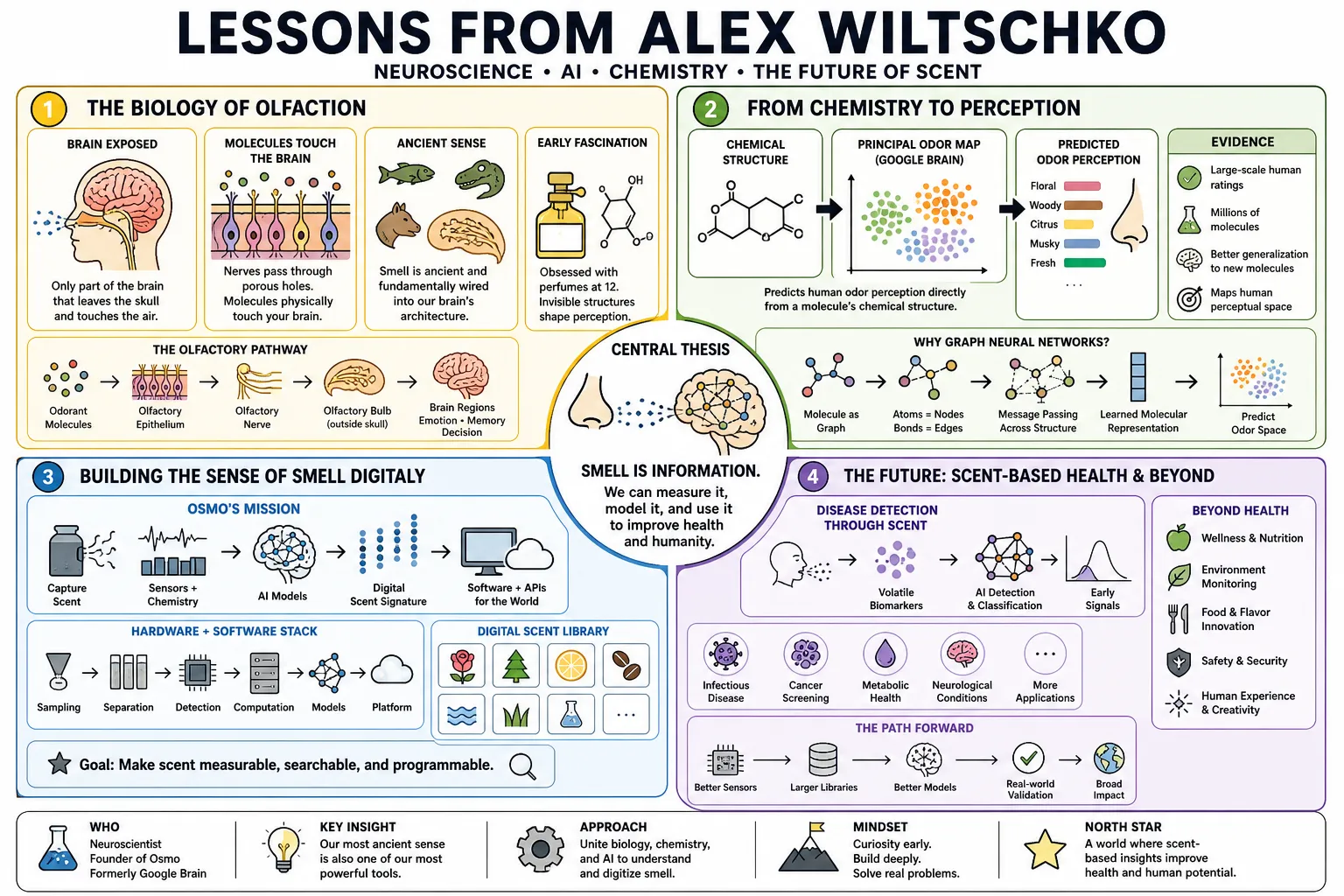
Part 1: The Biology of Olfaction
- On smell’s unusual anatomy: Wiltschko describes olfaction as unusually direct: airborne molecules contact sensory tissue in the nose, whose neurons send signals to the brain. His colorful “brain touches air” phrasing should not be read as literal exposure of brain tissue. — Salon — Digital Smell Has Arrived.
- On an early perfume obsession: Wiltschko says he began collecting perfumes in adolescence and that the interest persisted through his neuroscience and computing work. — Confessions of a Perfume Nerd.
- On an old sensory channel: Wiltschko treats olfaction as a biologically ancient way to detect information about the environment; the unverified “before language” chronology is removed. — Building a Map of Odor.
- On shared olfactory structure: Wiltschko and coauthors found that a human-trained odor representation predicted several receptor, neural and behavioral responses across animal datasets. — Metabolic Activity Organizes Olfactory Representations.
- On metabolism and odor: The coauthored eLife study found that nearby odors in the model’s representation tend to co-occur in nature and lie closer in metabolic pathways. — Metabolic Activity Organizes Olfactory Representations.
- On crossing disciplinary boundaries: Wiltschko connects chemistry, sensory neuroscience and machine learning in explaining why molecular structure can be modeled against human odor descriptions. — Securities Podcast — Wiltschko Interview.
- On scent and memory: Wiltschko describes his own especially vivid recall of smells and argues that odor contributes to emotionally rich experiences; the oversimplified direct-bulb-to-amygdala explanation is removed. — Securities Podcast — Wiltschko Interview.
- On mixtures rather than single molecules: Wiltschko warns that daily smells are mixtures, while early prediction research simplified the problem to one molecule at a time. — Securities Podcast — Wiltschko Interview.
- On structure and perception: His Google team framed the core structure–odor problem as predicting human descriptors for a molecule from its chemical structure without fully resolving every receptor-level mechanism. — Building a Map of Odor.
Part 2: The Limits of Current Science
- On the missing smell textbook: Wiltschko recounts comparing textbook space devoted to senses and finding only about 30 pages on smell, an anecdote about how underdeveloped olfaction theory seemed to him. — Securities Podcast — Wiltschko Interview.
- On the gap in sensory maps: Wiltschko contrasts mature quantitative maps of color and sound with the long absence of a similarly useful map for odor. — Building a Map of Odor.
- On expensive capture: Wiltschko says earlier approaches to collecting and analyzing smells could require costly, time-consuming work, motivating better sensing and data pipelines. — There’s Data in the Air.
- On vision’s simpler map: Color can be represented with a small set of coordinates, whereas smell involves hundreds of receptor types and called for a higher-dimensional learned representation. — Building a Map of Odor.
- On molecular activity cliffs: Wiltschko notes that even a small bond change can take a molecule from a familiar fragrance to no odor, complicating simple structure–odor rules. — Securities Podcast — Wiltschko Interview.
- On shared scent vocabulary: Osmo published a taxonomy to give perfumers, researchers and others common reference terms for odors, while acknowledging that subjective impressions are not eliminated. — Osmo Scent Taxonomy.
- On the sensing gap: Wiltschko distinguishes the predictive model from the harder physical task of capturing and reproducing arbitrary real-world odor mixtures. — Securities Podcast — Wiltschko Interview.
- On a slow fragrance workflow: Wiltschko describes traditional custom-fragrance development as specialized, expensive and slow, with sample and iteration cycles that can take months. — Letter from the Founder: Fragrance Design for All.
- On digitizing physical matter: Wiltschko’s account of scent teleportation requires collecting molecules, chemical analysis, a digital model and physical reformulation—not merely transmitting a waveform or image. — How We Invented Scent Teleportation.
Part 3: Graph Neural Networks and Smell
- On molecules as graphs: Wiltschko’s Google team represented a molecule as a graph of atoms and bonds, an apt input for a graph neural network rather than a perfect representation of all chemistry. — Google Research — Learning to Smell.
- On message passing: The model passes information among neighboring atoms before pooling a molecule-wide representation and predicting multiple odor descriptors. — Google Research — Learning to Smell.
- On prospective accuracy: In a 400-odorant prospective test, the model’s predicted odor profile matched a trained panel mean more closely than the median individual panelist did. — A Principal Odor Map Unifies Diverse Tasks in Olfactory Perception.
- On inspecting representations: Wiltschko’s team inspected learned odor embeddings and tested whether they transferred to related tasks, without claiming to identify one particular atom as the cause of a smell. — Google Research — Learning to Smell.
- On expanding training data: The Google Research team enlarged and tested the odor map using additional historical USDA data and a mosquito-assay dataset; the old Leffingwell-only account is incomplete. — Google Research — Digitizing Smell.
- On a learned odor geometry: The Principal Odor Map places molecules in a learned representation that preserves measured perceptual relationships and supports prediction of novel odorants. — A Principal Odor Map Unifies Diverse Tasks in Olfactory Perception.
- On out-of-sample testing: The research evaluated the model on odorants outside its training set; ongoing automatic self-refinement with every new molecule was not established. — A Principal Odor Map Unifies Diverse Tasks in Olfactory Perception.
- On what the graph encodes: The original model aggregated atom and bond connectivity into a molecule-level representation; it did not directly encode holistic three-dimensional shape. — Google Research — Learning to Smell.
- On adjacent molecular tasks: Wiltschko says graph-learning methods developed for chemistry and drug-discovery work inspired his group to try the architecture for smell. — Securities Podcast — Wiltschko Interview.
- On blind prospective validation: The team withheld model predictions for previously uncharacterized odorants before trained humans rated them, allowing a prospective comparison. — Securities Podcast — Wiltschko Interview.
Part 4: The Principal Odor Map
- On a perceptual map: The Principal Odor Map embeds molecules so that distance in the learned space carries information about human odor similarity; it is not an exact physical ruler. — A Principal Odor Map Unifies Diverse Tasks in Olfactory Perception.
- On the RGB analogy: Wiltschko uses RGB as an analogy for a useful sensory map, while explaining that odor requires a far higher-dimensional representation than color. — Building a Map of Odor.
- On untested odorants: The prospective study predicted descriptions for molecules not previously characterized by its panel, then compared those predictions with trained human ratings. — A Principal Odor Map Unifies Diverse Tasks in Olfactory Perception.
- On links to metabolism: The coauthored eLife study found associations between map proximity, natural co-occurrence and metabolic pathways across sampled organisms. — Metabolic Activity Organizes Olfactory Representations.
- On stereoisomer limits: The original Google model could not distinguish stereoisomers because its molecular graph omitted spatial positions; the current claim that it solved this difference is reversed. — Google Research — Learning to Smell.
- On gradients in odor space: The map represents odor relationships continuously rather than forcing every molecule into one isolated smell label; the garlic/onion example was not verified. — A Principal Odor Map Unifies Diverse Tasks in Olfactory Perception.
- On a design tool: Wiltschko frames the map as a way to predict candidate molecule odors and guide fragrance research, not a replacement for synthesis or human sensory testing. — Building a Map of Odor.
- On unresolved receptor mechanisms: The map predicts odor descriptions from molecular structure, while Wiltschko’s team says detailed receptor and brain mechanisms remain incompletely understood. — Google Research — Learning to Smell.
- On a validated model: The original research demonstrates a generalizable predictive odor map across new odorants and related tasks; the claim that all human smell was comprehensively digitized is removed. — A Principal Odor Map Unifies Diverse Tasks in Olfactory Perception.
Part 5: Digitizing and Teleporting Scent
- On a lab scent recreation: Wiltschko reports a laboratory scent-teleportation demonstration, first with coconut and later using the headspace above a plum; this is not yet routine consumer transmission. — How We Invented Scent Teleportation.
- On reading and writing smell: His process separates chemical capture and analysis from the later formulation step that mixes materials to recreate a scent. — How We Invented Scent Teleportation.
- On chemical capture: Osmo uses headspace sampling and gas chromatography–mass spectrometry to analyze a physical sample, rather than a smartphone-like real-time “smell camera.” — How We Invented Scent Teleportation.
- On formulation robots: The lab workflow sends a predicted formula to a robot that mixes scent materials, then compares the result with the original; the source does not specify a consumer microfluidic printer. — How We Invented Scent Teleportation.
- On smaller future devices: Wiltschko imagines a future device that can read and write scent with phone-like ease; the current Osmo lab process is not an existing smartphone chip. — Truth and Beauty: A Vision for the Future of Scent.
- On transmitting a recipe: The lab workflow uploads chemical measurements to a cloud model and sends a formulation recipe to a robot; Wiltschko describes ordinary message-like scent sharing as a future goal. — How We Invented Scent Teleportation.
- On subtle mixture components: Wiltschko notes that low-abundance compounds can materially alter a reconstructed odor, making faithful recreation more demanding than identifying the dominant molecule. — How We Invented Scent Teleportation.
- On the ultimate transmission goal: Wiltschko’s stated goal is to make sharing a scent from a hike as easy as sending a picture or song; his signed account describes this as an ideal still being approached. — How We Invented Scent Teleportation.
Part 6: Transforming the Fragrance Industry
- On expanding fragrance creation: Wiltschko told Fashionista he wants the number of unique fragrances to grow from roughly 100,000 to millions; treat this as his aspiration and rough estimate, not a verified industry census. — Fashionista — Wiltschko Fragrance Interview.
- On augmenting perfumers: Wiltschko says Osmo automates computational and compliance work so perfumers can spend more time on creative judgment and refinement. — Letter from the Founder: Fragrance Design for All.
- On access for smaller brands: Wiltschko argues that traditional fragrance houses often require large budgets and volumes, while Osmo’s custom workflow aims to make bespoke development accessible to smaller brands. — Letter from the Founder: Fragrance Design for All.
- On synthetic alternatives: Wiltschko’s Google Research account names potentially cheaper, more sustainable synthetic odorants as a research application, not proof that every natural ingredient can already be replaced. — Google Research — Learning to Smell.
- On screening constraints: Wiltschko says Osmo’s fragrance workflow screens for regulatory compliance and ingredients harmful to health or the environment early in design. — Letter from the Founder: Fragrance Design for All.
- On faster iteration: Wiltschko describes generating an initial fragrance sample and iterating with a perfumer faster than the traditional months-long cycle; this is Osmo’s reported workflow, not a universal R&D speedup. — Letter from the Founder: Fragrance Design for All.
- On new fragrance compositions: Wiltschko says the foundry and machine-learning approach have helped Osmo make fragrances previously unknown to its team; the stronger claim of an entirely new chemical class is removed. — Confessions of a Perfume Nerd.
- On human artistry: Osmo’s published workflow has perfumers evaluate, combine and refine AI-generated starting formulas; the technology is framed as assistance, not a substitute for human composition. — How Olfactory Intelligence and Perfumers Work Together.
- On an opening in fragrance: Wiltschko describes the traditional process as exclusive, opaque and slow and positions Osmo as a more accessible custom-development route; claiming an oligopoly has already been broken would overstate the evidence. — Letter from the Founder: Fragrance Design for All.
Part 7: AI in Molecular Chemistry
- On learning from adjacent chemistry: Wiltschko says graph-learning advances in drug discovery and chemistry prompted his Google Brain team to test the same kind of model for odor prediction. — Securities Podcast — Wiltschko Interview.
- On a vast candidate space: Google’s original account describes potentially billions of odor-producing molecules, making exhaustive human cataloguing impractical; the astronomical comparison and “only AI” claim are removed. — Google Research — Digitizing Smell.
- On designing from a fragrance brief: Osmo says its system can turn a text, image or mood-board brief into candidate fragrance formulas for perfumer review; this is not the same as generating one exact molecule for any requested smell. — Letter from the Founder: Fragrance Design for All.
- On physical validation: A computed odor description or formula is not the finished scent: Osmo’s lab process mixes real materials and compares the recreated smell with the original. — How We Invented Scent Teleportation.
- On molecular exceptions: Wiltschko’s Lyral example shows how a small structural change can produce a major odor difference, an activity cliff that simple chemical rules miss. — Securities Podcast — Wiltschko Interview.
- On computational screening: The Google team used a trained odor map to predict properties of novel molecules before physical testing; no inspected original source supports the “million compounds in a fraction of a second” statistic. — A Principal Odor Map Unifies Diverse Tasks in Olfactory Perception.
- On feedback from trials: Wiltschko describes recurring lab teleportation trials and data collection used to refine the scent-decoding and reformulation process, without a quantified compounding-accuracy claim. — How We Invented Scent Teleportation.
- On joining chemistry and ML: Wiltschko’s account combines graph models, sensory panels, physical chemical analysis and formulation; progress depends on these disciplines working together, not a verified “same room” maxim. — Securities Podcast — Wiltschko Interview.
Part 8: The Future of Health and Disease Detection
- On a health-sensing ambition: Wiltschko describes disease detection as a future application of olfactory intelligence, not an already validated Osmo clinical sensor. — Truth and Beauty: A Vision for the Future of Scent.
- On biological precedent: Wiltschko points to dogs’ odor-sensing abilities as a reason to investigate machine detection of disease, while making clear that equivalent software capability remains a goal. — Truth and Beauty: A Vision for the Future of Scent.
- On non-invasive possibilities: Wiltschko imagines odor-based disease sensing as a potentially accessible tool; the current direct sources do not demonstrate a validated breath or skin-swab diagnostic. — Truth and Beauty: A Vision for the Future of Scent.
- On metabolic information in scent: The coauthored eLife paper connects biologically emitted odorants with metabolic pathways, providing a research rationale for investigating chemical health signals without proving any disease test. — Metabolic Activity Organizes Olfactory Representations.
- On population-level monitoring: Wiltschko imagines future scent-based monitoring of population health; the specific claim that cheap home sensors already enable continuous monitoring is unsupported. — Truth and Beauty: A Vision for the Future of Scent.
- On earlier detection as a goal: Wiltschko suggests that future odor-based tools could detect some diseases earlier than current diagnosis; this is an aspiration, not a demonstrated clinical lead time. — Truth and Beauty: A Vision for the Future of Scent.
- On weak signals in mixtures: Wiltschko calls mixture modeling an unresolved frontier; any proposed health sensor would have to handle the complex blends people and environments emit. — Securities Podcast — Wiltschko Interview.
- On tuberculosis screening as a possibility: Wiltschko lists tuberculosis among diseases he hopes future olfactory intelligence could detect; no source here validates a low-cost field-screening device. — Truth and Beauty: A Vision for the Future of Scent.
- On the broader mission: Wiltschko frames digitizing scent as both a creative fragrance tool and a longer-term route to understanding biological and health signals. — Truth and Beauty: A Vision for the Future of Scent.