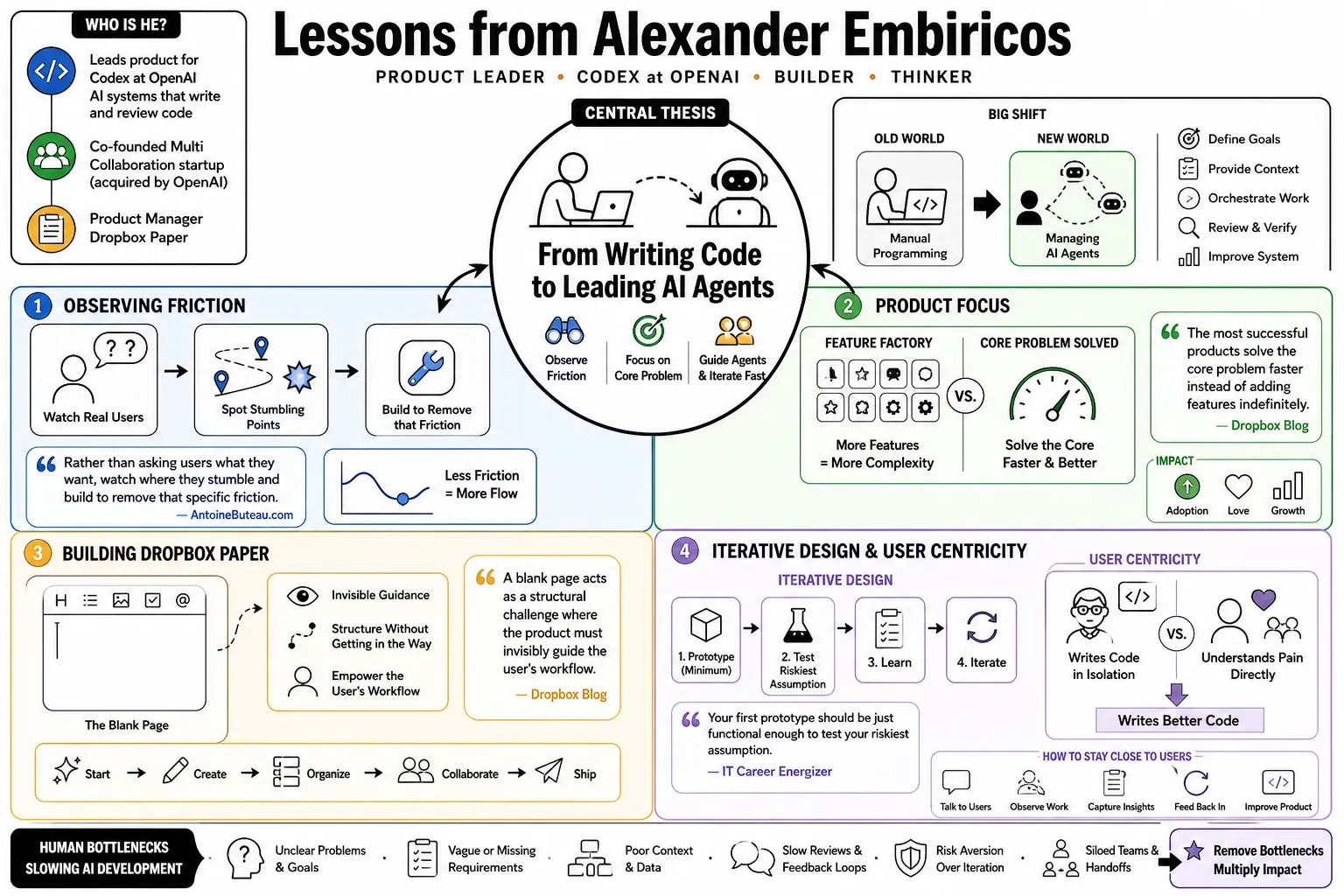
Lessons from Alexander Embiricos
Alexander Embiricos worked on Dropbox Paper, co-founded the remote-collaboration company Multi, and later led product work on OpenAI Codex. Across those roles, he has discussed how people collaborate on software and how coding agents shift engineers toward task definition and review. — Sequoia — OpenAI Codex.
Part 1: Product Management and Building for Users
- On Observing Friction: Interviews with new technical leads revealed that screen sharing felt like presenting rather than working together; that specific friction helped steer Remotion toward a tool for collaborative engineering. — Embiricos — Remotion Pivot.
- On Product Focus: After a shipping spree failed to solve the core user problem, Multi narrowed its audience and concentrated on doing a few essential functions well. — Embiricos — Product Quality.
- On Building Dropbox Paper: In his Dropbox product work, Embiricos described offline access and mobile collaboration features that kept Paper work moving when teammates were away from their desks. — Dropbox — Paper Mobile Apps.
- On Iterative Design: Multi's team paused feature expansion, cancelled two features in progress, and fixed 19 issues while improving the product's core experience. — Embiricos — Product Quality.
- On User Centricity: Talking with new technical leads, rather than relying only on established power users, exposed a different screen-sharing problem and informed the team's pivot. — Embiricos — Remotion Pivot.
- On Simplicity: Reflecting on Dropbox, Embiricos said a tool first has to feel like a natural, easy way to accomplish the user's work before deeper automation matters. — 20VC — Codex Lead Interview.
- On Prioritization: The pivot toward technical teams required Multi to stop building for roughly 60% of its previous top users, a concrete trade-off rather than an effort to please every segment. — Embiricos — Remotion Pivot.
- On Cross-functional Teams: Embiricos treats the product-manager role as context-dependent: its useful contribution varies with the team's needs rather than following one fixed division of labor. — 20VC — Codex Lead Interview.
- On Metrics: When Remotion's metrics were too weak, Embiricos concluded that incremental fixes were insufficient; usage and customer feedback pointed to a larger product change. — Engineering Founders — Remotion Pivot.
- On Shipping: After refocusing on technical teams, Multi watched actual call and screen-sharing usage rise even as some users churned, using live behavior to judge the pivot. — Embiricos — Remotion Pivot.
Part 2: The Evolution of Remote Work and Collaboration
- On Remote Culture: Remotion was designed to make small, informal conversations easier for distributed teammates, not only to facilitate scheduled meetings. — Ness Labs — Remotion Interview.
- On Virtual Offices: Remotion began with spontaneous team calls, but the team shifted toward making collaboration inside calls people were already having more productive. — Embiricos — Remotion Becomes Multi.
- On Pairing Remotely: Multi emphasized shared apps and co-editing during calls so teammates could work together rather than merely watch a screen presentation. — Embiricos — Remotion Becomes Multi.
- On Pivoting Multi: The team focused on technical users after discovering that new engineering leads struggled with existing screen-sharing tools for collaborative work. — Embiricos — Remotion Pivot.
- On Presence: Remotion offered ambient awareness of teammates while making availability and visibility opt-in, avoiding an always-on camera requirement. — Ness Labs — Remotion Interview.
- On Hybrid Friction: Embiricos warned that hybrid teams can create a two-tier experience if remote participants are treated as less present than people in the room. — Ness Labs — Remotion Interview.
- On Context Switching: Remotion's design aimed to keep notifications rare and protect focused maker time while still enabling quick conversations when they were useful. — Ness Labs — Remotion Interview.
- On Engineering Collaboration: The need Multi pursued was more productive collaboration during existing technical calls, especially where presentation-style screen sharing slowed joint work. — Embiricos — Remotion Pivot.
- On Startup Exits: When Multi joined OpenAI, Embiricos connected its earlier question of how people work together on computers to the newer question of how people work with computers through AI. — Multi — Joining OpenAI.
Part 3: The Transition from Pair Programming to Delegation
- On AI Tooling: Embiricos describes a shift beyond autocomplete toward assigning an agent a coding task that it can complete in its own environment and return for review. — Sequoia — OpenAI Codex.
- On Delegation vs Pairing: Pairing keeps the developer in an interactive loop; delegation lets a coding agent work independently on a task before the developer reviews the result. — Sequoia — OpenAI Codex.
- On Asynchronous Agents: Codex agents can work on separate tasks in their own environments, allowing developers to hand off work without watching one continuous editing session. — Sequoia — OpenAI Codex.
- On Reviewing AI Code: As agents handle more implementation, Embiricos emphasizes planning, inspecting and validating their returned changes before they are integrated. — Sequoia — OpenAI Codex.
- On Trusting AI: Reviewable agent work needs visible evidence such as tests and execution outputs, together with human judgment about whether the change meets the intended goal. — Sequoia — OpenAI Codex.
- On the Manager Mindset: The engineer's work increasingly includes specifying tasks, making design choices and reviewing completed agent work, not merely entering each line of code. — Sequoia — OpenAI Codex.
- On Iterative Delegation: Early cloud-agent adoption exposed friction around onboarding and task setup; developers learn to give enough context and configure environments for the work they delegate. — AI’s Biggest Bottleneck — Original Interview.
- On Speed to Value: Delegating scoped background tasks can free developers to focus on decisions and review, provided the agent returns a change that can actually be assessed. — Sequoia — OpenAI Codex.
- On Project Planning with AI: In his Codex demonstration, Embiricos uses a PLANS.md file to guide sufficiently complex work; he explicitly notes that a separate plan is not needed for every task. — How I AI — Codex Demonstration.
- On Prompting Models: Useful agent instructions depend on the task and its working context, including repository setup and constraints, rather than a prompt alone. — AI’s Biggest Bottleneck — Original Interview.
Part 4: AI as a Software Engineering Teammate
- On Proactive Agents: Embiricos describes a future coding teammate that could notice useful work and help proactively; he presents this as a product direction, not a capability already reliable today. — AI’s Biggest Bottleneck — Original Interview.
- On Building Internal Tools: Embiricos says OpenAI used Codex heavily while building the Sora Android app, reaching an initial build in 18 days and a public release in 28 days; this was a specific team example, not a general benchmark. — AI’s Biggest Bottleneck — Original Interview.
- On Agent Memory: Project instructions, configured environments and retained task context help a coding agent work less like a generic assistant and more like a teammate familiar with the codebase. — AI’s Biggest Bottleneck — Original Interview.
- On Context Windows: For long-running work, Embiricos points to context management and compaction across the model, API and product harness, rather than context-window size alone. — AI’s Biggest Bottleneck — Original Interview.
- On Agent Communication: Embiricos wants coding agents to be usable from the places developers already work, including command lines, IDEs and issue workflows, rather than one mandatory interface. — Sequoia — OpenAI Codex.
- On Debugging with AI: Embiricos recounts a launch bug for which several agent attempts ran in parallel and one produced the useful fix; the example supports parallel investigation, not a claim of exhaustive automated debugging. — Sequoia — OpenAI Codex.
- On Code Quality: Embiricos describes professional agent output as more than syntactically correct code: reviewable pull requests, useful descriptions and tests matter too. — Sequoia — OpenAI Codex.
- On the Copilot Evolution: Codex's product direction moves from completing the next line toward finishing a bounded task and returning a reviewable change. — Sequoia — OpenAI Codex.
- On Parallel Execution: Embiricos demonstrates Git worktrees for parallel local Codex tasks so agents can work in separate checkouts without colliding over the same files. — How I AI — Codex Demonstration.
Part 5: The Compression of the Talent Stack
- On Skill Compression: Embiricos expects AI tools to make engineering roles more full-stack, with individuals able to work across more parts of a product than before. — 20VC — Codex Lead Interview.
- On Lowering Barriers: Embiricos expects easier software creation to enable more builders and expand the kinds of useful applications worth making; this is a forecast, not proof of universal access today. — 20VC — Codex Lead Interview.
- On Productivity Multipliers: Embiricos cites the Sora Android project as an example of a small team moving unusually quickly with Codex; he does not establish a general equivalence between one engineer and a startup team. — AI’s Biggest Bottleneck — Original Interview.
- On the Value of Taste: As building becomes easier, Embiricos expects agency, taste and attention to quality to distinguish strong builders; he does not suggest technical quality ceases to matter. — 20VC — Codex Lead Interview.
- On Learning to Code: Working well with coding agents still calls for understanding the system well enough to specify tasks, inspect changes and judge tests, not just issuing natural-language requests. — Sequoia — OpenAI Codex.
Part 6: Humans as the Bottleneck in AGI
- On the Input Problem: Embiricos argues that as agents speed up implementation, the human effort of identifying and articulating useful tasks can become a bottleneck. — AI’s Biggest Bottleneck — Original Interview.
- On Multi-tasking: Separate agents can work on several tasks at once, but a developer still has to decide what to accept, revise or discard. — Sequoia — OpenAI Codex.
- On Speed of Execution: Faster agent implementation shifts more attention toward reviewing and validating the work, without proving any fixed code-generation rate. — AI’s Biggest Bottleneck — Original Interview.
- On System Latency: Long-running agent work makes up-front task specification and intermediate planning more important because the initial request may not contain every needed detail. — Sequoia — OpenAI Codex.
- On the Role of Humans: The developer remains responsible for defining intent, assessing the result and deciding whether an agent's change is ready to integrate. — Sequoia — OpenAI Codex.
- On Accelerating Progress: Embiricos wants more useful ways to tell coding agents what needs doing so that human task initiation does not limit their practical value. — AI’s Biggest Bottleneck — Original Interview.
- On Cognitive Load: Running many agents creates human coordination and review work; faster generation alone does not remove that burden. — AI’s Biggest Bottleneck — Original Interview.
Part 7: Adapting Engineering Culture for AI
- On Accountability: A coding agent can prepare a change, but the human workflow still requires review, validation and ownership of what ships. — Sequoia — OpenAI Codex.
- On Documentation: Embiricos treats documentation and repository conventions as part of software engineering work that agents need to understand, alongside implementation and tests. — Sequoia — OpenAI Codex.
- On Testing Practices: Tests give reviewers concrete evidence about agent-generated changes; Embiricos does not say test-driven development is mandatory for every task. — Sequoia — OpenAI Codex.
- On Technical Debt: Refactors, fixes and tests can be delegated when they are scoped and reviewable; agent assistance does not guarantee a reduction in technical debt. — Sequoia — OpenAI Codex.
- On Continuous Learning: Embiricos urges aspiring builders to make and share excellent projects, using new tools to demonstrate agency, taste and quality rather than relying on a static credential. — 20VC — Codex Lead Interview.
- On Team Dynamics: Repository instructions, environment setup and team conventions make agent collaboration more consistent across a codebase. — AI’s Biggest Bottleneck — Original Interview.
- On Security: Embiricos discusses permissions and guardrails as practical requirements for agents operating in enterprise environments, not as proof that agents can automatically patch every vulnerability. — 20VC — Codex Lead Interview.
Part 8: The Future of Software Development
- On Software Cost: Embiricos expects cheaper, easier software production to increase demand for bespoke software, rather than simply reducing the amount of development needed. — Sequoia — OpenAI Codex.
- On the End of Syntax: He compares AI coding tools to earlier moves up the programming abstraction stack; his prediction is that more people will build software, not that typing code has already disappeared. — 20VC — Codex Lead Interview.
- On Natural Language Interfaces: Natural-language interaction can let people describe coding tasks at a higher level, while human understanding and review remain necessary. — 20VC — Codex Lead Interview.
- On Maintenance: Coding agents can take on bounded maintenance work, including fixes and tests, when the changes remain inspectable before integration. — Sequoia — OpenAI Codex.
- On Human Creativity: Delegating implementation shifts more human attention toward choosing problems, shaping the product and evaluating what should exist. — Sequoia — OpenAI Codex.
- On the Evolution of Codex: Embiricos presents Codex as an early software-engineering teammate and describes richer team and project context as a direction for future versions. — AI’s Biggest Bottleneck — Original Interview.
- On New Abstractions: He uses the historical move from assembly to higher-level languages as an analogy for AI-assisted coding, while leaving the exact future interface open. — 20VC — Codex Lead Interview.
- On Prototyping vs Production: Embiricos distinguishes fast AI-assisted prototypes for learning from production applications, which require more deliberate architecture, specifications and review. — How I AI — Codex Demonstration.