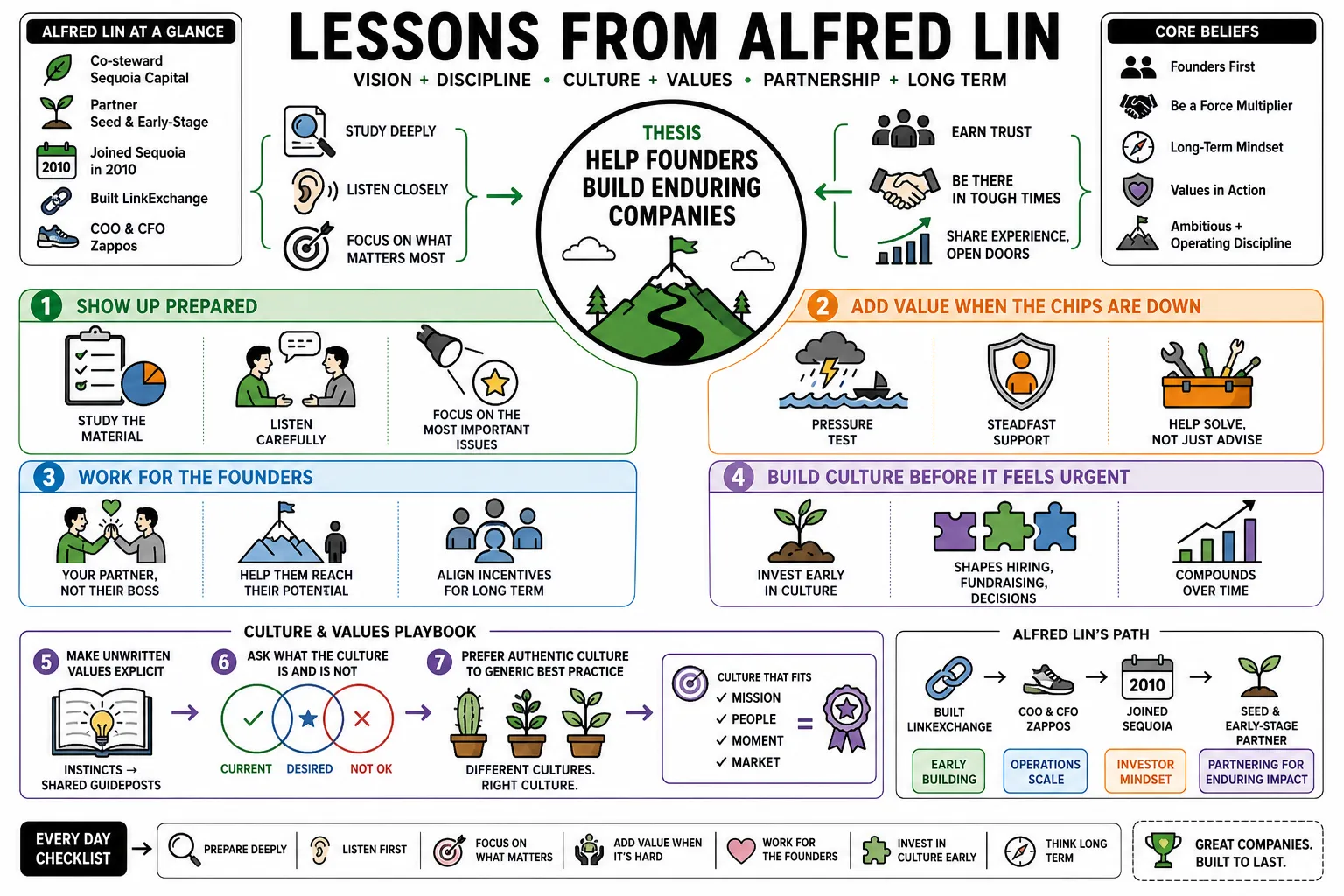
Alfred Lin is a partner on Sequoia Capital’s seed and early-stage team. Before joining Sequoia, he worked with Tony Hsieh at LinkExchange and Zappos. His first-person account and interviews emphasize founder partnership, deliberate company culture and disciplined execution. — Sequoia — Alfred Lin.
Culture, Leadership, and Partnership
- On Show Up Prepared: A useful board partner studies the material, listens closely, and arrives ready to focus attention on the most important issues. — Sequoia — Alfred Lin.
- On Add Value When the Chips Are Down: The real test of an investor or adviser is the quality of support they provide when the company is under pressure. — Sequoia — Alfred Lin.
- On Work for the Founders: Venture partnership should be organized around helping founders reach their potential rather than treating them as assets in a trade. — Sequoia — Alfred Lin.
- On Build Culture Before It Feels Urgent: Culture can appear abstract at the beginning, but it shapes fundraising, hiring, and decision-making as the organization grows. — Harvard Innovation Labs — Alfred Lin’s Path.
- On Make Unwritten Values Explicit: Founder instincts must become shared guideposts once the team grows beyond the people who were present at the beginning. — Harvard Innovation Labs — Alfred Lin’s Path.
- On Ask What the Culture Is and Is Not: A serious culture exercise identifies current values, desired values, and behaviors that the organization explicitly rejects. — Harvard Innovation Labs — Alfred Lin’s Path.
- On Prefer Authentic Culture to Generic Best Practice: Successful companies can have very different cultures; the important thing is an identity that fits the mission and team. — Harvard Innovation Labs — Alfred Lin’s Path.
- On Choose Investors Who Improve the Idea: Fundraising is not merely an exchange of capital for equity; the people around the table should sharpen the company's thinking. — Harvard Innovation Labs — Alfred Lin’s Path.
- On Look for Sparring Partners: The best investors challenge the company, support its mission, and remain dependable when circumstances become difficult. — Harvard Innovation Labs — Alfred Lin’s Path.
Founders, Resilience, and Execution
- On Combine Fire and Ice: A company needs both intense desire to solve an important problem and the composure required to execute consistently. — Sequoia — Seven Questions with Alfred Lin.
- On Finish What You Start: Enthusiasm for the next idea is not a competitive advantage if the team repeatedly fails to carry work to completion. — Sequoia — Seven Questions with Alfred Lin.
- On Focus on the Few Things That Matter: Professional execution comes from clear-eyed attention to reality, disciplined priorities, and repeatable core skills. — Sequoia — Seven Questions with Alfred Lin.
- On Compound Small Improvements: Large change becomes manageable when small daily gains are allowed to accumulate over time. — Sequoia — Seven Questions with Alfred Lin.
- On Use Deliberate Practice: Progress comes from practicing with intention, feedback, and a specific capability in mind. — Sequoia — Seven Questions with Alfred Lin.
- On Build Around a Problem the World Got Wrong: Strong founders begin with a personally meaningful problem and a conviction that prevailing assumptions are mistaken. — Thought Economics — Alfred Lin Interview.
- On Pair Work Ethic with Intellectual Honesty: Lin looks for founders who work hard, confront reality directly, and remain intensely curious. — Thought Economics — Alfred Lin Interview.
- On Expect the Journey to Be Lonely: Founders need trusted peers, cofounders, and investors because many struggles cannot be shared with the wider team. — Thought Economics — Alfred Lin Interview.
- On Avoid Pure Cheerleading: A useful support system preserves faith while still confronting the most difficult facts of the current situation. — Thought Economics — Alfred Lin Interview.
- On Turn Early Hardship into Muscle Memory: Surviving existential problems early can teach a company how to manage cash, inventory, and difficult decisions under later pressure. — Harvard Innovation Labs — Alfred Lin’s Path.
- On Do Not Let an Easy Start Hide Fragility: A company that first meets serious adversity at high stakes may lack the operating habits required to respond. — Harvard Innovation Labs — Alfred Lin’s Path.
- On Balance Optimism with Ground Truth: Transformative founders dream boldly while remaining precise about present constraints and the decisions required to survive. — Harvard Innovation Labs — Alfred Lin’s Path.
Investment Judgment and Long-Term Thinking
- On Look for Four Core Ingredients: An investable opportunity combines outlier founders, a delightful product, a path to a massive market, and a disruptive business model. — Sequoia — Alfred Lin.
- On Find Founder-Market Fit: A founder's lived experience, unique insight, and empathy for the customer can create an edge beyond conventional market analysis. — Sequoia — Alfred Lin.
- On Ask Whether You Would Work for Them: Lin's final founder test is whether he would genuinely want to help that team reach its full potential. — Sequoia — Alfred Lin.
- On Treat Partnership as a Type 1 Decision: Lin applies Jeff Bezos’s Type 1/Type 2 decision framework to venture partnerships: a relationship that may last a decade warrants deliberate choice even when the team moves quickly. — Sequoia — Seven Questions with Alfred Lin.
- On Make Reversible Decisions Fast: When a choice can be adjusted later, speed matters because course correction remains available. — Sequoia — Seven Questions with Alfred Lin.
- On Take Calculated Swings: The cost of missing a spectacular company can exceed the cost of backing one that ultimately fails. — Sequoia — Seven Questions with Alfred Lin.
- On Correct Mistakes Quickly: A missed investment or bad judgment is less damaging than refusing to admit the error and act on what was learned. — Sequoia — Seven Questions with Alfred Lin.
- On Do Primary Research: Founders and investors should form their own view instead of following whatever sector the market currently labels exciting. — Thought Economics — Alfred Lin Interview.
- On Expect Cycles of Love and Hate: A long startup journey will pass through changes in sentiment, so conviction cannot depend on current popularity. — Thought Economics — Alfred Lin Interview.
- On Align on the Ambition First: Before taking venture capital, founders and investors should agree that the goal is an independent, enduring franchise rather than a lifestyle business. — Thought Economics — Alfred Lin Interview.
- On Think Globally and Act Locally: A company may have global potential while its earliest recruiting, customers, and relationships remain rooted in a local network. — Thought Economics — Alfred Lin Interview.
- On Ask Why Now: Early-stage investing depends on identifying a market change that makes tomorrow's solution different from today's. — Acquired — Sequoia Investment Playbook.
- On Size Tomorrow's Market: Evaluate who will care about a solution once it is widely available, not only the size of the market today. — Acquired — Sequoia Investment Playbook.
- On Hold While the Future Brightens: In the Acquired discussion, the investment case for continuing to own a company depends on whether its future prospects look brighter than today; this is the episode’s playbook synthesis, not a verbatim Lin maxim. — Acquired — Sequoia Investment Playbook.
Markets, Competition, and Business Models
- On Bring a Prepared Market View: Acquired’s notes describe Sequoia bringing a prepared market perspective to a founder’s close knowledge of the problem; the intersection is presented as the basis for a strong partnership. — Acquired — Sequoia Investment Playbook.
- On Search for White Space: Acquired’s playbook notes say Sequoia maintains market maps and looks for white spaces; this is the hosts’ synthesis of the firm’s approach. — Acquired — Sequoia Investment Playbook.
- On Seek Compounders: Acquired’s playbook frames the goal as backing companies that can compound value for years, rather than trading quickly; this is the episode’s stated framework. — Acquired — Sequoia Investment Playbook.
- On Respect the Nitty-Gritty in Commerce: Lin says commerce businesses can face tough retention, heavy capital needs and close competition, making operational detail important even in a large market. — Thought Economics — Alfred Lin Interview.
- On Recognize Competition's Cost: Lin says competition can benefit consumers while intense rivalry destroys value for businesses; the statement is his investment judgment, not a universal measurement. — Thought Economics — Alfred Lin Interview.
- On Require Novel Insight: A founder needs a novel or competitive approach rather than a copy of an existing idea. — Harvard Innovation Labs — Alfred Lin’s Path.
- On Look for Decade-Long Tailwinds: A market does not need to be large today if durable forces can expand it over the next decade. — Harvard Innovation Labs — Alfred Lin’s Path.
- On Test the Financial Engine: Long-term impact still requires a sustainable mechanism for producing economic value. — Harvard Innovation Labs — Alfred Lin’s Path.
Learning, Time, and Personal Development
- On Keep Learning Outside Your Expertise: Curiosity should extend into technical, scientific, artistic, and creative fields that are not part of one's formal training. — Sequoia — Seven Questions with Alfred Lin.
- On Accept That Business Is Humbling: Good reasoning can lose money and flawed reasoning can make money, so outcomes alone do not prove the quality of a decision. — Sequoia — Seven Questions with Alfred Lin.
- On Do Not Let Time Pass Unnoticed: Lin treats an individual moment as irretrievable and cautions against letting time pass unnoticed. — Sequoia — Seven Questions with Alfred Lin.
- On Carry Lessons into the Next Chapter: Lin describes a chapter as a milestone whose learning can be carried into later work and life. — Sequoia — Seven Questions with Alfred Lin.
- On Build a Worthwhile Life Story: Lin’s “book” metaphor asks whether a whole life tells a purposeful story of a worthwhile journey. — Sequoia — Seven Questions with Alfred Lin.
- On Reexamine the Effects of Personal History: Background shapes decision-making and leadership in both useful and limiting ways, so its influence deserves periodic review. — Harvard Innovation Labs — Alfred Lin’s Path.