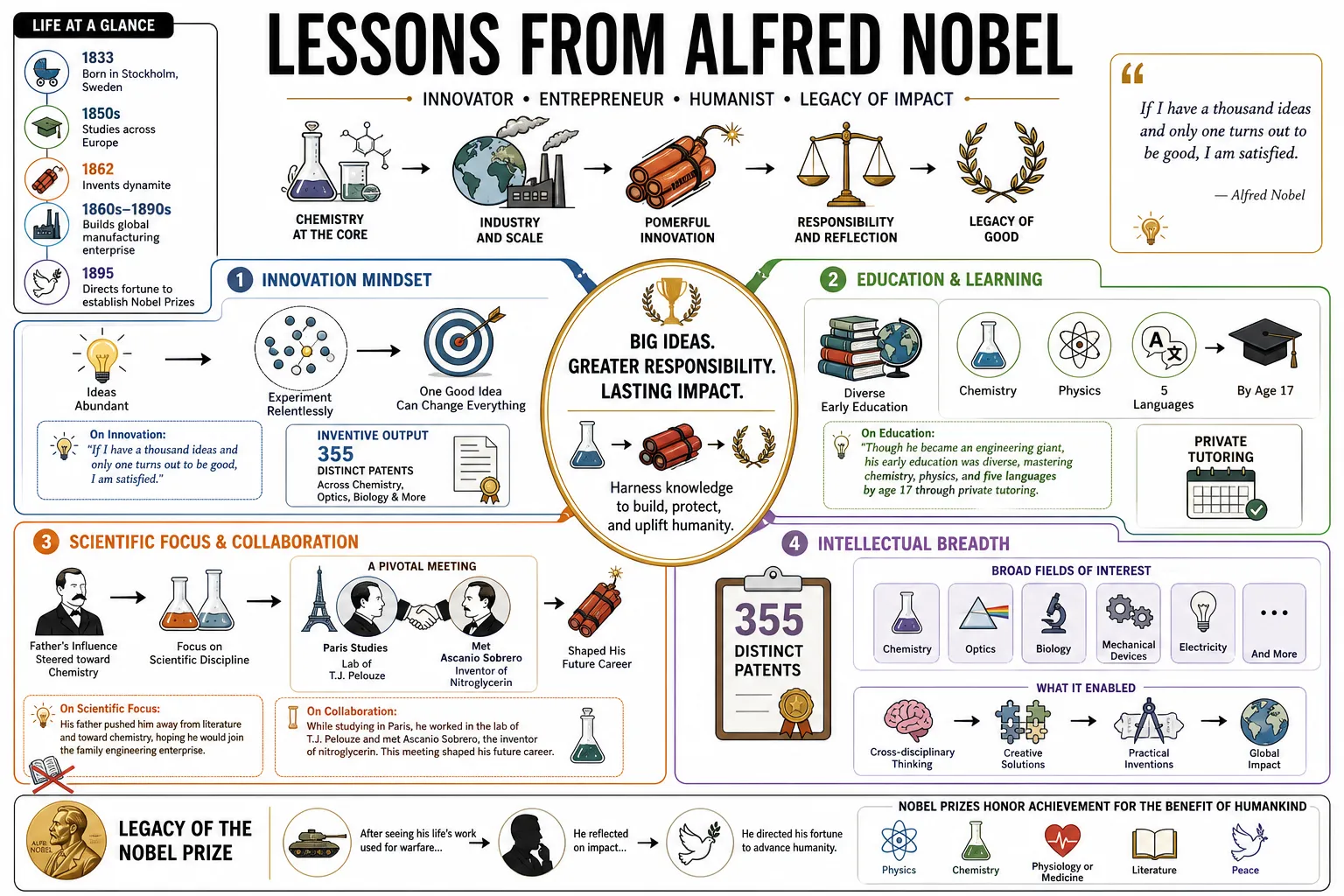
Lessons from Alfred Nobel
Alfred Nobel was a Swedish inventor and industrialist whose dynamite and detonating cap changed construction and explosives manufacturing. His inventions also had military uses. In his 1895 will, he directed most of his fortune toward recurring prizes in physics, chemistry, medicine, literature and peace; his correspondence with Bertha von Suttner documents a longstanding interest in preventing war. — Nobel Prize — His Life and Work.
Part 1: Chemistry and Scientific Innovation
- On Education: By age 17, Nobel had studied natural sciences, literature and several languages with private tutors; the Nobel Foundation records fluency in Swedish, Russian, French, English and German. — Nobel Prize — His Life and Work.
- On Scientific Focus: Nobel’s father wanted his sons to enter engineering and disliked Alfred’s literary interest, so he sent him abroad to study chemical engineering. — Nobel Prize — His Life and Work.
- On Collaboration: In Paris Nobel worked in T. J. Pelouze’s laboratory and met Ascanio Sobrero, whose nitroglycerine invention became central to Nobel’s later experiments. — Nobel Prize — His Life and Work.
- On Intellectual Breadth: Nobel held 355 patents by the time of his death, extending beyond explosives into materials such as synthetic rubber, leather and silk. — Nobel Prize — His Life and Work.
- On Purpose: Nobel pursued controlled nitroglycerine blasting for construction work; the resulting dynamite and detonator made rock blasting, tunnels and canals less costly. — Nobel Prize — His Life and Work.
- On Trial and Error: After lethal accidents, Nobel tested additives to make nitroglycerine easier to handle; mixing it with kieselguhr produced dynamite. — Nobel Prize — His Life and Work.
- On Scientific Benefit: Nobel’s will made benefit to humankind the overarching criterion for the prizes, including awards for important scientific discoveries and inventions. — Nobel Prize — Alfred Nobel’s Will.
- On Recognizing Brilliance: Nobel’s will directed annual prizes for consequential work in physics, chemistry, medicine, literature and peace, assigning the scientific decisions to specified institutions. — Nobel Prize — Alfred Nobel’s Will.
Part 2: The Invention of Dynamite
- On Naming: Nobel named his explosive dynamite from the Greek dynamis, meaning power, according to the Nobel Foundation’s centenary account. — Nobel Foundation — 1996 Opening Address.
- On Safety: Nobel mixed nitroglycerine with kieselguhr to make a moldable explosive safer to transport and handle than the liquid, though it remained hazardous. — Nobel Prize — His Life and Work.
- On Tragedy: A 1864 nitroglycerine explosion killed Nobel’s younger brother Emil and several others, sharpening the safety problem around the substance. — Nobel Prize — His Life and Work.
- On Practical Application: Nobel’s dynamite and detonating cap worked together as a controllable blasting system, reducing costs in construction and tunnelling. — Nobel Prize — His Life and Work.
- On Patent Rights: Nobel defended and licensed his patent rights across countries, using them to build stakes in local explosives businesses. — Nobel Prize — Dynamite Companies.
- On Global Impact: The combination of dynamite, detonators and improved drilling lowered the cost of blasting rock for tunnels, canals and other construction. — Nobel Prize — His Life and Work.
- On Continuous Improvement: Nobel continued developing explosives after dynamite, including blasting gelatine, which the company history describes as a technical improvement. — Nobel Foundation — 1996 Opening Address.
- On Weaponization: Nobel’s explosives had civilian and military applications; he later endowed a peace prize while continuing to work in explosives and armaments. — Nobel Prize — His Life and Work.
Part 3: Business Strategy and Global Operations
- On Early Hustle: Nobel personally demonstrated dynamite in new markets and supervised technical improvements while building companies abroad. — Nobel Prize — Dynamite Companies.
- On Licensing: Nobel often exchanged patent rights for an equity stake in local explosives companies, using partners and capital to establish production in different countries. — Nobel Prize — Dynamite Companies.
- On Organizational Structure: Formed in 1886, the Nobel Dynamite Trust was an early international holding company coordinating British, German and other member firms. — Nobel Prize — Dynamite Companies.
- On Delegation: In France Nobel relied on Paul Barbe to establish and administer companies while he supervised technical improvements and major organizational questions. — Nobel Prize — Paul Barbe Partnership.
- On the Limits of Ownership: Patent-for-equity deals gave Nobel stakes in local companies, but as he sold shares he lost control of most firms and had to negotiate to form the trust. — Nobel Prize — Dynamite Companies.
- On Local Production: Nobel sought partners and established local production in multiple countries to develop markets for dynamite. — Nobel Prize — Dynamite Companies.
- On Work Ethic: Nobel traveled repeatedly between laboratories and firms; Victor Hugo described him as “Europe’s richest vagabond.” — Nobel Prize — His Life and Work.
- On Financial Independence: Nobel invested substantially in his brother’s Russian petroleum company after selling shares in some dynamite firms; Robert and Ludvig developed the Baku oil business. — Nobel Prize — Dynamite Companies.
- On Operational Agility: The Nobel Dynamite Trust coordinated member companies’ production, sales, investments and raw-material purchasing across national borders. — Nobel Prize — Dynamite Companies.
- On Corporate Complexity: Nobel’s will surprised relatives and authorities; its implementation required the executors to form a foundation and resolve challenges across countries. — Nobel Prize — His Life and Work.
- On working everywhere: “Home is where I work and I work everywhere.” — Nobel Prize — Nobel’s Aphorisms.
Part 4: The Paradox of War and Deterrence
- On Weapons: In a letter to Bertha von Suttner, Nobel contrasted the reach of her arguments with contemporary weapons he called implements of hell. — UN Geneva — Nobel–von Suttner Letters.
- On the Horror of Conflict: Nobel told von Suttner he hoped weapons able to destroy opposing armies rapidly would make nations recoil from war; this was a speculative deterrence hope, not a proven outcome. — UN Geneva — Nobel–von Suttner Letters.
- On Practical Pacifism: Nobel was skeptical that congresses alone would stop war and also considered deterrence and collective action among states. — UN Geneva — Nobel–von Suttner Letters.
- On Deterrence Theory: A later Nobel Committee presentation compared Nobel’s letter about mutually destructive armies to ideas of total retaliation; the nuclear analogy is retrospective, not a theory Nobel could have named. — Nobel Peace Prize — 1974 Presentation Speech.
- On the Final Word: The final will endowed a peace prize for fellowship among nations, reduction or abolition of standing armies, and promotion of peace congresses. — Nobel Prize — Alfred Nobel’s Will.
Part 5: Peace and the Bertha von Suttner Influence
- On Skepticism of Diplomacy: Nobel’s correspondence and will turned his interest in peace into concrete financial support and a recurring prize for peace work. — Nobel Peace Prize — Alfred Nobel.
- On Future Philanthropy: In an 1893 letter to von Suttner, Nobel proposed setting aside part of his fortune for a peace prize while remaining skeptical that existing institutions would prevent war. — UN Geneva — Nobel–von Suttner Letters.
- On Intellectual Companionship: Nobel and von Suttner corresponded for about two decades; a study of their letters records only three in-person meetings. — UN Geneva — Nobel–von Suttner Letters.
- On Changing Minds: Von Suttner sent Nobel information about the organized peace movement and pressed him to support it; his correspondence shows attention as well as skepticism. — UN Geneva — Nobel–von Suttner Letters.
- On Respecting Opponents: After reading von Suttner’s anti-war novel, Nobel praised her as an “Amazon” waging war on war in a letter; the praise is directly preserved in their correspondence. — UN Geneva — Nobel–von Suttner Letters.
- On Financial Support: Nobel gave von Suttner money to attend the 1891 Rome peace congress and supported her Austrian Peace Society while questioning its methods and costs. — UN Geneva — Nobel–von Suttner Letters.
- On the Ultimate Challenge: Von Suttner’s 1891 request for his moral and practical support is preserved in their correspondence and preceded Nobel’s later peace-prize proposal. — UN Geneva — Nobel–von Suttner Letters.
- On Institutionalizing Peace: The 1895 will directs the Peace Prize toward work for fraternity among nations, reducing standing armies and holding peace congresses. — Nobel Prize — Alfred Nobel’s Will.
- On Poetic Justice: Bertha von Suttner received the Nobel Peace Prize in 1905, recognizing her anti-war writing and peace organizing. — Nobel Prize — Bertha von Suttner.
Part 6: Literary Ambitions and the Arts
- On Hidden Talents: Nobel left a private library of more than 1,500 volumes and wrote poetry and drama; the collection shows that literature was more than a passing hobby. — Nobel Prize — Nobel’s Private Library.
- On Language: Nobel wrote significant poems in English, some poetry in Swedish, and letters in French; his literary interests crossed languages as well as genres. — Nobel Prize — Alfred Nobel the Poet.
- On Solitude: Nobel wrote that poetry could relieve depression and help his English; archive-based scholarship identifies loneliness among its major themes. — Nobel Prize — Alfred Nobel the Poet.
- On Fiction: Nobel drafted the projected novel Systrarne (“The Sisters”) among other unfinished literary projects. — Nobel Prize — Alfred Nobel the Poet.
- On Satire: Nobel began a satirical comedy titled The Patent Bacillus in 1895, using a patent dispute to mock law and lawyers, according to Sweden’s national biographical archive. — Swedish National Archives — Alfred Nobel.
- On Controversy: Nobel’s tragedy Nemesis was printed in Paris in 1896; after his death, friends bought and destroyed the edition because they thought the work did him no justice. — Swedish National Archives — Alfred Nobel.
- On Literature's Purpose: Nobel’s will included a literature prize for outstanding work in an “ideal direction,” wording that later prize-awarding institutions had to interpret. — Nobel Prize — Alfred Nobel’s Will.
- On the Humanities: By endowing literature alongside science and peace, Nobel gave the arts a distinct place in his prize system. — Nobel Prize — Alfred Nobel’s Will.
Part 7: Human Nature and Philosophy
- On Love: “A heart can no more be forced to love than a stomach can be forced to digest food by persuasion.” — Nobel Prize — Nobel’s Aphorisms.
- On Truth: “Lying is the greatest of all sins.” — Nobel Prize — Nobel’s Aphorisms.
- On Justice: “Justice is to be found only in the imagination.” — Nobel Prize — Nobel’s Aphorisms.
- On Contentment: “Contentment is the only real wealth.” — Nobel Prize — Nobel’s Aphorisms.
- On Personal Hardship: Nobel’s family faced financial reversals; after his father’s bankruptcy in Stockholm, his mother supported the family with a grocery store before their move to Russia. — Nobel Prize — His Life and Work.
- On Self-Perception: Nobel described himself as both a misanthrope and a superidealist, a tension noted in the Norwegian Nobel Committee’s history. — Nobel Peace Prize — Alfred Nobel.
- On Religion and Philosophy: Nobel’s poems and philosophical letters explore religion, nature, reason and imagination, showing a questioning rather than a simple doctrinal outlook. — Nobel Prize — Alfred Nobel the Poet.
- On Resilience: After Immanuel Nobel’s Russian enterprise failed, Alfred returned to Sweden with his father and younger brother Emil, while Robert and Ludvig remained in Russia and rebuilt their business. — Nobel Prize — His Life and Work.
- On humbug as an industry: “Second to agriculture, humbug is the biggest industry of our age.” — Nobel Prize — Nobel’s Aphorisms.
- On hope hiding truth: “Hope is nature’s veil for hiding truth’s nakedness.” — Nobel Prize — Nobel’s Aphorisms.
- On worry as poison: “Worry is the stomach’s worst poison.” — Nobel Prize — Nobel’s Aphorisms.
- On unstable foundations: “We build upon the sand, and the older we become, the more unstable this foundation becomes.” — Nobel Prize — Nobel’s Aphorisms.
- On self-respect in daylight: “Self-respect without the respect of others is like a jewel which will not stand the daylight.” — Nobel Prize — Nobel’s Aphorisms.
- On earning respect: “It is not sufficient to be worthy of respect in order to be respected.” — Nobel Prize — Nobel’s Aphorisms.
- On fallen justice: “The best excuse for the fallen ones is that Madame Justice herself is one of them.” — Nobel Prize — Nobel’s Aphorisms.
- On truthful liars: “The truthful man is usually a liar.” — Nobel Prize — Nobel’s Aphorisms.
Part 8: Wealth, Legacy, and the Nobel Prize
- On the Core Mission: Nobel’s final will allocated most of his remaining estate to a fund whose annual income would reward work judged to benefit humankind; five prize categories were specified. — Nobel Prize — Alfred Nobel’s Will.
- On Erasing Borders: Nobel expressly directed that nationality not be considered when choosing prize recipients; the award should go to the worthiest candidate. — Nobel Prize — Alfred Nobel’s Will.
- On Legal Ambiguity: Nobel’s will met opposition from his family and some named institutions; resolving those challenges delayed the first prizes until 1901. — Nobel Prize — Alfred Nobel’s Will.
- On Selecting the Judges: Nobel assigned the Peace Prize to a five-person committee chosen by the Norwegian Storting, while Swedish institutions would choose the other laureates. — Nobel Prize — Alfred Nobel’s Will.
- On Endowing the Prizes: Rather than leaving most of his estate to relatives, Nobel instructed his executors to establish recurring prizes for science, literature and peace. — Nobel Prize — Alfred Nobel’s Will.