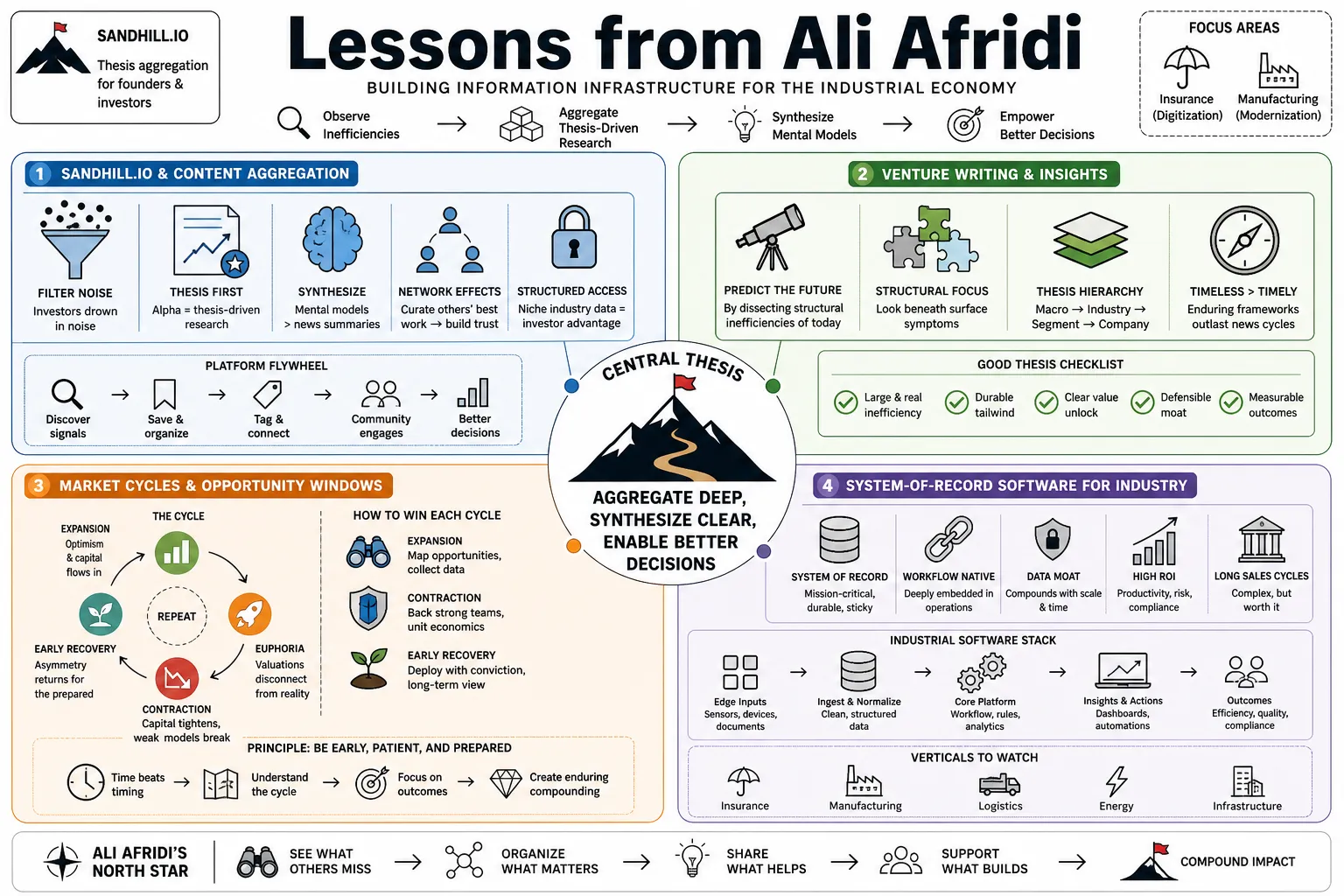
Lessons from Ali Afridi
Ali Afridi invests at Equal Ventures and has also built SandHill.io, a digest of investment themes written by many original authors. His own essays develop systematic approaches to startup ideation and examine opportunities in insurance, logistics, construction, and venture-market cycles. This profile focuses on what those signed and clearly coauthored sources actually support. — The Ultimate Startup Quest.
Part 1: SandHill.io and Content Aggregation
- On content curation: Afridi built SandHill.io to gather fragmented venture and startup writing into a single feed and weekly digest, while directing readers back to each original author. — Welcome to SandHill.io.
- On platform growth: SandHill.io’s weekly digest selects and shares investment theses and insights from hundreds of investors and startup analysts, alongside a live feed for newer work. — Welcome to SandHill.io.
- On venture writing: Afridi uses models such as forecasting market shifts and examining underserved customers to turn observations about an industry into possible venture theses; each idea still needs diligence. — Systematic Ideation for Startups & Venture Theses.
- On network effects in media: His weekly digest points readers to credited original authors rather than presenting their investment arguments as his own. — SandHill.io Weekly Digest.
- On reading habits: Afridi built cross-industry company teardowns to learn from fast-growing businesses in markets and geographies beyond his day-to-day coverage. — Introducing Teardowns by SandHill.io.
- On thesis development: At Equal, Afridi describes a “prepared mind” process: research industry shifts and pain points before meeting founders, then test which product approach could work in that market. — The Ultimate Startup Quest.
Part 2: Venture Capital Market Cycles
- On downturns: Afridi notes that venture firms have expanded into other asset classes during earlier downturns, complicating simple comparisons between today’s market and a narrowly defined historical VC industry. — What to Expect from VCs if the Downturn Persists.
- On founder priorities: He warns that weaker venture markets can bring tougher financing terms and more investor involvement in management, so founders should understand governance as well as price. — What to Expect from VCs if the Downturn Persists.
- On market corrections: After a valuation reset, companies with worthwhile technology or traction but excessive burn may need a recapitalization to survive and continue building. — What to Expect from VCs if the Downturn Persists.
- On liquidity events: Afridi describes investors and secondary funds searching for viable but overvalued venture-backed companies during downturns; this is a historically observed pattern, not a guaranteed exit. — What to Expect from VCs if the Downturn Persists.
- On dry powder: He observes that some venture firms have returned uninvested capital or reduced fund size in weak markets rather than deploy every available dollar into lower-quality opportunities. — What to Expect from VCs if the Downturn Persists.
- On resilience: Afridi says boom-time valuations and high burn leave some otherwise promising companies vulnerable when capital becomes scarce, requiring a more sustainable path or recapitalization. — What to Expect from VCs if the Downturn Persists.
Part 3: InsurTech and Digital Transformation
- On structural catalysts: Writing with Rick Zullo, Afridi identifies 2020 as a catalyst for digital adoption among carriers and brokers, while presenting later insurance opportunities as expectations rather than settled outcomes. — Four InsurTech Themes for 2021.
- On insurance value chains: Their later insurance market map argues that AI-native entrants can redesign workflows across pricing, risk, claims and service, moving beyond earlier front-end digitization. — Insurance x AI: The First Wave of Gen AI in P&C.
- On embedded insurance: Afridi and Zullo discuss embedding insurance within digital transaction platforms that already serve customers, including customized products offered at the point of purchase. — Four InsurTech Themes for 2021.
- On legacy infrastructure: Afridi’s coauthored insurance work describes decades-old, fragmented technology stacks as an opening for startups that connect data and modernize insurance workflows. — Insurance x AI: The First Wave of Gen AI in P&C.
- On data underwriting: The coauthors point to platforms that have transaction context or customer data as potential channels for improved underwriting, without claiming real-time behavioral pricing is universally in use. — Four InsurTech Themes for 2021.
- On claims processing: They report carriers placing more emphasis on customer experience not only in quoting but also in claims, alongside tools that can connect otherwise fragmented systems. — Four InsurTech Themes for 2021.
- On the broker's role: Their account emphasizes collaboration across brokers, carriers and software intermediaries rather than assuming technology simply eliminates brokers. — Four InsurTech Themes for 2021.
- On reinsurance: Afridi and Zullo identify reinsurance-market conditions and underwriting profitability as constraints that can alter which insurance startup models are viable. — Four InsurTech Themes for 2021.
Part 4: Startup Ideation Models
- On systematic thinking: Afridi explicitly lays out mental models for ideation so founders and thesis-driven investors can look systematically for market signals instead of waiting only for a chance introduction. — Systematic Ideation for Startups & Venture Theses.
- On solving personal pain: One of Afridi’s ideation models starts with a problem or unmet need that individuals or businesses would value solving; it need not originate as an internal tool. — Systematic Ideation for Startups & Venture Theses.
- On unbundling: He describes several forms of unbundling, including splitting horizontal platforms by vertical, large suites by product, or a value chain by function. — Systematic Ideation for Startups & Venture Theses.
- On arbitrage: His juxtaposition model asks whether a product or business model that works in one market can be adapted to a different market with similar underlying dynamics. — Systematic Ideation for Startups & Venture Theses.
- On regulatory changes: Afridi treats political and regulatory shifts as possible inputs for venture ideation; a founder still has to verify whether a specific new rule creates a real customer need. — Systematic Ideation for Startups & Venture Theses.
- On technology transitions: A technology-platform transition can make previously successful business models worth reconsidering in a new setting, but Afridi does not predict that edge computing must replicate the cloud era. — Systematic Ideation for Startups & Venture Theses.
- On fragmented markets: His unbundling framework looks for broad products serving many categories or customer sizes where a more focused offering could better fit an underserved segment. — Systematic Ideation for Startups & Venture Theses.
- On demographic shifts: Afridi lists changing customer behavior among the market shifts that can generate new venture ideas, while requiring diligence before concluding any legacy brand will lose. — Mapping the Insights that Drive Startup Ideas & Theses.
Part 5: Digitizing the Industrial Economy
- On legacy sectors: Afridi’s coauthored sector work describes substantial modern-software opportunities in large, operationally complex legacy industries, including insurance and logistics. — Insurance x AI: The First Wave of Gen AI in P&C.
- On supply chain visibility: Their logistics analysis finds fragmented legacy systems and continued demand for better visibility, orchestration and decision support across the supply chain. — Logistics x AI: The First Wave of Gen AI.
- On labor shortages: Afridi and his coauthor report that construction labor shortages and retiring experts create opportunities for tools that train workers, capture know-how and improve access to skilled labor. — 2025 Construction Tech Request for Startups.
- On construction tech: Their construction survey finds that manual data capture on busy job sites can fail; they highlight voice, image and workflow tools that reduce the burden on field workers. — 2025 Construction Tech Request for Startups.
- On industrial APIs: The construction survey identifies tool sprawl and disconnected data as problems, with buyers increasingly expecting compatible APIs and more integrated platforms. — 2025 Construction Tech Request for Startups.
- On B2B marketplaces: The survey identifies construction-material procurement and supply-chain visibility as possible marketplace opportunities, while noting that the category has not yet been solved. — 2025 Construction Tech Request for Startups.
Part 6: Systems of Record in Legacy Markets
- On core databases: In the construction survey, experts say existing systems of record often depend on manual input that is unrealistic on active job sites, pointing to a need for easier data capture. — 2025 Construction Tech Request for Startups.
- On wedge strategies: Their logistics map describes startups using a narrow automation wedge, such as calls or email, before expanding to more complete freight workflows; it is not a universal system-of-record law. — Logistics x AI: The First Wave of Gen AI.
- On vertical orientation: Afridi’s vertical-AI framework asks founders to match product strategy to industry-specific impact and customers’ willingness to adopt and pay, rather than assume a generic horizontal product fits every sector. — Winning in Vertical AI: The Two Pathways for Success.
- On user adoption: For a vertical product, Afridi treats willingness to adopt and pay as a central constraint: even a technically strong capability may require a different operating model if buyers resist new software. — Winning in Vertical AI: The Two Pathways for Success.
- On embedded fintech: His bundling model identifies software or marketplaces embedded in a transaction workflow as possible channels for payments, lending or insurance products; expansion is an option, not an automatic next step. — Systematic Ideation for Startups & Venture Theses.
Part 7: Emerging Managers and Fund Dynamics
- On market positioning: Afridi describes Equal’s differentiated position as proactive research into specific industries and deep relationships there, giving it a prepared view before founders arrive. — The Ultimate Startup Quest.
- On fund sizing: In a downturn, Afridi observes that some venture firms right-size their funds to match a smaller set of higher-conviction opportunities rather than keep raising ever-larger vehicles. — What to Expect from VCs if the Downturn Persists.
- On institutional investors: Afridi says proactive market research and industry relationships help Equal find and evaluate founders with a repeatable “prepared mind” instead of relying only on inbound pitches. — The Ultimate Startup Quest.
- On portfolio construction: He describes Equal’s deliberate low investment pace—roughly one to three deals per investor per year—as a way to spend more time on research and support for each company. — The Ultimate Startup Quest.
- On providing value: From his experience as a founder, Afridi values investor partners who know the company’s market well enough to bring useful questions, relevant parallels and ongoing support, not merely capital. — The Ultimate Startup Quest.