Alice Bentinck is co-founder and CEO of Entrepreneurs First, which backs people before they have a finished company, and co-founded Code First Girls, which offers free coding education to women. Her writing explores how prospective founders develop ideas, choose collaborators and learn the craft of starting a company. — Entrepreneurs First — About.
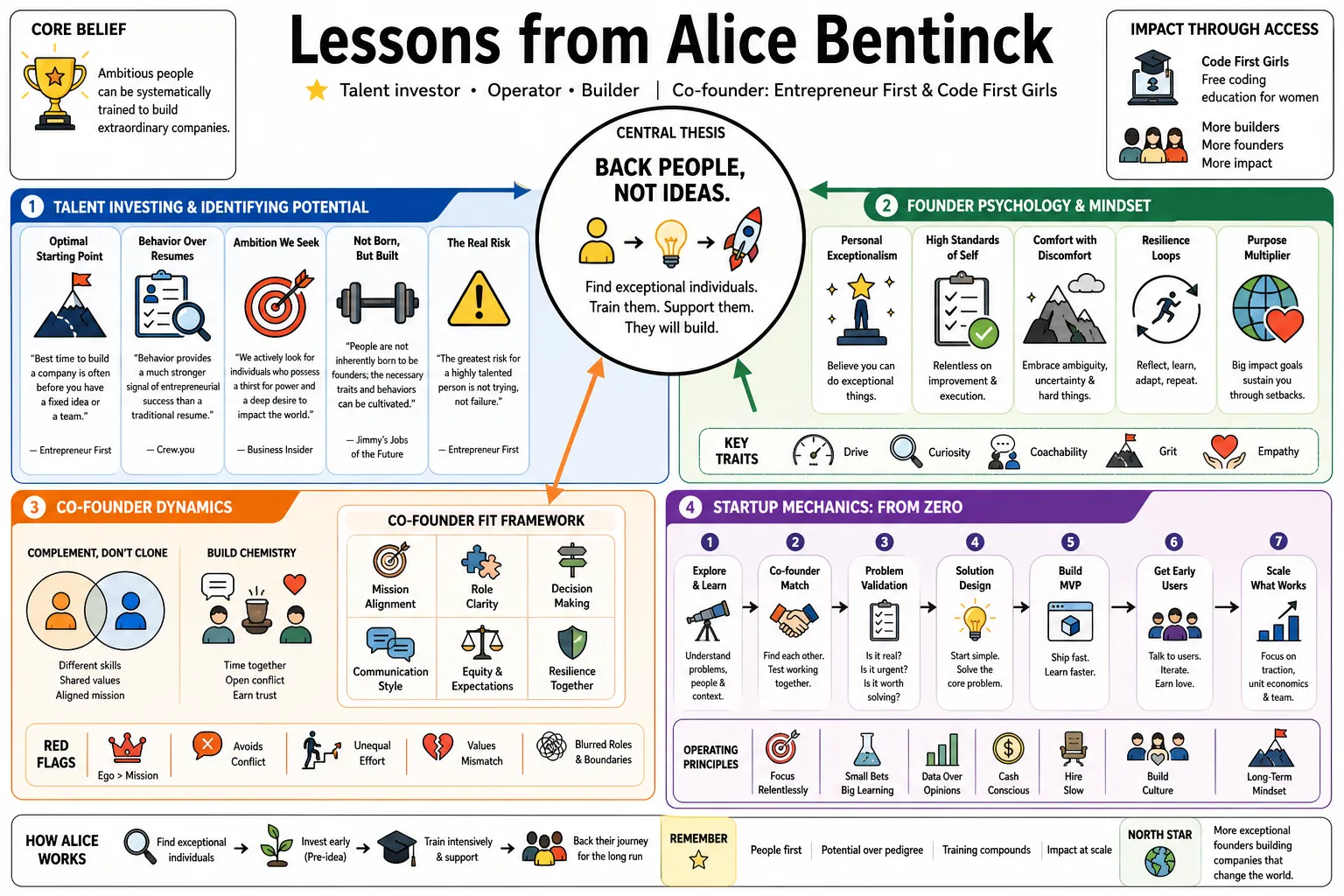
Part 1: Talent Investing and Identifying Potential
- Starting before a fixed idea: Bentinck argues that aspiring founders need not wait for a complete idea or a ready-made team; they can begin from a promising hunch, then test and develop it with customers. — Becoming a Founder Should Be a Lifelong Career Choice.
- Look for outlier behavior: EF looks at what prospective founders have done differently from their peers, not only their credentials. Bentinck presents observable behavior as a useful signal, without claiming résumés are worthless. — Becoming a Founder Should Be a Lifelong Career Choice.
- Back ambitious individuals: Bentinck and Clifford describe talent investing as identifying unusually ambitious people early and supporting them toward building consequential companies. — Talent: The Emerging Frontier of Investing.
- Founder skills can be cultivated: Bentinck argues that founder ability is not fixed at birth: the skills and behaviors EF seeks can be developed through practice and feedback. — Becoming a Founder Should Be a Lifelong Career Choice.
- The risk of waiting: For someone who wants to found a company, Bentinck argues that years spent preparing in a conventional career may delay founder-specific learning. — The Dangerously Bad Advice.
- Technical talent and impact: EF’s stated premise is that founding a technology company can give unusually capable technologists a way to expand their impact; it is an opportunity, not a guaranteed superior career. — Entrepreneurs First — About.
- Invest in people first: EF selects individuals before they have a company, team or fully formed idea, then supports the process of finding a co-founder and developing a startup. — Entrepreneurs First — About.
- Founding as a career path: Bentinck challenges the assumption that consulting, finance or a large technology employer is the necessary preparation for founding; she urges would-be founders to practice the craft itself. — The Dangerously Bad Advice.
- Beware the credential trap: Bentinck warns that promotions and prestigious badges can keep would-be founders on a conventional ladder even when they want to build a company. — Becoming a Founder Should Be a Lifelong Career Choice.
- Potential is not a standard milestone: Bentinck says EF looks for outlier behavior relative to someone’s peers, including unusual projects or initiative, rather than a single prescribed professional milestone. — Becoming a Founder Should Be a Lifelong Career Choice.
Part 2: Co-Founder Dynamics
- Co-founder fit is consequential: Bentinck says a co-founder pairing that cannot build and sell together can stall a young startup; EF tests teams through shared work rather than assuming a friendship will suffice. The source does not establish a breakup-rate comparison. — Productivity Is Traction for Teams.
- Test the working relationship: Bentinck recommends testing a prospective co-founder relationship under concrete deadlines and discussing friction early, so the pair can see how they handle hard work together. — Productivity Is Traction for Teams.
- Mutual respect matters: In Bentinck’s co-founder checklist, mutual respect for each person’s skills and willingness to carry the founder burden matter more than simply liking each other. — The Co-founder Checklist.
- Complementary contributions: Bentinck looks for teams with technical strength and, where a nontechnical co-founder joins, a specific domain edge; both founders still need to understand customers and the business. — The Co-founder Checklist.
- Discuss commitment early: Bentinck advises prospective co-founders to assess whether they share a genuine interest in the problem and are both prepared for the long-term burden of building the company. — The Co-founder Checklist.
- Confidence without boasting: In a direct interview, Bentinck distinguishes credible founder confidence from bragging; trust depends on what the founder can demonstrate, not performance alone. — Robb Report Singapore Interview.
- Shared direction before teaming up: Bentinck warns that co-founders who cannot agree on a problem they both care about may end up compromising on an idea neither wants to pursue. — Productivity Is Traction for Teams.
- Split early when the work stalls: Bentinck says that if a new pair cannot build or gain traction together, it is better to reconsider the team early than hope productivity appears later. — Productivity Is Traction for Teams.
- Share the founder burden: Bentinck says both co-founders must be ready to carry responsibility for the venture; a lopsided willingness to shoulder the burden can undermine the team. — The Co-founder Checklist.
- Structure the co-founder search: Bentinck argues that a structured environment can lower the cost of meeting and testing potential co-founders who would not otherwise build together. — EF Builds Teams That Wouldn’t Exist Otherwise.
Part 3: Personal Exceptionalism
- Personal exceptionalism: Bentinck defines personal exceptionalism as a quiet conviction that one can achieve an outcome beyond the norm, even when circumstances are difficult. — Personal Exceptionalism.
- Question constraints carefully: Bentinck says founders with personal exceptionalism may challenge social and industry norms. She also warns that rule-breaking can go too far, especially in regulated fields. — Personal Exceptionalism.
- Take on ambitious goals: Bentinck argues that unusually high self-belief can help founders attempt goals beyond their present experience; she does not say self-belief alone is enough to succeed. — Personal Exceptionalism.
- Notice the gap to your potential: Bentinck observes that some ambitious founders feel a persistent gap between current performance and what they believe they could achieve. — Personal Exceptionalism.
- Accept asymmetric odds: Bentinck acknowledges that most startups fail, while arguing that founders with personal exceptionalism believe they can improve their own odds. — Personal Exceptionalism.
- Ambition needs a legacy check: Using Frankenstein as an analogy, Bentinck argues that technically ambitious founders should consider the consequences and legacy of what they create, not merely whether they can build it. — What Deep Tech Founders Should Learn from Frankenstein.
- Resilience under rejection: Bentinck says founders who believe in their ability can remain committed to a mission through repeated rejection, while still needing openness to learning. — Personal Exceptionalism.
- Confidence from tested ability: Bentinck says personal exceptionalism can develop by repeatedly testing one’s ability against strong peers and using that evidence to build confidence; it is not simply belief without feedback. — Personal Exceptionalism.
- Humility and self-belief: Bentinck treats unusual self-belief as helpful for attempting difficult startup goals, but says it must be combined with a growth mindset and receptivity to feedback. — Personal Exceptionalism.
- Credibility before the outcome exists: Bentinck says early founders need to explain why their background and edge make them credible for a problem before the company has proved itself. — Play Your Strongest Card.
- Focus on the upside: Bentinck contrasts founders preoccupied with avoiding failure with those who focus on how to make a promising outcome happen. — Personal Exceptionalism.
- Choose active founders as peers: Bentinck advises prospective founders to spend time with people who are actually building companies, not only people who talk about wanting to. — The Founding Career.
- Expect social skepticism: Bentinck warns that friends, family and peers may not understand an unconventional founding path and may favor a safer career choice. — The Founding Career.
- Show resilience with examples: Bentinck says early-stage investors may probe how a founder handled adversity; a credible answer should show specific experience and learning, not a generic claim of toughness. — How I’d Answer SF Investors’ Questions.
Part 4: The Growth Mindset
- Learn quickly from real users: Bentinck identifies rapid learning from users and markets as a key early-founder capability; she does not prove it is the single most important trait in every case. — What Makes a Successful Founder.
- Learn outside your specialty: Bentinck says technical founders often need to learn customer development, sales, fundraising and management instead of staying only with the technical work they already know. — Why We Use Edge to Generate Ideas.
- Use setbacks to learn: Bentinck argues that founders who treat unsuccessful experiments and criticism as information can sustain learning and resilience better than those who read each setback as a verdict on ability. — What Makes a Successful Founder.
- Update beliefs with evidence: Bentinck describes strong beliefs that remain open to revision: founders need direction while updating their view as they learn from customers. — What Makes a Successful Founder.
- Ask corporates to try startups: Bentinck told Robb Report she wants established companies to move beyond their comfort zones and be more willing to try startup products. The advice was to corporates, not founders. — Robb Report Singapore Interview.
- Listen to customer objections: Bentinck says founders should seek direct feedback from people who might use the product and explain how they responded to objections, rather than treating polite praise as validation. — How I’d Answer SF Investors’ Questions.
- Outlearn through feedback: Bentinck argues that founders who ship, ask hard customer questions, and update quickly can learn faster than peers who avoid critical feedback. — What Makes a Successful Founder.
- Be willing to look inexperienced: Bentinck describes technically strong founders learning unfamiliar commercial skills, such as selling, and improving through feedback rather than protecting their ego. — Personal Exceptionalism.
- Expect the founder role to change: Bentinck says founding requires learning different skills as a company develops, from early selling and fundraising through later management; founder capability must keep evolving. — Why We Use Edge to Generate Ideas.
- Founder skill can compound: Bentinck argues that each startup attempt can build a founder’s skills and intuition for the next one; she presents this as a career thesis, not a guaranteed success rate. — The Founding Career.
- Build to develop intuition: Bentinck recommends starting to build a product and get users now, even while employed, to develop founder-specific skills and intuition. — The Founding Career.
- Connect today to the long-term vision: Bentinck says investors want to hear a plausible sequence of steps from the current product to a ten-year ambition, even if the exact plan will change. — How I’d Answer SF Investors’ Questions.
- Demonstrate commitment to the problem: Bentinck says an investor may ask how long a founder has cared about a problem to judge whether that founder will persist through difficult periods; the answer should be grounded in experience. — How I’d Answer SF Investors’ Questions.
Part 5: Macro vs. Micro Happiness
- Macro happiness: Bentinck describes macro happiness as the sense that daily work contributes to a larger life aim, such as creating a product or solving a problem that matters to others. — Balancing Micro and Macro Happiness.
- Do not optimize only for daily ease: Bentinck argues that maximizing pleasant day-to-day experiences can conflict with a larger ambition; this is her personal values framework, not a universal prescription. — Balancing Micro and Macro Happiness.
- Purpose can sustain difficult work: Bentinck says remembering why she is building EF helps her continue through stressful or unpleasant days. — Balancing Micro and Macro Happiness.
- Her deliberate trade-off: Bentinck says she has chosen to prioritize the longer-term mission of EF over some day-to-day comforts, while acknowledging the costs of that choice. — Balancing Micro and Macro Happiness.
- Novel work is difficult: Bentinck says building something that has not been done before is hard and can bring uncertainty as well as ambition. — Balancing Micro and Macro Happiness.
- Accept a long uncertain path: Bentinck emphasizes that building a startup can require years of effort with uncertain outcomes, so founders need a reason to persist beyond immediate reward. — Balancing Micro and Macro Happiness.
- Manage the emotional lows: Bentinck writes from her EF experience that early-stage founders can face uncertainty and difficult daily work; she uses a larger mission to sustain herself through it. — Balancing Micro and Macro Happiness.
Part 6: The Importance of an Edge
- Start from your Edge: Bentinck calls a founder’s Edge the particular skills, knowledge and network that make that person unusually suited to a problem. — Why We Use Edge to Generate Ideas.
- Compete where you have an advantage: Bentinck argues that working from an existing technical or market edge gives a founder a head start that a crowded, unfamiliar problem may not. — Why We Use Edge to Generate Ideas.
- Build on specific expertise: Bentinck says a founder’s Edge can come from accumulated technical skills, industry knowledge or a network that helps solve a problem and reach customers. — Why We Use Edge to Generate Ideas.
- Interest alone is not an Edge: Bentinck says caring about a problem helps sustain a founder, but the strongest opportunity also matches the founder’s distinctive capabilities or access. — Why We Use Edge to Generate Ideas.
- Generate ideas from insight: Bentinck recommends exploring problems from an area of unusual knowledge or experience rather than relying only on a list of attractive markets. — Ideas Pt I: Where Do Ideas Come From?.
- Explain why this team can win: Bentinck says founders should be able to explain why their own capabilities and experiences make them credible for a particular problem now. — Play Your Strongest Card.
- A technical Edge: EF describes a technical Edge as expertise in a domain that lets a founder see applications and possibilities others may overlook; it is an advantage, not an impenetrable moat. — Play Your Strongest Card.
- An Edge can clarify timing: Bentinck argues that close knowledge of a market or technology can help founders see why a problem is ripe to solve now. — Ideas Pt I: Where Do Ideas Come From?.
- Use the head start: Bentinck argues that founders should use their existing skills and network to move faster on an idea than someone starting from scratch; she does not claim a fixed deadline before incumbents notice. — Why We Use Edge to Generate Ideas.
- Explain the market mechanics: Bentinck says investors learn more from a founder who can explain how a market works than from an unsupported top-down market-size number. — How I’d Answer SF Investors’ Questions.
Part 7: Diversity and Code First Girls
- Teach practical skills: Bentinck says Code First Girls was designed around practical coding skills and hands-on work rather than encouragement alone. — Code First Girls Series A Announcement.
- Skills, confidence and community: Bentinck describes Code First Girls as combining practical coding education with confidence-building and a supportive community for women entering tech. — Code First Girls Series A Announcement.
- Open up technical career options: In her account of the Code First Girls pilot, Bentinck says coding instruction and role models helped participants see technical careers as possible; the account is not a controlled measure of long-term outcomes. — Tech Shouldn’t Be a Boys Club.
- Tech should not be a boys club: In her TEDx-derived essay, Bentinck argues that the tech sector’s gender imbalance involves access, confidence, role models and practical skills, and describes Code First Girls as a response. — Tech Shouldn’t Be a Boys Club.
- Bridge employers and women entering tech: Bentinck describes Code First Girls as a bridge between organizations seeking greater diversity and women who want a role in the technology sector. — Code First Girls Series A Announcement.
- Reduce the cost of entry: Code First Girls offers free coding education; Bentinck presents practical access as one way to reduce a barrier for women entering tech, not a complete solution to the gender gap. — Entrepreneurs First — About.
- Reach women early: Bentinck’s Code First Girls pilot targeted female graduates and undergraduates and combined programming with role models and confidence-building. — Tech Shouldn’t Be a Boys Club.
- Employers can support the pipeline: Bentinck says organizations seeking more diverse technology teams can help support practical training routes for women rather than waiting for the pipeline to change on its own. — Code First Girls Series A Announcement.
- Code literacy beyond coding jobs: Bentinck argues that some technical understanding helps people communicate with technical teammates and consider technology roles; she does not establish that it transforms every modern job. — Tech Shouldn’t Be a Boys Club.
Part 8: Building Global Companies
- More than one route to a global company: Bentinck describes different paths by which European EF alumni built San Francisco networks, found co-founders, reached US customers and raised capital. — From Students to SF Founders.
- Build proximity to the market: For European founders seeking US customers or investors, Bentinck recommends spending substantial time in the Bay Area and developing real relationships before a fundraise. — What to Do Before Raising in SF.
- Learn the Bay Area’s norms: Bentinck argues that repeated exposure to San Francisco’s founder and investor ecosystem helps newcomers understand its expectations and build relationships. — From Students to SF Founders.
- Make ambition visible in execution: Bentinck says SF investors look for evidence of fast product development and learning, not only a sweeping long-term vision. — Fundraising in the US for Europeans.
- Think globally from the start: Bentinck urges founders to build for a globally significant market rather than limiting themselves to a local benchmark; this is strategic advice, not a rule that relocation is mandatory. — Introducing The Bridge.
- Adapt the support model across geographies: EF’s San Francisco hub was designed to add local advisors, investors and operators for companies coming from its global sites; it is a specific operating change, not proof of universal cultural differences. — Launching Our SF Hub.
- Bridge European talent and US capital: Bentinck’s Bridge program aims to give early European founders direct access to the Bay Area’s teams, customers and financing rather than treating national borders as the limit of opportunity. — Introducing The Bridge.
- Commercialize technical talent: Bentinck says EF helps talented technologists turn capabilities into globally ambitious companies through co-founder matching, idea testing and access to investors. — Entrepreneurs First — About.
- Show execution velocity: Bentinck says seed investors may compare a startup’s progress with direct competitors and look for evidence that the team is learning and executing faster. — How I’d Answer SF Investors’ Questions.