Alison Gopnik is a developmental psychologist and philosopher at the University of California, Berkeley. Her research investigates how children learn causal relationships through observation, intervention and play; her writing also examines parenting, artificial intelligence and caregiving. — Alison Gopnik — Research.
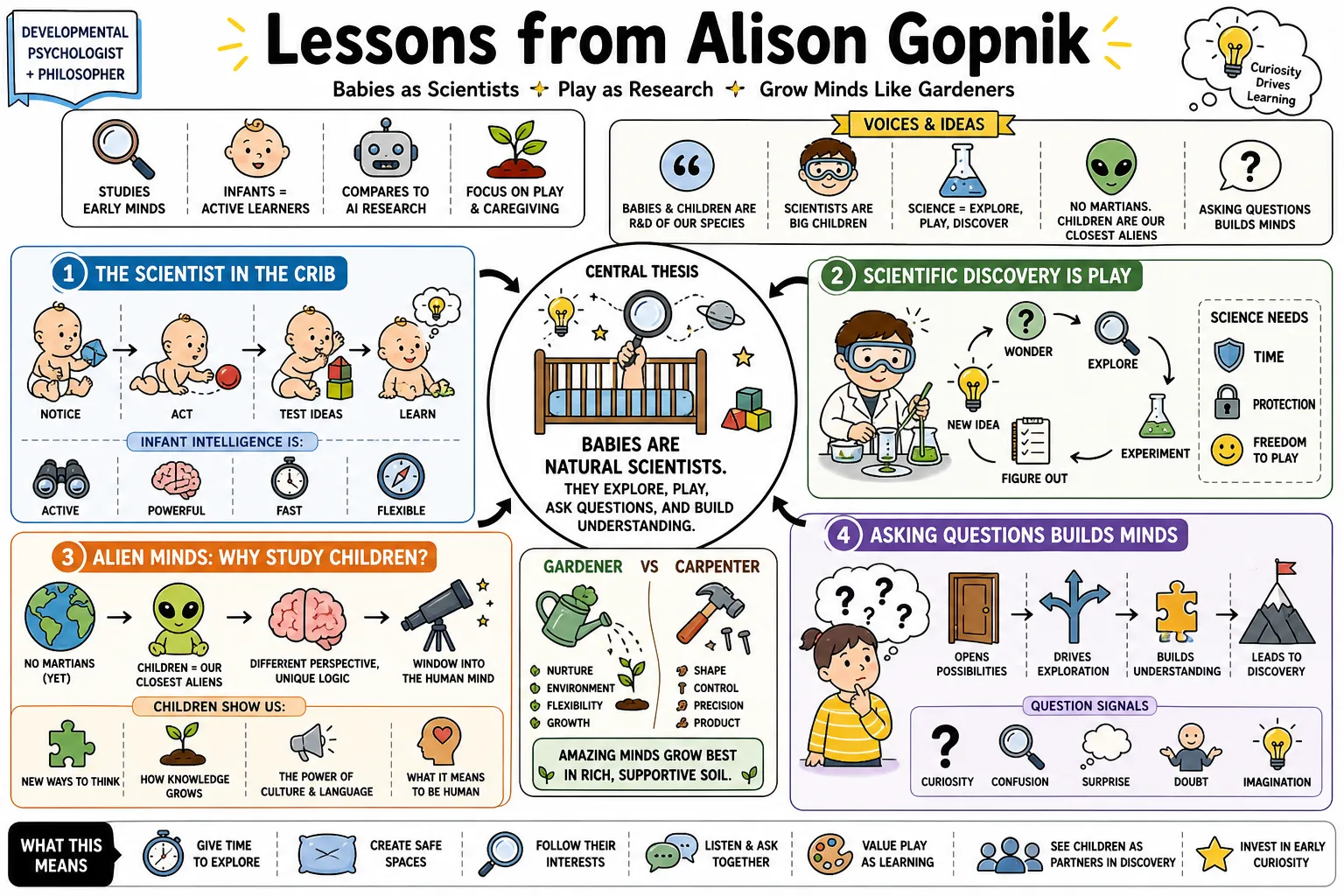
Part 1: The Scientist in the Crib
- Children as researchers: Gopnik likens young children’s open-ended learning to a research-and-development phase, while adults more often apply established knowledge. — TED — What Do Babies Think?.
- Scientists as grown-up explorers: Gopnik reverses the familiar metaphor: scientists can retain the exploratory habits that come naturally to young children. — Templeton Foundation Interview.
- Protected time to explore: Gopnik argues that scientific work, at its best, preserves space for open exploration, though career metrics can push researchers toward narrower output goals. — Templeton Foundation Interview.
- Children think differently from adults: Gopnik studies young children because their exploratory, flexible way of learning reveals capacities that are less visible in skilled adults; the Martians analogy is not independently verified in a direct source. — ABC Philosopher’s Zone — The Philosophical Baby.
- Children seek explanations: Gopnik argues that children’s questions and exploration actively seek useful explanations, often well beyond immediate practical needs; the food-or-water comparison is not verified in the signed essay. — Why Do We Ask Questions?.
- Knowledge and emotion intertwine: Gopnik argues that children’s learning, imagination and loving relationships are connected, not that knowledge simply overrides emotion as the old unattributed aphorism suggested. — Scientific American Interview — What Is It Like to Be a Baby?.
- The naming explosion: Gopnik and Meltzoff report a relation between early categorization and the onset of a rapid increase in children’s object naming. — Relations Between Thought and Language in Infancy.
- Structured but adaptable learning: Gopnik’s research examines how children form and revise intuitive theories of the world through observation and experiments. — Alison Gopnik — Research.
- Toddlers discover other minds: Gopnik describes toddlers learning that other people may want different things, helping explain some conflicts that adults call the “terrible twos.” — Tears, Tantrums and Other Experiments.
- Preschool curiosity in an information economy: Gopnik argues that young children’s tendency to seek new information can be valuable in an economy that rewards learning and adaptation. — Dropbox Interview — Learning More Like Children.
- The energy-hungry four-year-old brain: Gopnik describes four-year-olds as unusually active learners whose brains use a large share of their energy; the exact percentage is omitted pending independent verification. — Mindscape Podcast #308.
- The freedom to explore: Gopnik contrasts children’s open-ended search with adult scientists, who must also test ideas, secure grants and meet practical obligations. — Conversations with Tyler.
Part 2: The Gardener and the Carpenter
- Cultivate, do not construct: Gopnik argues that a parent’s role is to provide safety and love for unpredictable development, not to engineer one predetermined type of adult. — Edutopia Interview — Leave Those Kids Alone.
- Make room for possibilities: A rich, secure environment gives children opportunities to invent and learn in ways that adults cannot fully prescribe. — Edutopia Interview — Leave Those Kids Alone.
- Children do the learning: Gopnik emphasizes that young children actively learn through observation, interaction and play; adults can support the conditions rather than dictate every outcome. — Edutopia Interview — Leave Those Kids Alone.
- Guide without controlling the outcome: Gopnik questions attempts to manage every small parenting choice as if it deterministically shaped the eventual adult; she favors a safe, loving setting for exploration. — Edutopia Interview — Leave Those Kids Alone.
- Care toward independence: Gopnik describes caregiving as supporting a dependent child’s development toward greater ability to act and cooperate with peers, not permanent dependence on a parent. — Berkeley Distinguished Lecture.
- A resilient garden: Gopnik uses a protected garden as an analogy for care that allows more varied developmental paths, rather than producing one planned outcome. — Conversations with Tyler.
- Expect unpredictable growth: Gopnik’s gardener metaphor emphasizes that children’s eventual interests and capacities are not fully specified by a parent’s blueprint. — Edutopia Interview — Leave Those Kids Alone.
- Attachment changes with development: Gopnik says children gradually shift from dependence on particular caregivers toward pursuing goals with peers and other people; care should accommodate that transition. — Berkeley Distinguished Lecture.
- Let children direct play: For young children, Gopnik favors opportunities to play and explore within a safe setting over adults specifying every learning objective. — Edutopia Interview — Leave Those Kids Alone.
- Growing beyond parental dependence: Gopnik describes school-age development partly as learning to act with peers rather than relying on a parent to accomplish every goal. — Berkeley Distinguished Lecture.
Part 3: Play, Imagination, and Pretend
- Play and invention: Gopnik argues that imagination and play let children explore possibilities beyond immediate necessity, helping make invention possible. — Scientific American Interview — What Is It Like to Be a Baby?.
- Pretend play and causal reasoning: Gopnik and coauthors found a relation between children’s causally coherent pretend play and counterfactual reasoning; the study does not prove all pretend play is scientific experimentation. — Pretend Play and Counterfactual Causal Reasoning.
- Everyday experiments: Gopnik describes young children learning through everyday play and experiments with people and objects; the specific imitation, hiding and babbling list from the book was not independently verified here. — Tears, Tantrums and Other Experiments.
- Practice for the unexpected: Gopnik argues that play helps develop resilience and creativity because it lets children explore possibilities rather than rehearse only a fixed task. — Edutopia Interview — Leave Those Kids Alone.
- Explore without an immediate payoff: Gopnik describes children’s open-ended experimentation as a way to discover information that narrowly goal-directed learning might miss. — Berkeley Distinguished Lecture.
- A protected period for learning: Gopnik and coauthors hypothesize that humans’ long period of dependent childhood provides room for exploratory learning and play; this is an evolutionary account, not a measured universal law. — Pretend Play and Counterfactual Causal Reasoning.
- Play and counterfactuals: In two studies, causally coherent pretend play correlated with children’s counterfactual inferences, supporting a proposed link between play and causal reasoning without proving that play alone causes it. — Pretend Play and Counterfactual Causal Reasoning.
- Imagine alternatives: Gopnik connects children’s pretend play with the ability to imagine how the world might be different, a capacity relevant to creativity and invention. — Scientific American Interview — What Is It Like to Be a Baby?.
- From broad exploration to practiced skill: Gopnik distinguishes young children’s play-based exploration from the apprenticeship and feedback she favors as older children learn specific skills. — Conversations with Tyler.
- Imagination can aid adaptation: Gopnik and coauthors propose that causal imagination lets people consider alternative actions and outcomes before acting; the paper does not demonstrate that pretend play is a uniquely human evolutionary advantage. — Pretend Play and Counterfactual Causal Reasoning.
Part 4: Causality and Causal Learning
- Causes enable interventions: Gopnik distinguishes a causal relationship from a mere association: changing a cause should change its effect under appropriate conditions. — Causal Learning.
- Causal maps as a model of learning: Gopnik and Schulz report that young children make causal inferences consistent with aspects of Bayesian-network learning; this is a model of their behavior, not a claim that they consciously calculate probabilities. — Mechanisms of Theory Formation in Young Children.
- What the blicket detector reveals: In blicket-detector experiments, young children used patterns of conditional dependence to judge which novel objects made a machine activate; the studies do not imply that children consciously use a statistical formula. — Mechanisms of Theory Formation in Young Children.
- Infer structure from patterns: Gopnik says young children use observed patterns to infer what underlying structure could have produced them. — Conversations with Tyler.
- Controllability and causal learning: Gopnik and coauthors investigate whether children and adults use cues about controllability and variable outcomes to infer causal relations and design interventions; empowerment is their proposed computational bridge, not a proven universal drive. — Empowerment Gain and Causal Model Construction.
- Test ideas through action: Children learn causal relationships not only by observing others and hearing explanations but also by intervening and experimenting in everyday play. — Causal Learning.
- General causal reasoning: Goddu and Gopnik argue that humans develop unusually general and objective causal representations that support theories and invention; the review does not establish one exclusive evolutionary adaptation. — The Development of Human Causal Learning and Reasoning.
- Evidence can revise theories: Gopnik and Schulz review evidence that children’s intuitive causal theories can change in response to new experience and explicit training; the old quotation about neural representations is not verified. — Mechanisms of Theory Formation in Young Children.
- Young theories change: Research reviewed by Gopnik and Schulz shows that children’s intuitive accounts of the world change with evidence; the exact comparison to how often flexible adults change their minds is not established. — Mechanisms of Theory Formation in Young Children.
Part 5: Artificial Intelligence vs. Human Intelligence
- A child’s distinctive learning: Gopnik argues that current large language models can outperform people at some tasks yet still differ from young children in open-ended causal exploration; the old absolute computer-versus-human ranking is not defensible. — Berkeley Distinguished Lecture.
- The library analogy: Gopnik compares large models with libraries and legal codes: powerful ways to organize and access accumulated human knowledge, not straightforward evidence of a human-like agent. — Conversations with Tyler.
- AI as cultural technology: Gopnik and coauthors frame large models as cultural and social technologies that reorganize human-generated information, alongside earlier tools such as libraries and print. — Large AI Models Are Cultural and Social Technologies.
- The intelligence of care: Gopnik proposes that a system developing through interaction and care is a better model for human-like intelligence than a static store of information. — Berkeley Distinguished Lecture.
- Prediction versus exploration: Gopnik and coauthors find that the particular models they studied differ from children on new-tool and causal-structure tasks; they do not claim that all AI is permanently incapable of exploration. — Transmission Versus Truth, Imitation Versus Innovation.
- Anthropomorphic AI stories: Gopnik and coauthors warn that agent-like chat interfaces encourage people to treat large statistical models as though they had human-like motives; that is a critique of current large models, not every possible AI. — Large AI Models Are Cultural and Social Technologies.
- Focus on concrete AI effects: Gopnik and coauthors argue that treating current large models as autonomous agents can divert attention from the technology’s immediate social and governance effects. — Large AI Models Are Cultural and Social Technologies.
- Human data and fresh discoveries: Gopnik and coauthors contrast models trained mainly on human cultural data with children’s ability to test new causal possibilities in the world; the paper leaves open how future systems might acquire such abilities. — Transmission Versus Truth, Imitation Versus Innovation.
- Learning from the external world: Gopnik emphasizes active testing and revision against the world, but explicitly allows that an artificial system might do this without a conventional body; physical embodiment is not an absolute requirement in her account. — Berkeley Distinguished Lecture.
- Cultural technologies can reshape society: Gopnik contrasts introducing one new animal agent with introducing a technology such as print, which can reorganize how many people share information. — Conversations with Tyler.
- Novel relationships remain a test: Gopnik is skeptical that current large models reliably generate genuinely new causal relationships through direct inquiry, while acknowledging that their capabilities and future outcomes remain open questions. — Conversations with Tyler.
Part 6: The Philosophy of the Mind and Consciousness
- What a baby’s attention may feel like: Gopnik compares an infant’s broad, vivid attention with an adult’s experience of entering a surprising new place; the Paris-and-espresso line is a metaphor, not a scientific measurement. — Scientific American Interview — What Is It Like to Be a Baby?.
- Lantern rather than spotlight: Gopnik proposes that babies’ attention is more broadly distributed than adults’ focused attention, using a lantern-versus-spotlight analogy rather than claiming literal simultaneous awareness of everything. — Scientific American Interview — What Is It Like to Be a Baby?.
- Children reveal human flexibility: Gopnik argues that studying children shows how minds change as they learn, imagine possibilities and interact with others. — ABC Philosopher’s Zone — The Philosophical Baby.
- Learning about the world: Gopnik describes children using observed patterns and interventions to develop more accurate causal models; the old sweeping quote about what all brains are designed to do is not verified. — Causal Learning.
- Moral and conventional rules: Gopnik describes studies in which young children distinguish changeable classroom conventions from rules against harming others; the old “love and law” quotation is not verified. — ABC Philosopher’s Zone — The Philosophical Baby.
- Infant awareness has a different shape: Gopnik argues that infants are aware of a broad range of novel stimuli and may in some respects have a more vivid experience than focused adults; she does not establish a single scale on which babies are simply “more conscious.” — Scientific American Interview — What Is It Like to Be a Baby?.
- A more present-focused childhood: Gopnik suggests that young children’s still-developing autobiographical memory may leave them more focused on present experience; she does not deny that babies have episodic memory. — Conversations with Tyler.
- Knowledge, imagination and love: Gopnik links children’s learning to imagining and testing possibilities while caregivers give them the protected time to do so; this supports a bounded relation, not the old unverified computational quotation. — Scientific American Interview — What Is It Like to Be a Baby?.
- Exploration beyond adult routines: Gopnik describes young children as unusually open-ended explorers, while adults usually balance exploration with practical obligations; the absolute comparison with every scientist is not established. — Conversations with Tyler.
- Aphantasia and mental images: Gopnik argues that some people can solve visual problems without consciously seeing an internal picture; she explicitly does not infer from aphantasia that they lack ordinary visual consciousness. — Conversations with Tyler.
- Autobiographical memory and awareness: Gopnik suggests that adults often compress experience into autobiographical narratives whereas young children, whose such memory is still developing, can be more absorbed in the present; this is her qualified interpretation. — Conversations with Tyler.
Part 7: Aging, Elderhood, and The Science of Care
- Childhood and elderhood: Gopnik examines childhood and elderhood as important periods of human dependence and care, while presenting elderhood’s evolutionary role as a possibility rather than a settled universal fact. — Caregiving in Philosophy, Biology & Political Economy.
- Care underpins thriving: Gopnik argues that caring for children, elders, fragile people and those who are ill is central to human thriving and has been significant in human evolution. — Caregiving in Philosophy, Biology & Political Economy.
- The invisibility of care: Gopnik argues that caregiving is undervalued and often omitted from standard economic measures and political or philosophical frameworks. — Caregiving in Philosophy, Biology & Political Economy.
- Care beyond reciprocity: Gopnik explains that caring relationships do not fit the reciprocal social-contract model: carers may help a particular person pursue that person’s goals without expecting an equal return. — Caregiving in Philosophy, Biology & Political Economy.
- Responsibility and autonomy: Gopnik describes a caregiver’s difficult balance between taking responsibility for a dependent person and respecting that person’s emerging or remaining autonomy. — Caregiving in Philosophy, Biology & Political Economy.
- Grandmothers and long childhood: Gopnik describes grandmothers as an important additional source of care and cultural teaching during humans’ extended childhood, while discussing the grandmother hypothesis as an evolutionary account. — Caregiving in Philosophy, Biology & Political Economy.
- Care beyond the household: Gopnik argues that human care extends beyond parents and children to friends, neighbors, students, patients and elders; extending local care to larger political communities remains a challenge. — Caregiving in Philosophy, Biology & Political Economy.
- Care as a human practice: Gopnik treats caring relationships as a central part of human social life and moral development, not merely a private service to be omitted from accounts of cooperation. — Caregiving in Philosophy, Biology & Political Economy.
- Support for carers: Gopnik argues for policies that better support both caregivers and those they care for, including children and elders; these are policy proposals rather than established inevitable outcomes. — Caregiving in Philosophy, Biology & Political Economy.
- What people find meaningful in care: Gopnik says people often identify care for children, aging parents or partners as among their most important concerns, even while much of that work is economically invisible. — Conversations with Tyler.
- Care may enable varied paths: Gopnik hypothesizes that protection from caregivers can increase the range of developmental possibilities rather than channel every child toward one predetermined result. — Conversations with Tyler.
- Nurture and variation: Gopnik suggests that a safe, rich family environment may let siblings develop in different ways; she presents this as a hypothesis, not a demonstrated rule that nurturing always increases sibling differences. — Conversations with Tyler.
Part 8: Love, Development, and Society
- Love supports another person’s goals: Gopnik argues that care means helping another person pursue their own goals, even when those goals differ from the caregiver’s; the old book quotation was not independently verified. — Caregiving in Philosophy, Biology & Political Economy.
- Care without a fixed blueprint: Gopnik’s gardening metaphor favors a safe, loving setting for growth rather than a benchmark for producing one predetermined kind of child. — Edutopia Interview — Leave Those Kids Alone.
- Childhood and intelligence: Gopnik argues that across species an extended childhood is associated with later intelligence and flexibility, and that protected exploration may help explain the connection. — A Separate Kind of Intelligence.
- Adolescence changes the search: In Gopnik and coauthors’ experiments, adolescents were relatively flexible about an unfamiliar social causal hypothesis, while age patterns differed for physical problems; the old general claim about immature executive control is not established here. — Changes in Cognitive Flexibility Across Human Life History.
- Learning across generations: Gopnik and coauthors propose that long childhood and adolescence allow periods of exploratory learning that can help successive generations adapt and innovate. — Changes in Cognitive Flexibility Across Human Life History.
- A possible engine of cultural change: Gopnik and coauthors suggest a coevolutionary relationship between extended childhood, flexible learning and cultural innovation; they do not claim each generation invents society from scratch. — Changes in Cognitive Flexibility Across Human Life History.
- Dependence invites cooperation: Gopnik describes humans’ unusually long childhood and wide network of caregivers as important conditions for care and social learning; this does not prove cooperation is the baseline of all human behavior. — Caregiving in Philosophy, Biology & Political Economy.
- Care makes learning possible: Gopnik argues that care for dependent children creates conditions for their learning and later cultural contribution, and that societies undervalue this work. — Caregiving in Philosophy, Biology & Political Economy.
- Children illuminate truth and love: Gopnik says children’s learning joins imagination, testing possibilities and the care of others, making developmental psychology relevant to larger questions about knowledge and love; the old grand “meaning of life” quotation is not verified. — Scientific American Interview — What Is It Like to Be a Baby?.