Allison Pickens is a solo GP investor, a former Gainsight COO, and a board director at dbt Labs. Her writing and interviews focus on customer success, operating a growing software company and leadership. — Pickens — About.
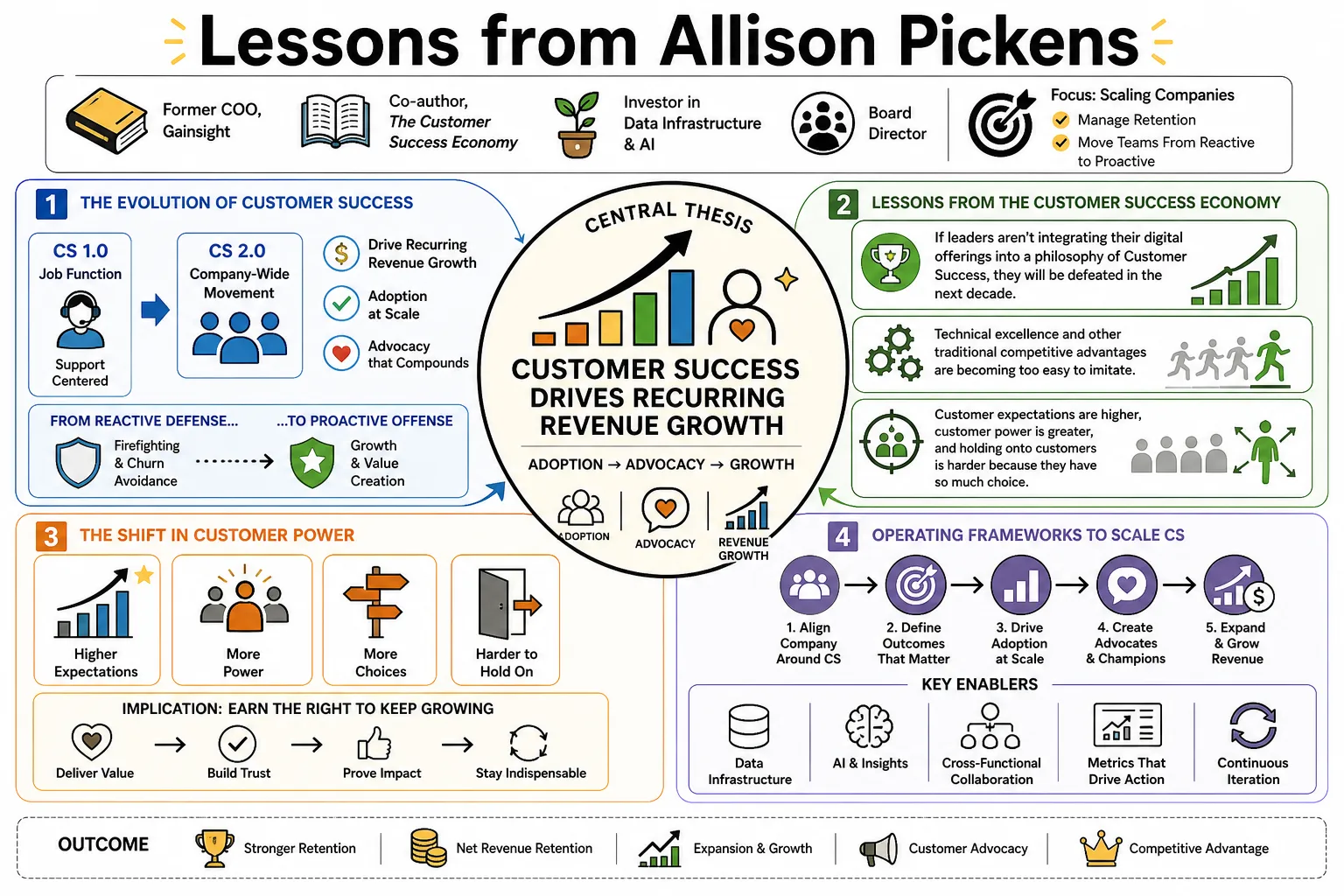
Part 1: The Evolution of Customer Success
- On the Evolution of Customer Success: Pickens describes customer success moving from an isolated post-sale job toward an executive function with responsibility for retention and growth across the company. — LearnExperts — Pickens Interview.
- On the Customer Success Economy: For recurring-revenue software, technology matters only insofar as it helps customers achieve the outcomes they bought it for; Pickens urges teams to document that path to value. — Pickens — Product-Outcomes Fit.
- On Changing Customer Expectations: Pickens observes that digital channels let customers publicize poor experiences quickly, raising the importance of timely and effective vendor responses. — Pickens — Growth and Customer Success.
- On Growth from Existing Customers: The Helix model treats renewal and expansion from current customers, alongside advocacy that attracts new buyers, as continuing sources of revenue rather than only churn prevention. — Gainsight — Revenue Growth Helix.
- On Support Versus Success: Pickens distinguishes reactive support queues from proactive customer-success work aimed at helping customers realize value, while noting that the functions can overlap in product-led businesses. — Chargebee — Customer Success Interview.
- On Predictable Value Delivery: Gainsight used strategy sessions, success plans, configuration and progress reviews to move at-risk customers toward healthier adoption and more repeatable value delivery. — Pickens — Predictable Value Delivery.
- On the Limits of a Linear Funnel: In a recurring-revenue business, a sale begins an ongoing cycle of renewal, expansion and advocacy rather than ending a one-way funnel. — Gainsight — Revenue Growth Helix.
- On the Vision of Customer Success: Pickens recalls that the field's vision often ran far ahead of practitioners' experience, motivating Gainsight to build prescriptive Elements that helped teams learn together. — LearnExperts — Pickens Interview.
- On Progress Without Perfection: Pickens says companies need not implement every Customer Success Element; they should prioritize the practices that fit their objectives and maturity. — Gainsight — Elements of Customer Success.
Part 2: Core Frameworks
- On the Helix Model: Successful customers can generate renewal, expansion and new-logo opportunities, creating successive loops of recurring growth in the Helix model co-authored by Pickens. — Gainsight — Revenue Growth Helix.
- On the Customer Success Equation: Pickens frames customer success as customer outcomes plus customer experience: measurable value and the customer's experience of obtaining it both matter. — Chargebee — Customer Success Interview.
- On Outcomes with Poor Experience: Even when a product delivers outcomes, friction and unpleasant interactions can limit a customer's willingness to advocate or expand the relationship. — Chargebee — Customer Success Interview.
- On Experience Without Outcomes: A friendly relationship alone may not win renewal if the customer cannot justify the business value of the product. — Chargebee — Customer Success Interview.
- On the Elements of Customer Success: Gainsight's Elements were prescriptive combinations of people, process and product for specific customer-success objectives, organized like a periodic table. — Gainsight — Elements of Customer Success.
- On the Maturity Curve: Pickens presents a progression from reactive work to insights and actions, outcomes and transformation; teams can select Elements according to their objectives rather than following a rigid checklist. — Gainsight — Elements of Customer Success.
- On Three Customer-Success Leads: The Helix framework asks CS to identify customers ready for renewal, those with expansion potential, and those whose advocacy can help bring in new buyers. — Gainsight — Revenue Growth Helix.
- On Customer-Risk Management: Pickens's framework identifies five risks—customer fit, launch, crisis, bad habits and pessimism—so teams can detect trouble early and choose a targeted response. — Gainsight — Managing Customer Risks.
- On Customer-Fit Risk: A customer can be a poor fit at sale or lose key conditions for success later, such as an executive sponsor; Pickens treats this as a distinct risk to detect early. — Gainsight — Managing Customer Risks.
- On Bad-Habits Risk: Customers may fail to maintain or fully use a product, limiting the value they can realize; CSMs can help restore effective usage habits. — Gainsight — Managing Customer Risks.
- On Objectives and Key Results: Pickens uses OKRs to align functions around shared customer and company goals, connecting broad objectives with measurable contributions without over-orchestrating very early teams. — LearnExperts — Pickens Interview.
Part 3: Operationalizing Success and Managing Risk
- On Pessimism Risk: A customer who loses faith may skip meetings, stop responding or give negative feedback; Pickens treats sentiment as a signal requiring relationship work. — Gainsight — Managing Customer Risks.
- On Crisis Risk and Support: Repeated technical issues and heavy support activity can signal a customer crisis; the CSM coordinates with Support around the customer's underlying business need. — Gainsight — Managing Customer Risks.
- On Time-to-Value: Pickens treats time-to-value as influenced by more than CS: sales fit and onboarding quality can affect how quickly a customer reaches useful outcomes. — Pickens — ROI of Customer Success.
- On Onboarding Discipline: Pickens describes a standardized onboarding process with milestones and risk-triggered follow-up so delayed implementations are surfaced before they become renewal problems. — Pickens — Best-in-Class Onboarding.
- On Scorecards and Calls to Action: At Gainsight, risk signals generated Calls to Action that a CSM could route across functions, while scorecards tracked the customer's health over time. — Gainsight — Cross-functional Coordination.
- On Meaningful Adoption Habits: Pickens's team tracked a Habits measure for patterns of use believed to signal value, not merely a raw count of logins or clicks. — Gainsight — Running the CS Team.
- On Preventable Versus Poor-Fit Churn: A churn review should distinguish execution failures that can be fixed from customers who were never a good fit, then change sales qualification or product strategy accordingly. — Pickens — What to Do When a Customer Churns.
- On Finding Root Causes: Pickens urges teams to ask why a risk arose until they identify an actionable systemic problem; a label such as declining usage or product risk is not itself the root cause. — Pickens — What to Do When a Customer Churns.
Part 4: The Role of the Customer Success Manager
- On the CSM as Coordinator: The CSM can coordinate responses to customer problems across Support, Services, Product and Engineering while each function retains its own role. — Gainsight — Cross-functional Coordination.
- On Consultative Customer Success: Pickens recommends understanding both what outcome customers seek and how they experience getting there, then helping them toward value rather than merely reacting to tickets. — Chargebee — Customer Success Interview.
- On Being Helpful and Prescriptive: In describing Gainsight's Elements, Pickens says customer teams should listen well and learn each client's goals while also challenging a path they believe will not work. — Gainsight — Elements of Customer Success.
- On Avoiding a Service Patch: Pickens warns that overloading Product with customer-specific risk requests can crowd out meaningful product work; CS should surface patterns and solve the right product problem rather than just ask for more manual fixes. — Pickens — Working with Product.
- On the Human Side of SaaS: Pickens treats customer experience as how people feel while engaging with the vendor, in addition to the measurable outcome the software delivers. — Chargebee — Customer Success Interview.
- On Measuring Customer Success ROI: Pickens argues that the return on CS cannot be read from renewal alone: CSM work may also influence expansion, referrals and product quality, while other teams affect retention. — Pickens — ROI of Customer Success.
- On the Limits of CSM Ownership: Renewals and upsells are influenced by Product, Sales, Support and Services as well as CS; assigning one team full credit obscures the real operating model. — Pickens — ROI of Customer Success.
- On Benchmarking a Practice: Pickens used an Elements maturity assessment and survey correlations to show CS teams where they stood and what practices to prioritize, without claiming every element caused better retention. — Gainsight — Elements of Customer Success.
Part 5: Organizational Design and Alignment
- On Organizing Around the Customer: Pickens argues for putting the customer, rather than the CS department itself, at the center of the company and having Sales, Product, Support and other functions coordinate around that journey. — Pickens — Make Customers the Center.
- On Customer Success Operations: Pickens says CS Ops helps leaders instrument scalable processes, understand customer data, forecast and allocate CSM capacity, much as Sales Ops does for sales teams. — LearnExperts — Pickens Interview.
- On Repeatable Technical Onboarding: Gainsight standardized onboarding milestones for a customer segment and used automated Calls to Action to detect delay; Pickens's example supports repeatable implementation, not a mandate for a separate Customer Engineering team. — Pickens — Best-in-Class Onboarding.
- On Departmental Ownership: For different customer-risk scenarios, Pickens documented which functions were responsible, accountable, consulted or informed so issues would not fall between teams. — Gainsight — Cross-functional Coordination.
- On RACI for Customer Problems: Gainsight applied a RACI framework to clarify cross-functional roles in resolving specific customer challenges; Pickens presents it as an implemented tool, not a universal rule for every lifecycle phase. — Gainsight — Cross-functional Coordination.
- On Learning from Churn: Pickens treats a lost customer as a cross-functional learning opportunity, using a root-cause review and departmental actions rather than treating churn as a CS-only failure. — Pickens — What to Do When a Customer Churns.
- On Aligning Growth Functions: The Helix framework assigns Sales, Marketing and CS distinct contributions to new-logo, renewal and expansion revenue events rather than leaving all growth work with one department. — Gainsight — Revenue Growth Helix.
- On Shared Adoption Work: Customer-success teams can identify adoption patterns and relay themes to Product, while Product engages customer feedback and adjusts its roadmap; neither function can solve adoption alone. — Pickens — Working with Product.
- On Making Customer Data Visible: Pickens describes sharing customer health, usage and risk context across Support, Services, Product and leadership so each function can act on the same customer situation. — Pickens — Make Customers the Center.
- On Protecting New Initiatives: Pickens recommends a small tiger team for a fledgling initiative and a place in broader OKRs so red tape and mature priorities do not smother it. — COO Alliance — Core Values Interview.
- On Meeting Preparation: Pickens describes starting a meeting with designated pre-read time and inviting the people needed for decisions, making preparation and follow-up part of the meeting design. — COO Alliance — Core Values Interview.
Part 6: Go-to-Market Strategy and Category Creation
- On Category Creation Through Listening: Pickens says Gainsight's category work grew from listening to a community and elevating its ideas, not from a company inventing a market movement on its own. — Pickens — Category Creation Through Listening.
- On Cross-functional Category Work: At Gainsight, Pickens linked community-building, product capabilities and professional development so the category's promise was reinforced by the business, not only a tagline. — LearnExperts — Pickens Interview.
- On Riding a Market Wave: Pickens cautions that founders cannot force a category into existence merely by wanting one; they must listen for an emerging need and meet the market at the right time. — Pickens — Category Creation Through Listening.
- On B2B Word of Mouth: Pickens notes that word of mouth matters in B2B but is often not tracked, so companies may miss opportunities to understand and support customer advocacy. — Chargebee — Customer Success Interview.
- On Segmenting Customers: Pickens recommends segmenting customers by both their needs and their value to the business, then making explicit service-level trade-offs rather than treating every account identically. — Pickens — Customer Segmentation.
- On Retention Readiness: Pickens recalls how boards looked past headline new-customer growth to customers lost, because replacing churned accounts can be expensive and can reveal a leaky business model. — LearnExperts — Pickens Interview.
- On Success Versus Selling: Pickens distinguishes the influence of customer success on outcomes, advocacy and renewals from a narrow commercial-sales metric; both functions contribute to revenue in different ways. — Pickens — ROI of Customer Success.
- On Segmentation with Sales: Gainsight identified strategic customers early in the sales cycle with Sales input, connecting the service model to the company's account strategy. — Pickens — Customer Segmentation.
Part 7: Leadership, Culture, and Board Management
- On When to Add a Chief of Staff: Pickens suggests that around Series A, a founder stretched across customers, revenue and a growing team may benefit from a Chief of Staff for special projects; timing depends on the CEO's needs. — Pickens — The Rise of the COO Role.
- On Independent Board Directors: Pickens advises hiring independent directors for the company's stage, strategic judgment, communication style and commitment, including the ability to coach through difficult decisions. — Pickens — Independent Board Directors.
- On Employee Energy: Pickens asks leaders to notice what energizes or drains employees so they can put people in roles where they can contribute sustainably. — COO Alliance — Core Values Interview.
- On Humility and Learning: Pickens argues that leaders who recognize their own mistakes are better able to learn and connect with their teams than leaders who protect their egos. — Pickens — Scaling Through Your Best Nature.
- On Weekly Operating Cadence: Pickens suggests translating quarterly goals into weekly targets and reviewing actual progress against them, rather than waiting for a quarter-end surprise. — Pickens — Operating Cadence.
- On Values in Decisions: Pickens argues that values should guide day-to-day decisions and hiring, not remain slogans displayed on office walls. — COO Alliance — Core Values Interview.
- On Integrity: Pickens describes honesty and integrity as enduring personal leadership values, distinguishing doing the right thing from merely appearing clever. — COO Alliance — Core Values Interview.
- On Listening Before Acting: Pickens uses skip-level conversations and cross-company roundtables to learn what people see before making changes from the top. — COO Alliance — Core Values Interview.
- On Versatile Early Operators: Pickens describes looking for people who are energized by a variety of tasks in growing organizations rather than assuming a narrow role will stay fixed. — COO Alliance — Core Values Interview.
- On Structured Skip-level Listening: In small roundtables, Pickens asks each participant for a concern, a pleasant surprise or a wish, giving quieter information a repeatable path to leadership. — COO Alliance — Core Values Interview.
Part 8: The "New Normal", AI, and Investing
- On AI as a Customer Success Aid: Pickens sees AI as an emerging fourth stage of customer success, including some automated outreach and agent-like interactions, while treating its effectiveness as use-case dependent. — Pickens — Growth and Customer Success.
- On Proactive Digital Success: Pickens describes product signals, virtual CSM outreach and AI assistance as ways to notice when users are stuck and offer help sooner; these are practices and emerging possibilities, not a proven universal prediction engine. — Pickens — Growth and Customer Success.
- On Continuous Learning: Pickens frames customer success as evolving through multiple business models, from reactive support to recurring revenue, product-led growth and AI-enabled workflows; teams need to adapt practices to the model they serve. — Pickens — Growth and Customer Success.
- On People-Market Fit: Pickens argues that founders need to earn the trust of the particular people they serve by understanding their language, networks, values and buying habits—not only build technically capable software. — Pickens — People-Market Fit.
- On Product-Outcomes Fit: Pickens proposes proving product-market fit through evidence that customers reach desired outcomes with a documented product-and-service methodology, rather than counting logins alone. — Pickens — Product-Outcomes Fit.
- On Proving Customer ROI: Pickens urges SaaS teams to show which customer goals their product helps achieve and to collect outcome proof, not merely activity measures, when explaining value to buyers. — Pickens — Product-Outcomes Fit.
- On Strengths and Energy: Pickens advises leaders to spend time where their strengths, sources of energy and the company's needs intersect, delegating work that misses that fit when possible. — Pickens — The Rise of the COO Role.
- On In-product Guidance: Pickens describes templates, in-product examples and virtual CSM outreach as ways to teach users how to get value without requiring every insight to be delivered by a human. — Pickens — Growth and Customer Success.
- On Long Hours as a Diagnostic: Pickens argues that chronically long hours can signal structural problems such as poor positioning, weak systems or misalignment even when surface business metrics look strong. — Pickens — A Contrarian Take on Long Hours.
- On Building Systems for Leverage: Pickens favors time spent fixing root causes and building repeatable systems over visible incremental effort; she does not set a universal target for hours worked. — Pickens — A Contrarian Take on Long Hours.
- On Purpose-built AI Products: Pickens expects more durable AI value from applications designed around a real user's problem and warns founders against adding AI to a roadmap merely because the technology is fashionable. — Pickens — Generative AI: Hype and Reality.