Alyssa Henry is the former CEO of Square and previously held senior leadership roles at Amazon Web Services. In March 2026, she joined PayPal’s board of directors. — PayPal — Board Appointment.
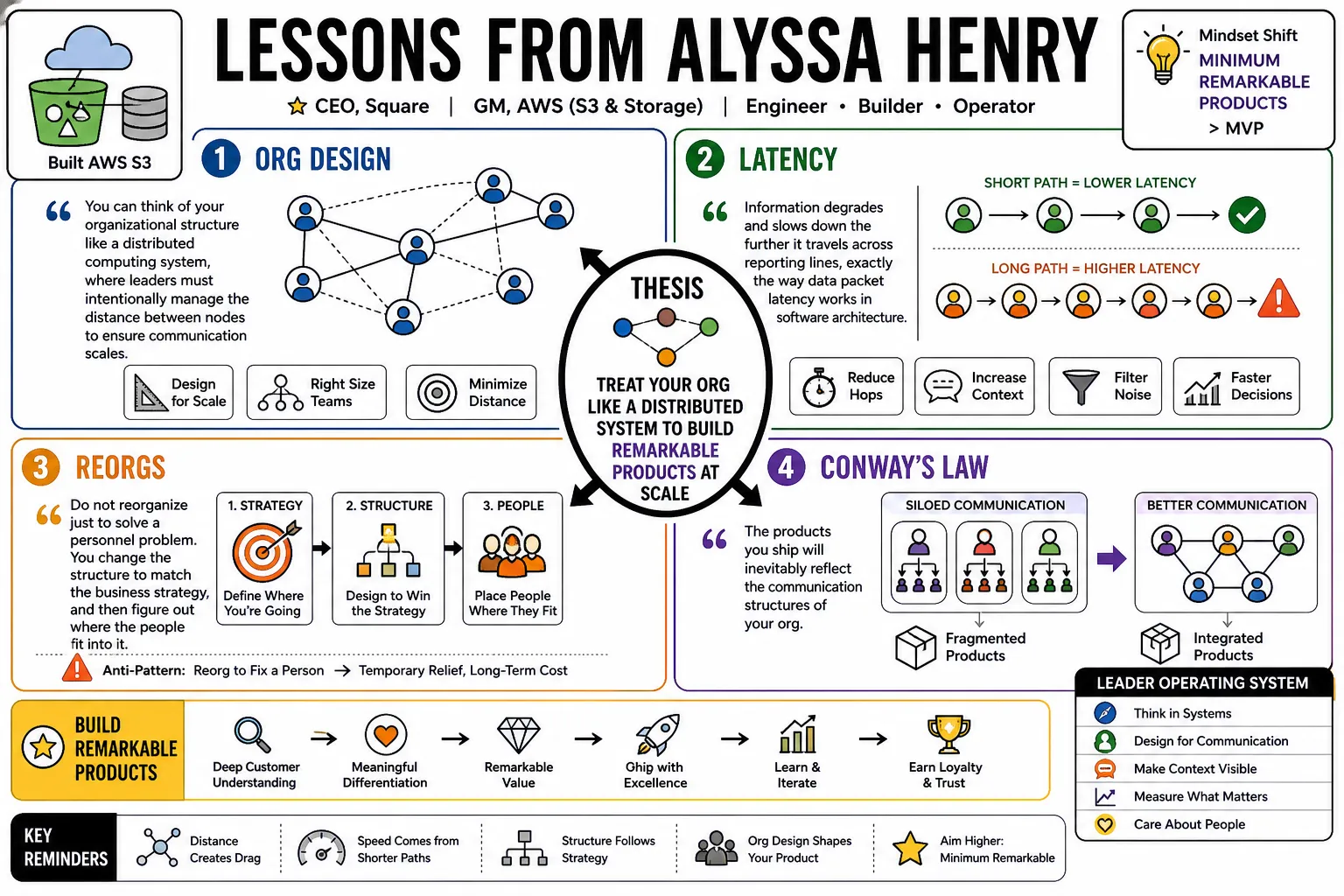
Part 1: Organizational Design as Distributed Systems
- Organizational Design as a Distributed System: Henry compares organizations to distributed systems: leaders must account for distance between teams, how communication scales, and how to decompose work as the organization grows. — First Round — Timeless Lessons.
- Change Communication Mechanisms as You Scale: As an organization grows by orders of magnitude, informal conversations stop reaching everyone. Henry recommends deliberately choosing written, spoken, synchronous, and asynchronous communication mechanisms. — First Round — Timeless Lessons.
- Bring Product and Engineering Closer Together: In a multi-product company, moving product and engineering leadership closer to each business can shorten the organizational distance between those functions and help teams move faster. — Engineering Leadership Podcast.
- Choose the Matrix for Your Product Portfolio: Henry says every multi-product company makes a matrix trade-off: functions can own the hierarchy while products cut across it, or product businesses can own teams while functions are coordinated across them. — First Round — Timeless Lessons.
- Shared Products Create Coordination Dependencies: A common platform lets related products reuse core entities, but integrated products also create sequencing dependencies that teams must manage explicitly. — First Round — Timeless Lessons.
- Push Functional Leadership Toward Product Businesses: As the product portfolio expands, Henry favors product-focused leaders with end-to-end responsibility, with functional expertise coordinated across those businesses. — First Round — Timeless Lessons.
Part 2: Minimum Remarkable Products
- Launch a Minimum Remarkable Product: At Square, Henry used the minimum remarkable product as a launch standard: in established categories, merely matching a competitor's basic functionality is unlikely to stand out. — First Round — Timeless Lessons.
- Make Simplicity Feel Crafted: Henry describes elegance as a differentiator: two chairs can be equally simple, yet one feels more carefully crafted. The same principle informed Square's product taste. — First Round — Timeless Lessons.
- The Bar Is Higher for a Fast Follower: Henry argues that a pioneer may be remarkable simply because a new product works, while a follower entering an existing market must offer a noticeably better reason to switch. — First Round — Org Design.
Part 3: Communication and Silent Meetings
- Start Group Reviews with Silent Reading: Henry popularized a Square meeting practice in which participants read and comment on a shared document silently for about 30 minutes, then discuss the most important unresolved points. — Square — Silent Meetings.
- Give Quieter and Remote Colleagues a Voice: Henry argues that written comments let people who are remote, introverted, or otherwise talked over contribute to a meeting without competing for airtime. — Square — Silent Meetings.
- Use Discussion Time for the Points That Matter: A silent reading and commenting period can surface key issues before conversation begins, leaving the spoken portion focused on unresolved questions. — Square — Silent Meetings.
- Let Participants Question the Document Directly: Square's document-led meetings invite participants to ask and answer questions in comments while reading, then bring the important remaining issues into discussion. — Square — Silent Meetings.
- Keep Meeting Context Open Beyond the Room: Henry says written documents and their comment threads let people outside the meeting, including remote employees, read the same context and add their views afterward. — Square — Silent Meetings.
- Prefer the Best Idea to the Loudest Voice: Henry's stated goal for silent commenting was a culture where ideas could be weighed without favoring the loudest speaker or the person closest to headquarters. — Square — Silent Meetings.
- Preserve the Questions and Answers: Document-led reviews leave the material and comment-thread Q&A available to a broader audience after the meeting, unlike a slide presentation's unrecorded talk track. — Square — Silent Meetings.
Part 4: Pioneer vs. Fast Follower Strategies
- Know Whether You Pioneer or Fast-Follow: Henry contrasts companies built to pioneer with those built to fast-follow and says few execute both models equally well; strategy should reflect which mode a business is actually good at. — First Round — Timeless Lessons.
- Different Strategies Need Different People: Henry notes that entering a crowded market calls for different people from pioneering a new one, a distinction that informed Square's move away from a purely functional organization. — First Round — Timeless Lessons.
- Let Market Position Shape the Roadmap: When Square expanded into crowded product categories, Henry says teams had to rethink their roadmap and decide whether to differentiate or compete as a better, cheaper, faster follower. — First Round — Timeless Lessons.
- Microsoft and Amazon Had Different Strengths: Henry describes Microsoft as a strong fast follower and Amazon as better organized to pioneer; she cautions that a company's operating mechanisms shape which approach it can execute. — First Round — Timeless Lessons.
- A Pioneer's Culture May Not Fit a Crowded Category: Square's first card reader was remarkable because it enabled something new. Henry says the same pioneer habits were less effective when Square later entered categories full of established competitors. — First Round — Org Design.
- Bridge Research and Product: Henry observed that research teams and operating product teams can struggle to translate a novel capability into something existing customers can use, allowing outsiders to commercialize the work first. — First Round — Timeless Lessons.
Part 5: Scaling Engineering and Infrastructure
- Offer Developers Building Blocks: Henry says AWS deliberately focused on basic, internet-accessible services that developers and startup customers could combine in ways AWS had not anticipated. — First Round — Timeless Lessons.
- Engineer Storage for Failure and Durability: In her S3 keynote, Henry describes building online storage to remain durable and available despite hardware, network and even data-center failures. — USENIX — Cloud Storage FUD.
- Use Shared Entities Across a Product Suite: Henry describes common employee, buyer, order and payment entities that let Square products reuse context—for example, payroll already recognizing an employee created in the point-of-sale system. — First Round — Timeless Lessons.
Part 6: Career Development and Engineering Leadership
- Keep Learning as Leadership Scope Expands: Henry moved from engineering into management, product and general management; when she lacked operations expertise, she hired a leader who could teach her the function. — Engineering Leadership Podcast.
- Define Product Taste So It Can Scale: At Square, Henry found it difficult to review every product's design centrally. She argues that explicit values and examples of trade-offs help teams apply a shared standard of taste. — First Round — Timeless Lessons.
- Broaden Beyond a Single Engineering Function: Henry describes growing from technical and engineering roles into product and general management, learning to work across operations, design, sales and support as her scope expanded. — Engineering Leadership Podcast.
- Build Complementary Teams Where People Can Contribute: Henry says people want to be useful; leaders should discover their distinct strengths and assemble complementary teams that let them contribute. — First Round — Org Design.
Part 7: The Seller Experience and Customer Obsession
- Use AI to Give Small Sellers Expert Assistance: Henry says many small-business owners lack the time or expertise to create effective marketing campaigns; AI can help them produce work they know would benefit their business. — No Priors — Alyssa Henry.
- Help Sellers Serve Buyers Across Channels: Henry describes Square's evolution from an in-person, hardware-and-payments focus toward software for sellers who meet buyers in person, online, by phone and on social media. — Crucible Moments — Block.
- Fit Restaurant Software to the Restaurant's Workflow: Henry says full-service restaurants needed a purpose-built point of sale with smart defaults and customizable workflows, rather than being forced to adapt their operations to the software. — Skift — Square for Restaurants.
- Apply AI to Back-Office Decisions Too: Beyond marketing and product imagery, Henry sees potential for AI to help small sellers understand cash flow, employee management and which products sell best, while noting that some quantitative capabilities were still immature. — No Priors — Alyssa Henry.
- Make Onboarding Self-Serve: Henry contrasts Square for Restaurants with traditional systems that require a sales call or an installer, emphasizing the ability for a restaurant to buy and set up the product itself. — Skift — Square for Restaurants.
- Use Smart Defaults Without Erasing Flexibility: Square built smart defaults to make restaurant setup easy, while letting operators customize the point of sale to match their own workflows. — Skift — Square for Restaurants.
- Look for Customer Pain Beyond Literal Requests: Henry says pioneers must see customers' pain points and solve them from first principles, rather than simply take feature requests at face value. — First Round — Timeless Lessons.
- Organize Around Distinct Customer Workflows: When Square expanded beyond horizontal payments into industry-specific software, Henry gave leaders end-to-end ownership of customer segments such as retail, restaurants and health and beauty. — First Round — Org Design.
Part 8: Culture, Values, and Execution
- Operationalize Values in Real Decisions: Henry says values matter only when hiring, candidate feedback, performance reviews, promotions, product strategy and day-to-day decisions actually refer back to them. — First Round — Timeless Lessons.
- Account for the Human Condition: Henry argues that people usually have good intent and want useful work; a shared set of beliefs can help a growing organization avoid unnecessary conflict. — First Round — Org Design.
- Calibrate Quality Investment to Failure Cost: Comparing Microsoft software shipped on physical media with Amazon's online services, Henry argues that quality-control investment should reflect the cost, reversibility and likelihood of failures in the particular business. — First Round — Timeless Lessons.
- Use Surprising Differences to Find Root Causes: Henry used the Five Whys to understand why two successful companies invested differently in testing, rather than assuming one company's process was universally right. — First Round — Timeless Lessons.
- Assume Good Intent Before Judging Disagreement: Henry's default is that people are well intentioned; disagreement often reflects different principles, information, or assessments of risk and reward. — First Round — Timeless Lessons.
- Make Stakeholder Priorities Explicit: Henry says companies balance customers, employees, shareholders and communities, and the relative priority of each shapes their operating culture. — First Round — Timeless Lessons.
- Align a Broad Portfolio Around a Few Themes: For Square's wide product suite, Henry used a small set of annual strategic priorities so each team could see how its work contributed, rather than relying on one generic financial goal. — First Round — Timeless Lessons.