Lessons from Aman Sanger
Aman Sanger co-founded Anysphere, the company behind the AI code editor Cursor. His team built an editor that reads entire project codebases to instantly generate and edit logic across multiple files. This collection tracks his approach to low-latency infrastructure and startup iteration as AI changes the underlying mechanics of writing software.
Part 1: The AI-First Paradigm
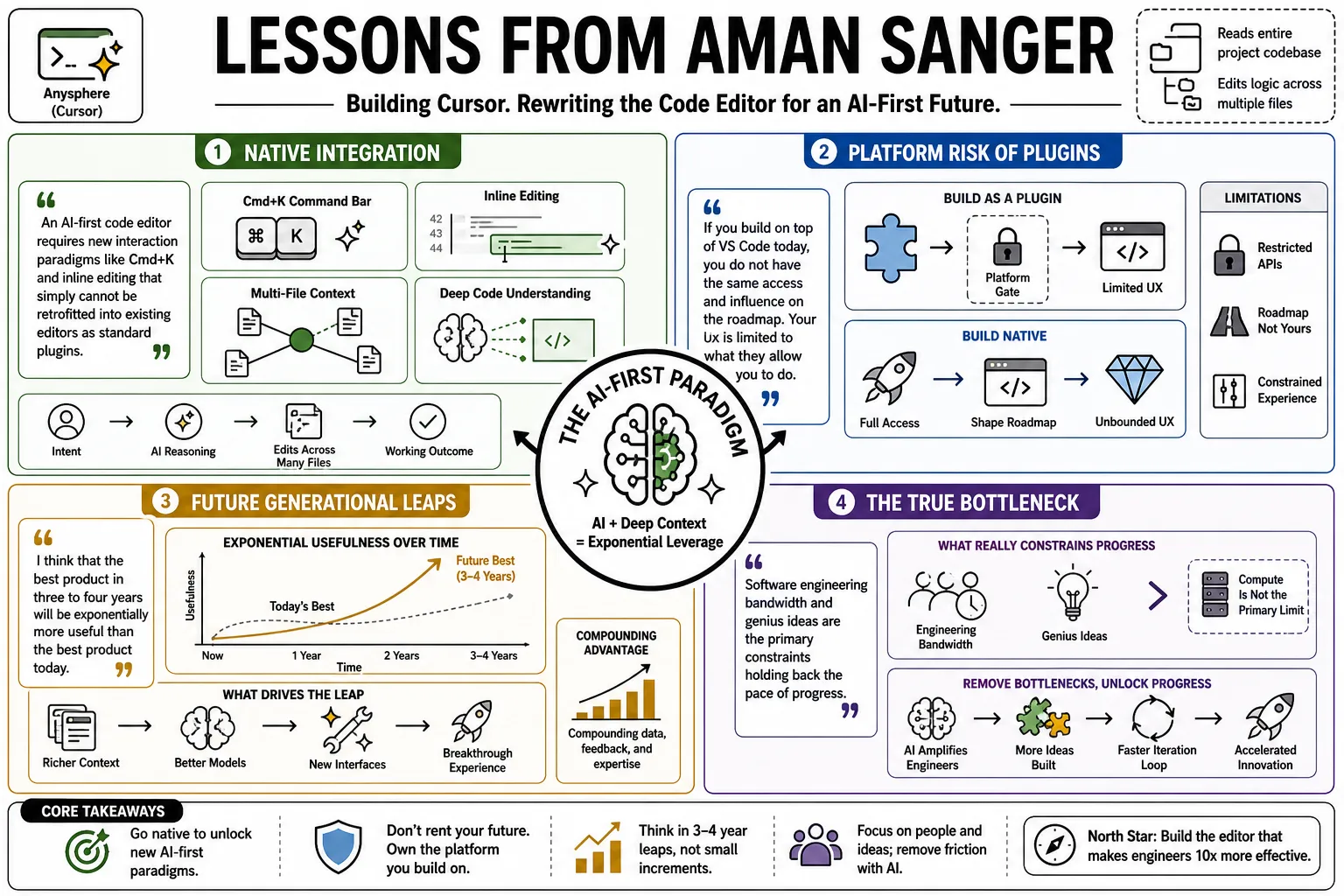
- On Native Integration: "An AI-first code editor requires new interaction paradigms like Cmd+K and inline editing that simply cannot be retrofitted into existing editors as standard plugins." — Source: [Latent Space Podcast]
- On the Platform Risk of Plugins: "If you build on top of VS Code today, you do not have the same access and influence on the roadmap. Your UX is limited to what they allow you to do." — Source: [Latent Space Podcast]
- On the Ceiling of Progress: "This space is different from past software spaces. The ceiling here is incredibly high." — Source: [Lex Fridman Podcast]
- On Future Generational Leaps: "I think that the best product in three to four years will be exponentially more useful than the best product today." — Source: [Lex Fridman Podcast]
- On the True Bottleneck: "Software engineering bandwidth and genius ideas are the primary constraints holding back the next major leaps in artificial intelligence." — Source: [Aman Sanger's Blog]
- On Tooling as Leverage: "The ultimate goal for Cursor is to make it much easier for anyone in the world to produce software. I think we are probably a bit more than one percent done." — Source: [Y Combinator Interview]
- On Generating Software: "We need a brand new AI-powered IDE to get to a state where the vast majority of code is written by AI." — Source: [Latent Space Podcast]
- On AI UX as a Defensible Moat: "A core engineering thesis is that new capabilities in AI demand new innovation in user experience, and that UX can actually be a viable moat." — Source: [Latent Space Podcast]
- On the AI Bubble: "I do not think the numbers make sense for a bubble. Look at where there is real demand and real revenue. The coding space is one clear area for this." — Source: [Y Combinator Interview]
- On Model Independence: "The advantage lies beyond plugging in a frontier model; it requires building the surrounding infrastructure that allows any model to interact fluidly with the codebase." — Source: [Latent Space Podcast]
Part 2: Designing Cursor and the UX Moat
- On Forking VS Code: "We realized early on that to have complete control over the text rendering, latency, and core user experience, we had to fork VS Code entirely." — Source: [Latent Space Podcast]
- On the Inflection Point: "Our growth really took off when we nailed two specific features: inline editing and comprehensive codebase indexing." — Source: [Y Combinator Interview]
- On Context Retrieval: "The core problem of AI coding involves giving the model the exact right slice of the project so it understands what to change." — Source: [Lex Fridman Podcast]
- On Shadow Workspaces: "We build mechanisms that allow the AI to simulate changes silently in the background, verifying them before presenting them to the user." — Source: [Cursor Blog]
- On Flow State: "Every millisecond of latency disrupts the programmer's flow. The user experience has to feel completely instantaneous." — Source: [Cursor Blog]
- On Seamless Interactivity: "The interaction should feel like the editor itself is anticipating your next keystroke, rather than a chatbot bolted onto a screen." — Source: [Latent Space Podcast]
- On Codebase Awareness: "Allowing the AI to see the entire project structure was a fundamental breakthrough for code accuracy." — Source: [Y Combinator Interview]
- On Multi-File Edits: "The next frontier of AI editing involves moving beyond single-file modifications and safely executing changes that span an entire repository." — Source: [Cursor Blog]
- On Explicit Context: "Creating the mention system allowed developers to pull specific documentation, files, or symbols into the AI's context with zero friction." — Source: [Latent Space Podcast]
- On Surpassing Autocomplete: "Standard autocomplete guesses the next word, whereas an AI-first editor understands the intent behind the change and writes the surrounding logic." — Source: [Lex Fridman Podcast]
Part 3: Rethinking Editor Architecture and Latency
- On Custom Infrastructure: "Cursor's technical advantage relies heavily on the custom infrastructure built specifically for fast context retrieval and real-time generation." — Source: [Lex Fridman Podcast]
- On Fast Apply Models: "To apply large edits instantly, you cannot wait on a standard model API; you have to run optimized, fine-tuned models built entirely for speed." — Source: [Cursor Blog]
- On Speculative Decoding: "With code edits, we have a very strong prior of what the existing code will look like, so we can feed chunks of the original code back into the model to verify them all at once." — Source: [Lex Fridman Podcast]
- On Speed Benchmarks: "Fine-tuning open-source models allows us to hit 1000 tokens per second for file editing, vastly outperforming generic APIs." — Source: [Cursor Blog]
- On Next-Action Prediction: "We are moving toward models that continuously predict your next action, pre-computing the edit before you even finish typing the prompt." — Source: [Cursor Blog]
- On Model Inference: "Deploying AI for code requires a fundamentally different approach to inference that optimizes for low-latency, high-throughput text replacement." — Source: [Cursor Blog]
- On Frontier Model Constraints: "While large models are incredibly capable, they are often too slow for the localized, split-second edits required in a text editor." — Source: [Cursor Blog]
- On Training in the Weights: "Eventually, we want to teach models to learn a codebase in the weights, so they inherently understand a project's architecture without needing huge prompt contexts." — Source: [Cursor Blog]
- On Cursor Tab: "Cursor Tab operates as a custom-trained model constantly evaluating the surrounding lines to make intelligent, multi-line jumps." — Source: [Lex Fridman Podcast]
- On Engineering for Speed: "If you want an editor to feel alive, you must ruthlessly shave down every architectural bottleneck between the user's intent and the rendered code." — Source: [Cursor Blog]
Part 4: The Reality of Modern Software Engineering
- On Real-World Messiness: "Real software engineering involves navigating legacy systems, missing context, and ambiguous requirements, which rarely resemble standard interview problems." — Source: [Lex Fridman Podcast]
- On Human Prompting: "Humans write in half-broken English sometimes, or tell the editor to 'do what I did before,' making the job highly context-dependent." — Source: [Lex Fridman Podcast]
- On Coding Benchmarks: "Standard AI coding benchmarks do not accurately reflect the daily reality of a developer navigating a massive enterprise codebase." — Source: [Latent Space Podcast]
- On Iteration Speed: "The rapid iteration speed of software development is what draws people to the field; you can build rapidly without the physical gatekeeping of other disciplines." — Source: [Lex Fridman Podcast]
- On Domain Knowledge: "The true value of a developer is the domain knowledge inside their head, which is notoriously difficult to communicate to an AI." — Source: [Y Combinator Interview]
- On Debugging vs. Writing: "A significant portion of coding involves deciphering why existing lines interact poorly within the broader system, rather than writing entirely new logic." — Source: [Latent Space Podcast]
- On the Developer's Burden: "Engineers spend an unreasonable amount of time wrangling boilerplate and fighting configurations rather than solving the actual business logic." — Source: [Latent Space Podcast]
- On Unspoken Rules: "Every codebase has an implicit style and logic that is not written down anywhere. An effective AI tool has to infer these unspoken rules on the fly." — Source: [Cursor Blog]
- On Collaboration: "Programming is fundamentally a collaborative act of translating fuzzy human desires into rigorous, executable logic." — Source: [Lex Fridman Podcast]
Part 5: From First Principles to Startup Strategy
- On Ignoring Conventional Wisdom: "Do not listen to advice. Just think from first principles. There is no real textbook for starting a company; you should think about what makes sense from scratch." — Source: [Y Combinator Interview]
- On Experimentation: "For everything you see in the product, there are ten failed experiments representing what did not work." — Source: [Lex Fridman Podcast]
- On Shipping Imperfect Tools: "We released half-finished features, which a lot of competitors refused to do. Once you release to the world and observe reactions, you can improve it significantly." — Source: [Y Combinator Interview]
- On the Pivot from CAD: "We started out trying to build AI tools for mechanical engineers, but quickly realized we had much stronger founder-market fit building tools for ourselves as software engineers." — Source: [Lex Fridman Podcast]
- On Talent Density: "We crafted Cursor from the start to be a place of extremely high talent density where we could hire a handful of exceptionally productive people." — Source: [Y Combinator Interview]
- On Product Paranoia: "Paranoia is part of daily life. You need to reinvent the product every few months to stay ahead." — Source: [Y Combinator Interview]
- On Hiring Without AI: "We often ask engineering candidates to code without AI during interviews to test their raw, first-principles problem-solving abilities." — Source: [Lex Fridman Podcast]
- On Finding the Core Loop: "Our initial launch saw usage tank. It only clicked when we built the exact interaction loops that developers actually wanted to use." — Source: [Y Combinator Interview]
- On Relentless Iteration: "The difference between an interesting prototype and a product people rely on daily comes down to thousands of micro-adjustments to the interface." — Source: [Latent Space Podcast]
Part 6: Human Effort and The Role of the Engineer
- On Shifting Focus: "Humans should focus on bigger problems. As AI handles the syntax and boilerplate, engineers must elevate their thinking to system-level design." — Source: [Latent Space Podcast]
- On the Future Programmer: "Programming itself will soon feel like reviewing the work of several interns, as engineers spend more time auditing AI-generated code than writing it." — Source: [Y Combinator Interview]
- On Low-Entropy Work: "The goal of AI in the editor is the total elimination of low entropy keystrokes, avoiding the repetitive typing that requires no creative thought." — Source: [Lex Fridman Podcast]
- On Human Taste: "While AI handles well-defined execution, the creative decision-making and taste in system design remain a fundamentally human-driven process." — Source: [Lex Fridman Podcast]
- On the Hybrid Engineer: "The engineer of the future is a human-AI hybrid who operates an order of magnitude more effectively because they have effortless control over their entire codebase." — Source: [Lex Fridman Podcast]
- On Passionate Coders: "The most effective programmers are often those who are simply obsessed, spending their free time digging deep into complex systems." — Source: [Lex Fridman Podcast]
- On Vibe Coding: "When the friction of syntax is removed, building software becomes a much more intuitive and fluid expression of ideas." — Source: [Y Combinator Interview]
- On Tokenmaxxing: "Founders are using context-aware AI tools to individually output the equivalent engineering work of an entire traditional team." — Source: [Y Combinator Interview]
- On the Joy of Building: "Automating the tedious parts of programming amplifies the joy of coding by letting developers stay purely in the creative zone." — Source: [Latent Space Podcast]
Part 7: Scaling Laws and AI Optimism
- On the 2020 Scaling Papers: "When I first read the OpenAI scaling laws papers, I went through the stages of grief—anger, denial, and finally acceptance of what it meant for the future." — Source: [Lex Fridman Podcast]
- On Embracing Scaling: "Once you accept the math behind scaling laws, you transition into a state of profound optimism about the rate of human progress." — Source: [Lex Fridman Podcast]
- On Compute as Progress: "The predictability of model improvement relative to compute investment is one of the most powerful realities in modern technology." — Source: [Lex Fridman Podcast]
- On Specialization of Training: "Future training will involve practitioners offloading massive jobs to specialized companies, resembling the chip design and fabrication industry." — Source: [Latent Space Podcast]
- On Data Abundance: "The public history of code repositories represents tens of terabytes of human reasoning. Utilizing that dataset effectively is key to unlocking agentic coding." — Source: [Latent Space Podcast]
- On Approaching AGI: "The coding domain is likely where we will see the most rapid approximations of general intelligence, because the feedback loops for correctness are incredibly tight." — Source: [Lex Fridman Podcast]
- On Unlocking Potential: "If software bandwidth is the bottleneck to AI development, then creating AI tools to write software creates a compounding acceleration loop." — Source: [Aman Sanger's Blog]
- On AI Safety through Capabilities: "Building capable, reliable AI software engineers serves as a prerequisite for managing and scaling the broader safety infrastructure we will need." — Source: [Aman Sanger's Blog]
- On Continuous Upgrades: "The beautiful thing about tying your product to language models is that your underlying engine gets fundamentally smarter every six months." — Source: [Latent Space Podcast]
Part 8: Math, Truth, and the Path Forward
- On Formal Verification: "Math is a great domain for AI because formal theorem proving provides an undeniable signal of whether the output is actually correct." — Source: [Lex Fridman Podcast]
- On Reinforcement Learning: "Because mathematics provides absolute ground truth, reinforcement learning applies incredibly effectively to teach models how to reason." — Source: [Lex Fridman Podcast]
- On Dual Disciplines: "Studying both Computer Science and Mathematics fundamentally shapes how you view problem-solving, moving from abstract proof to practical execution." — Source: [Lex Fridman Podcast]
- On the Limits of Heuristics: "In engineering, heuristics eventually break down. You ultimately need systems grounded in verifiable logic." — Source: [Aman Sanger's Blog]
- On the Purity of Code: "Code is the closest practical application we have to mathematical truth. It either compiles and executes correctly, or it fails." — Source: [Lex Fridman Podcast]
- On Building the Future: "The objective is to build the primary interface through which humans will direct machine intelligence." — Source: [Latent Space Podcast]
- On Expanding the Frontier: "The gap between what AI can do today and what it will do tomorrow requires builders willing to constantly tear down and rebuild their own infrastructure." — Source: [Cursor Blog]
- On Athletic Discipline: "The discipline required in competitive sports translates directly to startups. You have to show up, iterate relentlessly, and possess an obsessive drive to win." — Source: [Lex Fridman Podcast]
- On the Long Game: "We are just at the beginning of the curve. The work we are doing now to index, retrieve, and parse code is setting the foundation for autonomous engineering systems." — Source: [Lex Fridman Podcast]