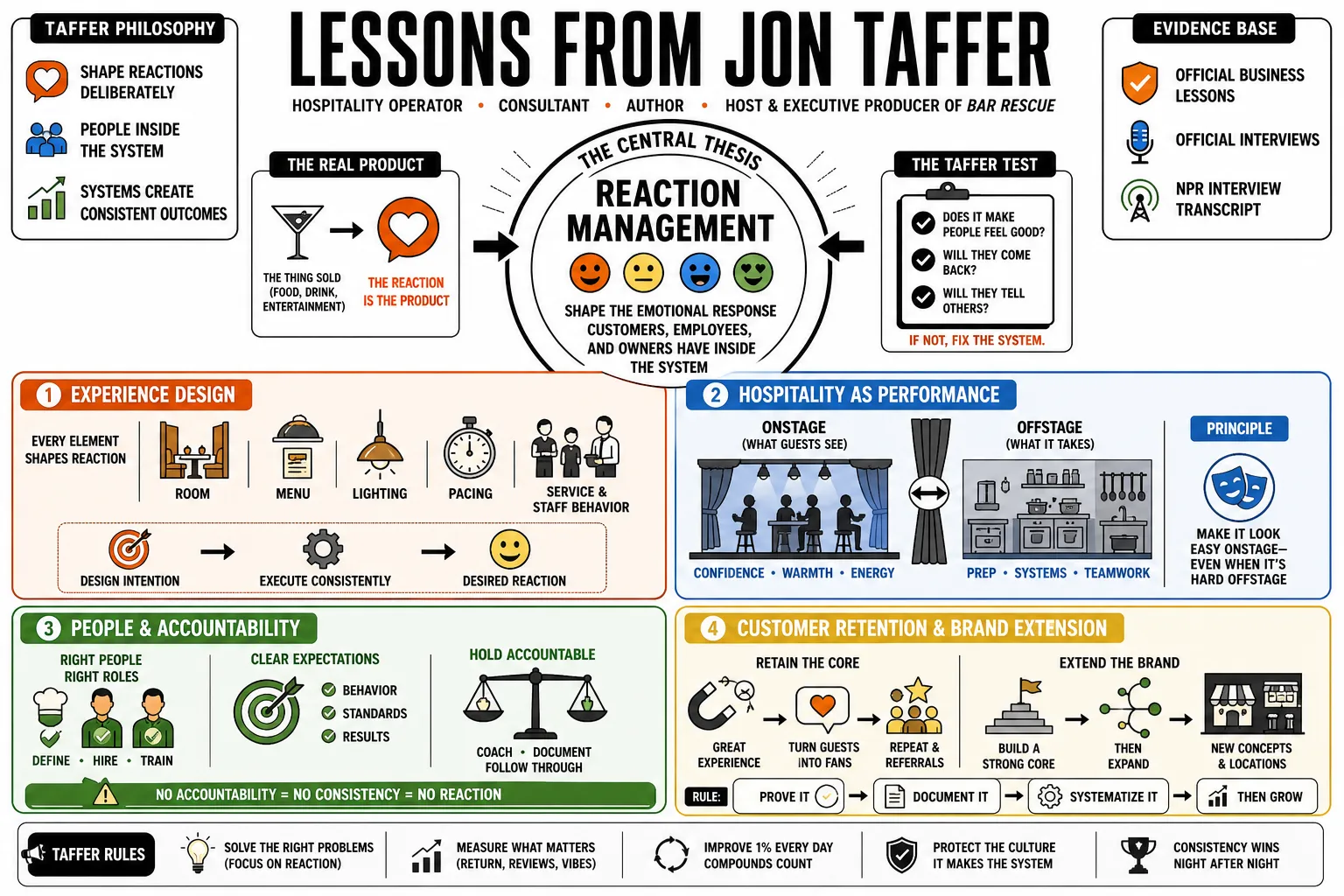
Jon Taffer is a hospitality operator, consultant, author, and the longtime host and executive producer of Bar Rescue. His operating philosophy is built around reaction management: businesses win when they deliberately shape the emotional response customers, employees, and owners have inside the system. These lessons cover his approach to hospitality, turnarounds, accountability, conflict, staff design, customer retention, and brand extension.
Part 1: Reaction Management
- On the real product: Treat the customer's reaction as the product, because the thing sold only matters if it creates the right emotional response. — Reference: Official Jon Taffer business lessons
- On experience design: The room, service, menu, lighting, pacing, and staff behavior all work together to create a reaction, so none of them should be left accidental. — Reference: Official Jon Taffer interview
- On hospitality as performance: A bar has an onstage and offstage reality; customers should see confidence, warmth, and energy even when the back-of-house work is hard. — Reference: NPR interview transcript
- On making people feel good: Taffer's core test for a hospitality business is whether it reliably makes people laugh, smile, connect, and want to return. — Reference: Official Jon Taffer business lessons
- On selling after entry: Marketing may get someone through the door, but selling really begins once the customer is inside the experience. — Reference: Official Jon Taffer business lessons
- On packaging expectations: Presentation changes what customers expect before they taste, buy, or evaluate the product, so packaging is part of the operating system. — Reference: NPR interview transcript
- On business category: Taffer argues that hospitality companies are not just food-and-beverage businesses; they are in the business of manufacturing reactions. — Reference: Official Jon Taffer interview
Part 2: Customer Retention
- On the third visit: Do not optimize only for a first visit; the real retention fight is getting customers back enough times for habit to form. — Reference: Official Jon Taffer business lessons
- On lifetime value: A rescued business is not fixed by one memorable night; it is fixed when the experience becomes predictable enough to earn repeat visits. — Reference: Official Jon Taffer business lessons
- On marketing cadence: Market to the first three visits, not just the first transaction, because loyalty usually forms after repeated flawless experiences. — Reference: Restaurant Den on Taffer's customer-service advice
- On discount traps: Discounts can train customers to wait for cheaper prices, while free or high-value moments can create goodwill without weakening price expectations. — Reference: Restaurant Den on Taffer's customer-service advice
- On consistency: The customer should encounter a high standard every time, because one inconsistent visit can interrupt the path from trial to habit. — Reference: Official Jon Taffer business lessons
- On target customers: Demographics should shape the offer, message, design, and delivery; the same promotion can work or fail depending on how it is framed. — Reference: Official Jon Taffer business lessons
- On emotional memory: People connect to great bars personally, so the goal is not only operational competence but a place that becomes part of someone's life. — Reference: NPR interview transcript
Part 3: Accountability and Excuses
- On excuses: Taffer treats excuses as the common denominator of failing businesses because they protect the owner from facing the real cause of decline. — Reference: Entrepreneur interview
- On self-honesty: A business cannot move in a positive direction when the owner is lying to themselves about what is really happening. — Reference: Jordan Harbinger transcript
- On ego: The more a failing owner protects their ego, the harder it becomes to read the numbers, accept feedback, and change behavior. — Reference: Jordan Harbinger transcript
- On ownership: The first rescue is psychological: owners must accept that their decisions produced the current reality before new systems can work. — Reference: Entrepreneur interview
- On accountability pressure: Taffer uses confrontation to force accountability when softer conversations would let owners stay comfortable with failure. — Reference: Newsweek interview
- On business survival: In a small hospitality business, poor habits are not abstract defects; they can cost homes, savings, payroll, and family stability. — Reference: Jordan Harbinger transcript
- On solutions: Taffer's operating stance is to reject excuses and move toward solutions, because diagnosis without behavior change is just theater. — Reference: NPR interview transcript
Part 4: Conflict as a Management Tool
- On deliberate anger: Taffer frames business anger as a tool, not a loss of control, when it is used to create accountability and urgency. — Reference: Newsweek interview
- On personal vs. business emotion: He separates personal anger from business anger; the point is not emotional release, but getting the system to change. — Reference: Newsweek interview
- On fighting for something: Confrontation works better when it is aimed at protecting employees, families, customers, and the business rather than humiliating the owner. — Reference: Jordan Harbinger transcript
- On breaking through denial: A turnaround often requires interrupting the story an owner tells themselves before any tactical recommendation will land. — Reference: Jordan Harbinger transcript
- On conflict literacy: His later work on conflict fits the same pattern as Bar Rescue: disagreement is useful when it is turned toward results instead of avoidance. — Reference: Newsweek interview
- On reality contact: A harsh conversation can be useful when it brings the owner into contact with financial, operational, or hygiene reality they have avoided. — Reference: Entrepreneur interview
- On audience intelligence: Taffer says the audience can tell when a show or business is fake, so the conflict has to be grounded in real stakes. — Reference: Newsweek interview
Part 5: Staff, Standards, and Training
- On hiring for attitude: Hire for the personality the job requires, then teach the tasks; attitude is harder to install after the fact. — Reference: Official Jon Taffer business lessons
- On role clarity: A job posting should describe the personality and behavior needed, not just list generic duties. — Reference: Official Jon Taffer business lessons
- On weak performers: Taffer dislikes treating a business like a family if that means endlessly protecting people who cannot perform the role. — Reference: Official Jon Taffer business lessons
- On team standards: A business should operate more like a team with clear objectives, where underperformance is addressed instead of quietly tolerated. — Reference: Official Jon Taffer business lessons
- On teaching vs. training: Teaching shows the task and then lets employees bring personality to the role; rigid training can over-control the human part of service. — Reference: Official Jon Taffer business lessons
- On controls: Taffer's Troubadour experience taught him that charisma and talent are not enough; without controls, theft and waste can hollow out the business. — Reference: Ritholtz transcript
- On hygiene: Operational basics like food safety, cleanliness, and back-of-house discipline are not optional details; they are the foundation of trust. — Reference: Entrepreneur interview
Part 6: Turnaround Mechanics
- On selecting rescues: Taffer looks for real distress and a compelling human story, not just a business trying to get a free remodel. — Reference: Official Jon Taffer interview
- On people as the story: In Bar Rescue, the people and their personalities matter as much as the physical bar because the business changes only if they change. — Reference: Official Jon Taffer interview
- On profit centers: His hotel work grew from the insight that restaurants and bars inside hotels had to become profit centers, not passive amenities. — Reference: Ritholtz transcript
- On local positioning: Taffer helped hotel food-and-beverage operations add outside entrances and reposition themselves for local demand rather than only hotel guests. — Reference: Ritholtz transcript
- On special-occasion traps: A restaurant positioned only for anniversaries and birthdays loses the frequency needed for durable economics. — Reference: Ritholtz transcript
- On root causes: A rescue has to identify whether the failure is concept, staff, controls, customer experience, ownership behavior, or all of them together. — Reference: Jordan Harbinger transcript
- On urgency: Turnarounds compress time; the intervention has to create fast belief, fast standards, and fast evidence that the business can be different. — Reference: Entrepreneur interview
Part 7: Menus, Brands, and Concepts
- On menu simplicity: Too many choices slow customers down, create confusion, and make execution harder; simplify the menu to improve both experience and operations. — Reference: Official Jon Taffer business lessons
- On realistic innovation: Innovate while listening to customers; novelty that leaves too many customers behind can narrow the market instead of expanding it. — Reference: Official Jon Taffer business lessons
- On designing for a segment: Upscale customers, neighborhood regulars, tourists, and late-night crowds respond to different signals, so the same idea needs different execution. — Reference: Official Jon Taffer business lessons
- On Las Vegas: Taffer sees Las Vegas nightlife as a distinct operating system built on exclusivity, high energy, merchandising, and market-specific behavior. — Reference: Official Jon Taffer interview
- On concept energy: The best venues match energy level to customer purpose; a networking bar and a high-energy nightclub should not be designed the same way. — Reference: Official Jon Taffer interview
- On brand extension: Taffer extends his authority through books, consulting, television, and owned hospitality concepts, but the through-line stays tied to customer reactions. — Reference: Official Jon Taffer interview
- On franchising a concept: A scalable hospitality concept still has to solve the same basic problem as an individual bar: create a reliable customer reaction that can be repeated. — Reference: Official Jon Taffer business lessons
Part 8: Career, Media, and Operating Philosophy
- On career compounding: Taffer's path from Troubadour manager to hotel consultant to Bar Rescue shows the value of turning operating experience into repeatable expertise. — Reference: Ritholtz transcript
- On creating the show: He built the Bar Rescue concept after being told he would never be on television, choosing the production partner he thought would make the best show rather than the richest offer. — Reference: Ritholtz transcript
- On rejection: A strong rejection can turn an idea into a mission when the founder uses it as fuel instead of proof to quit. — Reference: Ritholtz transcript
- On work intensity: Taffer attributes part of his career to extreme work intensity and investing early in his future, even before the media profile existed. — Reference: Official Jon Taffer interview
- On public authority: His authority comes from decades of operating, consulting, and rescue work, not from television alone. — Reference: Ritholtz transcript
- On industry service: He turns operating expertise into teaching, consulting, speaking, and repeatable frameworks rather than leaving it as one-off personal instinct. — Reference: Official Jon Taffer interview
- On the durable lesson: Whether the business is a bar, restaurant, hotel, media brand, or franchise, the same question remains: what reaction are you deliberately creating, and can you repeat it profitably? — Reference: Official Jon Taffer interview