Lessons from Bob Hoffman
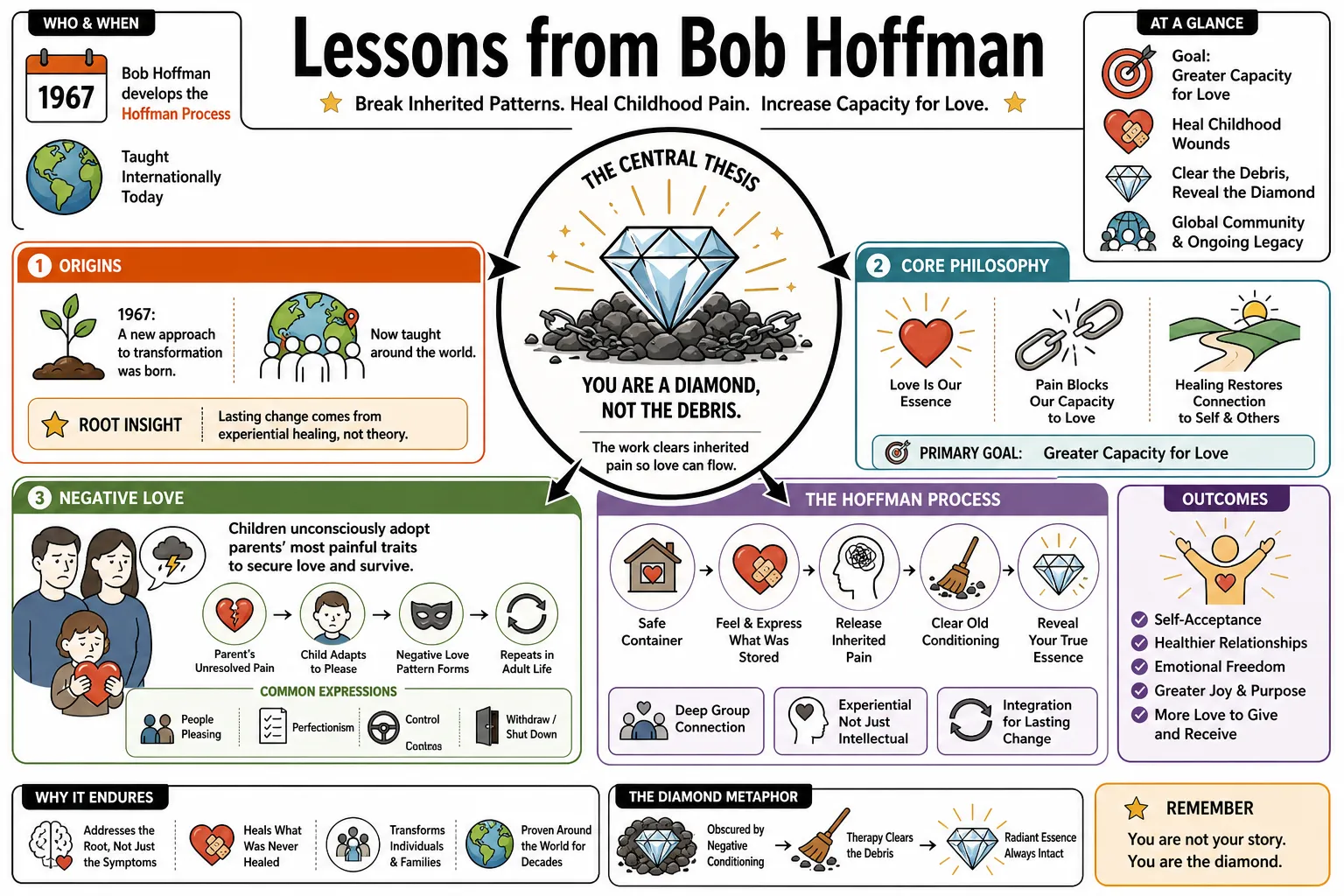
Bob Hoffman developed the Hoffman Process in 1967 as an intensive retreat to help adults break destructive childhood patterns. His work centers on the concept of Negative Love, the idea that children unconsciously adopt their parents' most painful traits to secure affection and survive. The system he built to unlearn these inherited behaviors is still taught internationally today.
Part 1: The Origins and Core Philosophy
- On the primary goal: The central objective of the work is to foster a greater capacity for love by helping individuals heal the unresolved childhood experiences that taught them they were unlovable. — Reference: What Is the Hoffman Process?
- On the durability of childhood pain: Rational adults often find themselves repeating self-defeating behaviors because early emotional conditioning cannot be resolved through intellectual understanding alone; it must be addressed experientially. — Reference: What Is the Hoffman Process?
- On the diamond metaphor: The human essence is akin to a perfect diamond that becomes obscured by the accumulated debris of negative conditioning, and the therapeutic goal is simply to clear away that debris. — Reference: What Is the Hoffman Process?
- On continuous evolution: What began in 1967 as a series of outpatient counseling sessions (then called the Fischer-Hoffman Process) evolved over the decades into an intensive, immersive residential retreat to better facilitate deep emotional shifts. — Reference: What Is the Hoffman Process?
- On the limits of the intellect: Because limiting behaviors are learned emotionally and physically as a child, trying to think your way out of them as an adult is fundamentally ineffective. — Reference: Hoffman International: The Hoffman Process
- On unconditional love as a birthright: The fundamental premise of the work is that every human being is born with an inherent capacity for unconditional love, which is merely buried by early psychological survival tactics rather than lost permanently. — Reference: What Is the Hoffman Process?
- On beginning with life history: Hoffman's early clients started by writing emotionally charged autobiographies covering birth through puberty, giving the work a concrete map of childhood experience before attempting behavioral change. — Reference: Bob Hoffman, Founder of the Hoffman Process
- On turning insight into a repeatable method: His early work combined eight to ten guided sessions, cathartic exercises, self-awareness practices, and tools for interrupting Negative Love behaviors; that sequence became the basis of the Process's enduring structure. — Reference: Bob Hoffman, Founder of the Hoffman Process
Part 2: The Architecture of the Quadrinity
- On wholeness: The human self is composed of four distinct but interconnected aspects—the Intellect, the Emotions, the Body, and the Spirit—which must operate in harmony for a person to feel fulfilled. — Reference: What Is the Hoffman Process?
- On the intellectual self: The adult intellect often overcompensates and attempts to dominate the personality, operating as a protective mechanism that internalizes the critical voices of early caregivers. — Reference: What Is the Hoffman Process?
- On the emotional child: The emotional aspect of the self frequently remains arrested in childhood, reacting to present-day stressors based on past conditioning rather than current reality. — Reference: What Is the Hoffman Process?
- On the physical body: The body exists entirely in the present moment and serves as the physical vessel for our experiences, making somatic awareness a necessary component of emotional healing. — Reference: What Is the Hoffman Process?
- On the spiritual center: The spiritual aspect represents the unconditioned, authentic core of an individual, which provides a source of peace and conscious choice when the other three aspects are balanced. — Reference: What Is the Hoffman Process?
- On daily maintenance: Achieving harmony among the four aspects requires active, ongoing reflection, often practiced through a regular Quadrinity Check-In to assess the state of one's thoughts, feelings, and physical sensations. — Reference: What Is the Hoffman Process?
- On the cost of misalignment: When the four quadrants are out of sync—such as when the intellect judges the emotions, or the body is ignored—individuals experience chronic internal conflict that manifests as anxiety or depression. — Reference: What Is the Hoffman Process?
Part 3: Negative Love Syndrome
- On the survival instinct: Children instinctively mimic the moods, attitudes, and behaviors of their parents as a biological and emotional survival strategy to ensure they receive care and attention. — Reference: Bob Hoffman, Founder of the Hoffman Process
- On adopting pain: In an attempt to secure a bond, children will subconsciously adopt even the most negative or dysfunctional traits of their caregivers, operating on the unspoken logic that similarity guarantees affection. — Reference: What Is the Hoffman Process?
- On romantic replication: Adults frequently project their unresolved Negative Love patterns onto romantic partners, unconsciously recreating the emotional dynamics of their childhood in a misguided attempt to finally win the love they lacked. — Reference: What Is the Hoffman Process?
- On false identity: The self-defeating behaviors individuals exhibit are not representative of their true character, but are rather borrowed survival mechanisms that have outlived their usefulness. — Reference: What Is the Hoffman Process?
- On the three responses: Individuals typically adapt to their parents' negative traits through one of three mechanisms: imitation (copying them exactly), rebellion (doing the extreme opposite), or reaction (developing specific, defensive responses). — Reference: What Is the Hoffman Process?
- On the unconscious nature of imitation: Because Negative Love forms before a child has the cognitive ability to filter or evaluate their parents' behavior, the adoption of these traits bypasses logic and becomes deeply embedded as default programming. — Reference: Bob Hoffman, Founder of the Hoffman Process
Part 4: The Mechanics of Childhood Conditioning
- On invisible inheritance: The most damaging behavioral patterns are often passed down from generation to generation completely unconsciously, operating outside the awareness of both parent and child. — Reference: What Is the Hoffman Process?
- On the illusion of adulthood: Many people who appear to be functioning adults are actually navigating their lives and relationships through the defensive programming installed during their most vulnerable developmental years. — Reference: What Is the Hoffman Process?
- On repetitive cycles: The primary consequence of unexamined childhood conditioning is the compulsion to repeat the same self-sabotaging mistakes, regardless of how much external success an individual achieves. — Reference: What Is the Hoffman Process?
- On divorcing the past: Healing requires a metaphorical loving divorce from one's parents, which means separating one's own identity and self-esteem from the historical expectations and emotional projections of the family system. — Reference: What Is the Hoffman Process?
- On moving beyond awareness: Simply realizing that a pattern exists is insufficient for change; the conditioning must be actively interrupted and replaced with conscious choices through directed experiential work. — Reference: What Is the Hoffman Process?
- On de-energizing the past: The goal is not just to identify where a habit came from, but to actively de-energize the emotional charge that keeps the pattern running in the background of everyday life. — Reference: What Is the Hoffman Process?
Part 5: Confronting the Dark Side
- On defining the dark side: The Dark Side is not an inherent evil within a person, but rather the accumulated armor of negative beliefs, fears, and reactive behaviors built up to protect the psyche from pain. — Reference: What Is the Hoffman Process?
- On the function of the dungeon: People often retreat into a psychological dungeon of their own making, using isolation, cynicism, or self-doubt as a shield against the vulnerability of authentic connection. — Reference: What Is the Hoffman Process?
- On the cost of protection: While the defensive mechanisms of the Dark Side originally served to keep a child safe, in adulthood they act as a barrier that prevents the experience of joy and intimacy. — Reference: What Is the Hoffman Process?
- On confronting gremlins: Deep emotional healing requires stepping away from daily distractions to face the internal patterns—sometimes referred to as gremlins—that drive compulsive negative behaviors. — Reference: What Is the Hoffman Process?
- On dismantling the armor: The process of change involves systematically identifying these habitual defenses and making the conscious decision to dismantle them, creating space for the true self to emerge. — Reference: What Is the Hoffman Process?
- On the symbiotic relationship of light and dark: The light and dark aspects of the personality are not true opposites locked in endless war; they are connected elements of the human experience that must both be acknowledged to achieve wholeness. — Reference: What Is the Hoffman Process?
Part 6: The Dynamics of Blame and Forgiveness
- On shared guilt: The maxim that "everyone is guilty and no one is to blame" means that while individuals are absolutely responsible for the harm their behaviors cause, those behaviors are ultimately the tragic result of inherited conditioning. — Reference: What Is the Hoffman Process?
- On parental limitations: Parents who pass down trauma are generally not acting out of malice, but are simply operating from the unresolved pain of their own childhoods, repeating what was done to them. — Reference: What Is the Hoffman Process?
- On the futility of blame: Holding onto blame against caregivers is emotionally unproductive; it keeps the individual tethered to the past and prevents them from taking agency over their present life. — Reference: What Is the Hoffman Process?
- On vindictiveness as a shield: Retaliatory or vindictive behaviors are usually secondary reactions masking deeper feelings of humiliation, powerlessness, or unacknowledged pain from early life. — Reference: What Is the Hoffman Process?
- On the true beneficiary of forgiveness: The act of forgiving one's parents is not necessarily for the parents' benefit, but is a necessary step for the individual to release the heavy emotional burden of resentment and achieve personal freedom. — Reference: What Is the Hoffman Process?
- On freedom from compulsion: Recognizing that no one is ultimately to blame for the generational chain of trauma is the specific insight required to stop compulsive, self-defeating behaviors and begin making conscious choices. — Reference: Bob Hoffman, Founder of the Hoffman Process
Part 7: Emotional Release and Expression
- On moving through the pain: Because negative conditioning is stored emotionally, participants cannot bypass it; the only effective way to resolve the pain is to directly confront and move through it. — Reference: Hoffman International: The Hoffman Process
- On the necessity of catharsis: A crucial step in unlearning childhood patterns is the physical and vocal expression of suppressed anger and resentment that was unsafe to express as a child. — Reference: What Is the Hoffman Process?
- On using the whole body: Effective emotional release requires integrating the voice, the physical body, and focused intention, rather than relying solely on cognitive talk therapy. — Reference: What Is the Hoffman Process?
- On safe environments for anger: Structured, guided environments allow individuals to safely express intense frustration toward parental figures without causing actual harm to their real-world relationships. — Reference: What Is the Hoffman Process?
- On the detox effect: Intense emotional release acts as a psychological detox, clearing out decades of accumulated tension and creating a sudden sense of lightness and clarity. — Reference: What Is the Hoffman Process?
Part 8: Reclaiming the Authentic Self
- On the Light Side: The Light Side represents a person's authentic, unconditioned state, characterized by joy, flow, self-worth, and a natural capacity for love. — Reference: What Is the Hoffman Process?
- On recovering innate abilities: The capacity to love unconditionally is an innate human trait that is never truly lost, only temporarily obscured by the survival strategies learned in youth. — Reference: What Is the Hoffman Process?
- On conscious choice: True adulthood is achieved when an individual can notice their historical negative patterns arising in real-time and use their free will to choose a different, healthier response. — Reference: What Is the Hoffman Process?
- On integrating the self: The ultimate aim is not to wage war between the Dark and Light sides, but to use the compassion of the Light Side to illuminate and soothe the persistent patterns of the Dark Side. — Reference: What Is the Hoffman Process?
- On the spiritual center: Accessing the spiritual self provides individuals with a reliable internal source of wisdom and presence that exists beneath the encrusted dirt of negative conditioning. — Reference: What Is the Hoffman Process?
- On authentic living: Reclaiming the authentic self allows a person to stop acting out of habitual reactivity and instead engage with relationships and challenges from a place of grounded clarity and compassion. — Reference: What Is the Hoffman Process?
Part 9: Method, Evidence, and Legacy
- On sequencing change: Hoffman's method developed a four-stage path—Awareness, Expression, Compassion and Forgiveness, and New Behavior—so participants move from seeing a pattern to releasing its charge and practicing a different response. — Reference: Bob Hoffman, Founder of the Hoffman Process
- On making wholeness visible: Hoffman designed the Quadrinity symbol with a circle for the Body, a central diamond for the Spirit, and two horizontal diamonds for the Intellect and Emotions, expressing his belief that the integrated whole is greater than its parts. — Reference: What Is the Hoffman Process?
- On writing the method down: Hoffman's 1978 book No One Is to Blame gave readers an introduction to changing self-destructive habits and helped move the work beyond the clients he could guide personally. — Reference: Bob Hoffman, Founder of the Hoffman Process
- On offering the principles directly: His booklet A Path to Personal Freedom & Love preserves a concise account of the principles behind the Process, making his framework available outside the retreat setting. — Reference: What Is the Hoffman Process?
- On designing for immersion: The modern Process concentrates more than 90 hours of instruction, individual attention, exercises, and reflection into one residential week, preserving Hoffman's conviction that entrenched patterns require sustained experiential work rather than occasional insight. — Reference: What Is the Hoffman Process?
- On measurable change: A three-year UC Davis grant study reported lasting reductions in depression, anxiety, and obsessive-compulsive tendencies alongside increases in emotional intelligence, life satisfaction, compassion, vitality, and forgiveness. — Reference: Hoffman Process Research Papers
- On preserving the core while changing the format: Earlier research examined a thirteen-week version of the Process rather than today's residential intensive, yet the Institute reports that its essential content remained the same as the format evolved. — Reference: Hoffman Process Research Papers
- On building a transferable legacy: Hoffman's work grew from an Oakland office into an international network that has served more than 125,000 participants, showing that the method could be standardized and taught beyond its founder. — Reference: The Hoffman Institute Foundation