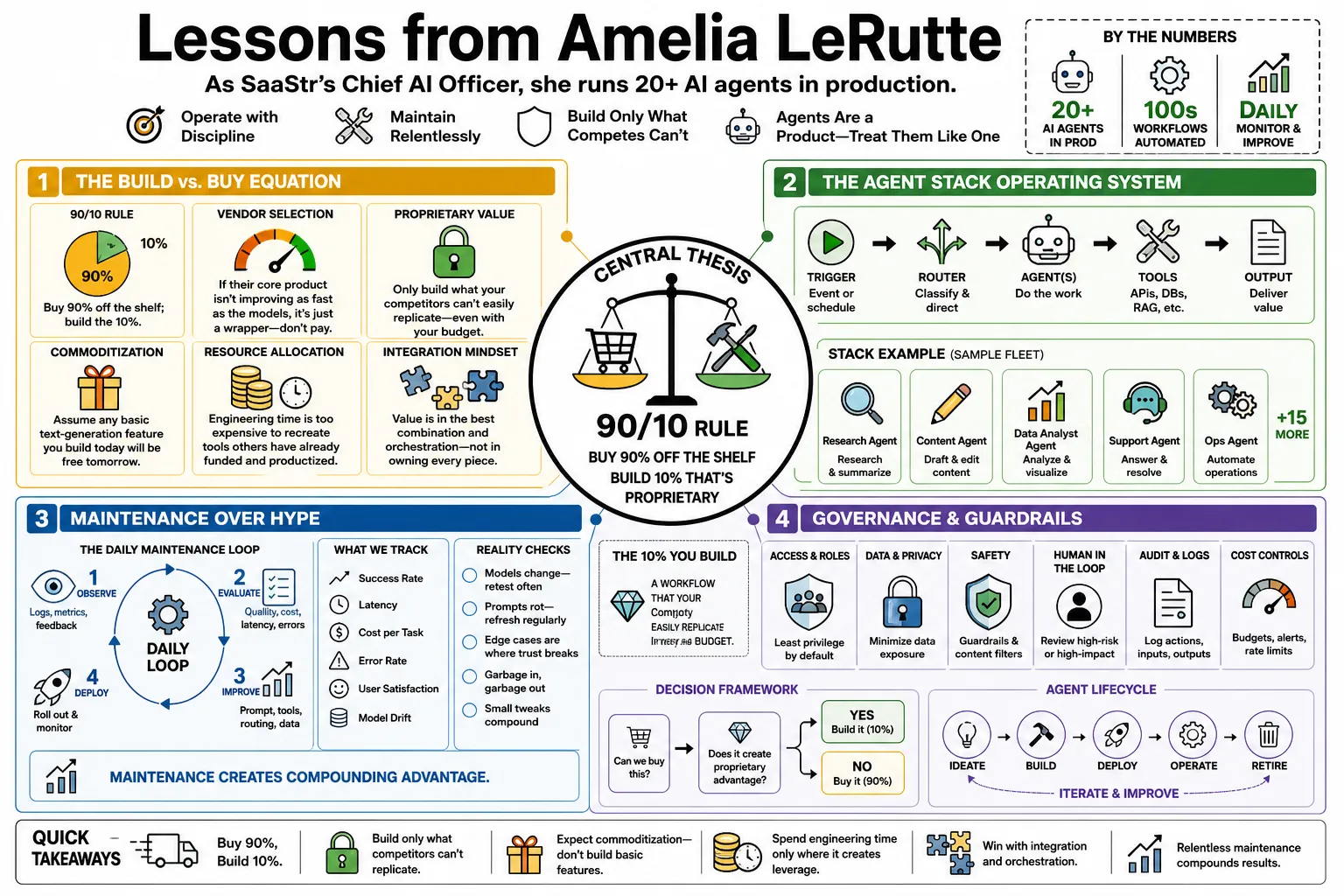
Lessons from Amelia LeRutte
As SaaStr’s Chief AI Officer, Amelia LeRutte manages a fleet of over 20 AI agents in production. This profile outlines her operating principles for building a working agent stack, prioritizing the unglamorous realities of daily maintenance over theoretical hype.
Part 1: The Build vs. Buy Equation
- On the 90/10 Rule: "Buy 90 percent of your AI solutions off the shelf and only build the 10 percent that gives you a proprietary advantage." — Source: [SaaStr Podcast 840]
- On Vendor Selection: "If a vendor's core product isn't improving at the same rate as the foundational models, they are just a wrapper you shouldn't be paying for." — Source: [SaaStr Annual 2026]
- On Proprietary Value: "The only thing worth building in-house is a workflow that your competitors cannot easily replicate even if they had your budget." — Source: [The Agents, Episode 1]
- On Commoditization: "Assume that any basic text-generation feature you build today will be given away for free by a major platform tomorrow." — Source: [SaaStr 828]
- On Resource Allocation: "Engineering time is too expensive to spend recreating tools that someone else has already productized and funded with venture capital." — Source: [SaaStr Podcast 840]
- On Integration: "The real value isn't in having the best standalone agent; it's in how well that agent reads and writes to your existing CRM." — Source: [The Agents, Episode 2]
- On Sunken Costs: "Do not get romantic about a custom tool you built six months ago if a SaaS company just released a better version for fifty dollars a month." — Source: [SaaStr 857]
- On Assessing Wrappers: "A good AI wrapper solves a specific workflow problem better than a blank ChatGPT prompt. A bad one just adds a logo to a prompt." — Source: [SaaStr Annual 2026]
- On Customization Limits: "Customizing an off-the-shelf model often yields diminishing returns compared to just feeding a standard model better context." — Source: [SaaStr Podcast 840]
- On Strategic Focus: "Your company's goal is to sell your product, not to become an AI research lab." — Source: [The Agents, Episode 1]
Part 2: The Reality of AI Maintenance
- On the Maintenance Gap: "Building the app is just the starting line. Maintaining the agents—dealing with outages and model regressions—is where the real work happens." — Source: [SaaStr 850]
- On Time Commitment: "People think AI runs on autopilot. I spend 15 to 20 hours a week just maintaining our AI SDR deployment." — Source: [SaaStr 857]
- On Model Drift: "An agent that works perfectly on Monday might start hallucinating by Friday because of an invisible update to the underlying model." — Source: [The Agents, Episode 1]
- On Monitoring: "You need a dashboard for your agents just like you need a dashboard for your server uptime. If you aren't looking, they are probably breaking." — Source: [SaaStr Podcast 840]
- On Regression Testing: "Every time you adjust a prompt to fix one edge case, you risk breaking three other workflows that were working fine." — Source: [SaaStr 864]
- On Silent Failures: "Agents rarely crash loudly. They fail silently by slowly degrading the quality of their output." — Source: [The Agents, Episode 2]
- On Human Oversight: "You cannot manage an agentic stack without human supervisors who understand what the output is actually supposed to look like." — Source: [SaaStr 850]
- On Tech Debt: "Prompt debt is real. If you have fifty different system prompts across your organization and no central repository, you are going to have a bad time." — Source: [SaaStr Annual 2026]
- On Incident Response: "When an agent goes off the rails, your first step isn't to rewrite the prompt. It's to figure out what garbage data it just ingested." — Source: [The Agents, Episode 1]
Part 3: Treating Agents as Teammates
- On Onboarding: "Treat your new AI agent like a new human employee. It needs onboarding, clear instructions, and access to the right internal documents." — Source: [SaaStr 864]
- On Feedback Loops: "You wouldn't let a junior SDR send 500 emails without reviewing the first ten. Do the same with your AI." — Source: [SaaStr Podcast 840]
- On Delegation: "An agent is not a software feature; it is a delegated task. Give it the autonomy it needs, but define the boundaries strictly." — Source: [The Agents, Episode 1]
- On Context Provision: "Agents fail because they lack context, just like humans do. If you give an agent a vague instruction, expect a vague result." — Source: [SaaStr 828]
- On Performance Reviews: "We audit our agents monthly. We look at their success rates, their error logs, and whether they are still serving the business goal." — Source: [SaaStr 857]
- On Organizational Structure: "Eventually, companies will have org charts that include both human and AI reports under the same manager." — Source: [SaaStr Annual 2026]
- On Troubleshooting: "When an agent underperforms, ask yourself if the instructions were bad before you blame the underlying model." — Source: [SaaStr 850]
- On Trust: "Trust is earned slowly with agents. Start them on low-stakes internal workflows before you let them talk to a customer." — Source: [SaaStr Podcast 840]
- On Firing Agents: "If an agent requires more time to manage than it saves, you have to be willing to turn it off." — Source: [The Agents, Episode 2]
- On Role Clarity: "Don't build a 'do-everything' agent. Build a 'VP of Marketing' agent, an 'SDR' agent, and an 'Analyst' agent." — Source: [SaaStr 864]
Part 4: Go-to-Market and Hyper-Personalization
- On Personalization at Scale: "The goal of AI in GTM is to deliver the level of personalization you'd give a million-dollar account to an account worth ten thousand." — Source: [SaaStr Podcast 840]
- On Signal Extraction: "Good GTM agents don't just write emails; they read the internet to find out why a specific company needs your product right now." — Source: [SaaStr 857]
- On Email Copy: "If your AI-generated email sounds like it was written by an AI, it will be deleted by an AI." — Source: [SaaStr Annual 2026]
- On Research: "The highest ROI of an AI SDR is not the sending of the message, but the ten minutes of account research it can do in two seconds." — Source: [The Agents, Episode 1]
- On Authenticity: "Hyper-personalization doesn't mean being creepy. It means being highly relevant to the prospect's immediate business pain." — Source: [SaaStr 828]
- On Multi-Channel: "Your agent shouldn't just live in the inbox. It needs to understand what the prospect is doing on LinkedIn and your website." — Source: [SaaStr 857]
- On Data Quality: "Hyper-personalization fails if your CRM data is garbage. The agent can only work with what it can see." — Source: [SaaStr 850]
- On A/B Testing: "Let the agents write their own subject lines and test them against each other. They will find patterns humans miss." — Source: [SaaStr 864]
- On Conversion Rates: "We don't measure agent success by volume of outreach. We measure it by positive reply rates and booked meetings." — Source: [SaaStr Podcast 840]
Part 5: The "No Lead Left Behind" Philosophy
- On Lead Coverage: "The simplest and most significant unlock of the agentic journey is contacting leads that humans otherwise wouldn't have time to call." — Source: [SaaStr 850]
- On Tier 3 Accounts: "Humans should focus on Tier 1 and Tier 2. Let the agents blanket Tier 3 and surface the ones that are ready to talk." — Source: [The Agents, Episode 1]
- On Speed to Lead: "An agent can respond to an inbound form fill in three seconds with a personalized answer. A human cannot physically do that." — Source: [SaaStr 857]
- On After-Hours: "Leads come in at 2 AM. If you rely solely on humans, you are making them wait until 9 AM to get a response." — Source: [SaaStr 840]
- On Follow-Up: "Humans give up after three emails. An agent will follow up indefinitely on a cadenced schedule until it gets a definitive answer." — Source: [SaaStr Annual 2026]
- On Qualification: "Use agents to disqualify bad leads early so your human reps only spend time on deals that can actually close." — Source: [SaaStr 864]
- On Nurturing: "A lead that says 'not right now' is a perfect candidate for an agent to passively nurture for the next twelve months." — Source: [SaaStr 828]
- On Consistency: "Agents don't have bad days. They deliver a consistent baseline experience to every single prospect." — Source: [The Agents, Episode 2]
- On Abandoned Carts: "In B2B, an abandoned trial is an abandoned cart. An agent should be immediately investigating why they stopped logging in." — Source: [SaaStr 857]
- On Scale: "The 'no lead left behind' model scales infinitely. If you get 10x the inbound traffic tomorrow, the agent handles it without breaking a sweat." — Source: [SaaStr 850]
Part 6: Navigating "Vibe-Coding" and Deployment
- On Vibe-Coding: "Vibe-coding is the reality of modern development. You are steering a model's output rather than writing deterministic logic." — Source: [The Agents, Episode 1]
- On Determinism vs. Probability: "Traditional software does exactly what you say. AI software does what it thinks you mean. That shift requires a completely different testing mindset." — Source: [SaaStr 840]
- On Prompt Engineering: "Prompt engineering is less about coding and more about clear, unambiguous communication." — Source: [SaaStr Annual 2026]
- On Iteration: "You don't write a prompt once. You write it, watch the agent fail, figure out why it misunderstood you, and rewrite it. Over and over." — Source: [SaaStr 864]
- On Guardrails: "The hardest part of vibe-coding is setting the negative constraints—telling the model exactly what it is not allowed to do under any circumstances." — Source: [SaaStr 850]
- On System Prompts: "Your system prompt is your agent's operating system. If it's a mess, the agent's behavior will be chaotic." — Source: [The Agents, Episode 2]
- On Temperature Settings: "Lower the temperature for tasks that require facts and logic. Raise it when you need the agent to draft creative copy." — Source: [SaaStr 857]
- On Edge Cases: "You cannot predict every edge case in an LLM. You have to build fallback mechanisms that catch the agent when it gets confused." — Source: [SaaStr 828]
- On Readability: "Keep your prompts readable. If a new engineer can't look at the prompt and understand what the agent is supposed to do, it's too complicated." — Source: [SaaStr 840]
Part 7: Scaling from 1 to 20+ Agents
- On Initial Deployment: "Start with one agent solving one specific, painful workflow. Do not try to launch ten agents at once." — Source: [SaaStr 840]
- On Tool Proliferation: "As you scale, the biggest risk is that your agents start creating silos because they don't talk to each other." — Source: [The Agents, Episode 1]
- On Orchestration: "When you hit five agents, you need an orchestration layer. They have to know who is responsible for what." — Source: [SaaStr 857]
- On Shared Memory: "Multiple agents need access to the same memory bank. If the SDR agent learns something, the Marketing agent needs to know it immediately." — Source: [SaaStr 864]
- On Process Mapping: "Before you build the second agent, map out the entire manual process on a whiteboard to see where the handoffs happen." — Source: [SaaStr Annual 2026]
- On Cost Management: "API costs scale aggressively. When you have twenty agents running constantly, you have to start tracking token usage like a hawk." — Source: [SaaStr 850]
- On Internal Adoption: "Getting the technology to work is 20% of the battle. Getting your human team to actually use and trust the 20 agents is the other 80%." — Source: [SaaStr 828]
- On Bottlenecks: "As you add more agents, the bottleneck shifts from task execution to human review. You have to automate the review process next." — Source: [The Agents, Episode 2]
- On ROI: "Our 20+ agent stack manages over 2 million sessions and drives $2M in revenue. The scale makes the maintenance effort worth it." — Source: [SaaStr 857]
Part 8: AI Leadership and the Future of Operations
- On the CAIO Role: "The Chief AI Officer is not a purely technical role. It is an operational role focused on translating capabilities into revenue." — Source: [SaaStr 864]
- On Table Stakes: "If you feel like your app has zero AI right now, that is where I would be worried. It is no longer optional." — Source: [SaaStr 828]
- On Change Management: "AI leadership requires managing fear. You have to prove to your team that the agents are there to make them faster, not to replace them." — Source: [The Agents, Episode 1]
- On Hiring: "We don't just look for AI engineers. We look for operators who understand the business problem and happen to know how to prompt an LLM." — Source: [SaaStr 850]
- On Competitive Advantage: "Your advantage isn't the model. Your advantage is your proprietary data and how quickly you can integrate the model into your workflows." — Source: [SaaStr Podcast 840]
- On Agility: "The AI landscape changes every three weeks. If your roadmap is locked in for the next twelve months, you are going to fall behind." — Source: [SaaStr Annual 2026]
- On Executive Alignment: "The CEO and the CAIO have to be perfectly aligned on which metrics the agents are supposed to move, or the project will stall." — Source: [SaaStr 857]
- On Continuous Learning: "If you aren't spending an hour a day reading about new agentic frameworks, your knowledge is already out of date." — Source: [The Agents, Episode 2]
- On the End Goal: "The ultimate goal is an organization where humans do the high-level strategic thinking, and the agents handle the execution silently in the background." — Source: [SaaStr 864]