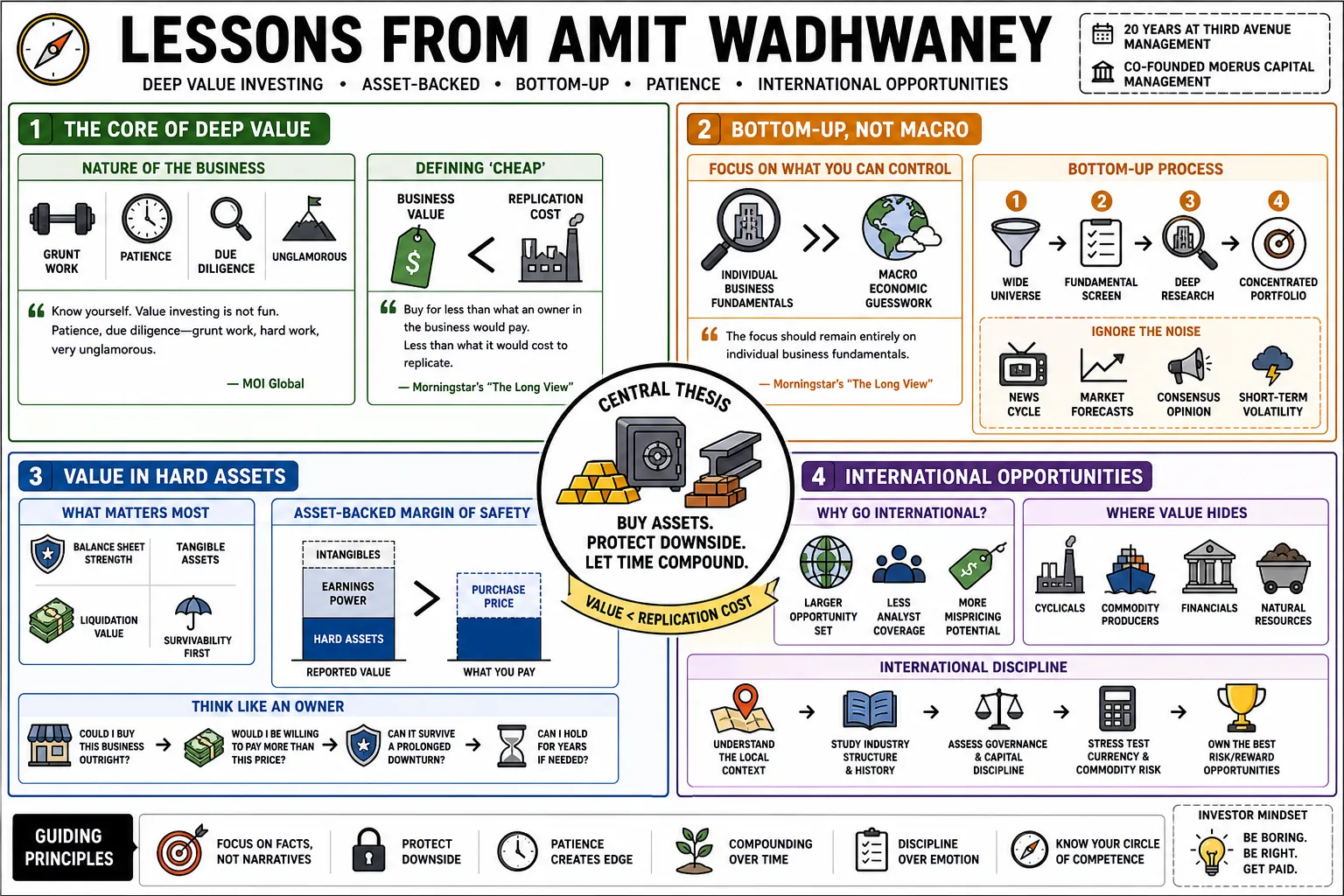
Lessons from Amit Wadhwaney
Amit Wadhwaney co-founded Moerus Capital Management after more than two decades at Third Avenue. His asset-based, global value approach emphasizes conservative estimates of what businesses own today and whether they can survive difficult periods. The lessons below distinguish his documented investing principles from unsupported or dated quotations. — Morningstar Long View Transcript.
Part 1: The Core of Deep Value
- Do the Unglamorous Work: Wadhwaney says overlooked situations often demand extra work and tolerance for career risk; that effort is part of the opportunity. — Fish the Ocean, Not the Pond.
- Define Cheap Against a Business Buyer: He compares a share price with what a knowledgeable operator might pay for, or spend to replicate, the underlying business. — Morningstar Long View Transcript.
- Build From Businesses, Not Macro Bets: Moerus describes its process as company-by-company research rather than a portfolio built around targeted macro exposures. — Trouble Is Opportunity.
- Look at Good Businesses After Mishaps: Wadhwaney describes strong businesses whose acquisitions or other missteps depress their share prices, then asks whether the damage can be repaired. — Morningstar Long View Transcript.
- Fish the Whole Ocean: Moerus seeks overlooked opportunities across geographies rather than limiting its search to one familiar market. — Fish the Ocean, Not the Pond.
- Allow Time for Value to Emerge: The firm says it is structured to wait through uncomfortable periods rather than require a quick market recognition of value. — Trouble Is Opportunity.
- Distinguish Transitory Trouble From Damage: Wadhwaney looks for discounted businesses that can survive a temporary rough patch, not businesses whose underlying value is permanently impaired. — Asset-Based Investing in an Earnings-Focused World.
- Search the Unfashionable Corners: His approach often turns to out-of-favor sectors and complex or overlooked companies where fewer buyers compete. — Fish the Ocean, Not the Pond.
Part 2: Defining Risk and Survivability
- Test Survivability First: Wadhwaney assesses a business model, capitalization and financing needs against possible adverse conditions before relying on long-term value. — Morningstar Long View Transcript.
- Separate Business Risk From Market Swings: Moerus distinguishes potential permanent impairment of the business from volatility in its quoted share price. — Trouble Is Opportunity.
- Seek a Cushion in the Price: The asset-based method aims to buy at a discount to conservative estimates of present net asset value; the cushion is an estimate, not a guaranteed floor. — Asset-Based Investing in an Earnings-Focused World.
- Favor Staying Power: A strong balance sheet is one of the attributes Wadhwaney looks for in companies that might endure adversity. — Fish the Ocean, Not the Pond.
- Use Volatility Selectively: Moerus views market-price volatility as a possible source of mispricing while trying to avoid permanent business impairment. — Trouble Is Opportunity.
- Name the Risk: Wadhwaney separates market, price and business risk; a cheap-looking share price alone does not resolve the last two. — Trouble Is Opportunity.
- Examine Financing Dependence: Wadhwaney asks whether a company can survive a closure of external funding and changing interest rates over a multi-year holding period. — Morningstar Long View Transcript.
- Reject Fragile Business Models: He says Moerus avoids businesses whose everyday operations require repeated access to external financing. — Morningstar Long View Transcript.
Part 3: Asset-Based Valuation
- Value What Exists Now: Rather than base value on an expected future scenario, Moerus emphasizes assets and business value it can estimate today. — Fish the Ocean, Not the Pond.
- Estimate Net Asset Value Conservatively: Its asset-based approach estimates present net asset value using conservative balance-sheet assumptions and seeks a discount to that estimate. — Fish the Ocean, Not the Pond.
- Limit Dependence on Long Forecasts: Wadhwaney says distant cash-flow projections are uncertain and therefore should not dominate the price paid. — Asset-Based Investing in an Earnings-Focused World.
- Assess Assets, Not Just Earnings: The firm asks what the assets of a business could fetch in an orderly arm’s-length transaction, instead of relying only on reported earnings. — Morningstar Long View Transcript.
- Compare Price With Replication Cost: Wadhwaney considers whether a cash buyer could replicate the business for more than the price embedded in the shares. — Morningstar Long View Transcript.
- See Past a Weak Earnings Snapshot: An earnings-focused market can overlook asset value when a company or industry faces a temporary rough patch. — Asset-Based Investing in an Earnings-Focused World.
- Build a Bedrock Estimate: Moerus describes a conservative present-asset valuation as a lower-bound estimate, while acknowledging that the cushion depends on its assumptions. — Asset-Based Investing in an Earnings-Focused World.
- Look for Unlockable Assets: Corporate reorganizations, asset sales or liquidations can reveal value not obvious in current earnings. — Asset-Based Investing in an Earnings-Focused World.
- Use Sale Value as an Anchor: Wadhwaney asks what the individual assets might sell for today in a normal transaction; this is not a prediction that the company will liquidate. — Morningstar Long View Transcript.
- Read the Balance Sheet Closely: The asset-based approach places greater weight on the balance sheet and present conditions than on distant earnings estimates. — Fish the Ocean, Not the Pond.
Part 4: Macro Awareness vs. Macro Forecasting
- Be Macro Aware, Not Macro Led: He does not base purchases on a macro forecast, but studies how current macro conditions affect the business under review. — Fish the Ocean, Not the Pond.
- Reduce Forecast Dependence: Wadhwaney says repeated macro forecasts are difficult to get right and can put capital at risk. — Morningstar Long View Transcript.
- Connect Macro Conditions to the Company: Moerus analyzes current macro influences on a company and its normalized operating environment rather than treating a GDP call as an investment thesis. — Fish the Ocean, Not the Pond.
- Choose Businesses That Can Endure: Wadhwaney tests whether capitalization and business economics can withstand adverse conditions over years of ownership. — Morningstar Long View Transcript.
- Consider Higher Funding Costs: He explicitly asks whether a business and its financing structure can survive materially higher interest rates. — Morningstar Long View Transcript.
- Test Political and Regulatory Exposure: Wadhwaney identifies changing regulation and country-specific intervention as risks to assess, not automatic reasons to buy a selloff. — Morningstar Long View Transcript.
Part 5: Navigating Global and Emerging Markets
- Study Markets Individually: Moerus searches across geographies but examines local laws, customs, accounting and business structures rather than treating every market alike. — Fish the Ocean, Not the Pond.
- Search Across Geographies: Moerus includes emerging and frontier markets in its search when a company meets its valuation and survivability standards. — Fish the Ocean, Not the Pond.
- Examine Emerging-Market Selloffs: Wadhwaney notes that growth disappointments and illiquidity can deepen share-price declines in emerging markets, occasionally creating asset-based opportunities. — Asset-Based Investing in an Earnings-Focused World.
- Study Local Structures: Foreign laws, customs, accounting and multi-tier holding companies are among the complexities Moerus says it researches rather than ignoring. — Fish the Ocean, Not the Pond.
- Remain Selective in Frontier Markets: Wadhwaney says asset-based bargains in emerging and frontier markets appear only sporadically, despite the firm’s broad geographic mandate. — Asset-Based Investing in an Earnings-Focused World.
- Avoid a Geography-Only Screen: Wadhwaney says attractive value pockets can exist even in markets whose aggregate valuations look expensive. — Morningstar Long View Transcript.
Part 6: Finding Opportunity in Trouble
- Treat Trouble as a Search Signal: His “trouble is opportunity” approach starts by examining neglected or challenged businesses, while still rejecting ones with lasting business risk. — Trouble Is Opportunity.
- Require the Trouble to Be Survivable: Wadhwaney prefers disruptions that can pass before they exhaust an otherwise viable company’s resources. — Morningstar Long View Transcript.
- Watch What Reorganization Can Unlock: He describes asset sales, spinoffs and buybacks as possible ways an underperforming business can realize value, not guaranteed catalysts. — Morningstar Long View Transcript.
- Separate a Commodity Business From a Commodity Bet: Wadhwaney’s oil-service examples turn on replacement cost, balance-sheet strength and industry structure, not a precise oil-price forecast. — Morningstar Long View Transcript.
- Go Where Others Decline to Look: Moerus argues that discomfort and career risk can leave out-of-favor companies under-researched. — Trouble Is Opportunity.
- Work Through Complexity: The firm searches underfollowed, complex and misunderstood businesses because fewer analysts may recognize their assets. — Asset-Based Investing in an Earnings-Focused World.
- Avoid the Broken Model: Wadhwaney distinguishes a viable business with temporary problems from one whose business model or financing needs create enduring risk. — Morningstar Long View Transcript.
Part 7: Patience and the Psychology of Investing
- Commit to a Longer Horizon: The firm says its investor base and structure let it judge performance over a full cycle, even when results are lumpy. — Trouble Is Opportunity.
- Resist the Herd: Wadhwaney argues that following the same popular holdings can limit the chance of buying materially mispriced securities. — Trouble Is Opportunity.
- Recheck the Thesis During Declines: In the Tidewater account, Wadhwaney says the team added after a steep decline because it still judged the business and balance sheet sound. — Morningstar Long View Transcript.
- Accept Unglamorous Research: Moerus says its approach often involves unpopular sectors and complex situations requiring work many investors avoid. — Fish the Ocean, Not the Pond.
- Base Conviction on Underwriting: Its willingness to hold through volatility depends on an analysis of lasting asset value and business survivability, not price action alone. — Trouble Is Opportunity.
- Do Not Chase Market Darlings: Wadhwaney worries that optimistic expectations already embedded in fashionable shares create price risk. — Trouble Is Opportunity.
- Seek a Margin in Both Price and Business: The firm combines a discount to present asset value with efforts to avoid financial and operational threats to that value. — Morningstar Long View Transcript.
- Hold Cash While Waiting for Price: The Moerus memo says patience can mean holding cash when attractive pricing is absent, then investing when a researched opportunity reaches a sufficiently modest price. — Asset-Based Investing in an Earnings-Focused World.
Part 8: Contrarian Independence and Portfolio Construction
- Accept Benchmark Difference: Moerus deliberately permits substantial tracking error because it builds holdings from individual opportunities rather than index weights. — Trouble Is Opportunity.
- Avoid Diversifying Into the Crowd: Wadhwaney argues that over-diversification can reflect a desire to avoid looking different; this does not imply diversification is unnecessary. — Trouble Is Opportunity.
- Let Business Value Drive Reassessment: The framework asks whether the estimated present asset value and business risk have changed; a broad market narrative alone is not its purchase thesis. — Fish the Ocean, Not the Pond.
- Prepare for Lumpy Returns: Moerus warns that value realization and returns may be uneven from year to year, even if the long-run thesis succeeds. — Trouble Is Opportunity.
- Tolerate Looking Different: Wadhwaney describes the career risk of holding unpopular ideas that can lag a benchmark while awaiting value realization. — Trouble Is Opportunity.
- Prioritize Avoiding Permanent Impairment: Moerus seeks to avoid lasting loss of business value even as it accepts temporary market-price swings. — Trouble Is Opportunity.
- Be Broad in Search, Conservative in Price: The documented philosophy combines an unrestricted geographic search with conservative asset valuation and a test of survivability. — Fish the Ocean, Not the Pond.