Amjad Masad is the co-founder and CEO of Replit. Raised in Jordan, he first built browser-based programming tools to make writing and sharing code easier. He now describes Replit’s mission as helping a billion people create software, including people who will never become specialist engineers. The lessons below separate his documented views from unverified quotations. — Product Hunt Interview.
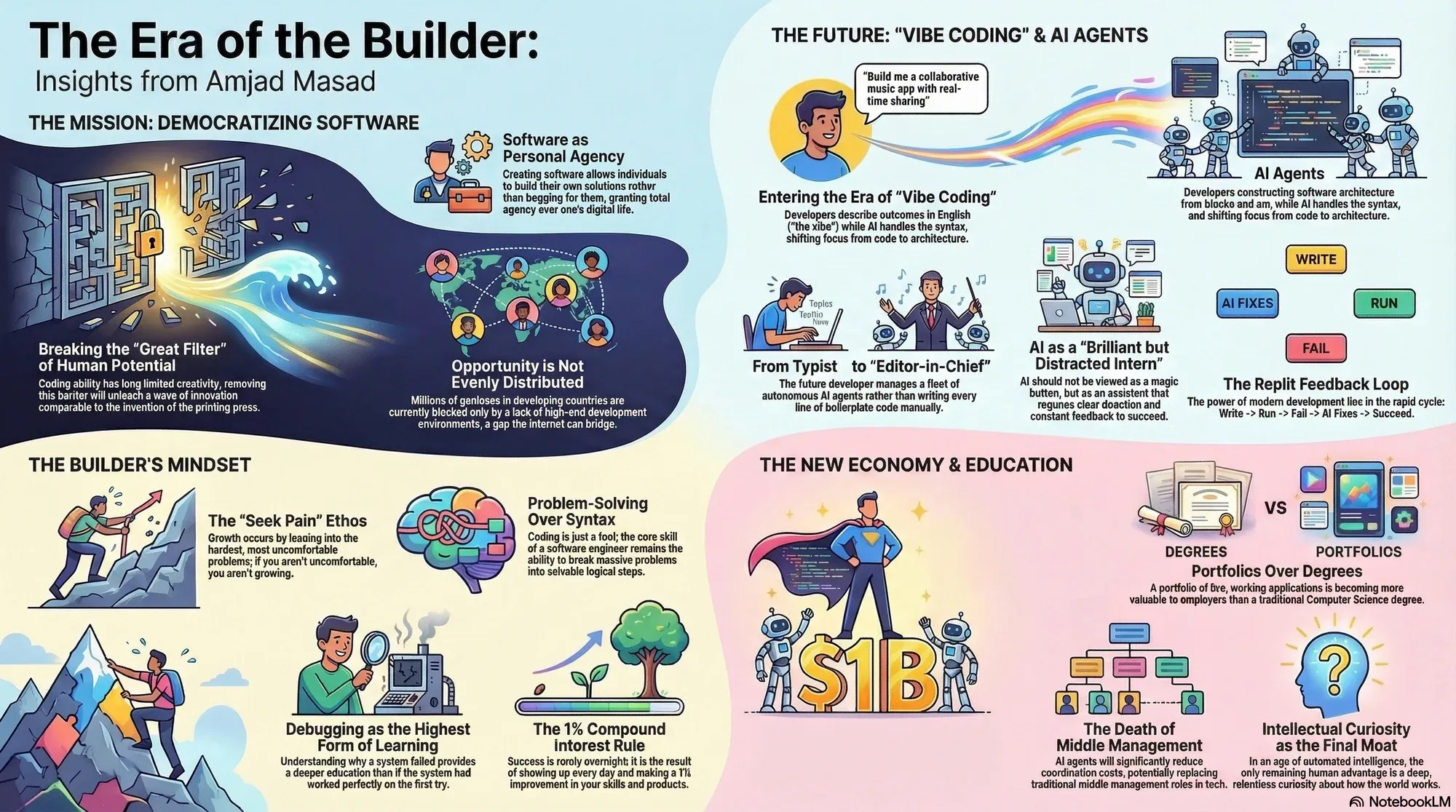
Part 1: The Mission to Democratize Software
- Expand Who Can Create Software: Masad frames easier programming as a way to let many more people make software, not merely to train more professional engineers. — Product Hunt Interview.
- Make Creation Approachable: He wants people to be able to describe the software they need and build it without first mastering a complex development environment. — Product Hunt Interview.
- Remove Setup Friction: Masad traces Replit to the repeated struggle of configuring environments, sharing code and collaborating during his computer-science studies. — First Round Interview.
- Give Talent Tools Beyond Its Location: After building in Jordan, Masad found that distribution through the web and access to startup infrastructure could make a decisive difference; he does not claim those are the only barriers. — First Round Interview.
- Build the Tool You Need: Masad describes people using Replit Agent to create bespoke personal or workplace applications when existing software does not fit. — Product Hunt Interview.
- Lower the Distance From Idea to App: Replit Agent combines natural-language requests with planning, coding, running and revision; this is a product direction, not a guarantee of instant profitable apps. — Product Hunt Interview.
- Let Early Access Shape Ambition: Masad says an early computer in his Jordanian home drew him into programming; he later set Replit the mission of enabling far more software creators. — Product Hunt Interview.
- Create Software Creators, Not Only Engineers: Masad distinguishes a broad group of people who can make useful software from specialists who study and engineer complex systems. — Product Hunt Interview.
- Serve Long-Tail Software Needs: He sees personal and last-mile business applications as work that generic software often fails to fit economically. — Product Hunt Interview.
Part 2: The Future of AI and "Vibe Coding"
- Describe the Result in Natural Language: Masad expects more people to express a software goal in natural language while agents handle more of the syntax and setup. — Possible Podcast.
- Abstract Accidental Complexity: Masad argues that AI can remove much of the tool and syntax overhead that distracts creators from the application they want to build; he gives no universal time split. — First Round Interview.
- Distinguish Creators From Specialists: Masad predicts that software creators may work more like product managers, while specialist engineers will still write and debug novel code. — Product Hunt Interview.
- Give Agents Feedback: Masad describes verification and feedback from the environment or a person as necessary to keep longer agent runs from drifting. — Possible Podcast.
- Describe Problems Precisely: He says successful AI-assisted building still requires breaking problems down, communicating clearly and understanding basic computing concepts. — Possible Podcast.
- Move From Assistance to Action: Masad describes software agents that can plan, use an editor, run code, test and revise an application rather than merely suggest completions. — Product Hunt Interview.
- Teach Making Alongside Coding: Masad says many application builders can start by making things with AI, while specialist engineers still benefit from computer-science study and direct coding. — Turing Post Interview.
- Close the Build-Test-Revise Loop: Masad describes an agent planning a project, making a prototype, testing an error hypothesis and revising the result through feedback. — Product Hunt Interview.
Part 3: Entrepreneurship and Building
- Correct the YC Rejection Story: Masad says Replit had three YC application rejections, then was accepted after its fourth application and interview; persistence mattered, but the old “rejected four times” number is wrong. — Replit YC Founding Account.
- Start With the Resources You Have: Masad and Haya began Replit from home with an initial $20,000 budget and tested ways to fund a freely available core product. — Replit YC Founding Account.
- Pair Domain Knowledge With AI Tools: Masad argues that specialized knowledge of a real workflow can become the basis for useful software when AI lowers development friction. — BigDeal Podcast.
- Find a Viable Model for the Mission: Masad says Replit could not rely indefinitely on venture funding; early API and classroom products earned money while the team searched for a scalable core model. — Replit YC Founding Account.
- Study Painful Workflows: Masad describes using software and AI to address routine, costly tasks that domain experts understand well, not a universal formula for billion-dollar ideas. — BigDeal Podcast.
Part 4: The Builder’s Mindset and Problem-Solving
- Keep Ideas From Dying in Setup: Masad originally built browser-based programming tools to remove the environment, sharing and collaboration friction he had encountered himself. — First Round Interview.
- Keep Computational Thinking: He says AI-era builders still need to break problems into parts and understand ideas such as databases, persistence and lists. — Possible Podcast.
- Plan Before Generating: Masad identifies planning, reasoning and feedback as core steps in building a working agent-generated application. — Product Hunt Interview.
- Learn by Tinkering: Masad recounts learning from making games and seeing how real users broke his first programs; he links those experiences to later product design. — Possible Podcast.
- Let Ideas Meet Execution: Masad argues that when AI can handle more implementation, people’s ability to identify worthwhile problems and describe solutions matters more. — Possible Podcast.
- Treat Errors as Feedback: In his description of agent development, an error leads to a hypothesis, a test and a fix; he does not call debugging the highest form of learning. — Product Hunt Interview.
- Communicate With the Machine Clearly: Masad says product managers often use AI building tools well because they can break down a problem and explain its parts. — Possible Podcast.
- Improve Through Repeated Work: Masad urges entrepreneurs to keep showing up, learning and improving incrementally, rather than relying on an overnight breakthrough. — BigDeal Podcast.
- Keep Problem-Solving Central: Masad distinguishes the goal of making an application from the mechanics of writing code; AI changes the route, not the need to understand the problem. — Turing Post Interview.
Part 5: Re-evaluating Education and the Rise of the Generalist
- Use AI to Broaden a Builder’s Range: Masad describes high-agency generalists using AI agents across several functions; he presents this as a direction, not proof one person can master every discipline. — Vanta Frameworks for Growth.
- Start Making, Then Decide What to Study: For many aspiring application builders, Masad recommends beginning with a project and learning code more deeply if the work calls for it; specialist engineering remains a separate path. — Turing Post Interview.
- Let AI Handle More Syntax: Masad argues that code is a means of programming and that agents can absorb more syntax work, while precision-critical engineering still needs specialists. — Turing Post Interview.
Part 6: Engineering Culture and Product Philosophy
- Seek Painful Feedback: Replit’s “Seek Pain” value asks people to face difficult feedback and decisions rather than defer them until the cost grows. — Vanta Frameworks for Growth.
- Look for High-Agency Misfits: Masad says some original thinkers are poorly rewarded by conventional institutions and that Replit values people who take initiative. — Vanta Frameworks for Growth.
- Make Setup Part of Accessibility: The original Replit prototype reduced the effort to run and share code in the browser; Masad saw that friction as a barrier to use. — First Round Interview.
- Recover the Joy of Making: Masad says programming tools became increasingly cumbersome and wanted Replit to preserve the creative feel he remembered from earlier tools. — Possible Podcast.
- Use Open Source as a Foundation: Masad describes Replit building a polished interface over standard open-source components and packages; the old universal claim about every contributor is not supported. — Possible Podcast.
- Listen to the Community: Masad credits cofounder Haya with learning directly how people used the product and says investment in a core user community strengthened Replit. — Vanta Frameworks for Growth.
- Share a Technical Direction: Masad says Replit published an AI manifesto to explain its approach to prospective employees and the community; that does not establish full roadmap or failure disclosure. — Vanta Frameworks for Growth.
- Rebuild Culture Through Work: After a layoff, Masad says Replit restored confidence by working toward wins, not merely staging culture events. — Vanta Frameworks for Growth.
Part 7: Personal Philosophy and the "Seek Pain" Ethos
- Choose Venture Scale for the Mission: Masad says building a venture-scale company is arduous and not the easiest path to wealth; he advises doing it for a mission and an ambition to build something large. — BigDeal Podcast.
- Give People More Complete Work: Masad criticizes highly atomized jobs and hopes agents can absorb routine process work so people can be more creative and entrepreneurial. — Possible Podcast.
- Argue for Constructive Uses of AI: Masad presents AI as a way to expand creative agency while acknowledging that people have real worries about jobs and social change. — Possible Podcast.
- Aim for a Billion Software Creators: Masad states Replit’s mission as empowering a billion people to create software, explicitly distinct from producing a billion specialist engineers. — Product Hunt Interview.
- Test Assumptions Instead of Defending Them: Masad says he tries to reason from basic assumptions, then confront what product and market evidence shows rather than convince himself weak fit is strong. — Vanta Frameworks for Growth.
Part 8: The Global Impact and Future Economy
- Extend Creation Beyond Tech Hubs: Masad expects easier software creation to support specialized businesses in many communities, rather than a single one-size-fits-all platform. — Possible Podcast.
- Solve a Particular Human Need: Masad’s examples emphasize software made for one family, business workflow or narrow customer problem, not generic applications for everyone. — Product Hunt Interview.
- Build Inside an Existing Job: Masad describes workers creating software to improve a company workflow even without becoming full-time startup founders. — Possible Podcast.
- Leave More Room for Creative Work: Masad hopes agents will take on routine, standardized tasks so people can work more entrepreneurially; he frames it as a possibility, not a guaranteed labor outcome. — Possible Podcast.
- Count Creators, Not Code Typists: His stated billion-person ambition is about people using software to make things, not a billion people writing code professionally. — Product Hunt Interview.