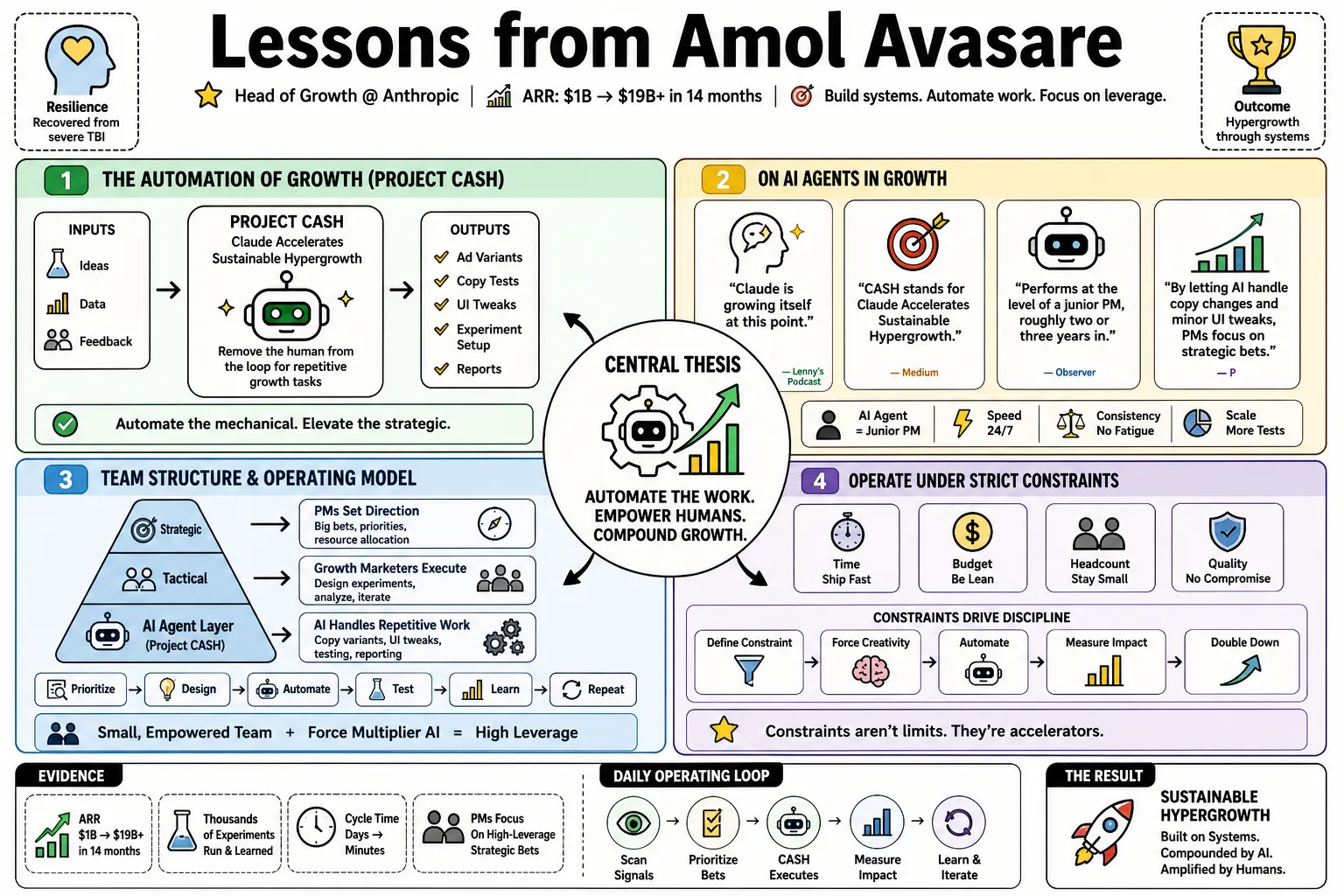
Lessons from Amol Avasare
Amol Avasare is the Head of Growth at Anthropic, where he led the team as the company's ARR scaled from $1 billion to over $19 billion in 14 months. He built Project CASH, an internal AI agent that automates growth experiments, and his approach to product management was shaped by his recovery from a severe traumatic brain injury. This profile breaks down his exact methods for automating work, structuring teams, and operating under strict constraints.
Part 1: The Automation of Growth (Project CASH)
- On AI agents in growth: "Claude is growing itself at this point. We use it to automate the mechanical aspects of growth experiments." — Lenny's Newsletter: How a Traumatic Brain Injury Made Amol Avasare a Better PM
- On the goal of CASH: "CASH stands for Claude Accelerates Sustainable Hypergrowth, and its purpose is to remove the human from the loop for repetitive growth tasks." — YouTube: Anthropic Head of Growth on Automating Hypergrowth
- On agent capability: "The current iteration of our internal growth agent performs at the level of a junior PM, roughly two or three years into their career." — YouTube: Amol Avasare on AI Prototyping and Growth Systems
- On unblocking PMs: "By letting AI handle copy changes and minor UI tweaks, growth teams are free to focus on strategic, high-leverage bets." — YouTube: Anthropic Head of Growth on Automating Hypergrowth
- On the experimentation loop: "We automated four stages: identifying opportunities, building features, testing for quality, and analyzing the final results." — Lenny's Newsletter: How a Traumatic Brain Injury Made Amol Avasare a Better PM
- On iterative vs. autonomous: "It’s not just about running tests faster; it’s about the system independently recognizing a drop-off and launching an experiment to fix it." — YouTube: Anthropic Head of Growth on Automating Hypergrowth
- On the future of growth teams: "As AI handles standard optimizations, the role of a growth PM shifts entirely toward deep user psychology and novel mechanics." — Lenny's Newsletter: How a Traumatic Brain Injury Made Amol Avasare a Better PM
- On AI memory: "Our internal agent has memory and tools, meaning it doesn't just run one test—it learns what failed last week and adjusts its next hypothesis." — YouTube: Anthropic Head of Growth on Automating Hypergrowth
- On scaling automation: "You start by automating the easiest variable—usually copy—and slowly give the agent permission to alter structural UI components." — YouTube: Amol Avasare on AI Prototyping and Growth Systems
Part 2: Rethinking Engineering and PM Ratios
- On shifting ratios: "Because AI makes engineers exponentially more productive, the traditional 1-to-8 PM-to-engineer ratio is breaking down." — Lenny's Newsletter: How a Traumatic Brain Injury Made Amol Avasare a Better PM
- On the new bottleneck: "When coding is no longer the rate-limiting step, deciding exactly what to build and why becomes the bottleneck, demanding more product management bandwidth." — Lenny's Newsletter: How a Traumatic Brain Injury Made Amol Avasare a Better PM
- On PM density: "We might start seeing teams with a higher concentration of PMs than engineers, simply because the output per engineer is so vastly amplified by AI." — YouTube: Amol Avasare on AI Prototyping and Growth Systems
- On the evolving engineer: "Engineers in an AI-assisted world act more like technical reviewers and architects rather than pure syntax writers." — YouTube: Anthropic Head of Growth on Automating Hypergrowth
- On product spec velocity: "If engineering can build a feature in two days instead of two weeks, the PM has to be ready with the next validated spec immediately." — YouTube: Anthropic Head of Growth on Automating Hypergrowth
- On scoping: "The cost of scoping incorrectly is lower in terms of engineering hours, but higher in terms of user experience degradation if you ship too much too fast." — Lenny's Newsletter: How a Traumatic Brain Injury Made Amol Avasare a Better PM
- On cross-functional flow: "Design and product must move at the new speed of engineering, or they become the anchor holding the ship back." — YouTube: Anthropic Head of Growth on Automating Hypergrowth
- On the definition of technical: "A 'technical PM' used to mean someone who understood the database schema; now it means someone who understands how to prompt and evaluate model outputs." — YouTube: Anthropic Head of Growth on Automating Hypergrowth
- On resource allocation: "You no longer hoard engineering weeks for a quarter; you deploy them dynamically as the model's capabilities update." — Lenny's Newsletter: How a Traumatic Brain Injury Made Amol Avasare a Better PM
Part 3: Scaling and Big Bets (The 70/30 Rule)
- On rapid scaling: "Going from $1 billion to $19 billion in ARR in 14 months forces you to abandon anything that doesn't scale non-linearly." — Lenny's Newsletter: How a Traumatic Brain Injury Made Amol Avasare a Better PM
- On the 70/30 split: "We index 70% toward big, structural bets and only 30% toward iterative, bread-and-butter growth optimizations." — YouTube: Amol Avasare on AI Prototyping and Growth Systems
- On avoiding local maxima: "If you spend all your time optimizing button colors, you might squeeze out a 2% gain, but you miss the 200% gain of a completely new user flow." — Lenny's Newsletter: How a Traumatic Brain Injury Made Amol Avasare a Better PM
- On taking swings: "Big bets require conviction. You can't A/B test your way into a paradigm shift; you have to build it and see if the market pulls." — YouTube: Anthropic Head of Growth on Automating Hypergrowth
- On defining a big bet: "A big bet fundamentally alters how the user perceives the product's value, not just how quickly they can click through a screen." — YouTube: Anthropic Head of Growth on Automating Hypergrowth
- On balancing the portfolio: "The 30% of iterative work pays the bills and keeps the metrics stable while the 70% is out looking for the next growth curve." — Lenny's Newsletter: How a Traumatic Brain Injury Made Amol Avasare a Better PM
- On hypergrowth reality: "In hypergrowth, the product you had six months ago is functionally obsolete. Your growth tactics must decay and refresh at the same rate." — YouTube: Amol Avasare on AI Prototyping and Growth Systems
- On resource starvation: "You deliberately starve the incremental ideas of resources to force the team to work on the uncomfortable, high-risk projects." — Lenny's Newsletter: How a Traumatic Brain Injury Made Amol Avasare a Better PM
- On metric horizons: "Big bets rarely show positive returns in the first 72 hours. You have to extend your measurement horizon to see the actual impact." — YouTube: Anthropic Head of Growth on Automating Hypergrowth
- On conviction vs. data: "Data tells you what is happening; conviction tells you what should happen next. Over-relying on data creates timid roadmaps." — YouTube: Anthropic Head of Growth on Automating Hypergrowth
Part 4: The Power of Intentional Friction
- On onboarding design: "Adding intentional friction—like multi-step quizzes—can actually improve downstream retention by filtering and educating the user." — YouTube: Anthropic Head of Growth on Automating Hypergrowth
- On user qualification: "Friction isn't always bad; sometimes it's the exact mechanism that helps a user understand why the product is right for them." — Lenny's Newsletter: How a Traumatic Brain Injury Made Amol Avasare a Better PM
- On the MasterClass experience: "At MasterClass, we learned that asking users questions about their goals before they watched a class made them more likely to stick around." — YouTube: Anthropic Head of Growth on Automating Hypergrowth
- On the Mercury approach: "For financial products like Mercury, friction in onboarding builds trust. A process that feels too easy can feel insecure." — YouTube: Anthropic Head of Growth on Automating Hypergrowth
- On cognitive investment: "When a user spends two minutes answering questions about their use case, they are psychologically committing to trying the solution." — Lenny's Newsletter: How a Traumatic Brain Injury Made Amol Avasare a Better PM
- On tailoring the experience: "The friction you introduce must be used to customize the subsequent experience. If you ask a question and don't use the answer, it's just an annoyance." — YouTube: Amol Avasare on AI Prototyping and Growth Systems
- On filtering out noise: "Sometimes you want lower conversion at the top of the funnel if it means a significantly higher activation rate for the users who make it through." — YouTube: Anthropic Head of Growth on Automating Hypergrowth
- On designing friction: "Friction must feel like progress. A progress bar, clear copy, and relevant questions make the delay feel valuable." — YouTube: Anthropic Head of Growth on Automating Hypergrowth
- On the paradox of choice: "Forcing a user to make a choice upfront removes the burden of figuring out where to start once they land in the app." — Lenny's Newsletter: How a Traumatic Brain Injury Made Amol Avasare a Better PM
Part 5: Solving the Activation Problem in AI
- On the cold start: "Activation is the single highest-leverage growth problem in the AI sector right now." — Lenny's Newsletter: How a Traumatic Brain Injury Made Amol Avasare a Better PM
- On the blank canvas: "Giving a user a blank text box and saying 'talk to the AI' is terrifying. You have to scaffold the interaction." — YouTube: Anthropic Head of Growth on Automating Hypergrowth
- On demonstrating value: "The user must experience a magic moment within the first 60 seconds, or they will assume the AI is just a gimmick." — YouTube: Amol Avasare on AI Prototyping and Growth Systems
- On template libraries: "Pre-written prompts and use-case templates are the training wheels that get a user to their first successful interaction." — YouTube: Anthropic Head of Growth on Automating Hypergrowth
- On educating the market: "Growth in AI isn't just about moving metrics; it's about fundamentally educating the market on what the technology can actually do." — Lenny's Newsletter: How a Traumatic Brain Injury Made Amol Avasare a Better PM
- On capability discovery: "Users often default to using AI for simple tasks like summarization. Activation means pushing them to discover its reasoning and synthesis capabilities." — YouTube: Anthropic Head of Growth on Automating Hypergrowth
- On iterative onboarding: "You don't teach them everything on day one. You teach them one skill, wait for them to master it, and then introduce the next." — YouTube: Anthropic Head of Growth on Automating Hypergrowth
- On measuring activation: "Activation in AI shouldn't just be that they sent one message. It should be that they achieved one meaningful output that saved them time." — Lenny's Newsletter: How a Traumatic Brain Injury Made Amol Avasare a Better PM
- On the chat interface: "The chat interface is intuitive, but it lacks affordances. We have to design UI elements that suggest what is possible without cluttering the screen." — YouTube: Amol Avasare on AI Prototyping and Growth Systems
Part 6: Freedom Through Constraints (The TBI Experience)
- On recovering from a TBI: "Being forced away from work for nine months due to a brain injury taught me that true prioritization only happens when you physically cannot do everything." — Lenny's Newsletter: How a Traumatic Brain Injury Made Amol Avasare a Better PM
- On ruthless prioritization: "It’s not prioritization unless it hurts. If you aren't feeling the pain of dropping a project, you are just reorganizing your to-do list." — Lenny's Newsletter: How a Traumatic Brain Injury Made Amol Avasare a Better PM
- On working less: "Limiting my daily work hours significantly forced me to identify the exact tasks that actually moved the needle, ignoring the rest." — Lenny's Newsletter: How a Traumatic Brain Injury Made Amol Avasare a Better PM
- On the danger of baseline capacity: "When you have infinite energy, you fill your time with low-leverage tasks just to feel productive." — Lenny's Newsletter: How a Traumatic Brain Injury Made Amol Avasare a Better PM
- On scheduling breaks: "I implemented Do Not Disturb blocks. Scheduled, screen-free time is mandatory for maintaining cognitive endurance." — Lenny's Newsletter: How a Traumatic Brain Injury Made Amol Avasare a Better PM
- On cognitive load: "You have a finite budget of decisions each day. Don't spend them on things that don't matter." — Lenny's Newsletter: How a Traumatic Brain Injury Made Amol Avasare a Better PM
- On accepting a new normal: "Resilience isn't about bouncing back to exactly who you were; it's about optimizing the person you are now." — Lenny's Newsletter: How a Traumatic Brain Injury Made Amol Avasare a Better PM
- On physical constraints: "No alcohol, no caffeine, and mandatory meditation weren't just recovery tactics; they became a framework for sustained high performance." — Lenny's Newsletter: How a Traumatic Brain Injury Made Amol Avasare a Better PM
- On empathy in management: "Experiencing invisible limitations made me infinitely more empathetic to the silent struggles of the people on my team." — Lenny's Newsletter: How a Traumatic Brain Injury Made Amol Avasare a Better PM
- On artificial constraints: "Even if you are fully healthy, imposing artificial time constraints on yourself will drastically improve your output quality." — Lenny's Newsletter: How a Traumatic Brain Injury Made Amol Avasare a Better PM
Part 7: Career Tactics & The Cold Email
- On creating opportunities: "I landed my job at Anthropic by cold-emailing Mike Krieger when there wasn't even a job listing posted." — Lenny's Newsletter: How a Traumatic Brain Injury Made Amol Avasare a Better PM
- On the anatomy of a cold email: "A successful cold email doesn't ask for a favor; it presents a well-researched thesis on a problem the company is actively facing." — YouTube: Anthropic Head of Growth on Automating Hypergrowth
- On bypassing the front door: "The standard application process is crowded. Direct, thoughtful outreach to a decision-maker proves your agency before you even interview." — YouTube: Amol Avasare on AI Prototyping and Growth Systems
- On showing value upfront: "Don't say you can do the job. Do a piece of the job in the email and send them the results." — YouTube: Anthropic Head of Growth on Automating Hypergrowth
- On timing: "You have to reach out when a company is hitting an inflection point. That's when they know they need help but haven't written the job description yet." — Lenny's Newsletter: How a Traumatic Brain Injury Made Amol Avasare a Better PM
- On rejection: "A non-response isn't a rejection; it's just a lack of timing. You have to be willing to send the email knowing it might vanish into the void." — YouTube: Anthropic Head of Growth on Automating Hypergrowth
- On founder mentality: "As a former founder, you learn that no one is coming to save you and no one is handing you an opportunity. You have to manufacture it." — YouTube: Amol Avasare on AI Prototyping and Growth Systems
- On building a narrative: "Your career shouldn't read like a list of titles; it should read like a progression of increasingly complex problems you've learned to solve." — YouTube: Anthropic Head of Growth on Automating Hypergrowth
- On leveraging past experience: "The lessons from MasterClass on consumer psychology and Mercury on B2B trust perfectly combined to tackle Anthropic's hybrid growth challenges." — Lenny's Newsletter: How a Traumatic Brain Injury Made Amol Avasare a Better PM
Part 8: Culture, Communication, and Focus
- On transparent culture: "Anthropic operates with open Slack notebook channels, which creates a culture of default transparency and ambient awareness." — Lenny's Newsletter: How a Traumatic Brain Injury Made Amol Avasare a Better PM
- On ambient awareness: "When you can read how other teams are solving problems in real-time, it breaks down silos without requiring unnecessary sync meetings." — YouTube: Amol Avasare on AI Prototyping and Growth Systems
- On writing over talking: "A culture that relies on written documents over verbal presentations scales much faster because the context is searchable and asynchronous." — YouTube: Anthropic Head of Growth on Automating Hypergrowth
- On minimizing meetings: "Meetings should be for debating decisions, not sharing status updates. Status updates belong in a text channel." — YouTube: Anthropic Head of Growth on Automating Hypergrowth
- On psychological safety: "Open channels only work if there is psychological safety. People must feel comfortable posting half-baked ideas without fear of harsh judgment." — Lenny's Newsletter: How a Traumatic Brain Injury Made Amol Avasare a Better PM
- On maintaining focus: "The biggest threat to a hypergrowth company isn't the competition; it's the temptation to chase every good idea instead of the one great idea." — YouTube: Amol Avasare on AI Prototyping and Growth Systems
- On the cost of context switching: "Every time you ask a team to context switch, you burn a percentage of their cognitive capacity. Guard their attention ruthlessly." — YouTube: Anthropic Head of Growth on Automating Hypergrowth
- On alignment: "True alignment doesn't mean everyone agrees; it means everyone understands the rationale behind the decision and commits to executing it." — Lenny's Newsletter: How a Traumatic Brain Injury Made Amol Avasare a Better PM
- On hiring for resilience: "In a startup, things break daily. You have to hire people who view broken processes as puzzles to solve, not as reasons to complain." — YouTube: Anthropic Head of Growth on Automating Hypergrowth
- On the end goal: "Growth isn't about hacking numbers. It's about connecting a genuinely useful technology with the people who need it most, as efficiently as possible." — Lenny's Newsletter: How a Traumatic Brain Injury Made Amol Avasare a Better PM