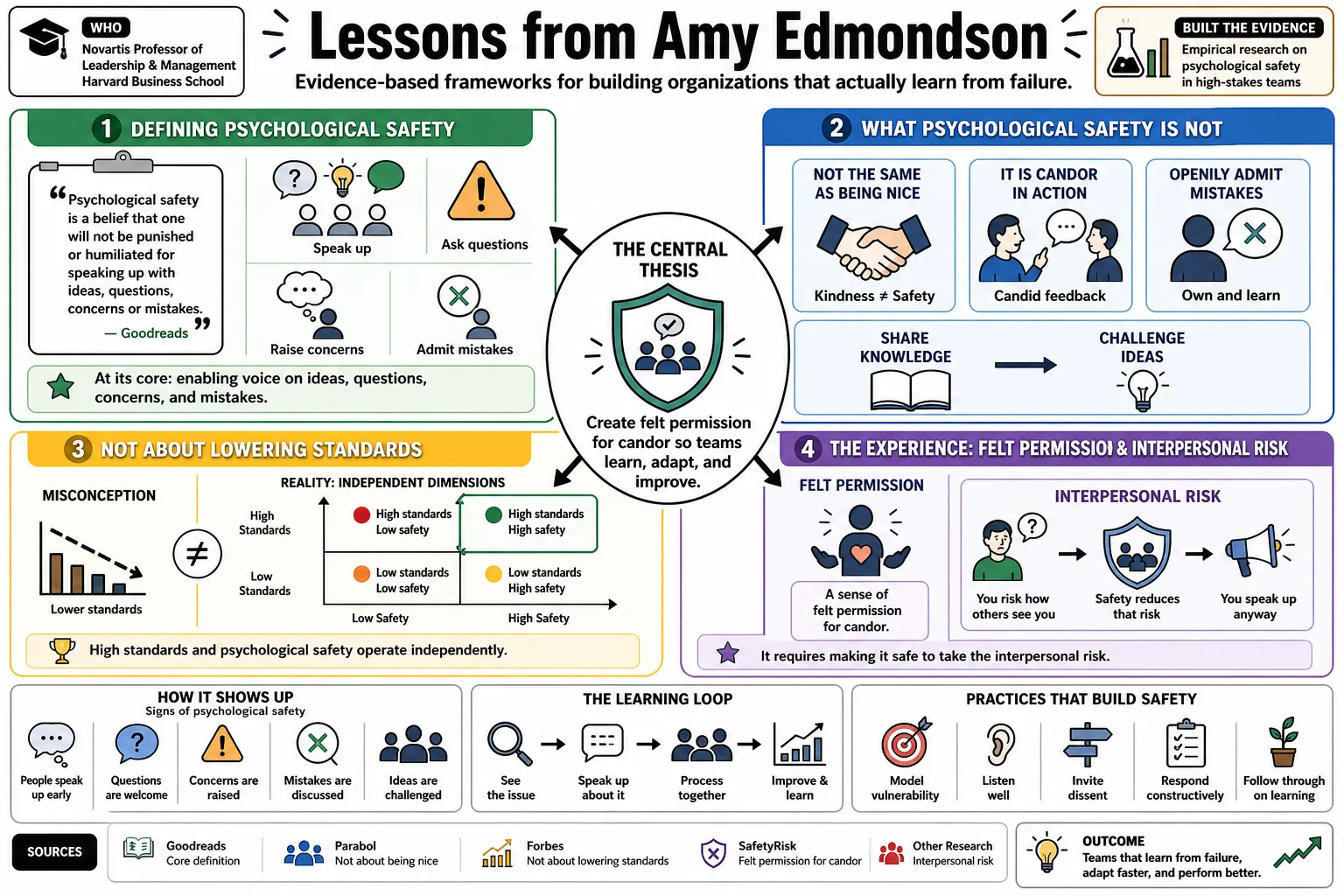
As the Novartis Professor of Leadership and Management at Harvard Business School, Amy Edmondson built the empirical foundation for psychological safety. Her research explains exactly what it takes for teams to admit errors and take interpersonal risks in high-stakes environments. Here are her frameworks for building organizations that actually learn from failure. — Harvard Business School — Amy Edmondson Research.
Part 1: Defining Psychological Safety
- On the core definition: Psychological safety is a belief that one will not be punished or humiliated for speaking up with ideas, questions, concerns or mistakes. — Harvard Business School — Psychological Safety.
- On what it is not: Psychological safety is not the same as being nice; it supports candid feedback, admitting mistakes, asking questions, and sharing knowledge. — Harvard Business School — Psychological Safety.
- On lowering standards: It is a misconception that psychological safety means lowering performance standards; the two dimensions operate independently of each other. — Harvard Business School — Psychological Safety.
- On felt permission: Psychological safety is best understood as a sense of felt permission for candor in the workplace. — Harvard Business School — Psychological Safety.
- On interpersonal risk: It requires making it safe to take the interpersonal risk of being honest, rather than defaulting to conflict avoidance. — Harvard Business School — Managing the Risk of Learning.
- On the goal: Psychological safety isn't the goal. Psychological safety is the means to the goal, and that goal is excellence. — Harvard Business School — Psychological Safety.
- On necessity: Psychological safety is not a 'nice-to-have.' It's essential to unleashing talent and creating value. — Harvard Business School — Psychological Safety.
- On trust vs. safety: While trust exists between individuals, psychological safety is a group-level phenomenon that describes the operating climate of an entire team. — Harvard Business School — Managing the Risk of Learning.
- On reporting errors: Edmondson’s early hospital research suggested that stronger teams did not necessarily make more errors; they were more willing to report them. — Harvard Business School — Psychological Safety.
- On shared expectations: Psychological safety is a group climate shaped by shared expectations about how others will respond when someone takes an interpersonal risk. — Harvard Business School — Psychological Safety.
Part 2: The Fearless Organization
- On the fearless norm: In a fearless organization, employees expect that their ideas and concerns will count rather than be punished or ignored. — Harvard Business School — Fostering Candor.
- On the Cassandra culture: Low levels of psychological safety can create a culture of silence. They can also create a Cassandra culture – an environment in which speaking up is belittled and warnings go unheeded. — Harvard Business School — Fostering Candor.
- On the VUCA environment: In volatile, uncertain, complex, and ambiguous work, employee voice becomes especially important for learning and adaptation. — Harvard Business School — Fostering Candor.
- On the combination of fear and standards: High standards in a context where there is uncertainty or interdependence (or both) combined with a lack of psychological safety comprise a recipe for suboptimal performance. — Harvard Business School — Fostering Candor.
- On the cost of silence: A culture of silence can push operational problems underground, making them harder to detect and manage. — Harvard Business School — Fostering Candor.
- On missing warnings: In many organizations, employees detect early warning signs of failure but choose not to escalate them because the culture implicitly punishes the messenger. — Harvard Business School — Fostering Candor.
- On the illusion of harmony: An absence of visible disagreement can reflect reluctance to speak candidly rather than genuine alignment. — Harvard Business School — Fostering Candor.
- On the mission's priority: Impression management should be in the back seat, not driving the car. The mission should be in charge. — Harvard Business School — Fostering Candor.
- On unleashing talent: Organizations are more likely to benefit from the talent they hire when people are not silenced by interpersonal fear. — Harvard Business School — Fostering Candor.
- On structural fear: Organizations have relied too heavily on fear and relentless execution; complex work requires conditions that support learning and candor. — Harvard Business School — Fostering Candor.
Part 3: The Mechanics of Teaming
- On teaming as a verb: Teaming is teamwork on the fly: a pickup basketball game rather than plays run by a team that has trained as a unit for years. — Harvard Business School — Building High-Performing Teams.
- On shifting structures: Teaming requires active collaboration and coordination to get things done without the luxury of stable membership. — Harvard Business School — Building High-Performing Teams.
- On crossing boundaries: Teaming is the art of communicating and coordinating with people across boundaries of all kinds—expertise, status, and distance. — Harvard Business School — Teaming in the Twenty-First Century.
- On execution versus ideas: Complex knowledge work depends on generating useful ideas and coordinating across expertise to put them into practice. — Harvard Business School — Teaming in the Twenty-First Century.
- On the three mindsets: Effective teaming requires an underlying software of three mindsets: curiosity, passion, and empathy. — Harvard Business School — Teaming in the Twenty-First Century.
- On managing the unknown: Because teaming is more chaotic than traditional teamwork, it must start with an embrace of the unknown and an aggressive commitment to learning. — Harvard Business School — Building High-Performing Teams.
- On extreme teaming: The 2010 Chilean mine rescue serves as a prime example of extreme teaming, where strangers from disparate industries experimented on the fly to solve an unprecedented crisis. — Harvard Business School — Chilean Mine Rescue.
- On empathy under pressure: In cross-boundary teaming, empathy helps collaborators understand unfamiliar perspectives and coordinate under pressure. — Harvard Business School — Teaming in the Twenty-First Century.
- On fluid expertise: Teaming helps organizations bring together the relevant expertise as new problems emerge. — Harvard Business School — Teaming in the Twenty-First Century.
- On structural interdependence: While a team is defined by static interdependence toward a shared outcome, teaming requires that interdependence to be managed dynamically in real time. — Harvard Business School — Building High-Performing Teams.
Part 4: The Intelligent Failure Framework
- On separating failure types: We used to think of failure as the opposite of success... The trouble is that both approaches lack the crucial distinctions to help us separate good failure from bad. — Harvard Business School — Framing Failure.
- On intelligent failures: Intelligent failures are the only type genuinely worth celebrating. — Harvard Business School — Framing Failure.
- On uncharted territory: An intelligent failure must occur in new territory, where there is no existing playbook or proven blueprint to follow. — Harvard Business School — Framing Failure.
- On meaningful goals: For a failure to be categorized as intelligent, it must be in pursuit of a valued objective rather than resulting from random experimentation. — Harvard Business School — Framing Failure.
- On hypothesis testing: An intelligent failure is hypothesis-driven, deliberately informed by the best available knowledge indicating that the approach might work. — Harvard Business School — Framing Failure.
- On scaling risk: Intelligent failures must be as small as possible, ensuring the test provides the necessary information while restricting waste and harm. — Harvard Business School — Framing Failure.
- On journeying: Entering genuinely new territory makes some well-designed failures unavoidable. — Harvard Business School — Framing Failure.
- On binary cultures: Organizations must move past the binary dilemma of avoiding failure at all costs versus failing fast, and instead build systems to fail well. — Harvard Business School — Framing Failure.
- On calculated risk: Carefully bounded experiments in new territory are a necessary route to learning and innovation. — Harvard Business School — Framing Failure.
- On The necessity of intelligent failure: Failing well does not mean accepting preventable mistakes; it means increasing small, informed experiments whose learning value outweighs their downside. — Harvard Business School — Framing Failure.
- On Thinking about failure with nuance: Progress requires a more nuanced view of failure that distinguishes preventable errors from informative experiments in new territory. — Harvard Business School — Framing Failure.
- On Elite failure practitioners: Scientists and inventors make progress by testing informed hypotheses and learning from well-designed experiments that fail. — Harvard Business School — Framing Failure.
Part 5: Mistakes, Errors, and Blame
- On the failure spectrum: Treating basic errors the same as complex systemic failures actively inhibits an organization's ability to learn. — Harvard Business School — Failure Types.
- On the definition of a mistake: A mistake is an unintended deviation from a known standard, whereas a failure is simply an undesired outcome. — Harvard Business School — Failure Types.
- On hiding errors: When people do not feel safe reporting failures, the problems do not disappear; they are more likely to remain hidden. — Harvard Business School — Learning from Failure.
- On basic failures: Preventable errors in known territory are basic failures, usually caused by slips, lapses, or ignoring established protocols. — Harvard Business School — Failure Types.
- On complex failures: Complex failures are perfect storm events where multiple small factors align to create a systemic breakdown. — Harvard Business School — Failure Types.
- On curiosity over shame: To extract value from failure, individuals must replace the blame game with curiosity, analyzing what actually happened versus what was expected. — Harvard Business School — Learning from Failure.
- On human error: Mistakes are inevitable; the important organizational question is whether people can detect, report, correct, and learn from them. — Harvard Business School — Learning from Failure.
- On the recovery window: Early warning signs can create an opportunity to interrupt a complex failure before multiple contributing factors align. — Harvard Business School — Failure Types.
- On investigating gaps: The healthiest response to a failure requires asking three questions: What did I hope would happen? What happened instead? What explains the difference? — Harvard Business School — Failure Types.
Part 6: Leadership in Complex Systems
- On the core of leadership: Leadership at its core is about harnessing others' efforts to achieve something no one can achieve alone. — Harvard Business School — Fostering Candor.
- On shifting focus: Under these conditions, a leader’s emphasis has to shift from composing and managing teams to inspiring and enabling teams. — Harvard Business School — Fostering Candor.
- On driving out fear: Today's leaders must be willing to take on the job of driving fear out of the organization to create the conditions for learning, innovation, and growth. — Harvard Business School — Fostering Candor.
- On vulnerability: Leaders who embrace vulnerability and acknowledge their limitations create an environment where team members feel more secure in voicing their ideas and concerns. — Harvard Business School — Fostering Candor.
- On modeling curiosity: Leaders must model curiosity by actively asking questions, signaling to the broader team that inquiry holds more value than absolute certainty. — Harvard Business School — Fostering Candor.
- On framing work: It is the leader's specific responsibility to frame daily work as a learning problem rather than a pure execution problem. — Harvard Business School — Fostering Candor.
- On acknowledging fallibility: When a leader proactively acknowledges their own fallibility, it dramatically lowers the threshold for employees to speak up. — Harvard Business School — Fostering Candor.
- On creating conditions: If leaders want to unleash individual and collective talent, they must foster a psychologically safe climate where employees feel free to contribute ideas. — Harvard Business School — Fostering Candor.
- On talent realization: Hiring experts is not enough; leaders also need a climate where people can contribute what they know. — Harvard Business School — Fostering Candor.
Part 7: Overcoming the Culture of Silence
- On knowledge flow: For knowledge work to flourish, the workplace must be one where people feel able to share their knowledge! This means sharing concerns, questions, mistakes, and half-formed ideas. — Harvard Business School — Fostering Candor.
- On the prevalence of silence: Employees often withhold important concerns because speaking up can feel personally risky, even when the issue matters to the organization. — Harvard Business School — Fostering Candor.
- On anyone's voice: In rapidly changing environments, useful information or a mission-critical warning can come from anyone. — Harvard Business School — Fostering Candor.
- On being wrong: Finding out that you are wrong is even more valuable than being right, because you are learning. — Harvard Business School — Fostering Candor.
- On half-formed ideas: Innovation stalls when people wait for an idea to be perfect; a healthy culture demands the sharing of half-formed ideas without judgment. — Harvard Business School — Fostering Candor.
- On overcoming impression management: The natural human instinct to look good to others must be intentionally overridden by a culture that rewards raw honesty over flawless perception. — Harvard Business School — Fostering Candor.
- On the illusion of safety: A manager stating their door is always open does not equate to employees feeling it is safe to walk through it with bad news. — Harvard Business School — Fostering Candor.
- On localized safety: Psychological safety can vary substantially across work groups because local leaders shape how people expect candor to be received. — Harvard Business School — Fostering Candor.
- On candid debates: Organizations that successfully break the culture of silence engage in rigorous, unvarnished debates about the work itself. — Harvard Business School — Fostering Candor.
Part 8: The Interpersonal Risks of Knowledge Work
- On the four fears: Employees constantly manage four specific interpersonal risks in the workplace: looking ignorant, looking incompetent, looking intrusive, and looking negative. — Harvard Business School — Managing the Risk of Learning.
- On avoiding ignorance: Avoiding the appearance of ignorance can keep people from asking necessary questions, depriving the organization of clarification. — Harvard Business School — Managing the Risk of Learning.
- On avoiding incompetence: Avoiding the appearance of incompetence can keep people from admitting mistakes or weaknesses, allowing problems to persist. — Harvard Business School — Managing the Risk of Learning.
- On avoiding disruptiveness: Avoiding the appearance of being disruptive can keep people from offering suggestions and challenging the status quo. — Harvard Business School — Managing the Risk of Learning.
- On asymmetric risk: The risk of speaking up is immediate and personal to the employee, while the benefit of speaking up is delayed and organizational, creating a natural barrier to candor. — Harvard Business School — Managing the Risk of Learning.
- On discounting the future: When individuals face interpersonal risk, they instinctively prioritize their present comfort over the organization's long-term success. — Harvard Business School — Managing the Risk of Learning.
- On the currency of modern work: Knowledge work depends on people contributing ideas, questions, concerns, and expertise despite interpersonal risk. — Harvard Business School — Managing the Risk of Learning.
- On invisible losses: Unasked questions, unshared ideas, and unvoiced warnings deprive organizations of information they need to learn. — Harvard Business School — Managing the Risk of Learning.
- On the ultimate goal: Reducing interpersonal fear makes productive disagreement possible in service of the work and the mission. — Harvard Business School — Managing the Risk of Learning.