A leading voice in futurism and strategic foresight, Amy Webb is the founder and CEO of the Future Today Strategy Group and an adjunct professor at NYU Stern School of Business. Her work offers critical insights into navigating our complex and rapidly evolving technological landscape, providing a roadmap for understanding emerging trends, the profound implications of artificial intelligence, and the strategic imperatives for leaders in all sectors. — Future Today Strategy Group: Tech Convergence Outlook.
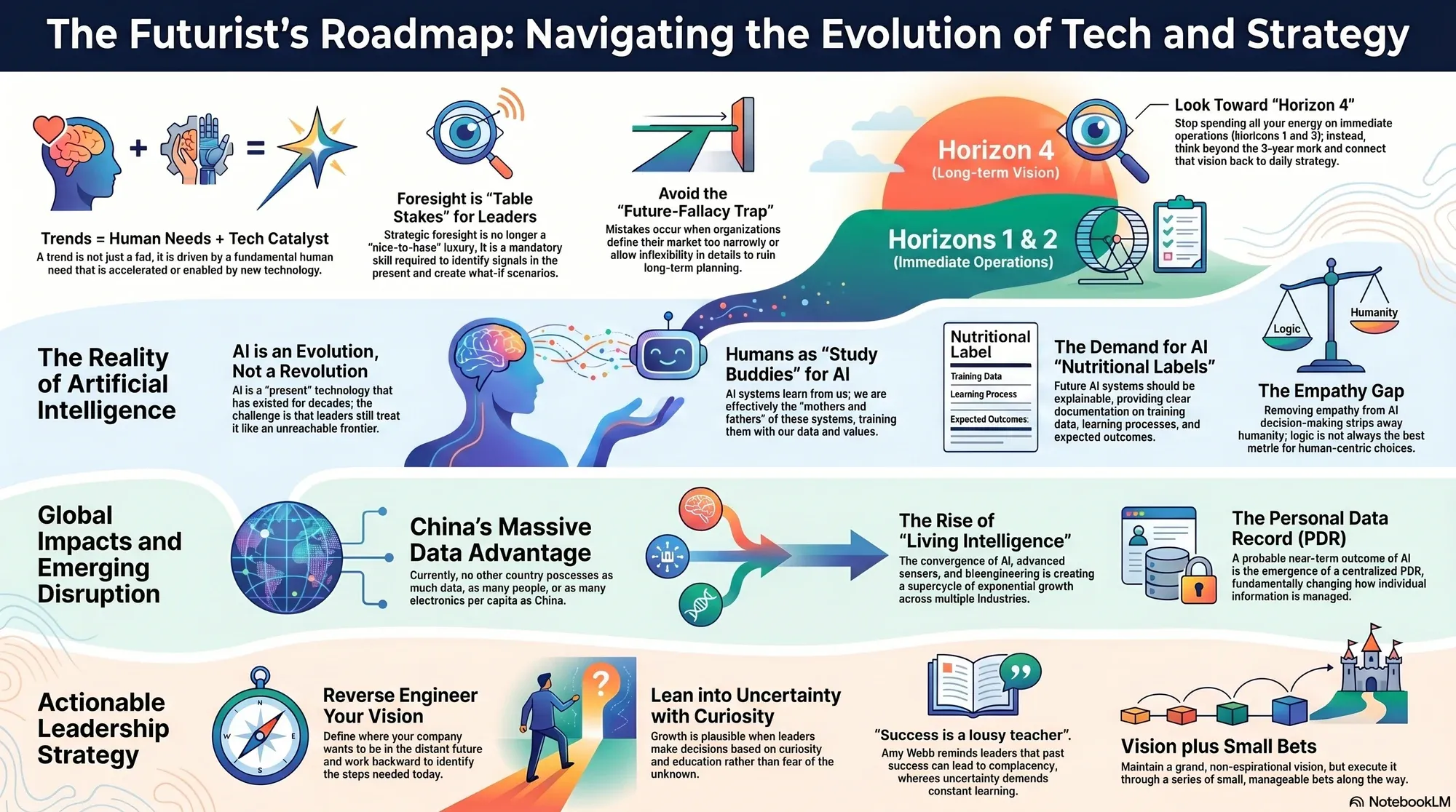
On Strategic Foresight and Thinking Like a Futurist
The foundation of Webb's work is the principle that the future is not something to be passively awaited but actively shaped through disciplined foresight. — Harvard Business Review: How to Do Strategic Planning Like a Futurist.
- Strategic Foresight vs. Prediction: Futurists do not predict the future; their discipline uses present signals to identify emerging trends and build plausible what-if scenarios that inform strategic action. — Microsoft WorkLab: Futurist Amy Webb on Plausible AI Outcomes.
- Catalyzed Human Needs: A genuine trend is always anchored in a fundamental human need that is catalyzed and accelerated by emerging technology, distinguishing enduring shifts from ephemeral hype. — Harvard Business Review: How to Do Strategic Planning Like a Futurist.
- Interpreting Weak Signals: Listening to and interpreting weak signals at the periphery is a systematic, learnable capability that any organization can master through disciplined observation. — Harvard Business Review: How to Do Strategic Planning Like a Futurist.
- First-Mover Influence: Organizations that identify technological trends early gain first-mover influence, allowing them to shape the rules and standards of emerging markets rather than reacting to disruption. — Harvard Business Review: How to Do Strategic Planning Like a Futurist.
- Escaping Narrow Paradigm Traps: Strategic forecasting fails when leadership defines its problem space too narrowly using legacy market research categories, blinding the organization to cross-industry threats. — Harvard Business Review: How to Do Strategic Planning Like a Futurist.
- The Future-Fallacy Trap: The future-fallacy trap occurs when rigid assumptions about operational details cause executive planning to fail as soon as external conditions deviate from expectations. — Harvard Business Review: How to Do Strategic Planning Like a Futurist.
- Separating Strategy from Tactics: Organizations frequently conflate tactical maneuvers and aspirational vision with strategy; genuine strategic planning requires modeling uncertainties beyond a three-year horizon. — Harvard Business Review: How to Do Strategic Planning Like a Futurist.
- Goals vs. Strategic Vision: Annual performance targets and quarterly milestones are operational goals, not a strategic vision; leaders must evaluate what enabling capabilities unlock long-term resilience. — Harvard Business Review: How to Do Strategic Planning Like a Futurist.
- Foresight as Executive Table Stakes: Strategic foresight is no longer an optional luxury for specialized think tanks; it is table stakes for every executive navigating volatile technological landscapes. — Big Think: Futurist Amy Webb on Why We Need to Stop Fearing the Future.
- Multi-Technology Convergence: The future is rarely determined by a single isolated technology, but by the convergence of multiple disciplines—such as AI, advanced sensors, and biotechnology—colliding simultaneously. — Future Today Strategy Group: Tech Convergence Outlook.
- Connecting Long-Term Horizons to Present Operations: Leaders must move beyond near-term operational horizons (Horizons 1 and 2) and actively connect fourth-horizon possibilities to day-to-day capital allocation. — Oslo Business Forum: The Futures of Artificial Intelligence.
- Convergence Risk Modeling: Rather than evaluating technologies in isolation, systemic risk analysis requires understanding how adjacent trends intersect like colliding weather systems. — SXSW: Amy Webb and the End of the Trend Report.
On Artificial Intelligence: Its Present and Future
Webb is a crucial voice in the discourse on AI, demystifying its function while highlighting the immense power and responsibility held by those who build it. — Convergence: AI Leaders and The Big Nine Retrospective.
- The Convenience Bargain: Society has struck an asymmetric bargain with algorithmic platforms, trading personal autonomy and privacy for immediate convenience and operational efficiency. — Convergence: AI Leaders and The Big Nine Retrospective.
- Human Accountability in AI Training: Because AI architectures learn directly from human data, biases, and behavior, their creators and users remain fundamentally responsible for the outputs these systems generate. — Big Think: Futurist Amy Webb on Why We Need to Stop Fearing the Future.
- The Concentration of Algorithmic Power: The development of artificial intelligence is concentrated among a handful of tech titans (the "Big Nine") that are building the foundational infrastructure for global cognition. — Convergence: AI Leaders and The Big Nine Retrospective.
- Preserving Empathy in Automated Systems: Removing empathetic human judgment from decision-making pipelines risks codifying cold optimization metrics that disregard human consequences. — Convergence: AI Leaders and The Big Nine Retrospective.
- Commercial Incentives vs. Public Good: While many advocate for AI that serves the public good, current market dynamics heavily prioritize commercial monetisation and rapid deployment over long-term societal safety. — Convergence: AI Leaders and The Big Nine Retrospective.
- Dynamic Governance Over Static Rules: AI systems cannot be governed by a static list of immutable commandments; oversight frameworks must evolve dynamically alongside capabilities and sociotechnical realities. — Convergence: AI Leaders and The Big Nine Retrospective.
- Encoding Values into Code: Building artificial intelligence inherently requires predicting future values; developers inadvertently bake contemporary cultural assumptions and corporate incentives into algorithms. — Convergence: AI Leaders and The Big Nine Retrospective.
- The Right to Interrogate Algorithms: Citizens and organizations currently lack the legal and technical right to interrogate black-box algorithms, creating an accountability vacuum in consequential life decisions. — Convergence: AI Leaders and The Big Nine Retrospective.
- Evolutionary Progression of AI: Artificial intelligence is an evolutionary technology built on decades of statistical methods, not an ungrounded sudden revolution that arrived overnight. — Oslo Business Forum: The Futures of Artificial Intelligence.
- AI as Operational Reality: Treating AI as a distant science-fiction concept blinds organizations to the fact that algorithmic systems already underpin current logistics, finance, and consumer platforms. — Microsoft WorkLab: Futurist Amy Webb on Plausible AI Outcomes.
- Task Reconfiguration vs. Total Job Elimination: While sensational forecasts predict massive job elimination, AI's primary near-term impact is the reconfiguration of discrete workflows, requiring proactive worker adaptation. — Microsoft WorkLab: Futurist Amy Webb on Plausible AI Outcomes.
- Active Co-Creation of the Future: A desirable technological future will not arrive automatically; leaders and citizens must actively deliberate on boundaries, incentives, and ethical guardrails today. — Convergence: AI Leaders and The Big Nine Retrospective.
- Independent Verification and Safety: High-stakes AI systems must undergo independent third-party audits and rigorous adversarial testing to verify security and reliability before widespread deployment. — Convergence: AI Leaders and The Big Nine Retrospective.
- Nutritional Labels for Algorithms: AI models should carry standardized, transparent nutritional labels documenting their training datasets, fine-tuning methodologies, and performance boundaries. — Convergence: AI Leaders and The Big Nine Retrospective.
- The Agent-First Internet: The architecture of the internet is being redesigned not for direct human navigation, but for autonomous AI agents that transact, synthesize data, and execute tasks on our behalf. — SXSW: Amy Webb and the End of the Trend Report.
On Technology, Society, and Geopolitics
Webb extends her analysis beyond corporate strategy to the societal and geopolitical ramifications of technological advancement, with a particular focus on the U.S. and China. — Convergence: AI Leaders and The Big Nine Retrospective.
- The Data Advantage in Global AI: National AI competitiveness is heavily determined by data volume and centralized access; China's unified data ecosystem creates structural advantages in model training. — Convergence: AI Leaders and The Big Nine Retrospective.
- Long-Term Geopolitical Planning: While Western economies often focus on quarterly corporate earnings, competitors like China execute multi-decade national development plans for artificial intelligence. — Convergence: AI Leaders and The Big Nine Retrospective.
- The Personal Data Record: The proliferation of ambient sensors and AI assistants leads toward a consolidated Personal Data Record that tracks biometric, behavioral, and financial history across life. — Convergence: AI Leaders and The Big Nine Retrospective.
- Human Intent as the Greatest Threat: The primary existential risk of advanced technology is not rogue autonomous machines, but the shortsighted, reckless, or malicious ways humans deploy and incentivize them. — Convergence: AI Leaders and The Big Nine Retrospective.
- Reinventing the Business Model of Information: Traditional journalism and public information architectures require radical business model redesign as algorithmic synthesis breaks standard advertising and subscription funnels. — Convergence: AI Leaders and The Big Nine Retrospective.
- Living Intelligence and Industrial Supercycles: The convergence of artificial intelligence, advanced sensors, and synthetic biology creates "living intelligence," sparking a multi-decade industrial supercycle. — Future Today Strategy Group: Tech Convergence Outlook.
- Hardware Proliferation for Data Harvesting: Technology giants are developing novel consumer devices and ambient hardware specifically to capture real-world multimodal data necessary to train next-generation models. — Future Today Strategy Group: Tech Convergence Outlook.
On Leadership, Strategy, and Action
Ultimately, Webb's insights are a call to action for leaders to be more proactive, curious, and responsible in the face of profound change. — World Economic Forum: Strategic Foresight for Corporate Resilience.
- Reverse-Engineering Future Strategy: Resilient organizations define their target future state a decade out, then reverse-engineer strategic milestones backward into current operational and capital budgets. — Harvard Business Review: How to Do Strategic Planning Like a Futurist.
- Baseline Technological Fluency: Every business leader and board member requires a foundational understanding of emerging technologies and their convergence points to govern responsibly. — Future Today Strategy Group: Tech Convergence Outlook.
- Non-Aspirational Vision Framing: Strategic vision must be grounded in observable signals and operational mechanics rather than vague, aspirational marketing slogans that fail under execution pressure. — Harvard Business Review: How to Do Strategic Planning Like a Futurist.
- Portfolio of Small Bets: Maintain a long-term directional vision while deploying a disciplined portfolio of small, reversible experimental bets along the way to test assumptions. — Harvard Business Review: How to Do Strategic Planning Like a Futurist.
- Leaning into Uncertainty with Curiosity: When market volatility strikes, resilient leaders resist defensive panic and instead lean into uncertainty with empirical curiosity and disciplined investigation. — UNLEASH World: Leaning into Uncertainty with Curiosity.
- Avoiding Panic-Induced Compromises: Tough economic cycles frequently provoke erratic executive choices; operating without a structured foresight plan causes leadership to mortgage the company's future for short-term fixes. — UNLEASH World: Leaning into Uncertainty with Curiosity.
- Confidence Over Fear-Based Governance: Long-term enterprise growth remains highly plausible when executive decision-making is rooted in rigorous technological understanding rather than reactionary fear. — Microsoft WorkLab: Futurist Amy Webb on Plausible AI Outcomes.
- The Peril of Single-Trend Myopia: Organizations that hyper-focus on a single technological trend while ignoring adjacent shifts risk unexpected disruption when cross-industry convergences mature. — Future Today Strategy Group: Tech Convergence Outlook.
- Unifying Foresight and Execution: Asking whether foresight or execution is more vital presents a false dilemma; sustained market leadership requires both seeing what is coming and executing timely responses. — World Economic Forum: Strategic Foresight for Corporate Resilience.
- The Continuous Strategy Spectrum: Strategy and foresight operate on a single unbroken continuum; reuniting them restores strategic agility and elevates organizational expectations. — World Economic Forum: Strategic Foresight for Corporate Resilience.
- Equitable Data Treatment Across Demographics: Data-driven systems must treat individuals fairly across demographics, protecting civil liberties and ensuring algorithms do not amplify historical inequities. — Convergence: AI Leaders and The Big Nine Retrospective.
- Internal Disruption vs. External Threats: An organization's greatest existential threat is rarely an external competitor, but its own internal reluctance to dismantle obsolete business models from within. — Future Today Strategy Group: Tech Convergence Outlook.
- The Danger of Calcification: Incumbent organizations that assume historical success guarantees future relevance rarely fail overnight; they gradually calcify into irrelevance as market realities shift. — Future Today Strategy Group: Tech Convergence Outlook.
- Leadership's Duty to Frame the Future: Executives abdicate their core governance duty when they leave teams chasing quarterly metrics without articulating a clear, grounded perspective on the future. — Future Today Strategy Group: Tech Convergence Outlook.
- Consequential Foresight: Foresight without strategy is merely insight without consequence; actionable futurism bridges speculative vision directly into concrete operating decisions. — SXSW: Amy Webb and the End of the Trend Report.
Learn more:
- Microsoft WorkLab: Futurist Amy Webb on Plausible Outcomes for AI and Work
- Harvard Business Review: How to Do Strategic Planning Like a Futurist
- Big Think: Futurist Amy Webb on Why We Need to Stop Fearing the Future
- Oslo Business Forum: The Futures of Artificial Intelligence
- World Economic Forum: Strategic Foresight for Corporate Resilience
- UNLEASH World: Leaning into Uncertainty with Curiosity
- Future Today Strategy Group: Tech Convergence Outlook
- Convergence: AI Leaders and The Big Nine Retrospective
- SXSW: Amy Webb and the End of the Trend Report