Lessons from Ana Marshall
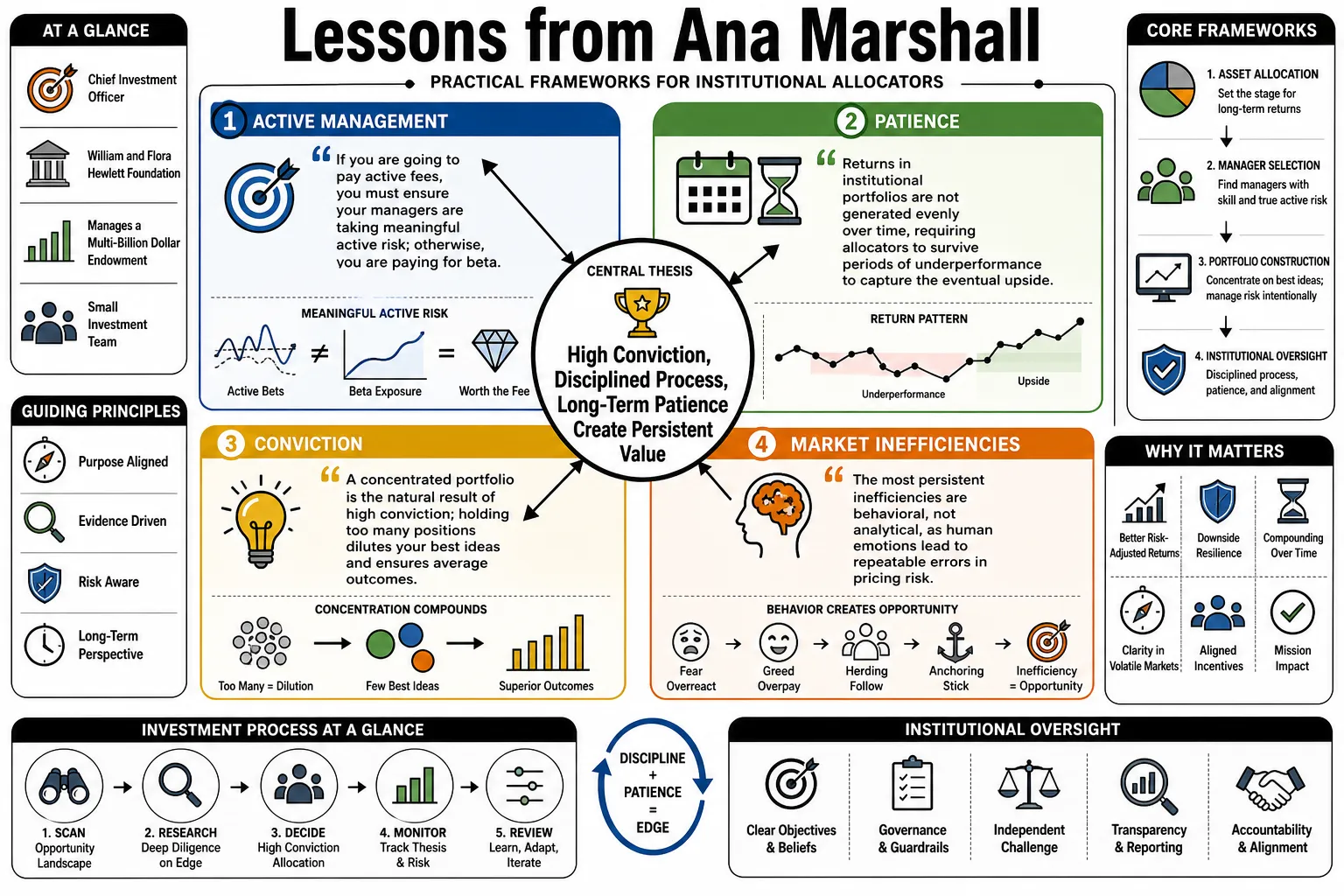
Ana Marshall is the Chief Investment Officer of the William and Flora Hewlett Foundation, where she has managed its multi-billion dollar endowment since 2011. She is known for her disciplined approach to concentrated portfolios and her preference for a small investment team. This profile details her practical frameworks for asset allocation, manager selection, and institutional oversight to explain why her methods matter to modern allocators. Reference: The Climb to Investment Excellence: A Practitioner's Guide to Building Exceptional Portfolios and Teams
Part 1: Investment Philosophy
- Active Risk vs. Benchmark Hugging: When committing to active management fees, an institution must ensure that portfolio managers take meaningful active risk rather than closet-indexing and charging active prices for market beta. — Capital Allocators: Applied Direct Investing at the William and Flora Hewlett Foundation.
- Patience and Compounding Asymmetry: Institutional investment returns compound unevenly over multi-year cycles, requiring allocators to maintain discipline through inevitable drawdowns to capture ultimate payoff. — The Climb to Investment Excellence: A Practitioner's Guide to Building Exceptional Portfolios and Teams.
- Conviction-Driven Concentration: A concentrated portfolio naturally emerges from high analytical conviction, whereas excessive diversification dilutes high-conviction ideas into mediocre index returns. — The Climb to Investment Excellence: A Practitioner's Guide to Building Exceptional Portfolios and Teams.
- Behavioral Market Inefficiencies: The most enduring market inefficiencies stem from behavioral biases and human emotional swings rather than data deficits, producing predictable mispricings during panics. — CFA Society Chicago: Ana Marshall on The Climb to Investment Excellence at the Hewlett Foundation.
- Penalties of Portfolio Complexity: Introducing operational or financial complexity into an asset allocation framework rarely enhances net returns, but consistently increases administrative friction, fee drag, and opacity. — The Climb to Investment Excellence: A Practitioner's Guide to Building Exceptional Portfolios and Teams.
- Perpetual Horizon as Core Advantage: An endowment’s structural competitive edge is its perpetual time horizon, enabling it to absorb temporary paper volatility and illiquidity that short-horizon market participants cannot withstand. — Capital Allocators: Preparing for the New Environment at Hewlett.
- Filtering Strategic Signal from Noise: Superior investment judgment requires systematically filtering out daily market noise to concentrate underwriting on the few primary variables that govern asset value. — CFA Society Chicago: Ana Marshall on The Climb to Investment Excellence at the Hewlett Foundation.
- Absolute Purchasing Power Delivery: While relative benchmarks offer short-term diagnostic context, philanthropic foundations spend absolute dollars, requiring the portfolio to compound real inflation-adjusted purchasing power. — The Climb to Investment Excellence: A Practitioner's Guide to Building Exceptional Portfolios and Teams.
- Dissecting Structural Competitive Edge: Prior to committing institutional capital, an investment office must rigorously determine whether its intended advantage is analytical, informational, or behavioral. — The Climb to Investment Excellence: A Practitioner's Guide to Building Exceptional Portfolios and Teams.
Part 2: Team Building and Culture
- Agility of Compact Investment Teams: Maintaining a small investment staff enforces direct communication, prevents bureaucratic paralysis, and ensures every investor maintains an integrated perspective across the total balance sheet. — Stanford Graduate School of Business: Ana Marshall Faculty Profile.
- Hiring for Curiosity and Low Ego: Institutional allocator recruitment should prioritize rigorous intellectual curiosity paired with low personal ego, recognizing that financial markets ruthlessly humble overconfidence. — Capital Allocators: Applied Direct Investing at the William and Flora Hewlett Foundation.
- Institutionalizing Constructive Conflict: A high-performance allocator culture demands structured debate where junior analysts are not merely permitted but obligated to stress-test the strategic premises of leadership. — The Climb to Investment Excellence: A Practitioner's Guide to Building Exceptional Portfolios and Teams.
- Generalist Mindset Across Asset Classes: Structuring an investment team as generalists rather than siloed asset-class heads eliminates internal territorial disputes and directs capital toward optimal risk-adjusted opportunities. — CFA Society Chicago: Ana Marshall on The Climb to Investment Excellence at the Hewlett Foundation.
- Aligning Incentives with Long-Term Solvency: Compensation frameworks should reflect multi-year whole-fund capital preservation and real growth rather than incentivizing short-term outperformance within isolated sub-asset benchmarks. — The Climb to Investment Excellence: A Practitioner's Guide to Building Exceptional Portfolios and Teams.
- Empowering Next-Generation Allocators: Mentorship in endowment management requires entrusting emerging allocators with real decision-making authority and the psychological safety to navigate reversible mistakes. — The Climb to Investment Excellence: A Practitioner's Guide to Building Exceptional Portfolios and Teams.
- Mission Connection as Retention Anchor: Top investment talent remains committed to institutional allocators when their work is deeply aligned with the foundation’s philanthropic mission and intellectual development. — Capital Allocators: Preparing for the New Environment at Hewlett.
- Defending Cognitive Capacity Against Distraction: Guarding team bandwidth against low-conviction commercial pitches is necessary to maintain intense diligence on core partners and strategic underwriting. — The Climb to Investment Excellence: A Practitioner's Guide to Building Exceptional Portfolios and Teams.
- Cognitive Diversity Mitigating Groupthink: Assembling teams with diverse career paths and analytical backgrounds prevents the reflexive consensus and behavioral conformity that endanger portfolios during market bubbles. — CFA Society Chicago: Ana Marshall on The Climb to Investment Excellence at the Hewlett Foundation.
- Process-Driven Decision Post-Mortems: Investment reviews must analyze the rigorous quality of the underwriting process at the moment of commitment rather than judging decisions by the luck of short-term outcomes. — The Climb to Investment Excellence: A Practitioner's Guide to Building Exceptional Portfolios and Teams.
Part 3: Portfolio Construction
- Asset Allocation for Drawdown Survival: Asset allocation is a macro-level risk instrument whose primary mandate is ensuring the balance sheet survives deep drawdowns with sufficient liquidity to rebalance aggressively. — Capital Allocators: Preparing for the New Environment at Hewlett.
- Treating Illiquidity as a Finite Budget: Illiquidity represents a strictly rationed capital allocation budget, as becoming a forced seller of private assets during credit contractions permanently impairs compounding. — The Climb to Investment Excellence: A Practitioner's Guide to Building Exceptional Portfolios and Teams.
- Liquidity as Ultimate Diversifier in Crisis: During systemic liquidity panics, correlations across diverse asset classes converge toward one, leaving unencumbered liquidity as the only dependable portfolio diversifier. — Capital Allocators: Preparing for the New Environment at Hewlett.
- Counter-Cyclical Discipline of Rebalancing: Systematic portfolio rebalancing is psychologically uncomfortable because it mandates trimming appreciated holdings to purchase depressed assets, which is precisely why it generates excess return. — The Climb to Investment Excellence: A Practitioner's Guide to Building Exceptional Portfolios and Teams.
- Justifying the Illiquidity Premium in Private Assets: Private equity and venture capital allocations are only defensible when selected managers consistently produce a substantial net spread over public equivalents to compensate for long lockups. — CFA Society Chicago: Ana Marshall on The Climb to Investment Excellence at the Hewlett Foundation.
- Position Sizing and Meaningful Impact: Every portfolio position must be scaled large enough to tangibly influence aggregate fund returns, avoiding small nominal allocations that consume monitoring bandwidth without moving the needle. — The Climb to Investment Excellence: A Practitioner's Guide to Building Exceptional Portfolios and Teams.
- Managing Foreign Currency Volatility: For a US foundation whose grants are denominated in dollars, unmanaged foreign currency fluctuations introduce uncompensated volatility over the long term. — Capital Allocators: Applied Direct Investing at the William and Flora Hewlett Foundation.
- High-Quality Fixed Income as Dry Powder: The principal mandate of pristine sovereign debt in an endowment is not yield generation, but acting as liquid dry powder to redeploy into beaten-down equities during panics. — The Climb to Investment Excellence: A Practitioner's Guide to Building Exceptional Portfolios and Teams.
- Steady Pacing Over Macroeconomic Timing: Disciplined, programmatic vintage deployment across private market cycles protects allocators far more reliably than attempting to time macroeconomic inflections. — Capital Allocators: Preparing for the New Environment at Hewlett.
Part 4: Risk Management
- Differentiating Volatility from Capital Loss: True investment risk is not mark-to-market statistical volatility, but the permanent impairment of capital that jeopardizes an institution’s ongoing grant-making capability. — Capital Allocators: Applied Direct Investing at the William and Flora Hewlett Foundation.
- Underwriting Hidden Leverage in Portfolios: Implicit operational and financial leverage within portfolio operating companies is often the hidden vulnerability that transforms a mild recession into severe permanent capital loss. — CFA Society Chicago: Ana Marshall on The Climb to Investment Excellence at the Hewlett Foundation.
- Margin of Safety Over Synthetic Hedges: Preparing for low-probability tail risks requires establishing deep fundamental margins of safety in asset entry valuations rather than relying on expensive, bleeding synthetic hedges. — The Climb to Investment Excellence: A Practitioner's Guide to Building Exceptional Portfolios and Teams.
- Continuous Underwriting in Concentrated Books: Maintaining a concentrated portfolio requires vigilant, non-stop fundamental underwriting, as underwriting errors in focused books cannot be masked by broad diversification. — The Climb to Investment Excellence: A Practitioner's Guide to Building Exceptional Portfolios and Teams.
- Skepticism of Private Mark-to-Model Valuations: Relying on delayed mark-to-model valuations in illiquid holdings during public market sell-offs breeds dangerous complacency regarding true portfolio drawdowns. — Capital Allocators: Preparing for the New Environment at Hewlett.
- Embracing Tracking Error as the Price of Alpha: Allocators must cultivate the fortitude to endure extended periods of looking wrong against consensus benchmarks, as low tracking error reflects an absence of independent conviction. — CFA Society Chicago: Ana Marshall on The Climb to Investment Excellence at the Hewlett Foundation.
- Operational Due Diligence as Inflexible Requirement: Catastrophic institutional losses frequently result from operational failures, back-office deficiencies, or fraudulent practices, making operational due diligence non-negotiable. — The Climb to Investment Excellence: A Practitioner's Guide to Building Exceptional Portfolios and Teams.
Part 5: Manager Selection and Partnerships
- Proprietary Sourcing Through Allocator Networks: Elite investment managers rarely deploy aggressive marketing machinery, requiring allocators to cultivate trusted peer networks to discover boutique investment talent. — The Climb to Investment Excellence: A Practitioner's Guide to Building Exceptional Portfolios and Teams.
- Skin in the Game and Liquid Wealth Alignment: Endowment allocators should partner with managers who commit the vast majority of their own liquid personal net worth directly alongside limited partner capital. — Capital Allocators: Applied Direct Investing at the William and Flora Hewlett Foundation.
- Track Records as Behavioral Forensic Evidence: Historical performance is valuable primarily as a forensic record of how a manager navigates stress, preserves discipline, and executes under pressure, not as a mathematical guarantee. — The Climb to Investment Excellence: A Practitioner's Guide to Building Exceptional Portfolios and Teams.
- Candor and Partnership During Underperformance: An authentic institutional partnership is demonstrated when managers and allocators hold transparent discussions during difficult drawdowns without the imminent threat of redemption. — CFA Society Chicago: Ana Marshall on The Climb to Investment Excellence at the Hewlett Foundation.
- Articulating Counterparty Edge and Source of Alpha: If a prospective asset manager cannot clearly articulate why the market is offering them a mispriced security and who sits on the other side of the trade, their edge is likely ephemeral. — Capital Allocators: Applied Direct Investing at the William and Flora Hewlett Foundation.
- Team Stability and Compensation Culture: Elevated turnover among senior investment personnel is an immediate indicator of flawed governance, misaligned carry economics, or dysfunctional partnership dynamics. — The Climb to Investment Excellence: A Practitioner's Guide to Building Exceptional Portfolios and Teams.
- Negotiating Fair Economics Against Asset Gathering: While endowments should generously compensate demonstrable alpha, allocators must negotiate fee structures that prevent managers from accumulating vast wealth purely on management fees. — Capital Allocators: Applied Direct Investing at the William and Flora Hewlett Foundation.
- Terminating on Strategy Drift, Not Short-Term Noise: Redemption decisions should be triggered by fundamental strategy drift, ethical breaches, or key-person turnover rather than reacting to short-term cyclical underperformance. — The Climb to Investment Excellence: A Practitioner's Guide to Building Exceptional Portfolios and Teams.
- Internal Rigor Required for Direct Co-Investing: Co-investing lowers the total cost of capital deployment, but demands internal allocator teams equipped with the speed, technical acumen, and bandwidth to underwrite single-asset deals. — Capital Allocators: Applied Direct Investing at the William and Flora Hewlett Foundation.
Part 6: Governance and Institutional Alignment
- Educating Boards for Crisis Resilience: A Chief Investment Officer’s most vital strategic mandate is educating the investment committee and board during tranquil periods so they have the fortitude to maintain policy during market panics. — The Climb to Investment Excellence: A Practitioner's Guide to Building Exceptional Portfolios and Teams.
- Connecting Returns to Philanthropic Impact: In an endowment setting, every basis point of net performance translates directly into philanthropic grants, providing an inspiring institutional purpose that guides day-to-day capital stewardship. — Ana Marshall: Executive Biography & Career Overview.
- Tailoring Policy Portfolios to Institutional DNA: An institution’s policy benchmark must directly reflect its unique liabilities, liquidity constraints, and mission risk profile rather than mimicking peer university averages. — The Climb to Investment Excellence: A Practitioner's Guide to Building Exceptional Portfolios and Teams.
- Demystifying Finance for Non-Financial Trustees: Articulating sophisticated investment concepts in transparent, jargon-free prose builds foundational credibility and enduring trust with non-finance board members. — CFA Society Chicago: Ana Marshall on The Climb to Investment Excellence at the Hewlett Foundation.
- Clear Division Between Governance and Execution: An effective investment committee maintains its focus on governance, asset allocation, and risk budgets, delegating direct manager selection to the professional CIO team. — Capital Allocators: Preparing for the New Environment at Hewlett.
- Spending Policies Designed to Smooth Market Volatility: Endowment spending formulas must be engineered with rolling averages to smooth cyclical market drawdowns, ensuring programmatic grant commitments remain uninterrupted. — The Climb to Investment Excellence: A Practitioner's Guide to Building Exceptional Portfolios and Teams.
- The Hazards of Chasing Peer Return League Tables: Chasing the published returns of peer endowments tempts institutions into adopting unsuitable risk profiles and allocating capital to crowded asset classes at the peak of the cycle. — The Climb to Investment Excellence: A Practitioner's Guide to Building Exceptional Portfolios and Teams.
- Transparency and Immediate Bad News Delivery: Unanticipated negative developments destroy board trust; adverse performance or operational breakdowns must be delivered to governance committees promptly and with full strategic context. — The Climb to Investment Excellence: A Practitioner's Guide to Building Exceptional Portfolios and Teams.
Part 7: Market Volatility and Cycles
- Financial History as Inoculation Against Euphoria: Studying long-term financial history provides institutional allocators with the historical perspective to recognize that speculative euphoria and market panics are permanent features of human psychology. — Capital Allocators: Preparing for the New Environment at Hewlett.
- Defending Endowment Capital Against Inflation: Inflation represents a quiet, insidious tax that erodes real purchasing power, demanding exposure to real assets and productive operating businesses with genuine pricing power. — Capital Allocators: Preparing for the New Environment at Hewlett.
- Navigating Shifts in Secular Interest Rate Regimes: Decades of secular interest rate declines provided tailwinds for all financial assets; forward-looking returns in higher-rate regimes depend strictly on organic earnings growth and operational value-add. — Capital Allocators: Preparing for the New Environment at Hewlett.
- The Psychological Cost of Authentic Contrarianism: Executing an authentic contrarian strategy requires exceptional emotional endurance, as the allocator will inevitably look isolated and wrong for extended stretches before being validated. — CFA Society Chicago: Ana Marshall on The Climb to Investment Excellence at the Hewlett Foundation.
- Separating Geopolitical Volatility from Fundamentals: Macroeconomic and geopolitical headlines trigger sharp short-term market fluctuations, but rarely disrupt the multi-decade compounding trajectory of premier global franchises. — Capital Allocators: Preparing for the New Environment at Hewlett.
- Balancing Technological Disruption and Valuation Discipline: Technological shifts create dramatic commercial winners and obsolescent losers, requiring allocators to participate in innovation without surrendering valuation discipline during market frenzies. — Capital Allocators: Applied Direct Investing at the William and Flora Hewlett Foundation.
- Preparing Dry Powder for Credit Cycles: Compelling distressed debt and credit opportunities appear exclusively when institutional liquidity vanishes, meaning allocators must maintain dry powder to invest when markets freeze. — CFA Society Chicago: Ana Marshall on The Climb to Investment Excellence at the Hewlett Foundation.
- Recognizing Seductive Late-Cycle Narratives: Late-cycle speculative markets generate elaborate intellectual narratives to rationalize unsustainable asset multiples; identifying these rationalizations protects portfolios from severe losses. — The Climb to Investment Excellence: A Practitioner's Guide to Building Exceptional Portfolios and Teams.
Part 8: Leadership and The Climb to Excellence
- The Mountain Metaphor for Long-Term Stewardship: Navigating an institutional investment career resembles high-altitude mountaineering: it demands establishing disciplined base camps, adapting to volatile weather, and persevering through exhaustion. — The Climb to Investment Excellence: A Practitioner's Guide to Building Exceptional Portfolios and Teams.
- Evolving Strategies Without Compromising Principles: Asset allocation tactics that generated outstanding returns over prior decades must adapt to shifting macroeconomic realities without compromising foundational investment tenets. — Capital Allocators: Preparing for the New Environment at Hewlett.
- Emotional Equilibrium Across Boom and Bust: Sustained excellence in capital management requires an internal emotional equilibrium that prevents allocators from succumbing to hubris during booms or despair during market crashes. — CFA Society Chicago: Ana Marshall on The Climb to Investment Excellence at the Hewlett Foundation.
- Unwavering Focus on Multi-Year Horizons: Endowment leadership requires tuning out the 24-hour financial media circus and concentrating organizational attention entirely on multi-year strategic objectives. — The Climb to Investment Excellence: A Practitioner's Guide to Building Exceptional Portfolios and Teams.
- Measuring Leadership by Institutional Succession: The definitive achievement of a Chief Investment Officer is not merely past portfolio gains, but leaving behind an enduring governance architecture and an empowered team. — Capital Allocators: Applied Direct Investing at the William and Flora Hewlett Foundation.
- Continuous Intellectual Renewal: Financial markets represent a dynamic, ever-evolving ecosystem; the moment an investor stops learning and updating their mental models is when analytical decay begins. — CFA Society Chicago: Ana Marshall on The Climb to Investment Excellence at the Hewlett Foundation.