Anaïs Nin was a pioneering French-Cuban American author who redefined the boundaries of the personal diary and modern erotica, transforming the act of self-observation into a profound literary art form. Her work remains a cornerstone of 20th-century psychological literature, emphasizing the necessity of inner exploration, the fluid nature of identity, and the courage required to live an authentic, uninhibited life. Reference: Literary Ladies Guide: Anaïs Nin – French-Cuban Author and Diarist
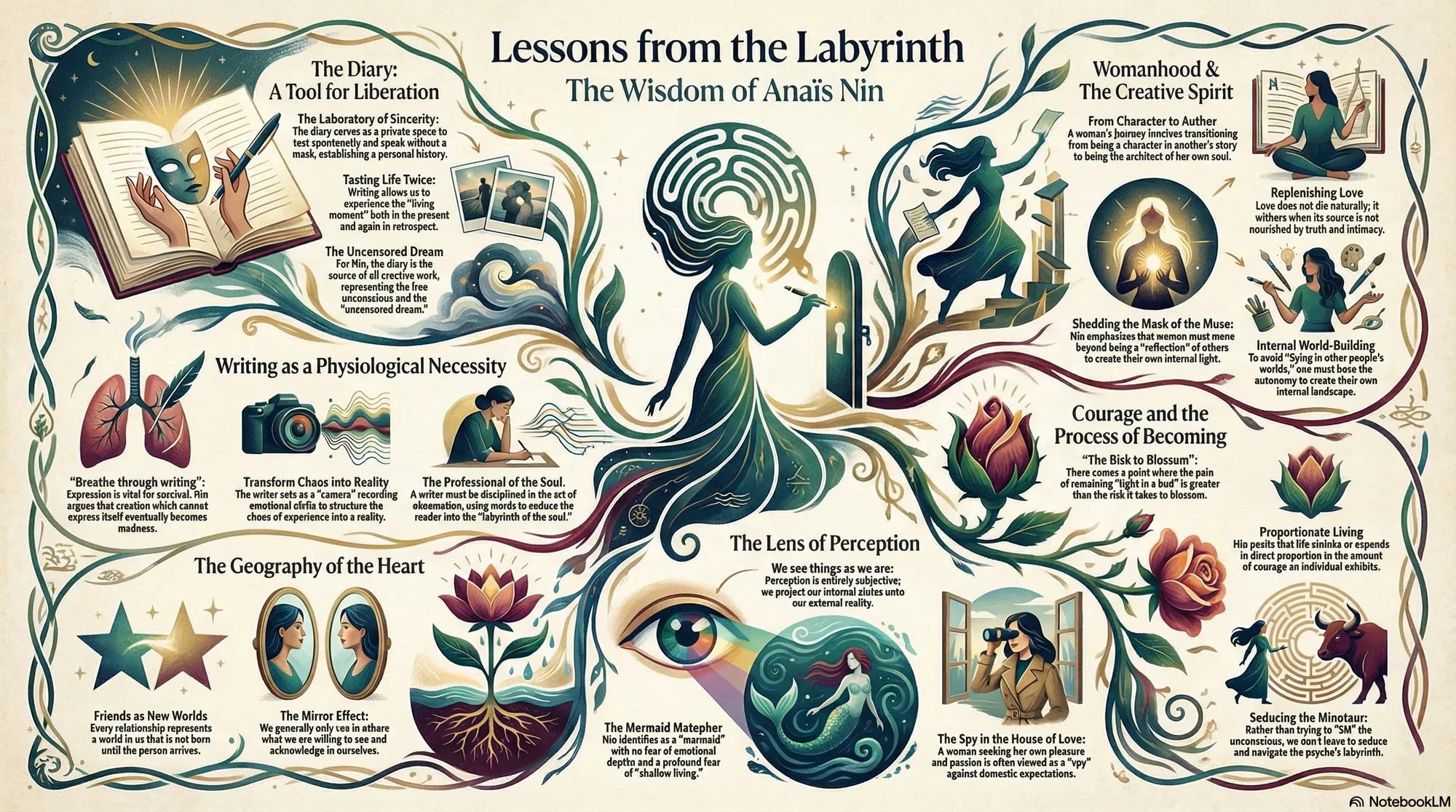
Part 1: The Diary: A Tool for Capture & Liberation
- Capturing the Living Moment: Writing a diary functions as an immediate net for living sensation, catching impressions while still emotionally warm rather than smoothing them into distant convention — The Marginalian: Anaïs Nin on Writing and Emotional Excess (1947).
- The Diary as a Laboratory of Spontaneity: Treat personal journaling as a testing ground for emotional sincerity, allowing unpolished, uninhibited experimentation without the burden of external evaluation — Literary Ladies Guide: Anaïs Nin’s Diaries: From the Personal to the Universal.
- Speaking Without the Mask: Cultivate a private reflective space where you can discard social personas and address your deepest contradictions with unvarnished honesty — New Orleans Review: Anaïs Nin: Link in the Chain of Feeling (Interview by Jeffrey Bailey).
- Writing to Inhabit Your Own Reality: Construct an internal world through dedicated creative practice when external environments feel hostile, stifling, or alien to your values — The Marginalian: Anaïs Nin on Why We Shouldn’t Fossilize Ourselves into a 'Fixed Personality'.
- Tasting Life Twice: Document meaningful experiences to apprehend them twice—first in the immediacy of occurrence and subsequently through reflective retrospection — Literary Ladies Guide: Anaïs Nin’s Diaries: From the Personal to the Universal.
- Establishing Personal History: Use personal chronicle to anchor identity and establish continuity of selfhood through exile, dislocation, and turbulent life transitions — Online Archive of California: Anaïs Nin Papers (UCLA Library Special Collections).
- Honoring Emotional Fragmentation: Permit internal fragmentation and conflicting impulses onto the page without imposing artificial narrative resolution or forced coherence — Literary Hub: The Wild, Impassioned World of Anaïs Nin’s Diaries.
- The Journal as Uncensored Subconscious: Regard daily personal writing as an uninhibited channel to the unconscious, providing raw psychological material for all broader creative endeavors — Literary Hub: The Wild, Impassioned World of Anaïs Nin’s Diaries.
- The Personal as Universal: Trust that probing deeply into specific individual vulnerability connects more profoundly with others than detached, abstract generalization — The Guardian: Interview with Anaïs Nin (Archive, 1970).
- Heightening Everyday Awareness: Maintain regular introspective notation to sharpen observational sensitivity, noticing subtle shifts in mood and atmosphere that unexamined routines erase — Literary Ladies Guide: Anaïs Nin’s Diaries: From the Personal to the Universal.
- Rejecting the Puritan Bias Against Inner Exploration: Recognize that dismissing subjective self-examination as self-indulgent or neurotic reflects cultural puritanism rather than a flaw in self-inquiry — New Orleans Review: Anaïs Nin: Link in the Chain of Feeling (Interview by Jeffrey Bailey).
Part 2: Writing: A Physiological Necessity
- Writing as a Visceral Compulsion: Engage in creative expression as an organic necessity akin to breathing, pursuing writing only when driven by authentic internal pressure — The Marginalian: Anaïs Nin on Writing and Emotional Excess (1947).
- Articulating the Unspoken: Define the artist's responsibility as uncovering and giving voice to the buried, taboo, or unarticulated emotional realities of human experience — The Marginalian: Anaïs Nin on Emotion, Writing, and the Purpose of Life.
- Extracting Nourishment from All Experience: Recognize that every encounter, disappointment, and emotional upheaval serves as fertile material and psychological nourishment for creative development — The Marginalian: Anaïs Nin on Writing and Emotional Excess (1947).
- Structuring Chaotic Experience: Use the discipline of language and craft to give coherent form and psychological meaning to the raw, disorganized turbulence of lived events — The Marginalian: Anaïs Nin on Writing and Emotional Excess (1947).
- The Writer as an Emotional Lens: Operate as a sensitive recording instrument, registering micro-tensions, shifting emotional currents, and unvoiced undercurrents in social dynamics — New Orleans Review: Anaïs Nin: Link in the Chain of Feeling (Interview by Jeffrey Bailey).
- Prioritizing Emotional Truth Over Sterile Polish: Favor the raw authenticity of genuine feeling over rigid stylistic formalism that drains work of its vital life force and spontaneity — Literary Ladies Guide: Anaïs Nin’s Diaries: From the Personal to the Universal.
- The Danger of Stifled Expression: Provide outlets for internal creative energy; repressing imaginative drive forces it inward where it turns toxic and psychologically destabilizing — Literary Hub: The Wild, Impassioned World of Anaïs Nin’s Diaries.
- Language as an Entry to the Soul's Labyrinth: Employ evocative, lyrical language to guide the reader past intellectual defenses into the complex, subterranean chambers of the psyche — The Marginalian: Anaïs Nin on Writing and Emotional Excess (1947).
- Disciplined Observation of the Interior Life: Approach self-investigation with professional rigor and disciplined attentiveness rather than casual indulgence, treating interiority as a serious field of study — Literary Ladies Guide: Anaïs Nin – French-Cuban Author and Diarist.
- Dismantling the Romanticization of Suffering: Reject the romantic myth that acute neurosis and suffering are prerequisites for art; emotional clarity and psychological growth yield far deeper creative work — New Orleans Review: Anaïs Nin: Link in the Chain of Feeling (Interview by Jeffrey Bailey).
- Moving Forward by Starting Anew: Overcome creative paralysis by initiating the next work rather than obsessively polishing the previous one, allowing new projects to stimulate fresh momentum — New Orleans Review: Anaïs Nin: Link in the Chain of Feeling (Interview by Jeffrey Bailey).
- Cross-Fertilizing Fact and Fiction: Allow raw autobiographical diary entries and structured imaginative fiction to cross-pollinate, enriching narrative architecture with personal intimacy — New Orleans Review: Anaïs Nin: Link in the Chain of Feeling (Interview by Jeffrey Bailey).
Part 3: The Creative Spirit: Building Internal Worlds
- Creating Your World to Avoid Dying in Others': Actively build an autonomous philosophical and physical world that reflects your values, rather than acquiescing to the restrictive frameworks designed by others — The Marginalian: Anaïs Nin on Why We Shouldn’t Fossilize Ourselves into a 'Fixed Personality'.
- The Fluidity of the Creative Mind: Refuse to freeze yourself into a permanent, static identity; allow your sensibilities and artistic methods to transform across different life chapters — The Marginalian: Anaïs Nin on Why We Shouldn’t Fossilize Ourselves into a 'Fixed Personality'.
- Transmuting Terror and Loneliness into Art: Harness profound isolation and acute vulnerability as the primary crucible for creative work, transmuting private distress into resonant expression — The Marginalian: Anaïs Nin on Writing and Emotional Excess (1947).
- Recognizing Reality as a Subjective Construct: Acknowledge that external reality is continually shaped and filtered by subjective consciousness, empowering you to reconstruct your relationship to it — New Orleans Review: Anaïs Nin: Link in the Chain of Feeling (Interview by Jeffrey Bailey).
- The Autonomous Freedom of the Imagination: Preserve the imaginative realm as an untouchable sanctuary of sovereign freedom, inaccessible to outside coercion or social conformity — Literary Hub: The Wild, Impassioned World of Anaïs Nin’s Diaries.
- Refusing to Be a Passive Reflection of Mentors: Resist the temptation to serve merely as a mirror or muse for influential mentors, asserting your distinct creative vision and independent authority — The Guardian: Interview with Anaïs Nin (Archive, 1970).
- Mapping the Geography of the Heart: Direct creative attention toward interior emotional terrains and relational dynamics rather than external, conventional social milestones — New Orleans Review: Anaïs Nin: Link in the Chain of Feeling (Interview by Jeffrey Bailey).
- Collage Technique for Fragmented Modern Experience: Adopt non-linear, collage-like structures in writing and thinking to reflect the fractured, multifaceted realities of modern consciousness — Literary Hub: The Wild, Impassioned World of Anaïs Nin’s Diaries.
- Sustaining Poetic Vision Against Cynicism: Defend the validity of dreams and lyrical intuition against the encroaching cynicism of purely utilitarian or dogmatic worldviews — The Marginalian: Anaïs Nin on Writing and Emotional Excess (1947).
Part 4: Relationships: Meeting New Worlds in Others
- Friends as Catalysts for Unborn Worlds: Recognize that each profound connection awakens dormant faculties and latent perspectives within you that could not emerge in isolation — The Marginalian: Anaïs Nin on Why We Shouldn’t Fossilize Ourselves into a 'Fixed Personality'.
- Actively Replenishing the Sources of Love: Understand that love rarely dies of natural causes; it withers when partners fail to actively replenish its springs through honesty and renewal — Literary Ladies Guide: Anaïs Nin Quotes on Writing, Life, and Love.
- Love Beyond Utilitarian Justification: Acknowledge that deep affection operates beyond instrumental logic, resisting the need to rationalize genuine connection with pragmatic reasons — The Guardian: Interview with Anaïs Nin (Archive, 1970).
- Intimacy as the Gateway to Understanding: Engage with ideas and individuals through close personal intimacy, which cultivates empathy far more effectively than detached theoretical analysis — The Marginalian: Anaïs Nin on Why We Shouldn’t Fossilize Ourselves into a 'Fixed Personality'.
- Recognizing Projection in Relationships: Remain conscious that what you perceive and react to in others is frequently a reflection of unresolved, unacknowledged dynamics within yourself — New Orleans Review: Anaïs Nin: Link in the Chain of Feeling (Interview by Jeffrey Bailey).
- Nourishing Connections with Vulnerable Truth: Maintain intimate bonds by continuously watering them with candid emotional honesty, preventing the silent decay of evasions and polite pretenses — Literary Ladies Guide: Anaïs Nin’s Diaries: From the Personal to the Universal.
- The Necessity of Solitary Withdrawal: Step back periodically from social immersion into quiet solitude to reconstitute your internal center and reconnect with your inner voice — New Orleans Review: Anaïs Nin: Link in the Chain of Feeling (Interview by Jeffrey Bailey).
- Choosing Expansive Rather Than Constricting Companions: Surround yourself with individuals whose curiosity and imagination enlarge your horizon, actively avoiding those who seek to diminish your scope — The Guardian: Interview with Anaïs Nin (Archive, 1970).
- Examining Non-Monogamous Emotional Complexity: Investigate the multifaceted nature of desire and connection without defensive hypocrisy, acknowledging when single frameworks fail to contain all passions — The Guardian: Interview with Anaïs Nin (Archive, 1970).
- Overcoming Persona-to-Persona Isolation: Recognize that interacting solely through polished social masks generates profound loneliness; authentic intimacy requires dropping defensive posturing — New Orleans Review: Anaïs Nin: Link in the Chain of Feeling (Interview by Jeffrey Bailey).
Part 5: Desire & Eroticism: The Depths of Passion
- Eroticism as an Instrument of Self-Knowledge: Treat erotic desire not as mere physical diversion but as a fundamental avenue of self-knowledge and psychological revelation equal to poetry — The Guardian: Interview with Anaïs Nin (Archive, 1970).
- Articulating the Female Erotic Perspective: Claim female sexual desire as legitimate literary territory, articulating sensuality with nuance, psychological depth, and poetic resonance — The Guardian: Interview with Anaïs Nin (Archive, 1970).
- The Potency of Erotic Imagination: Recognize that internal fantasy and mental anticipation frequently carry greater psychological power than physical acts alone — The Guardian: Interview with Anaïs Nin (Archive, 1970).
- Confronting Taboo Desires for Psychological Wholeness: Examine buried taboos and shadow impulses directly, recognizing that true psychological integration requires acknowledging the full spectrum of self — Literary Hub: The Wild, Impassioned World of Anaïs Nin’s Diaries.
- Desire as a Language of Poetic Images: Understand that sensual attraction communicates primarily through rich emotional metaphors and mental imagery rather than mechanical physical mechanics — The Guardian: Interview with Anaïs Nin (Archive, 1970).
- The Multivalent Complexity of Passion: Accept that intense passion is rarely simple or pure; it weaves admiration, vulnerability, fear, and self-discovery into a complex tapestry — Literary Hub: The Wild, Impassioned World of Anaïs Nin’s Diaries.
- The Mermaid Metaphor: Embracing Depths Over Shallows: Choose the perils and riches of psychological depth over the sterile security of superficial living, refusing to compromise your capacity for intense experience — Literary Ladies Guide: Anaïs Nin Quotes on Writing, Life, and Love.
- Navigating Espionage in the House of Love: Analyze how women seeking self-directed pleasure have historically felt cast as spies infiltrating a world designed around male prerogatives — The Guardian: Interview with Anaïs Nin (Archive, 1970).
- The Sterility of Unchallenged Hedonism: Recognize that pursuit of pleasure detached from emotional risk, moral friction, or personal struggle becomes hollow and psychologically deadening — New Orleans Review: Anaïs Nin: Link in the Chain of Feeling (Interview by Jeffrey Bailey).
Part 6: Womanhood: Defining One's Own Terms
- Rejecting Fear of Female Strength: Refuse to shrink or mute your intellectual and creative power to appease insecure companions intimidated by female autonomy — The Guardian: Interview with Anaïs Nin (Archive, 1970).
- Asserting Full Human Vulnerability: Claim the right for women to exist as complete, flawed human beings with contradictions, rather than being confined to idealized pedestals or subordinate roles — The Guardian: Interview with Anaïs Nin (Archive, 1970).
- Creating One's Own Reality Instead of Waiting for Men: Take full accountability for building the cultural, intellectual, and relational reality you desire, rather than waiting for a partner to construct it for you — Literary Ladies Guide: Anaïs Nin Quotes on Writing, Life, and Love.
- Embracing the Multifaceted Internal Cast: Acknowledge the multitude of distinct identities within yourself beneath an external appearance of consistency, honoring their varying needs — Literary Ladies Guide: Anaïs Nin Quotes on Writing, Life, and Love.
- Transcending the Muse Role to Become Creator: Shed the passive, secondary identity of the artistic muse to assume your rightful position as the primary creator and architect of your own work — New Orleans Review: Anaïs Nin: Link in the Chain of Feeling (Interview by Jeffrey Bailey).
- The Unique Register of the Feminine Voice: Champion the distinct emotional cadence and psychological perceptiveness of the feminine voice, resisting pressure to mimic masculine literary norms — The Guardian: Interview with Anaïs Nin (Archive, 1970).
- Authoring Your Own Narrative: Transform your life journey from acting as a secondary character in someone else's drama into becoming the sovereign author of your own story — Literary Hub: The Wild, Impassioned World of Anaïs Nin’s Diaries.
- Validating Emotional Intelligence Over Rationalist Dismissal: Uphold deep emotional insight as a vital form of intelligence, refusing to let rationalist cynicism denigrate intuitive and feeling-based perception — The Marginalian: Anaïs Nin on Emotion, Writing, and the Purpose of Life.
- Internal Liberation as the Foundation of Autonomy: Achieve genuine psychological emancipation within your own consciousness before seeking external validation or political standing — The Guardian: Interview with Anaïs Nin (Archive, 1970).
Part 7: Courage: The Pain of Remaining in the Bud
- The Pain of Remaining in the Bud: Recognize the critical juncture when the suffocating safety of remaining tightly enclosed becomes far more painful than the vulnerability of blossoming — Literary Ladies Guide: Anaïs Nin Quotes on Writing, Life, and Love.
- Expanding Life in Proportion to Courage: Understand that the scope, vibrancy, and depth of your lived existence expand or contract in direct alignment with your courage to take emotional risks — Literary Ladies Guide: Anaïs Nin Quotes on Writing, Life, and Love.
- Living Deeply Eliminates Fear of Mortality: Immerse yourself fully in immediate, purposeful, and intense living; individuals who live deeply lose their paralyzing terror of death — Literary Ladies Guide: Anaïs Nin Quotes on Writing, Life, and Love.
- The Exhaustion of Evading Life: Realize that attempting to resist, suppress, or hide from living generates far greater psychic exhaustion than actively facing reality's demands — The Marginalian: Anaïs Nin on Writing and Emotional Excess (1947).
- Surpassing Assumed Boundaries to Find Limits: Discover the true perimeter of your capabilities only by daring to push past inherited assumptions and self-imposed psychological constraints — Literary Hub: The Wild, Impassioned World of Anaïs Nin’s Diaries.
- Disciplined Confrontation of Fear: Make it an active personal rule to move directly toward the challenges and emotional exposures that provoke the most intense apprehension — New Orleans Review: Anaïs Nin: Link in the Chain of Feeling (Interview by Jeffrey Bailey).
- The Courage to Reveal Authentic Nature: Cultivate the stamina to expose your genuine sensibilities in an environment that constantly rewards safe mediocrity and social conformity — Literary Ladies Guide: Anaïs Nin’s Diaries: From the Personal to the Universal.
- Static Security as Psychic Stagnation: Acknowledge that settling into permanent comfort is a gradual form of decay; psychological health requires continual movement into the unknown — The Marginalian: Anaïs Nin on Why We Shouldn’t Fossilize Ourselves into a 'Fixed Personality'.
- Present Choice Over Historical Determinism: Refuse to define yourself as an inevitable victim of childhood traumas, claiming the power of present creative choices to shape future reality — New Orleans Review: Anaïs Nin: Link in the Chain of Feeling (Interview by Jeffrey Bailey).
Part 8: The Unconscious: Seducing the Minotaur
- Seducing the Unconscious Minotaur: Engage the shadow material of the subconscious through gentle curiosity and creative seduction rather than attempting to violently suppress it — New Orleans Review: Anaïs Nin: Link in the Chain of Feeling (Interview by Jeffrey Bailey).
- Navigating the Psychic Labyrinth: Accept the human psyche as a complex, non-linear labyrinth that yields understanding only through courageous, recursive self-exploration — New Orleans Review: Anaïs Nin: Link in the Chain of Feeling (Interview by Jeffrey Bailey).
- Integrating the Repressed Shadow: Acknowledge dark fears and suppressed instincts as necessary components of the self, achieving emotional liberation through conscious integration — New Orleans Review: Anaïs Nin: Link in the Chain of Feeling (Interview by Jeffrey Bailey).
- Dreams as Vital Psychological Sustenance: Regard nighttime and waking dreams as indispensable food for the spirit, preserving the psychic equilibrium necessary for everyday endurance — The Marginalian: Anaïs Nin on Writing and Emotional Excess (1947).
- Launching Dreams Like Kites into Space: Cast bold visions and imaginative experiments outward without demanding immediate certainty, observing what unexpected wisdom they pull back — The Marginalian: Anaïs Nin on Writing and Emotional Excess (1947).
- The Dynamic Interdependence of Dream and Action: Fuse visionary imagination with concrete daily action, understanding that their continuous feedback loop generates the most vibrant form of living — The Marginalian: Anaïs Nin on Writing and Emotional Excess (1947).
- Living in Ephemeral Unison with the Ideal: Treasure fleeting moments of absolute harmony where internal poetic vision and outward reality align, treating them as life's true miracles — The Marginalian: Anaïs Nin on Writing and Emotional Excess (1947).
- The Unconscious as Uncensored Sanctuary: Recognize the unconscious as the sole domain free from external censorship, mining its honest impulses for authentic creative direction — Literary Hub: The Wild, Impassioned World of Anaïs Nin’s Diaries.
- Synthesizing Fragments Through Art: Acknowledge that human identity is inherently composed of disjointed fragments, using artistic practice to assemble them into a meaningful mosaic — The Marginalian: Anaïs Nin on Writing and Emotional Excess (1947).
- Rigorous Self-Study as the Foundation for Empathy: Understand that dedicated introspection is not shallow vanity but a prerequisite for comprehending the shared psychological depths of other humans — New Orleans Review: Anaïs Nin: Link in the Chain of Feeling (Interview by Jeffrey Bailey).
Part 9: Reality vs. Fantasy: Seeing as We Are
- Subjective Projection in Experience: Recognize that we do not encounter an objective world in isolation, but project our internal anxieties, longings, and emotional states onto external reality — New Orleans Review: Anaïs Nin: Link in the Chain of Feeling (Interview by Jeffrey Bailey).
- Pursuing the High Moments of Being: Refuse to let routine compromise your hunger for emotional vibrancy, orienting your life around moments of peak awareness and authentic connection — The Marginalian: Anaïs Nin on Writing and Emotional Excess (1947).
- Life as Continuous Becoming: Accept life as an ongoing, fluid process of becoming; stagnation occurs when people attempt to freeze an agreeable state and dwell within it permanently — The Marginalian: Anaïs Nin on Why We Shouldn’t Fossilize Ourselves into a 'Fixed Personality'.
- Embracing Internal Contradictions: Reject the tyrannical demand for rigid personal consistency, embracing the diverse and competing facets of your evolving nature — New Orleans Review: Anaïs Nin: Link in the Chain of Feeling (Interview by Jeffrey Bailey).
- The Primacy of Psychic Reality: Recognize that emotional resonance and psychic reality often carry far greater weight in shaping human behavior than bare external facts — New Orleans Review: Anaïs Nin: Link in the Chain of Feeling (Interview by Jeffrey Bailey).
- The Personal Relationship as the Source of Meaning: Infuse events, art, and surroundings with personal significance, understanding that individual emotional investment is what imbues existence with meaning — The Marginalian: Anaïs Nin on Why We Shouldn’t Fossilize Ourselves into a 'Fixed Personality'.
- Surveillance and Deception in Intimate Life: Recognize the covert surveillance and self-protective deceptions that emerge when individuals conceal their true passions from judgmental scrutiny — Literary Hub: The Wild, Impassioned World of Anaïs Nin’s Diaries.
- Art as an Intensification of Reality: View artistic creation not as a cowardly retreat from real life, but as a deliberate distillation and intensification of its deepest truths — The Marginalian: Anaïs Nin on Writing and Emotional Excess (1947).
- Transforming Circumstance Through Reimagined Perspective: Alter seemingly intractable outward difficulties by fundamentally shifting your interior vantage point and emotional stance toward them — New Orleans Review: Anaïs Nin: Link in the Chain of Feeling (Interview by Jeffrey Bailey).
- Accepting that Life Lacks a Tidy Denouement: Abandon expectations of tidy novelistic conclusions; lived experience moves in recursive cycles of crisis, resolution, and renewed becoming — New Orleans Review: Anaïs Nin: Link in the Chain of Feeling (Interview by Jeffrey Bailey).
Part 10: Transformation: The Process of Becoming
- Delighting in Personal Metamorphosis: Take active pleasure in your perpetual self-renewal, welcoming the knowledge that your perspectives and desires are continually evolving — The Marginalian: Anaïs Nin on Why We Shouldn’t Fossilize Ourselves into a 'Fixed Personality'.
- Emotional Resilience Without Psychic Destruction: Attain emotional mastery by cultivating the capacity to feel every intensity of joy and grief without permitting sorrow to crush your core vitality — The Marginalian: Anaïs Nin on Emotion, Writing, and the Purpose of Life.
- The Self as an Unfolding Mystery: Approach selfhood as an endless, rewarding riddle to be gradually uncovered through ongoing curiosity rather than a fixed problem to be solved — Literary Hub: The Wild, Impassioned World of Anaïs Nin’s Diaries.
- The Diary as an Interior Navigation Map: Leave a detailed record of introspective navigation through personal diaries, providing guideposts for future seekers exploring their own inner territory — Online Archive of California: Anaïs Nin Papers (UCLA Library Special Collections).
- Nostalgia as a Warning of Present Stagnation: Recognize habitual yearning for the past as an alarm that current creative and relational vitality has grown constrained, calling for renewal — New Orleans Review: Anaïs Nin: Link in the Chain of Feeling (Interview by Jeffrey Bailey).