At Runway, co-founder and co-CEO Anastasis Germanidis focuses on the research behind generative video models like Gen-4 and Gen-4.5. He is pushing AI beyond basic text and images to build systems that simulate real-world physical dynamics. This profile covers his views on designing interfaces for artists, the practical limits of machine learning, and the mechanics of modern visual storytelling. — Anastasis Germanidis, personal site.
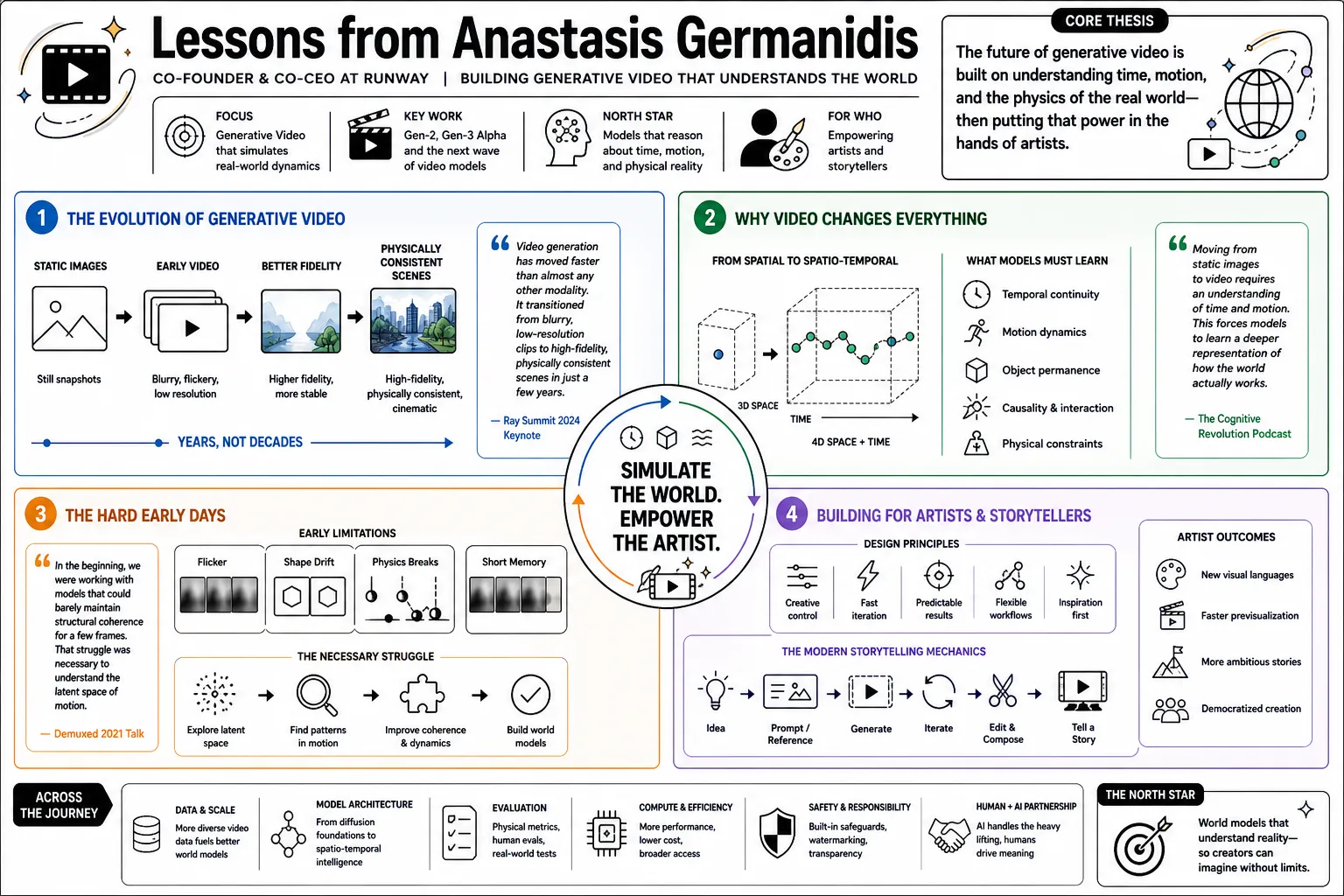
Part 1: The Evolution of Generative Video
- On the pace of progress: Germanidis frames video generation as a field that has moved unusually quickly: the useful lesson is to watch the compounding curve from crude early clips toward models that can represent motion, depth, and scene structure. — Reference: Ray Summit talk on the recent history of video generation
- On the transition to video: Germanidis treats video as more than a richer media format; because humans act in a visual, physical world, video models become a path toward representations of space, motion, and activity. — Reference: Cognitive Revolution interview on video generation as world modeling
- On temporal consistency: For Gen-3 Alpha, Runway paid particular attention to keeping a character's identity consistent through a clip, because it was the feedback filmmakers gave them all the time. — Reference: Cerebral Valley talk on character consistency in Gen-3 Alpha.
- On scaling laws for video: As Runway scales video models, Germanidis watches for emergent scene understanding: better 3D consistency, more believable physical dynamics, and model behavior that is not just memorized pixel patterning. — Reference: Cognitive Revolution episode notes on emergent properties in scaled video models
- On multi-modal inputs: Gen-3 Alpha shows why Germanidis sees multimodality as a control surface: text, image, video, motion, and camera inputs can all become ways of steering the same generative system. — Reference: Runway Gen-3 Alpha research note on multimodal training and control modes
- On Gen-1 versus Gen-2: Gen-1 transformed an existing video into a new style from a text or image prompt while keeping the source's structure; Gen-2, released weeks later, went further by producing video from a text prompt alone. — Reference: TWIML AI Podcast #622 on Gen-1 and Gen-2.
- On iterative breakthroughs: Germanidis describes progress as cumulative engineering: better data pipelines, larger-scale training, model iteration, and infrastructure work combine into visible leaps in video quality. — Reference: Ray Summit talk on scaling data and model infrastructure
- On the complexity of human motion: Germanidis treats convincing people as central to storytelling: Gen-3 Alpha's gains mattered because characters could perform a wide range of actions and interact with objects whose state changes in response, like piano keys reacting to a player. — Reference: Ray Summit talk on human characters and object interaction.
- On future modalities: Germanidis is not stopping at video clips; his stated research focus is multimodal world simulation, where video generation becomes one step toward richer simulated environments. — Reference: Germanidis personal site on multimodal simulators of the world
- On Build a Culture That Avoids Sunk Costs: AI teams need a culture that embraces change and avoids defending work simply because time has already been invested. — First Round Review
Part 2: World Simulators and Physics
- On general world models: Runway treats video generation models as general world models, and Germanidis says scale is the lever: "The more we put compute and data behind scaling those models, the more capable they become at simulating reality." — Reference: Semafor interview on simulating reality.
- On the limitations of 2D data: Germanidis sees 2D video as powerful but indirect: it can teach models 3D structure and human activity, while still leaving open the harder work of richer world representation. — Reference: Cognitive Revolution interview on learning 3D knowledge from 2D footage
- On interactive simulations: The world-model goal is not just making a finished clip; Runway describes models that can maintain environments, allow navigation, and support interaction inside simulated worlds. — Reference: Runway General World Models note on navigation and interaction
- On robotics applications: World models have drawn robotics customers to Runway, and Germanidis sees simulation as the missing piece: "Simulation is the big bottleneck that's going to be required to solve challenges that are in robotics and self-driving, or any real-world problems that one might care about." — Reference: Semafor interview on robotics and simulation.
- On intuitive physics: Germanidis is candid about the limits: Gen-3 Alpha has an intuitive, human-like grasp of physics rather than an exact one, and it still fails at cases as simple as gravity acting on a bouncing ball. — Reference: Cognitive Revolution interview on the limits of learned physics.
- On breaking physical laws: Germanidis argues that realism and invention go together: the more accurately a model learns the world, the more it can go out of distribution and combine concepts into videos unlike any that have been made before. — Reference: Ray Summit talk on world modeling and out-of-distribution art.
- On the scale of data required: Germanidis treats data work as core research infrastructure: curation, preprocessing, and scalable pipelines are part of what lets video models learn motion and physical consistency. — Reference: Ray Summit talk on data preprocessing and model scaling
- On Learn Rules Instead of Programming Them: Learned simulators can model worlds without requiring engineers to program every physical rule explicitly. — Real-World Superintelligence Essay
- On Compress Expensive Feedback Loops: Simulation and world models can compress slow, expensive feedback loops, helping AI systems learn how to act in unpredictable environments. — Real-World Superintelligence Essay
Part 3: Democratizing Creativity
- On lowering the barrier to entry: In pre-production, Runway lets teams generate an "80% version" of the final result, so they can pitch an idea or define every shot before committing to an expensive shoot. — Reference: Modern CTO interview on Runway in pre-production.
- On the cost-cutting myth: Germanidis frames Gen-3 Alpha as artist leverage, not a taste substitute; the point is to make creators more effective while leaving artistic vision in human hands. — Reference: TIME Best Inventions profile on Gen-3 Alpha empowering artists
- On storytelling over technical skill: Germanidis describes Runway as a multiplier of a creator's ability to turn a vision into finished output, not a source of the vision itself; the ideas still have to come from the artist. — Reference: Modern CTO interview on AI as a multiplier of creative vision.
- On independent studios: Germanidis expects lower production friction to widen participation: more films, stranger films, and more creators who previously lacked the resources to get a visual story made. — Reference: Cerebral Valley talk on wider participation in filmmaking
- On creative exploration: Cheaper generation changes which ideas get tried: traditional filmmakers tell Runway they can now make their low-confidence, crazier ideas themselves first, instead of convincing many people to pay for an expensive attempt. — Reference: Cerebral Valley talk on filmmakers testing riskier ideas.
Part 4: AI as an Augmentation Tool
- On artificial general intelligence: Germanidis links video generation to general intelligence through world representation: models that understand visual reality can support tasks beyond media generation. — Reference: Cognitive Revolution interview on video models and general intelligence
- On human-in-the-loop: Rather than building agents that take multi-step actions on their own, Runway treats its models as thought partners and tries to maximize the number of choices artists make, because a story reflects the person telling it. — Reference: Ray Summit talk on models as thought partners.
- On replacing mundane tasks: Runway's early AI tools went after tedious VFX chores such as rotoscoping. The Late Show's effects team used its Green Screen tool to separate subjects from backgrounds on comedy sketches produced the same day, work that is normally annotated frame by frame. — Reference: Modern CTO interview on The Late Show and rotoscoping.
- On continuous progress: Runway presents Gen-3 Alpha as one step in a larger curve: better fidelity, consistency, and motion today, with general world models as the longer research direction. — Reference: Runway Gen-3 Alpha note on progress beyond Gen-2
- On workflow integration: Adoption does not require a zero-to-one switch: Runway is often used alongside traditional editing tools, on one part of the production pipeline. — Reference: Cerebral Valley talk on Runway alongside traditional tools.
- On Knowing What Software Should Do: Cheaper code does not solve the hardest real-world problems when the true bottleneck is knowing what the software should do. — Real-World Superintelligence Essay
Part 5: Rethinking User Interfaces
- On visual control: Germanidis is building toward interfaces where artists can direct the model through camera, motion, structure, style, and other controls instead of relying on text prompts alone. — Reference: Runway Gen-3 Alpha note on fine-grained control modes
- On hiding the math: Runway began because even running a Colab notebook was too much for many artists; the idea was to wrap new models in the kind of interface artists already knew from other creative tools. Each time Runway simplified how to use a model, the range of uses expanded. — Reference: Practical AI episode on bringing models to artists.
- On real-time interaction: Germanidis sees latency and 3D consistency changing the medium: as generation gets closer to real time, the experience can become navigation through a world, not just playback of a clip. — Reference: Cerebral Valley talk on real-time interactive video simulation
- On iterative prompting: Germanidis does not expect a single prompt to return a finished piece. Creating stays iterative because many details of a project are only decided once you start making it, and prompting itself is a skill built by adding one keyword at a time and watching the effect. — Reference: Modern CTO interview on prompting as an iterative skill.
- On Product Discovery Beyond Customer Requests: When AI research advances faster than users can imagine applications, product discovery cannot rely only on customer requests; teams must also build from newly possible capabilities. — First Round Review
Part 6: The Intersection of Art and Code
- On early GAN experiments: An early project with his co-founders turned an NVIDIA model trained on self-driving street scenes into a drawing tool. Artists used that narrow, utilitarian model to make surreal images, such as giant pedestrians and raining traffic signs, which showed that artists can find expressive uses for models never built for creativity. — Reference: Modern CTO interview on repurposing a self-driving model for art.
- On interactive installations: Germanidis came to Runway with a hybrid background: engineering jobs at startups alongside his own practice in media and interactive art. Runway, which started in art school, was the first place those two careers converged. — Reference: Practical AI episode on his engineering and art background.
- On cross-disciplinary collaboration: Germanidis treats Gen-3 Alpha as a cross-disciplinary product: researchers, engineers, and artists have to work together if the model is going to understand cinematic language and creative use. — Reference: Runway Gen-3 Alpha note on artists, engineers, and researchers working together
- On the role of the engineer: Germanidis says the goal is not to have the best model but to get artists making the most compelling things with it. Runway researchers get feedback from artists daily instead of guessing whether their work is useful. — Reference: Practical AI episode on building models around artists.
- On historical context: Germanidis expects AI filmmaking to become a continuation of traditional filmmaking rather than a separate category, with all the same variety, once the models are demystified and used every day. — Reference: Cerebral Valley talk on AI filmmaking as a continuation of film.
Part 7: Responsible AI and Cultural Impact
- On provenance and trust: Runway shipped Gen-3 Alpha with an in-house visual moderation system and C2PA provenance standards, so AI-generated content can be traced back to its source. — Reference: Runway Gen-3 Alpha note on safeguards and C2PA provenance.
- On model-level safeguards: Runway treats model behavior as something shaped before and after training: data filtering, safeguards, testing, and product-level mitigations all matter. — Reference: Runway safety page on model-level safeguards and data filtering
- On deepfakes and misuse: Asked about deepfakes, Germanidis called alignment central to how Runway deploys models: it has a team dedicated to quality, alignment and safety, and it releases new models gradually to small groups of testers before opening them up. — Reference: TWIML AI Podcast #622 on deepfakes and staged releases.
- On the impact on jobs: Germanidis expects AI to unbundle acting skills. With generated appearances, a performer whose strength is the performance can focus on that: "If you're amazing at the performance itself, you can just focus on that." — Reference: Semafor interview on unbundling actors' skills.
- On building safely: Germanidis describes safety as work across the whole pipeline, from the data side to training to inference, including automatic moderation tools that identify potentially harmful content. — Reference: TWIML AI Podcast #622 on safety from data to inference.
Part 8: The Future of Filmmaking and Storytelling
- On Hollywood adoption: Germanidis has moved beyond abstract demos: TIME points to Runway partnering with Lionsgate and backing AI-augmented film projects as signs that generative video is entering professional production. — Reference: TIME Best Inventions profile on Lionsgate and Runway film initiatives
- On breaking narrative rules: Gen-3 Alpha is built for imaginative transitions and temporal control, which gives filmmakers a practical way to create shots and scene changes that conventional production would struggle to stage. — Reference: Runway Gen-3 Alpha note on imaginative transitions and temporal control
- On the next ten years: Germanidis expects the curve to keep steepening: TIME quotes him predicting photorealistic outputs within a few years, which makes the strategic question how artists use that capability rather than whether it arrives. — Reference: TIME Best Inventions profile quoting Germanidis on photorealistic outputs