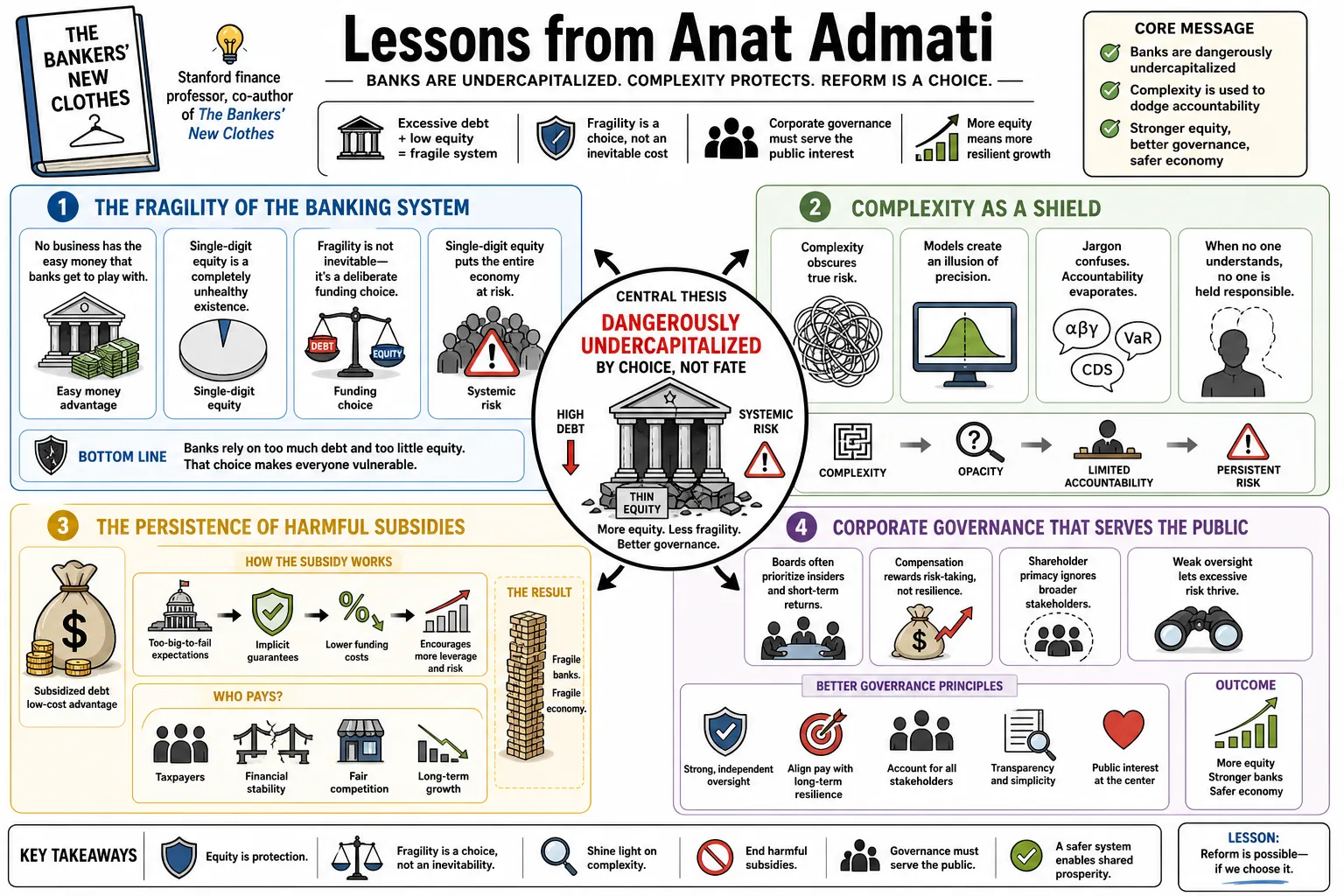
Lessons from Anat Admati
Stanford finance professor Anat Admati, co-author of The Bankers' New Clothes, argues that banks are dangerously undercapitalized. She has consistently dismantled industry claims that requiring banks to fund themselves with more equity would harm the economy. This collection gathers her insights on how the financial sector uses complexity to dodge accountability, why harmful debt subsidies persist, and how corporate governance fails the public. — EconTalk: Admati on bank regulation and The Bankers' New Clothes (2013).
Part 1: The Fragility of the Banking System
- On systemic risk: The fragility of banks is not an unavoidable cost of doing business, but a deliberate choice driven by how they choose to fund themselves. — Reference: Admati and Hellwig, "Does Debt Discipline Bankers?" (Bankers' New Clothes supplement).
- On risk management: Operating with single-digit equity percentages is a highly dangerous approach to managing bank capital that puts the entire economy at risk. — Reference: INET interview, "Our Banking System is a Giant House of Cards" (2015).
- On the danger of current structures: Despite the widespread narrative that post-2008 reforms fixed the system, banks remain dangerously fragile today. — Reference: City St George's, "Carry on banking" (Bayes seminar, 2025).
- On the burden of bailouts: The current system allows bankers to capture the upside while forcing the public to bear the burden of bailouts and economic instability when crises hit. — Reference: INET interview, "Our Banking System is a Giant House of Cards" (2015).
- On bank un-specialness: "Politicians are always saying that banks have always been friends. No. The entire problem in banking is bad governance – including bad rules." Banks are special only because of the privileges they are afforded, and they are so coddled that they do not even know it. — Reference: City St George's, "Carry on banking" (Bayes seminar, 2025).
- On recurring failures: The sudden collapse of banks like Silicon Valley Bank proves that the underlying systemic issues regarding capital and risk have remained unresolved. — Reference: Capitalisn't, "The Capitalisn't of Banking" transcript (2024).
- On the level-playing-field excuse: Weak rules abroad are no reason to weaken them at home. We would not let chemical companies pollute rivers and lakes because another country allows it, and chasing "level playing fields" in banking becomes a race to the bottom. — Reference: Admati and Hellwig, "The Parade of the Bankers' New Clothes Continues" (2019).
Part 2: Debunking Capital Requirements and "Expensive Equity"
- On the definition of capital: "Capital requirements do not require banks to hold anything; they only concern the source of funding banks use and the extent to which investments are funded by equity." — Reference: Admati, written evidence to the UK Treasury Committee (2017).
- On the fallacy of expensive equity: "We examine the pervasive view that 'equity is expensive'... We find that arguments made to support this view are either fallacious, irrelevant, or very weak." — Reference: Admati, DeMarzo, Hellwig and Pfleiderer, "Fallacies, Irrelevant Facts, and Myths" (paper).
- On the social benefits of equity: "Setting equity requirements significantly higher than the levels currently proposed would entail large social benefits and minimal, if any, social costs." — Reference: Admati et al., "Fallacies, Irrelevant Facts, and Myths" (RePEc abstract).
- On industry rhetoric regarding lending: The frequent claim that increasing equity requirements will automatically make lending too expensive or stall economic growth is fundamentally flawed. — Reference: INET interview, "Our Banking System is a Giant House of Cards" (2015).
- On who holds the capital: Corporations do not "hold" their own funding; rather, investors hold claims, such as common shares, that are paid from the cash flows the firm generates. — Reference: Admati, written evidence to the UK Treasury Committee (2017).
- On industry fear-mongering: Admati often borrows Paul Volcker's line that whatever anyone proposes, the banks will claim it restricts credit and harms the economy. Her answer is that lending suffers most when banks have too little equity to absorb losses. — Reference: INET interview, "Our Banking System is a Giant House of Cards" (2015).
Part 3: Too Big to Fail and Regulatory Failure
- On TBTF as a symptom: "‘Too big to fail’ is a symptom of regulatory failure." — Reference: Admati, written evidence to the UK Treasury Committee (2017).
- On the license for recklessness: "Too Big to Fail is a license for recklessness. These institutions defy notions of fairness, accountability, and responsibility." — Reference: INET interview, "Our Banking System is a Giant House of Cards" (2015).
- On the scale of the problem: Megabanks are the largest, most complex, and most heavily indebted corporations in the entire economy. — Reference: INET interview, "Our Banking System is a Giant House of Cards" (2015).
- On the danger of immense institutions: "Institutions considered too big to fail are particularly dangerous because they have an incentive to, and can, become inefficiently large, complex, and opaque." — Reference: Admati, "It Takes a Village to Maintain a Dangerous Financial System" (2016).
- On the impossibility of management: It has become nearly impossible for executives to manage, and for regulators to effectively oversee, financial institutions of this size and opacity. — Reference: INET interview, "Our Banking System is a Giant House of Cards" (2015).
- On regulatory willful blindness: Policymakers frequently succumb to the influence of the banking lobby, resulting in the design and perpetuation of unnecessarily complex rules that fail to address core risks. — Reference: Admati, "It Takes a Village to Maintain a Dangerous Financial System" (2016).
Part 4: Corporate Governance vs. Democracy
- On the definition of good governance: "In the title [of our paper, Why 'Good' Corporate Governance is Not Always Good], the first good is in quotation marks – because it's not good." — Reference: Corporate Crime Reporter interview on internal versus external governance (2024).
- On the limits of corporate law: Corporate law ignores the fact that many of society's most pressing problems cannot be solved in the boardroom; they must be solved at the level of democracy. — Reference: Corporate Crime Reporter interview on internal versus external governance (2024).
- On democratic enforcement: "That's where the government creates and enforces rules. If we did that, we wouldn't need to beg CEOs to do it." — Reference: Corporate Crime Reporter interview on internal versus external governance (2024).
- On misaligned incentives: "The corporations consider good governance as aligning the interests of the shareholders with the interests of the managers... That can actually undermine external enforcement." — Reference: Corporate Crime Reporter interview on internal versus external governance (2024).
- On external vs internal governance: Corporate governance research focuses almost entirely on aligning managers with shareholders, and implicitly assumes the law protects everyone else and is effectively enforced. When that assumption fails, well-aligned managers can cause significant harm. — Reference: Admati, Atkinson and Pfleiderer, "The Harmful Effects of 'Good' Corporate Governance" (ProMarket, 2026).
- On the market test fallacy: "Economists often assume any economic activity that passes the market test is beneficial for society and don't seriously consider the possibility that corporations can find it profitable to cause harm." — Reference: Stanford GSB Insights, "When Good Corporate Governance Creates Incentives for Bad Behavior".
- On threats to institutions: The sheer size and unchecked dominance of the financial industry pose direct threats to the integrity of democratic institutions. — Reference: Stanford FSI, "How Banking Undermines Democracy".
- On false choices: "The stark choices we are often presented within the political discourse — between 'free market capitalism' and 'big government socialism' — are simplistic and misleading." — Reference: Admati, "Anat Admati on Milton Friedman and Justice" (Stanford GSB Insights).
Part 5: The Problem with Debt and Leverage
- On the addiction to borrowing: Borrowing can become addictive through a ratchet effect: once in debt, a borrower is tempted to borrow more but resists reducing it, and government guarantees make that worse. — Reference: Admati and Hellwig, "Does Debt Discipline Bankers?" (Bankers' New Clothes supplement).
- On the subsidization of debt: The current tax code and implicit government guarantees create a system inherently structured to favor borrowing over raising equity. — Reference: INET interview, "Our Banking System is a Giant House of Cards" (2015).
- On magnified losses: Debt mechanically magnifies both returns and losses, rendering any institution operating with minimal equity exceptionally vulnerable to slight downturns in asset values. — Reference: EconTalk: Admati on bank regulation and The Bankers' New Clothes (2013).
- On crony capitalism: Institutions that cannot be allowed to fail are not market capitalism: "Having an institution that cannot fail without imploding the whole system is not capitalism. That's capitalisn't." — Reference: Capitalisn't, "The Capitalisn't of Banking" transcript (2024).
- On the systemic risk of debt: The largest firms can hide enormous risk in derivatives, which ties banks together and turns the system into a house of cards; that opacity is what scares policymakers into bailouts. — Reference: INET interview, "Our Banking System is a Giant House of Cards" (2015).
- On the failure of current regulation: Regulation is complicated because the system is kept living on the edge of a cliff. Admati argues for simpler, stronger rules and much larger safety margins rather than ever more complex fine-tuning. — Reference: INET interview, "Our Banking System is a Giant House of Cards" (2015).
- On the reality of bank funding: High leverage is not an economic necessity for banking; it is a strategic choice made to maximize return on equity for insiders. — Reference: Admati, DeMarzo, Hellwig and Pfleiderer, "Fallacies, Irrelevant Facts, and Myths" (paper).
- On shadow banking: Shadow banking does not escape the problem. Its institutions are intertwined with regular banks through layers of intermediation, so the whole system has to be regulated as one. — Reference: Capitalisn't, "The Capitalisn't of Banking" transcript (2024).
Part 6: The Banking Industry's Political Influence and Lobbying
- On the power of the banking lobby: "Banks are the most powerful lobby in Washington." — Reference: City St George's, "Carry on banking" (Bayes seminar, 2025).
- On the political nature of finance: "Banking is political. You do not understand outcomes in banking without understanding the politics." — Reference: City St George's, "Carry on banking" (Bayes seminar, 2025).
- On industry obstruction: Rational, simple reforms like higher equity requirements are consistently stalled by a lack of political will driven by intense industry lobbying. — Reference: INET interview, "Our Banking System is a Giant House of Cards" (2015).
- On the confusion tactic: The financial sector benefits heavily from public confusion, using technical jargon to shut down democratic debate over how they are regulated. — Reference: Admati, written evidence to the UK Treasury Committee (2017).
- On the co-opting of regulators: The outsized influence of large financial institutions and their executives actively undermines both the regulatory apparatus and the rule of law. — Reference: City St George's, "Carry on banking" (Bayes seminar, 2025).
- On Banking industry narratives: "a disheartening display that showcased the toxic blend of politics and asinine rhetoric" — Nonsense and Bad Rules Persist in Banking
Part 7: Accountability, Liability, and the Rule of Law
- On corporate impunity: When large corporations cause massive societal harm, the legal structure often means that "there's kind of nobody home when you come for—you caused harm." — Reference: Masters in Business transcript with Barry Ritholtz (2022).
- On the enforcement gap: Basic principles of justice and law enforcement frequently and routinely fail when applied in the corporate context. — Reference: Admati, Atkinson and Pfleiderer, "The Harmful Effects of 'Good' Corporate Governance" (ProMarket, 2026).
- On the need for external enforcement: Accountability depends on whether the law is enforced against the corporation, its executives, or both. Aligning managers with shareholders can undermine that external enforcement. — Reference: Corporate Crime Reporter interview on internal versus external governance (2024).
- On basic liability: Deterrence fails when decision-makers are shielded: shareholders routinely protect managers through insurance and indemnification, so increasing the personal liability of key decision-makers in ways shareholders cannot undo would be valuable. — Reference: Admati, Atkinson and Pfleiderer, "The Harmful Effects of 'Good' Corporate Governance" (ProMarket, 2026).
- On the subversion of law: The legal protections and implicit guarantees afforded to major financial institutions create an environment where they are effectively above the law. — Reference: Stanford FSI, "How Banking Undermines Democracy".
- On the impact of corporate dominance: Admati points to HSBC, which laundered money for a murderous drug cartel for years. Concern for financial stability kept the fine to "a few weeks of profits"; in her words, "The banks break the law, and there's nothing we can do." — Reference: City St George's, "Carry on banking" (Bayes seminar, 2025).
- On transparency: Because of the opacity of modern financial systems, we require intense, enforced transparency so that both the public and regulators can recognize when laws are being broken. — Reference: INET interview, "Our Banking System is a Giant House of Cards" (2015).
Part 8: Challenging Economics and Speaking Truth to Power
- On the difficulty of speaking out: "I persisted because I felt a strong sense of responsibility. But challenging people is difficult and no fun. I understand why people avoid it." — Reference: Stanford GSB Faculty Voices profile of Anat Admati.
- On the intersection of disciplines: Admati now treats disinformation as a financial-stability issue: her keynote at the 2026 Cambridge Disinformation Summit was titled "Disinformation and Finance: Systemic Financial Industry Risks." — Reference: Admati, presentations list (Cambridge Disinformation Summit, 2026).
- On the role of academics: Admati sees skepticism as an academic duty: scholars are privileged and should not accept what people say at face value, yet too many are focused on their next top-journal paper instead. — Reference: City St George's, "Carry on banking" (Bayes seminar, 2025).
- On the definition of capitalism: There is no capitalism and there are no markets without functioning democratic institutions and legal systems. Without basic institutions there are no enforceable contracts and no real markets. — Reference: Age of Economics interview with Anat Admati (2021).
- On the necessity of public understanding: Plain language matters. Saying "use more equity" or "borrow less" instead of "hold capital" would elevate the debate and let more people understand the issues that the jargon obscures. — Reference: Admati, written evidence to the UK Treasury Committee (2017).
- On the danger of blind trust: Misplaced trust in powerful financial institutions is not just naive but dangerous: much of the system runs on an illusion of oversight and accountability, while the reality is often regulatory capture and opacity. — Reference: TrustTalk, "The Danger of Blind Trust in Finance" (2025).
- On the purpose of economic advice: Economists should be held accountable for their advice, because failed economic ideas have caused real harm and the same people often keep shaping policy. — Reference: Age of Economics interview with Anat Admati (2021).