Finance researcher André Perold spent three decades teaching at Harvard Business School before co-founding HighVista Strategies, where he serves as Chief Investment Officer. He is best known for inventing the “implementation shortfall”—a mathematical framework that measures the hidden costs of trading—and served on Vanguard’s board of directors for over two decades before retiring in mid-2026. This profile details his findings on market mechanics and portfolio construction, showing how investment theory works in practice. — Vanguard press release on André Perold's board retirement (2026).
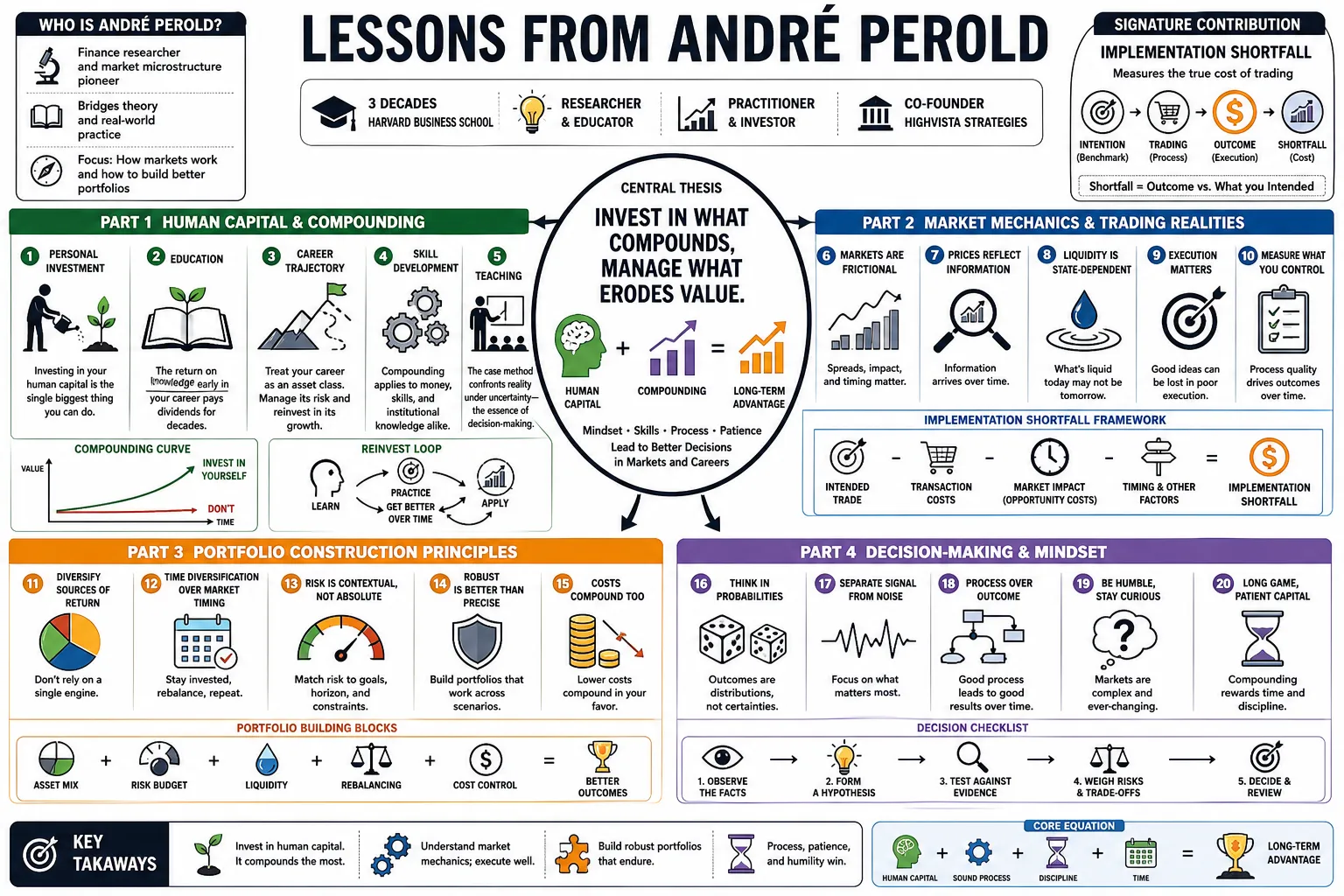
Part 1: Human Capital and Compounding
- On Personal Investment: "Investing in your human capital is the single biggest thing you can do – that's what compounds." — Reference: Podcast Notes on Art of Investing Ep. 10 with André Perold (2024).
- On Skill Development: Compounding is a game of inches: effective compounding means grinding away, little by little, over many decades, and there is nothing glamorous about it. — Reference: Podcast Notes on Art of Investing Ep. 10 with André Perold (2024).
- On Teaching: He chose Harvard Business School for its case method and its focus on the real world, and taught through cases for three decades. — Reference: Podcast Notes on Art of Investing Ep. 10 with André Perold (2024).
- On Early Mistakes: Take chances often and accept you may fail. If a pursuit fails but you keep building your human capital, you are still trending in the right direction. — Reference: Podcast Notes on Art of Investing Ep. 10 with André Perold (2024).
- On Human Relationships in the AI Era: In a world saturated with AI-generated data, maintaining long-term relationships with trusted individuals provides a critical investing edge by revealing risks and opportunities that quantitative analysis alone cannot uncover. — Institutional Investor
Part 2: Implementation Shortfall and Trading Costs
- On Paper vs. Reality: His implementation shortfall measures the gap between a paper portfolio, traded instantly at the decision price, and the actual portfolio after all trading frictions. — Reference: Implementation shortfall explained: the Perold (1988) framework.
- On the Decision Price: The benchmark is the decision price, the price when the investment decision is made, so every cost incurred between deciding and completing the trade is counted. — Reference: Implementation shortfall explained: the Perold (1988) framework.
- On Hidden Friction: Commissions are only the visible part. The framework adds market impact, the cost of delay, and the opportunity cost of shares never bought or sold. — Reference: Implementation shortfall explained: the Perold (1988) framework.
Part 3: Market Efficiency and Inefficiencies
- On Zero-Sum Games: There is never safety in numbers in investing: there is always someone else on the other side of your trade. — Reference: Podcast Notes on Art of Investing Ep. 10 with André Perold (2024).
- On Structural Inefficiency: He looks for "beautifully inefficient" markets: smaller corners of the investing world where size, specialization and human behavior still create opportunities. — Reference: Institutional Investor, "Andre Perold on AI" (2026).
- On Market Niches: Knowing where the large money cannot play is an advantage. Small, smart money can win in areas too small or illiquid for big investors. — Reference: Podcast Notes on Art of Investing Ep. 10 with André Perold (2024).
- On Technological Change: "The ability to get an edge is much greater when new things are happening, for better or worse. You can see things, understand things, and react more easily in this new world." — Institutional Investor
- On Biotech Market Structure: "There are some 600-700 biotech stocks, and the vast bulk of them are small cap and quite illiquid." — Hedge Fund Alpha
Part 4: The Endowment Model and Multi-Asset Investing
- On policy before tactics: Rebalancing decisions follow from the investment policy and strategy: "If well formulated, they will tell you what to do." — Reference: André Perold, "Portfolio Rebalancing: What, When, How?" AIF Institute presentation (May 2020).
- On different missions, same portfolios: "Institutional pools are often managed similarly even though they serve very different objectives." He warns to "beware of competing objectives which compromise goal setting and execution." — Reference: André Perold, "Portfolio Rebalancing: What, When, How?" AIF Institute presentation (May 2020).
- On buy and hold: Of all portfolio strategies, doing nothing (buy and hold) is special: "This is the only strategy we all can follow." — Reference: André Perold, "Portfolio Rebalancing: What, When, How?" AIF Institute presentation (May 2020).
- On price: Investing is all about when the price is a good price. Great compounders command high prices, so you must account for the price you pay to compound. — Reference: Podcast Notes on Art of Investing Ep. 10 with André Perold (2024).
Part 5: Private Equity and Venture Capital
- On Life Sciences: He sees biotech as the future of healthcare. Small biotechs are high-risk moonshots, and successful ones are typically acquired by large pharmaceutical companies. — Reference: Podcast Notes on Art of Investing Ep. 10 with André Perold (2024).
Part 6: Active versus Passive Management
- On Small Geniuses: Some of the most interesting managers are small, low-profile investors; strong results eventually attract capital, so the search for the next overlooked manager must continue. — Institutional Investor
Part 7: Risk Management and Downside Protection
- On diversification: Diversification is "the great free lunch" in investing, though it is much harder to practice in life. — Reference: Podcast Notes on Art of Investing Ep. 10 with André Perold (2024).
- On concave and convex strategies: With Bill Sharpe he showed that rebalancing to a constant mix (buying on dips, selling on rallies) earns a benefit from volatility, while portfolio insurance (selling on dips, buying on rallies) pays a cost for it. — Reference: André Perold, "Portfolio Rebalancing: What, When, How?" AIF Institute presentation (May 2020).
- On when rebalancing hurts: Rebalancing has a weakness: "Long term divergences are unfavorable for rebalancing"—when one market keeps outrunning another, as the S&P 500 did against EAFE and Japan, selling the winner costs you. — Reference: André Perold, "Portfolio Rebalancing: What, When, How?" AIF Institute presentation (May 2020).
- On Regulatory Vulnerability: Within the biotech sector, development-stage firms are disproportionately punished by negative political sentiment because their entire business model relies on smooth regulatory approvals, whereas commercial-stage firms often track broader equities. — Hedge Fund Alpha
Part 8: Academic Theory versus Practitioner Reality
- On theory versus reality: Financial theory is an idealized description of the world. The world does not work the way the theory says, and there is money to be made in the gap. — Reference: Podcast Notes on Art of Investing Ep. 10 with André Perold (2024).
- On the CAPM's legacy: The Capital Asset Pricing Model "revolutionized modern finance" by providing "the first coherent framework for relating the required return on an investment to the risk of that investment." — Reference: André F. Perold, "The Capital Asset Pricing Model," Journal of Economic Perspectives (2004).
- On Teaching versus Doing: Teaching is the best way to learn something. Teaching others forces you to work out problems in a superior way. — Reference: Podcast Notes on Art of Investing Ep. 10 with André Perold (2024).