Andrew Ambrosino is an engineer and product leader who helped found the financial infrastructure company Catch before joining OpenAI as a Member of Technical Staff, where he leads the Codex desktop app. He argues that as AI drives software implementation costs to zero, product work inverts, leaving curation and taste as a team’s primary value. This profile collects his notes on AI workflows, design, and strategy to show how technical roles are adapting to frontier models.
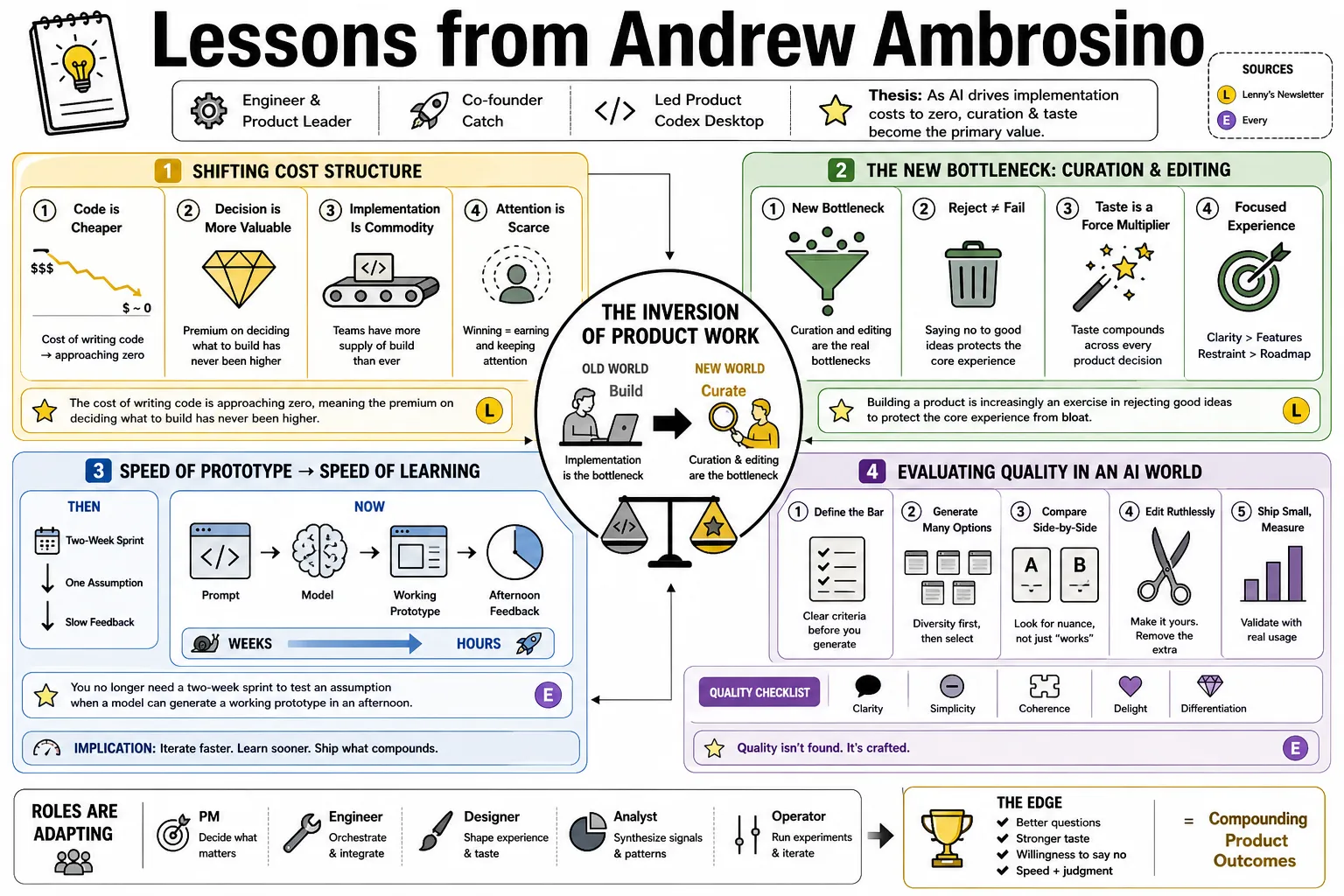
Part 1: The Inversion of Product Work
- On the shifting cost structure: "The cost of writing code is approaching zero, meaning the premium on deciding what to build has never been higher." — Source: Lenny's Newsletter
- On the new bottleneck: "Implementation used to be the primary constraint for software teams; today, curation and editing are the real bottlenecks." — Source: Lenny's Newsletter
- On curation: "Building a product is increasingly an exercise in rejecting good ideas to protect the core experience from bloat." — Source: Lenny's Newsletter
- On prototyping speed: "You no longer need a two-week sprint to test an assumption when a model can generate a working prototype in an afternoon." — Source: Every
- On evaluating quality: "When generation is cheap, the skill that matters most is the ability to recognize whether the output is actually good." — Source: Lenny's Newsletter
- On product debt: "Faster coding means faster accumulation of technical and product debt if teams lack rigorous editing filters." — Source: Lenny's Newsletter
- On the value of editing: "An AI can give you fifty iterations of a feature; a great product manager is the one who confidently discards forty-nine of them." — Source: Every
- On building conviction: "You have to develop a strong internal thesis for the product, because you can no longer hide behind the excuse that 'it takes too long to build'." — Source: Lenny's Newsletter
- On rapid iteration: "The feedback loop between having an idea and interacting with it has shrunk from months to hours." — Source: Every
- On shifting focus: "We spend less time arguing about how to build a feature and more time debating why we should build it at all." — Source: Lenny's Newsletter
Part 2: Taste and Design Judgment
- On defining taste: "Taste is more than making things look nice; it is the specific judgment required to align a product with user expectations and constraints." — Source: Lenny's Newsletter
- On the compiler for design: "Code is easy to evaluate because there is a compiler that tells you if it works. Design is harder because the compiler is human emotion." — Source: Business Insider
- On AI's design limits: "Language models excel at logic and syntax, but they still struggle to invent novel visual paradigms from scratch." — Source: Business Insider
- On the value of aesthetic intuition: "As logic becomes commoditized, aesthetic intuition and user empathy become the primary differentiators for consumer software." — Source: Lenny's Newsletter
- On subjective feedback: "You can't write a unit test for delight. That still requires a human adjusting the timing of an animation or the weight of a font." — Source: Business Insider
- On training taste: "You develop better product taste by relentlessly consuming high-quality software and paying attention to the micro-interactions." — Source: Lenny's Newsletter
- On visual hierarchy: "Models can place elements on a screen, but they often fail to understand the subtle visual hierarchy needed to guide a user's eye naturally." — Source: Business Insider
- On opinionated design: "The best software in an AI era will be highly opinionated, because unopinionated software will be trivial to generate automatically." — Source: Lenny's Newsletter
- On craft: "Craft is the margin between something that technically functions and something a user actually wants to interact with every day." — Source: Ambrosino.io
- On the human edge: "Until models can feel frustration, human designers will hold an advantage in anticipating and solving user friction." — Source: Business Insider
Part 3: The OpenAI Codex Desktop App
- On initial adoption: "Nearly every person at OpenAI, regardless of their role or engineering background, uses the Codex app on a weekly basis." — Source: Lenny's Newsletter
- On creating a home base: "We wanted to build a persistent home base that acts as the coordinating layer for your daily workflows." — Source: Every
- On timing the launch: "Releasing a product too early can ruin the magic. We held back on Codex until the underlying models met a specific reliability threshold." — Source: Lenny's Newsletter
- On continuous context: "The app is designed to maintain context across your environment so you don't have to constantly explain your workspace to the model." — Source: Every
- On automating chores: "A major goal of the app is handling the invisible, mundane tasks, like writing boilerplate or hunting down minor bugs, so developers can focus on architecture." — Source: Every
- On user trust: "Building a desktop agent requires earning trust quickly; if it hallucinates or deletes code early on, the user won't come back." — Source: Every
- On non-technical usage: "The fact that non-engineers are using a coding tool shows that the barrier between natural language and software creation is dissolving." — Source: Lenny's Newsletter
- On desktop vs web: "A native desktop environment provides the deep system access necessary for an agent to actually execute tasks on your behalf." — Source: Every
- On internal dogfooding: "Testing the app relentlessly within OpenAI gave us the feedback loops needed to understand how power users actually want to interact with agents." — Source: Lenny's Newsletter
- On the ultimate goal: "The aim goes beyond autocomplete for code; it is building a collaborator that can manage an entire PR lifecycle." — Source: Every
- On Diverse use cases: People are already using the application for video editing, documents, spreadsheets, slide decks, production code, and internal launch-tracking sites. — Big Technology
- On User experience toggles: A toggle can change whether the app presents a code-intensive or less technical experience without changing the product's underlying capabilities. — Big Technology
Part 4: Redefining Team Dynamics and Roles
- On zone defense: "Rather than rigid roles, our product teams operate in a 'zone defense' model where anyone can jump in to solve the most pressing bottleneck." — Source: Lenny's Newsletter
- On collapsing roles: "The traditional boundaries between product management, design, and engineering are blurring as tools allow individuals to span all three disciplines." — Source: Lenny's Newsletter
- On the danger of eliminating PMs: "Getting rid of product managers entirely is a mistake; the need for coordination and strategic alignment scales up, not down, when execution speeds up." — Source: Lenny's Newsletter
- On engineering versatility: "Engineers are increasingly expected to make product decisions because they can iterate on the experience directly with the model." — Source: Lenny's Newsletter
- On cross-functional empathy: "When a designer can spin up a functional React component, they develop a deeper empathy for the engineering constraints." — Source: Ambrosino.io
- On speed of alignment: "High-performing teams in the AI era spend their synchronous time strictly on alignment, leaving execution to asynchronous work augmented by models." — Source: Lenny's Newsletter
- On hiring criteria: "We index heavily on agency and the ability to navigate ambiguity over deep specialization in a single framework." — Source: Lenny's Newsletter
- On the role of design: "Designers must evolve into system architects, creating the rule sets that allow AI to generate on-brand interfaces dynamically." — Source: Ambrosino.io
- On organizational drag: "Any process that slows down the deployment of a validated prototype is organizational drag that needs to be eliminated." — Source: Lenny's Newsletter
- On Flexible team structures: Ambrosino uses a “zone defense” model for product management at OpenAI when everyone can build, while cautioning that eliminating roles entirely would be a mistake. — Lenny's Newsletter
Part 5: AI's Capability Thresholds
- On threshold dynamics: "There are specific thresholds of model capability where a tool suddenly flips from being a neat toy to an indispensable workflow engine." — Source: Lenny's Newsletter
- On predictability: "The challenge with frontier models is that their capabilities often increase irregularly; a capability might be completely absent one month and state-of-the-art the next." — Source: Lenny's Newsletter
- On roadmapping with AI: "Traditional product roadmaps fail when the underlying technology improves faster than you can execute your plan." — Source: Lenny's Newsletter
- On latency vs intelligence: "Sometimes the intelligence of a model is less important than its latency; a slightly dumber model that responds instantly is often better for flow state." — Source: Every
- On context windows: "Expanding context windows fundamentally changes how we interact with agents, moving from single prompts to continuous, ambient collaboration." — Source: Every
- On debugging agents: "When an agent fails, it is often a failure of context, not reasoning. It didn't know a specific constraint about your codebase." — Source: Every
- On anticipating improvements: "You have to build features assuming the model will be twenty percent smarter by the time you ship, otherwise you arrive at launch with a legacy product." — Source: Lenny's Newsletter
- On the ceiling of generation: "We are still finding the ceiling of what context-aware generation can do before it requires explicit logical planning from the user." — Source: Every
- On the transition to agents: "The shift from chatbots to agents is the shift from a tool that answers questions to a tool that takes accountability for outcomes." — Source: Every
- On Over-refusal in general AI: General knowledge-work tools should avoid unnecessary constraints and refusals that prevent actions coding agents can already perform, while retaining permission checks. — Big Technology
Part 6: Catch and Financial Infrastructure
- On fragmented infrastructure: "We built Catch because the financial infrastructure for independent workers was completely fragmented across disparate, outdated systems." — Source: Catch
- On B2C complexity: "At the time, we were unique in building a B2C product that had to simultaneously handle the regulatory complexities of banking, investing, and health insurance." — Source: Ambrosino.io
- On building trust: "When you are handling someone's taxes and retirement, the UI cannot afford to look experimental; it must project absolute stability and security." — Source: Ambrosino.io
- On the gig economy: "The gig economy created a massive gap in the social safety net, and technology was the only way to aggregate those services scalably." — Source: Catch
- On API integrations: "The hardest part of building financial platforms is normalizing the chaotic APIs of legacy insurance and banking providers." — Source: Ambrosino.io
- On the Y Combinator experience: "YC forces you to compress years of assumed progress into a few weeks, which clarifies exactly what features are actually necessary for survival." — Source: Ambrosino.io
- On product consolidation: "Users do not want five different apps to manage their financial life; they want a single, cohesive interface that makes the routing decisions for them." — Source: Catch
- On market timing: "Catch proved that the demand for portable benefits was real, even if the regulatory environment was slow to catch up." — Source: Ambrosino.io
- On startup exits: "Selling a company requires the same intense focus on narrative and value alignment as raising your seed round." — Source: Ambrosino.io
Part 7: The Limitations of AI in Creative Software
- On the absence of constraints: "AI struggles with design because great design requires adhering to invisible, cultural constraints that aren't documented in codebases." — Source: Business Insider
- On spatial reasoning: "Translating a flat, two-dimensional layout into a responsive, fluid interface requires a type of spatial reasoning that models are still learning." — Source: Business Insider
- On the uncanny valley of UI: "When AI generates a user interface without human editing, it often falls into an uncanny valley where it looks like a real app, but feels fundamentally off when you interact with it." — Source: Ambrosino.io
- On iterative refinement: "You can't easily tell a model to make a design pop more. You need a shared vocabulary of design principles, which is hard to prompt." — Source: Business Insider
- On brand identity: "Maintaining a strict, unique brand identity across a sprawling application is difficult for an AI that defaults to the statistical average of all design." — Source: Ambrosino.io
- On motion and timing: "The subtleties of motion design, such as knowing when a modal should ease-in versus snap, remain heavily dependent on human intuition." — Source: Ambrosino.io
- On standardizing components: "AI is excellent at assembling pre-designed components from a design system, but terrible at inventing the design system itself." — Source: Business Insider
- On emotional resonance: "Software is a relationship between the creator and the user; AI can simulate the function, but humans must inject the warmth." — Source: Ambrosino.io
- On the future of front-end: "The role of the front-end developer will shift from writing CSS to art-directing the model's visual outputs." — Source: Ambrosino.io
- On Explicit intent: "There are a lot of use cases where we can’t necessarily tell what you want" — Big Technology
Part 8: The Future of Workflow and Software
- On ambient computing: "The goal of AI in the workplace is not building another dashboard. It is creating an ambient layer that anticipates what you need before you type a query." — Source: Every
- On software creation: "In the future, buying SaaS might be replaced by generating bespoke, single-use software that exists only for the duration of a task." — Source: Lenny's Newsletter
- On the death of boilerplate: "Nobody should be writing boilerplate routing logic or authentication wrappers ever again." — Source: Every
- On natural language: "Natural language is becoming the universal API for interacting with complex systems, bypassing the need for specialized syntax." — Source: Lenny's Newsletter
- On tool consolidation: "As agents become capable of executing tasks across different domains, the need for dozens of specialized productivity tools will collapse." — Source: Every
- On the speed of thought: "The ultimate metric for an AI workflow tool is how closely it matches the speed of the user's thought process." — Source: Every
- On continuous integration: "Agents will eventually manage the entire integration pipeline autonomously, alerting humans only when strategic decisions are required." — Source: Every
- On personalizing workflows: "Every user will have a uniquely configured agent that understands their specific quirks, coding style, and preferences." — Source: Lenny's Newsletter
- On the enduring value of humans: "No matter how advanced the models get, the human will remain the executive deciding which problems are actually worth solving." — Source: Lenny's Newsletter
- On Tapping into memory: The new ChatGPT experience limits automatic reliance on user history but will access its memory if explicitly prompted. — Big Technology
- On The Superapp: Ambrosino described the new application as the start of a superapp meant to handle anything a user can do on a computer. — Big Technology
- On Competitive advantage: Moving after competitors can be useful when it lets a team observe how the product category should work before executing its own version. — Big Technology