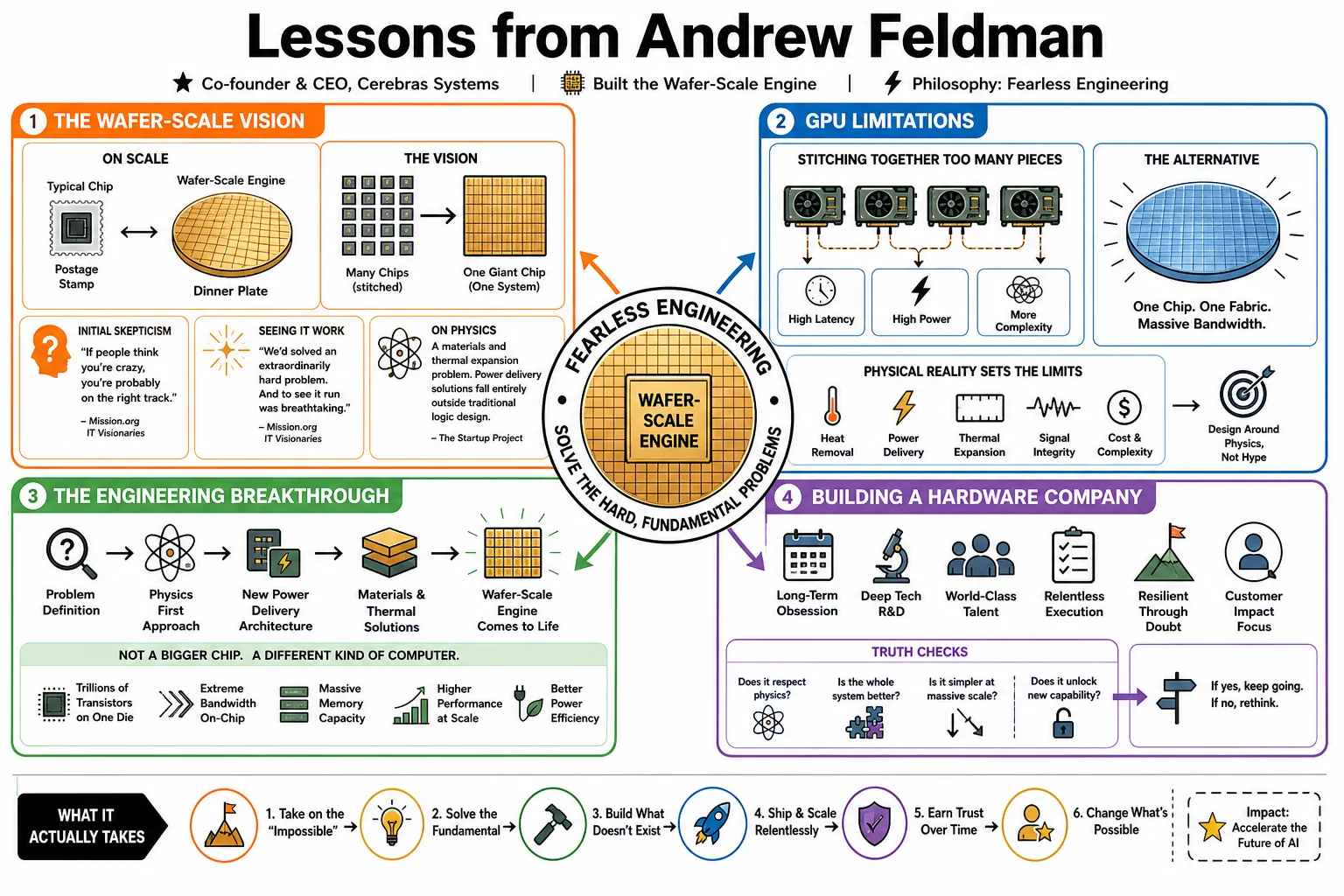
Lessons from Andrew Feldman
Andrew Feldman is the co-founder and CEO of Cerebras Systems, where he led the development of the Wafer-Scale Engine, the largest computer chip ever built. He built the company around "fearless engineering," a philosophy of taking on the fundamental physics and hardware problems the rest of the industry wrote off as impossible. This profile covers his perspective on hardware design, the physical limits of AI infrastructure, and what it actually takes to build a hardware company.
Part 1: The Wafer-Scale Vision
- On Scale: "Most chips are the size of a postage stamp, and this is the size of a dinner plate." — Source: Bloomberg Odd Lots
- On Initial Skepticism: "If people think you're crazy, you're probably on the right track." — Source: Mission.org IT Visionaries
- On Seeing It Work: "We'd solved an extraordinarily hard problem. And to see it run was breathtaking." — Source: Mission.org IT Visionaries
- On Physics: The challenge of building a wafer-scale chip is a materials and thermal expansion problem, requiring solutions for power delivery that fall entirely outside traditional logic design. — Source: The Startup Project
- On GPU Limitations: Stitching together thousands of tiny GPUs creates massive communication bottlenecks; the wafer-scale engine solves this by keeping everything on a single piece of silicon. — Source: The Twenty Minute VC
- On Inference: High-speed AI inference requires a fundamentally different architecture than hardware designed for graphics rendering. — Source: Bloomberg Odd Lots
- On Architectural Shifts: We believed in 2015 that AI workloads would require an entirely new architecture, rendering a remodel of existing silicon insufficient. — Source: The Startup Project
- On Memory Bandwidth: The massive size of the chip allows for unprecedented memory bandwidth, which acts as the true bottleneck for AI inference. — Source: The Twenty Minute VC
- On Data Movement: You cannot trick physics; if your chip is small, you spend the majority of your time moving data off-chip, resulting in slow and expensive operations. — Source: Bloomberg Odd Lots
Part 2: Fearless Engineering
- On Problem Selection: "We love solving problems that other people say can't be solved. We love hard problems... if you know the answer when you start, it's not an interesting problem." — Source: EE Times
- On Definition: Fearless engineering means pursuing problems that others believe cannot be solved, intentionally working without a safety net. — Source: Mission.org IT Visionaries
- On Mindset: The core of our engineering philosophy prioritizes learning heavily over the fear of failure. — Source: The Key Executives
- On Capital: Venture capital serves as the dry powder that allows a team to continue making aggressive, fearless engineering choices. — Source: Financial Post
- On Incrementalism: We set out to do fearless engineering in relentless pursuit of the extraordinary rather than building something incrementally better. — Source: Cerebras Systems
- On Hardware Mistakes: In hardware, mistakes are baked into silicon and cost millions; fearless engineering requires getting the fundamentals right before you tape out. — Source: The Startup Project
- On Technical Risk: True innovation requires taking technical risks that actively make traditional engineers uncomfortable. — Source: Mission.org IT Visionaries
- On Safety Nets: When you are building something that has never been built before, there is no reference manual to fall back on. — Source: EE Times
- On The Climax of Development: "It was such an awesome moment where every ounce of what you've put in is now alive and working." — Source: Mission.org IT Visionaries
- On Challenging Assumptions: The entire semiconductor industry assumed wafer-scale was impossible because of yield issues, an assumption we had to systematically prove wrong. — Source: The Twenty Minute VC
Part 3: Challenging the Status Quo
- On Competition: We built Cerebras to challenge the dominant forces in the industry rather than to exist as a secondary player. — Source: The Twenty Minute VC
- On Breaking Monopolies: The market wants an alternative, but that alternative has to be vastly superior to break the existing ecosystem lock-in. — Source: The Startup Project
- On Ecosystems: The future of AI relies heavily on open-source models, which act as a counterbalance to closed-source monopolies. — Source: Bloomberg Odd Lots
- On Market Misunderstanding: "It is misunderstood. You know, we laid out a plan at the start of '26... and we're beating that plan." — Source: Yahoo Finance
- On The AI Bubble: We are in the early stages of a massive infrastructure build-out trying to meet unprecedented demand, contrary to bubble narratives. — Source: The Twenty Minute VC
- On Historical Context: Unlike the 1990s fiber optic build-out where supply outpaced demand, today's AI hardware market is defined by a desperate lack of supply. — Source: Substack
- On Data Sovereignty: Nations are realizing they need sovereign AI infrastructure, shifting the primary buyer dynamic from enterprise IT to national governments. — Source: Bloomberg Odd Lots
- On System Requirements: The ecosystem expands beyond the chip to encompass compilers, open-source models, and massive power management. — Source: theCUBE
- On Public Markets: Navigating public markets requires focusing strictly on execution over short-term price fluctuations. — Source: Bloomberg Talks
Part 4: Entrepreneurial Hustle and Work Ethic
- On Work-Life Balance: "This notion that somehow you can achieve greatness, you can build something extraordinary by working 38 hours a week and having a work-life balance — that is mind-boggling to me." — Source: The Economic Times
- On Commitment: Challenging a trillion-dollar incumbent requires an "every waking minute" level of commitment from the founding team. — Source: Business Insider
- On Elite Performance: Building a generational company is like competing in elite athletics, requiring sacrifice that most people are unwilling to make. — Source: The Economic Times
- On Hiring: You have to find people who are completely obsessed with solving the exact problem you are tackling. — Source: The Startup Project
- On The Founder's Job: The founder must absorb the stress of the unknown so the engineering team can focus strictly on the physics. — Source: Alejandro Cremades
- On Stamina: The hardware cycle is long and unforgiving, demanding the stamina to sustain intense focus for years before you see a working product. — Source: The Twenty Minute VC
- On Intensity: The intensity of the work environment acts as a filter, attracting the people who want to do the best work of their lives. — Source: Business Insider
- On Greatness: Greatness is the result of compounding extreme effort over a long period. — Source: The Economic Times
- On Reality: You cannot wish away technical hurdles; you must face the brutal facts of your design every single day. — Source: Mission.org IT Visionaries
- On Ambition: If you want to change the computing landscape, you have to accept that it will cost you a normal life. — Source: Alejandro Cremades
Part 5: Infrastructure and Physical Bottlenecks
- On The Bottleneck: "A wonderful irony is that after we and Nvidia invented all this technology, buildings are the limiting factor." — Source: TradingKey
- On Capacity: "It's no secret that data center capacity is at a premium. It's a dog fight out there." — Source: MooMoo
- On Power Requirements: The next frontier of AI involves securing the megawatts required to turn the chips on, rather than simply optimizing floating-point operations. — Source: Bloomberg Odd Lots
- On Grid Mismatch: We currently have 21st-century silicon heavily constrained by 20th-century power grids. — Source: The Twenty Minute VC
- On The Memory Wall: Memory bandwidth dictates how fast an AI model can generate tokens, serving as a harder limit than pure compute speed. — Source: theCUBE
- On Thermodynamics: Pushing massive amounts of power into a small area creates a thermal challenge that requires entirely new cooling architectures. — Source: Bloomberg Odd Lots
- On Supply Chains: The semiconductor supply chain is incredibly fragile and requires years of advance planning to secure packaging and memory. — Source: Bloomberg Talks
- On Physical Reality: AI is pulling software back into the physical world; you cannot scale AI without pouring concrete and pulling copper wire. — Source: The Twenty Minute VC
- On Deployment: The speed at which you can physically deploy a cluster is now a major competitive advantage in the AI arms race. — Source: theCUBE
- On Supercomputers: What used to be considered a national supercomputer is now standard infrastructure for training a frontier AI model. — Source: Bloomberg Odd Lots
Part 6: Corporate Responsibility and Community
- On Reputation: The AI industry has done a "terrible job" of being good neighbors when building massive data centers. — Source: India Times
- On Thoughtful Building: "These can be clean, they can make jobs, they can be good for communities. We can do this thoughtfully." — Source: Business Insider
- On Giving Back: Tech companies should proactively invest in local infrastructure like schools and sports facilities, rather than simply extracting resources. — Source: India Times
- On Scale and Ethics: We cannot build the future of AI at the expense of the local communities that host our machines. — Source: Business Insider
- On Energy Efficiency: As we consume more power, we have a moral obligation to pursue the most energy-efficient architectures possible. — Source: theCUBE
- On Partnerships: A data center represents a multi-decade commitment to a town, requiring you to treat the municipality as a partner. — Source: The Twenty Minute VC
- On Transparency: Communities deserve to know the exact environmental and economic impact of the AI factories being built in their backyards. — Source: India Times
- On Growth: Unchecked growth is a dangerous mindset when dealing with physical infrastructure that affects real people. — Source: Business Insider
- On Backlash: If we fail to change how we build data centers, the AI industry will face severe regulatory and public backlash. — Source: The Twenty Minute VC
Part 7: Hiring, Talent, and Immigration
- On Visas: "We are a company that relies on the H-1B program." — Source: PBS Nightly Business Report
- On Global Sourcing: The hardest engineering problems require the smartest people in the world, regardless of where they were born. — Source: UC Davis Economics
- On Competitiveness: Restricting high-skilled immigration directly harms American competitiveness in the semiconductor industry. — Source: PBS Nightly Business Report
- On Hiring Criteria: We evaluate engineers based on their willingness to fail at something that has never been done before. — Source: The Startup Project
- On The Real Bottleneck: The bottleneck for AI encompasses finding engineers capable of writing compilers for massive parallel architectures, beyond physical constraints like power. — Source: The Twenty Minute VC
- On Retention: You keep elite talent by giving them problems that are so difficult they cannot stop thinking about them. — Source: Alejandro Cremades
- On Multidisciplinary Work: Building a wafer-scale engine requires material scientists, compiler engineers, and hardware architects to speak a common language. — Source: Mission.org IT Visionaries
- On Silicon Valley: The unique advantage of Silicon Valley is its ability to aggregate brilliant immigrants and point them at impossible problems. — Source: PBS Nightly Business Report
- On Ambition: A great engineer wants to put a dent in the universe rather than simply holding a job. — Source: The Key Executives
Part 8: Lessons from SeaMicro and Past Ventures
- On Identifying Inefficiencies: SeaMicro was born from the realization that traditional servers wasted massive amounts of power on tasks that didn't require it. — Source: UChicago
- On Early Microservers: We proved that you could build high-bandwidth, energy-efficient infrastructure by completely rethinking the fundamental building blocks of a server. — Source: Clay.com
- On Timing: Being early to a hardware trend requires surviving long enough for the software ecosystem to catch up. — Source: One Giant Leap
- On Validation: The AMD acquisition heavily validated our thesis that energy-efficient, dense compute was the future of the data center. — Source: Financial Express
- On Hardware Constraints: The lessons learned at SeaMicro regarding power limits and bandwidth directly informed the architecture of Cerebras. — Source: The Startup Project
- On Serial Entrepreneurship: Every company you build teaches you exactly which assumptions to challenge and which physics equations you must respect. — Source: Alejandro Cremades
- On Evolution: We moved from optimizing power at SeaMicro to optimizing memory bandwidth at Cerebras, while maintaining a core focus on data center efficiency. — Source: theCUBE
- On Incumbents: At SeaMicro, we learned how to carve out a massive market opportunity even when surrounded by entrenched competitors. — Source: UChicago
- On Resilience: Building a hardware startup is a grueling marathon; the experience of SeaMicro built the specific resilience needed for Cerebras. — Source: Alejandro Cremades