Andrew Golden served as the president of the Princeton University Investment Company (PRINCO) from 1995 to 2024, guiding the university’s endowment from under $4 billion to more than $34 billion. Following his retirement from Princeton, he became a Senior Advisor at WestBridge Capital and a trustee for the Simons Foundation. He is known for building a distinct investment culture focused on finding “undertapped pools of talent” and cultivating deep, long-term partnerships with outside managers. This profile collects his approaches to manager selection, institutional discipline, and the behavioral realities of capital allocation. — WestBridge Capital, Andrew Golden profile.
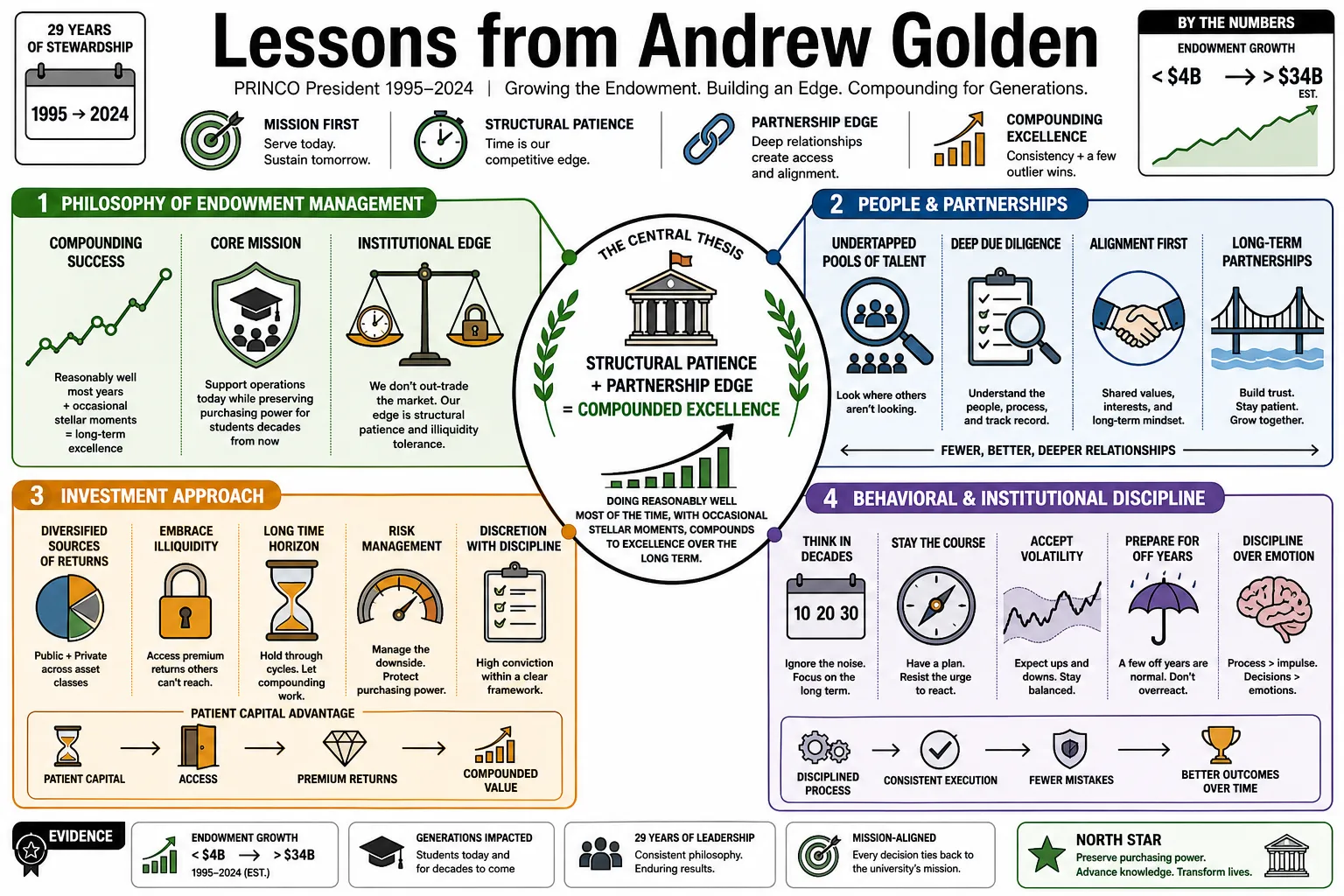
Part 1: The Philosophy of Endowment Management
- On saying "I don't know": "The most dangerous words in investing are, 'It's different this time.' I think the most powerful words in investing are, 'I don't know.'" The policy portfolio is what you fall back on when you don't know. — Reference: Vintage Investment Partners, interview with Andrew K. Golden (2021).
- On the Core Mission: The endowment's mission is to provide inflation-adjusted support in perpetuity, and that "redefines risk": "Playing it safe, the way a retiree might play it safe, actually guarantees failure." — Reference: Princeton University, "PRINCO President Andrew Golden to retire in 2024" (2023).
- On Institutional Edge: Asked about PRINCO's investment horizon, his answer is "Forever." The endowment backs managers early and sticks with them through market ups and downs. — Reference: Institutional Investor, "How Andy Golden Reinvented the Endowment Model for Princeton" (2023).
- On investing for your circumstances: Every investor should work out their objectives and where they do and don't have advantages: "A $26 billion diamond should be invested differently than the funds for an 80-year-old widow." — Reference: Vintage Investment Partners, interview with Andrew K. Golden (2021).
- On Policy Portfolios: The policy portfolio is "a default position, a kind of safe harbor… for those times when we're not sure about the world." In his view "the most powerful words in investing are, 'I don't know.'" — Reference: Vintage Investment Partners interview with Andrew Golden (2021).
- On Values and the Endowment: "I often hear people say, 'I wish that the endowment would reflect my own values.' Well, that’s not entirely correct. The endowment should reflect the values of the entire University community, which more often than not are messy and contradictory." — Princeton Alumni Weekly
- On Divestment and Morality: Golden argues that when the University community recognizes a moral obligation, it should act even at a financial cost. — The Daily Princetonian
- On Intergenerational Equity: His north star was strong returns over a 25-year horizon and beyond, so that future Princeton students enjoy the same opportunities as past generations. — Reference: Princeton University, "PRINCO President Andrew Golden to retire in 2024" (2023).
Part 2: Finding Talent and Avoiding the Herd
- On Manager Selection: PRINCO focuses "much more on talent than what fishing pond they're playing" when choosing managers. — Reference: Vintage Investment Partners interview with Andrew Golden (2021).
- On Undertapped Pools of Talent: Seek undertapped pools of talent. If you rely only on referrals from managers you already know, "and if that network is reasonably homogenous, then you can see that you're never going to break free." — Reference: Institutional Investor, "How Andy Golden Reinvented the Endowment Model for Princeton" (2023).
- On bottom-up bets: PRINCO leans on managers' expertise rather than grand asset-allocation calls, so "you have the law of large numbers working for you, as opposed to the law of small numbers working against you." — Reference: Vintage Investment Partners, interview with Andrew K. Golden (2021).
Part 3: The Meaning of True Partnership
- On the Pursuit of Partnership: "I think the hallmark of PRINCO, one of the things that distinguishes us, is that pursuit of partnership." — Reference: Princeton University, "PRINCO President Andrew Golden to retire in 2024" (2023).
- On Client Dynamics: He dislikes the phrase "manager selection" because it implies the managers make all the decisions; he describes the work as partnering with managers. — Reference: Institutional Investor, "How Andy Golden Reinvented the Endowment Model for Princeton" (2023).
- On good clients: "There's an old saying that good clients make for good architects"—a principle he applies across PRINCO's relationships with its managers. — Reference: Vintage Investment Partners, interview with Andrew K. Golden (2021).
Part 4: Managing Through Crises and Volatility
- On not catching a falling knife: In 2008 he broke his habit of buying into declines: "We had a sense this was actually as big a deal as the markets were indicating. We didn't want to be catching a falling knife." — Reference: Princeton Alumni Weekly, "After the crash" (2009).
- On flexibility as overrated: "Our whole approach is predicated on the sense that flexibility in any one given time is an overrated commodity." — Reference: Princeton Alumni Weekly, "After the crash" (2009).
- On long-term, not autopilot: In October 2008 he called it "the toughest market environment that any active professional has ever seen," but held the plan: "There's a difference between focusing on the long term and being on autopilot. We're not on autopilot." — Reference: Princeton Alumni Weekly, "Endowment gains in '07-'08, then takes a slide" (2008).
- On a liquidity buffer: After 2008 Princeton built a conservative liquidity fund so that "in the heat of tough times... you're able to react with greater confidence," accepting lower expected returns on that slice. — Reference: Princeton Alumni Weekly, "After the crash" (2009).
- On staying the course: "We recognized there would be extreme environments. So we stayed the course. Sticking with the plan is actually responsible for the solid results this year." — Reference: Princeton Alumni Weekly, "A 14.7% investment return as Princo 'stays the course'" (2010).
- On False Recoveries: After a long liquidity drought in private equity he cautioned that a thaw might be "just a blip" or "a head fake," not the start of a new trend. — Reference: Pension Pulse, quoting Golden's 2024 Financial Times interview.
Part 6: Building a Winning Culture
- On the Secret Sauce: "Our secret sauce is to partner well with a promise of long-term partnership," which he says has paid off through good and bad markets more than timing any one area. — Reference: Vintage Investment Partners interview with Andrew Golden (2021).
- On Team Design: His roughly 20-person team sits in one room, meets three times a week and votes on decisions. He believes the constant flow of information improves outcomes and helps attract and retain talent. — Reference: Institutional Investor, "How Andy Golden Reinvented the Endowment Model for Princeton" (2023).
Part 7: The David Swensen Influence
- On His Mentor: He came to investing via Yale: Dean Takahashi's "toaster-oven argument" talked him out of a socially responsible investing career and into the Yale Investments Office, "ground zero for the David Swensen revolution." — Reference: Institutional Investor, "How Andy Golden Reinvented the Endowment Model for Princeton" (2023).
- On Swensen's Legacy: "Every day I worked for him, every day since, and I suspect every day in the future, I had at least one debate with him, internal in my mind." — Reference: Institutional Investor, "Friends and Colleagues Remember David Swensen" (2021).
- On the Internal Debate: That internal debate asks: "What would Dave say about this investment opportunity, this organizational choice, this potential hire, etc.?" — Reference: Institutional Investor, "Friends and Colleagues Remember David Swensen" (2021).
- On Building a Team: He kept Swensen's parting advice: "You have to focus on building a team. This job is too big for one person." — Reference: Institutional Investor, "Friends and Colleagues Remember David Swensen" (2021).
Part 8: Long-Term Horizons and a Three-Decade Marathon
- On His Tenure: "It's been almost a three-decade marathon… My goal for the year ahead is to sprint through the tape." — Reference: Princeton University, "PRINCO President Andrew Golden to retire in 2024" (2023).
- On Preparing for the Future: His final aim was "to make sure that Princeton is positioned for success over the next 25 years." — Reference: Princeton University, "PRINCO President Andrew Golden to retire in 2024" (2023).
- On Contrarian Conviction: Board trust enabled contrarian calls: in the late 1990s PRINCO avoided tech and growth stocks for small caps, value and emerging markets, which "helped create a virtuous cycle of confidence, both internal and external." — Reference: Institutional Investor, "How Andy Golden Reinvented the Endowment Model for Princeton" (2023).
- On Long-Term Underperformance: "When you invest over the long term, and when you want to add value over what you get in the market, you have to be willing to put yourself in the position of not doing well every year." — Princeton Alumni Weekly
- On Liquidity Droughts: Golden described the private equity landscape in early 2024 as severely constrained, marking an unprecedented bottleneck for returning capital to investors. — Financial Times (via The Daily Princetonian)