Andrew Lo is the Charles E. and Susan T. Harris Professor at the MIT Sloan School of Management and director of the MIT Laboratory for Financial Engineering. He studies how biology and evolution drive investor behavior, having developed the Adaptive Markets Hypothesis to explain why standard economic models break down during market panics and booms. This profile covers his work on market ecosystems, his push to fund cancer research using financial engineering, and his views on AI in asset management. — CFA Institute Enterprising Investor, "The Adaptive Markets Hypothesis: A Financial Ecosystems Survival Guide" (2017).
Part 1: The Adaptive Markets Hypothesis
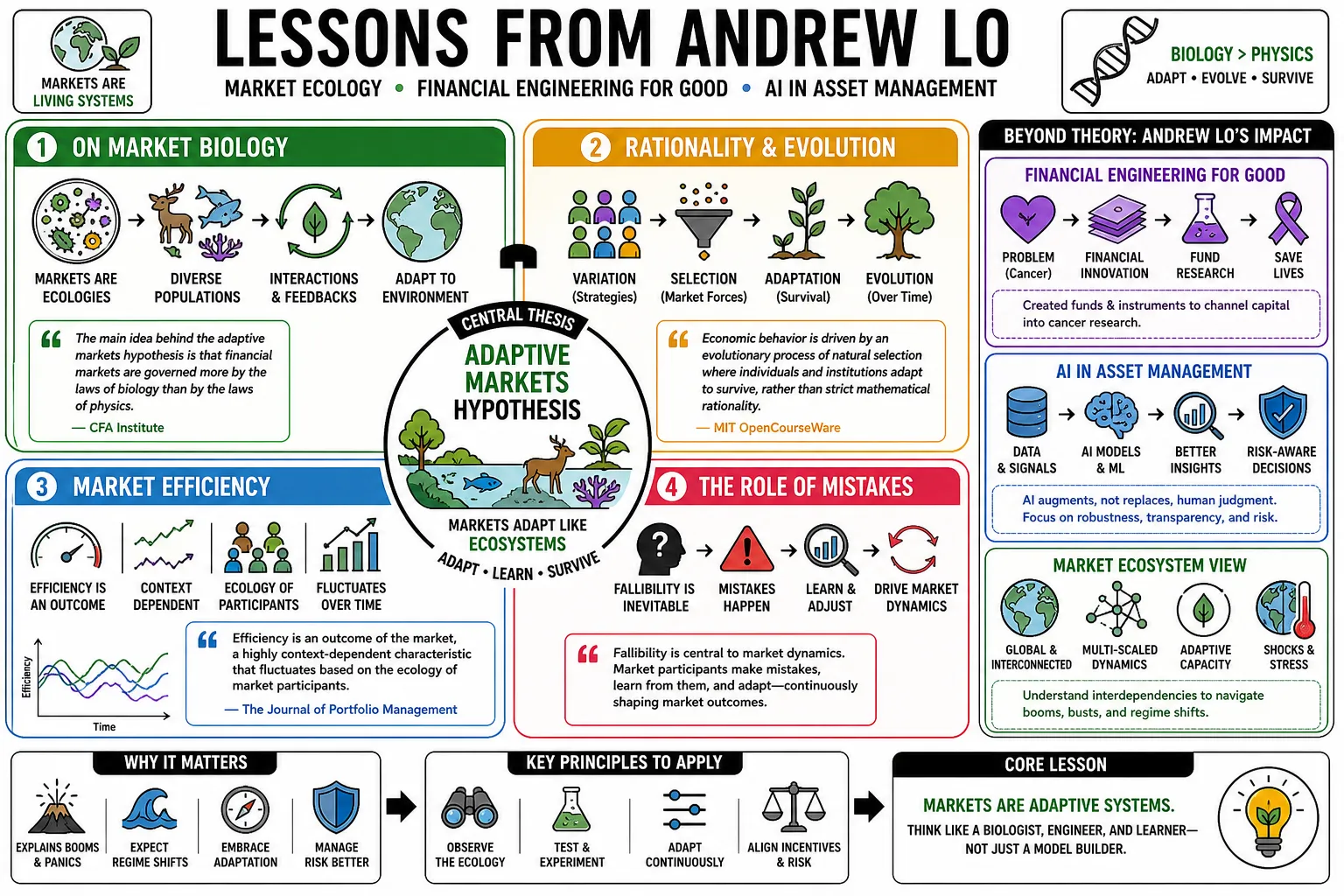
- On Market Biology: "The main idea behind the adaptive markets hypothesis is that financial markets are governed more by the laws of biology than by the laws of physics." — Reference: CFA Institute Enterprising Investor, "The Adaptive Markets Hypothesis: A Financial Ecosystems Survival Guide" (2017).
- On Rationality and Evolution: The hypothesis rests on simple tenets: people act in their own self-interest, make mistakes, and learn, adapt and innovate. Natural selection then operates on individuals, institutions and markets, and "this evolutionary process is what determines financial market dynamics." — Reference: CFA Institute Enterprising Investor, "The Adaptive Markets Hypothesis: A Financial Ecosystems Survival Guide" (2017).
- On Reconciling Theories: The adaptive markets hypothesis reconciles efficient markets and behavioral finance: seen through evolutionary biology, the two can "happily and productively co-exist." — Reference: CFA Institute Enterprising Investor, "The Adaptive Markets Hypothesis: A Financial Ecosystems Survival Guide" (2017).
Part 2: Human Behavior and Evolution in Markets
- On Fear and Survival: "Strong emotions like fear are an immediate call-to-arms to survive, selected by evolution over millions of generations of life in hostile environments." — Reference: Adaptive Markets (2017), quotations collected on Goodreads.
- On money and the brain: Monetary gain "stimulates the same reward circuitry as cocaine," while the threat of loss triggers the same fight-or-flight response as a physical attack. — Reference: Andrew W. Lo, "Fear, Greed, and Crisis Management: A Neuroscientific Perspective," Freakonomics guest post (2009).
- On prosperity as anesthetic: "Extended periods of prosperity act as an anesthetic in the human brain," lulling investors, executives and regulators into taking "risks that we know we should avoid." — Reference: Andrew W. Lo, "Fear, Greed, and Crisis Management: A Neuroscientific Perspective," Freakonomics guest post (2009).
- On fear of the unknown: "The most potent form of fear is fear of the unknown," so the best way to fight a panic is "with transparency and education." — Reference: Andrew W. Lo, "Fear, Greed, and Crisis Management: A Neuroscientific Perspective," Freakonomics guest post (2009).
- On regulation as self-restraint: "Regulation enables us to restrain our behavior during periods when we know we will misbehave"—so it should be designed for periods of collective fear or greed. — Reference: Andrew W. Lo, "Fear, Greed, and Crisis Management: A Neuroscientific Perspective," Freakonomics guest post (2009).
- On protecting naysayers: "If we truly value naysayers during periods of corporate excess, then we should institute management changes to protect and reward their independence." — Reference: Andrew W. Lo, "Fear, Greed, and Crisis Management: A Neuroscientific Perspective," Freakonomics guest post (2009).
- On emotion in the best traders: Measuring traders' pulse and skin conductance, he found emotion can hijack professionals too. The most successful ones confined their emotional responses to moments of rapid, volatile price movement. — Reference: MIT Sloan Management Review, "The Opportunities Brought to You By Distress".
Part 3: Healthcare Finance and Megafunds
- On Financial Engineering for Good: Some of the "financial weapons of mass destruction" behind 2008 can be used for good: securitizing biomedical intellectual property in megafunds, run by money managers and scientists, could fund the neglected "valley of death" of early drug development. — Reference: Institutional Investor, "MIT's Andrew Lo Touts Megafund to Tackle Cancer, Rare Diseases" (2015).
- On Diversifying Risk: "More projects equal lower risk." Not every drug in a megafund has to succeed: "We're just trying to have a few big winners." — Reference: Institutional Investor, "MIT's Andrew Lo Touts Megafund to Tackle Cancer, Rare Diseases" (2015).
- On Personal Motivation: "Friends and family were dealing with various kinds of cancer, and I felt pretty useless to them… I decided that if I was going to really be useful to my friends and family, I needed to learn more about how drug development works." — Reference: pharmaphorum Deep Dive, "Bridging the risk gap in biotech investing".
- On the Funding Contradiction: "Scientists and clinicians are making breakthroughs all the time with regard to drug developments, but the amount of funding that is going into biomedicine is declining." — Reference: Institutional Investor, "MIT's Andrew Lo Touts Megafund to Tackle Cancer, Rare Diseases" (2015).
- On His Academic Role: "I'm not qualified to manage any of these vehicles. I'm hoping to play the role of glorified wedding planner. I'll bring the bride and groom together; they should know what to do after the wedding." — Reference: Institutional Investor, "MIT's Andrew Lo Touts Megafund to Tackle Cancer, Rare Diseases" (2015).
- On Uncomfortable Conversations: "For the first few years, I really felt extremely uncomfortable talking with oncologists about investing. It actually seemed offensive and obscene." — Reference: pharmaphorum Deep Dive, "Bridging the risk gap in biotech investing".
- On the Scale Requirement: Scale matters: his team simulated megafunds of $5 billion to $15 billion, large enough for diversification across many projects to justify the risk. — Reference: Institutional Investor, "MIT's Andrew Lo Touts Megafund to Tackle Cancer, Rare Diseases" (2015).
- On Balancing Social and Financial Returns: Mega-funds must carefully balance drug market values with portfolio size; lower market values hurt financial returns but allow for more projects and greater overall social impact through more approved drugs. — The Health of Nations Fund: Financing global drug development (PLOS Global Public Health)
Part 4: Financial Crises and Systemic Risk
- On Financial Energy: "Global financial markets contain enormous financial energy, and when detonated in an uncontrolled and irresponsible manner, you get bubbles, crashes, and years of nuclear fallout." Used carefully, he adds, the same tools can fuel innovation and growth. — Reference: CFA Institute Enterprising Investor, "Book Review: Adaptive Markets" (2017).
- On crises and capitalism: "Financial crises are an unfortunate but necessary consequence of modern capitalism." Losses come with innovation, but damage is magnified "when risks have been incorrectly assessed and incorrectly assigned." — Reference: MIT Sloan Management Review, "The Opportunities Brought to You By Distress".
- On Inevitability: Financial manias and panics "cannot be legislated away, and may be an unavoidable aspect of modern capitalism." Their worst effects can be mitigated through preparation. — Reference: Andrew W. Lo, "Regulatory reform in the wake of the financial crisis of 2007-2008," Journal of Financial Economic Policy (2009).
- On Systemic Contagion: "Like an epidemiologist studying the spread of a contagious disease from its point of origin, we should identify the potential linkages through which a financial crisis may travel." — Reference: Adaptive Markets (2017), quotations collected on Goodreads.
- On the Illusion of Science: "Many of us like to think of financial economics as a science, but complex events like the financial crisis suggest that this conceit may be more wishful thinking than reality." — Reference: Andrew W. Lo, "Reading about the Financial Crisis: A Twenty-One-Book Review," Journal of Economic Literature (2012).
Part 5: Rethinking Regulation
- On Regulatory Efficacy: "Financial markets do not need more regulation; they need smarter and more effective regulation." — Reference: Andrew W. Lo, "Regulatory reform in the wake of the financial crisis of 2007-2008," Journal of Financial Economic Policy (2009).
- On Software Paradigms: "Could the principles of good software design be used to improve the way we write financial regulations?" — Reference: Adaptive Markets (2017), quotations collected on Goodreads.
- On Counter-Cyclical Measures: He proposes counter-cyclical leverage constraints as part of more adaptive regulation. — Reference: Andrew W. Lo, "Regulatory reform in the wake of the financial crisis of 2007-2008," Journal of Financial Economic Policy (2009).
- On Deliberate Policymaking: After a crisis, resist the temptation to react too hastily; deliberate thoughtfully and broadly before crafting new rules. — Reference: Andrew W. Lo, "Regulatory reform in the wake of the financial crisis of 2007-2008," Journal of Financial Economic Policy (2009).
- On Transparency: Reform should center on greater transparency and better measures of systemic risk. — Reference: Andrew W. Lo, "Regulatory reform in the wake of the financial crisis of 2007-2008," Journal of Financial Economic Policy (2009).
- On Professional Certification: He calls for certifications in financial engineering for the senior management and directors of all financial institutions. — Reference: Andrew W. Lo, "Regulatory reform in the wake of the financial crisis of 2007-2008," Journal of Financial Economic Policy (2009).
Part 6: Quantitative Finance and Portfolio Management
- On the three L's: His lesson from 1998, 2007 and 2010: the "three L's of financial crises" are liquidity, leverage and losses, and today's strategies are more crowded and connected than before. — Reference: Andrew W. Lo, "From the Quant Quake of August 2007 to the Flash Crash of May 2010," New York Fed conference slides (2010).
- On fair-weather liquidity: Hedge funds and high-frequency traders now provide much of the market's liquidity, but "can withdraw liquidity suddenly, unlike banks," and that withdrawal can dislocate markets. — Reference: Andrew W. Lo, "From the Quant Quake of August 2007 to the Flash Crash of May 2010," New York Fed conference slides (2010).
- On the Perfect Portfolio: He describes finding the perfect portfolio as a "never-ending journey." — Reference: In Pursuit of the Perfect Portfolio, "Andrew Lo: Finding the Perfect Portfolio, a 'Never-Ending Journey'" (2022).
Part 7: Machine Learning and AI in Finance
- On the AI Revolution: "I believe that within the next five years we're going to see a revolution in how humans interact with AI." — Reference: InvestmentNews (Bloomberg), "MIT's Andrew Lo sees AI ready to run your money in five years" (2025).
- On AI as a Fiduciary: With the right guardrails, he believes AI could be trusted to meet the high bar of fiduciary advice, though the industry needs "extra layers of protection" first. — Reference: InvestmentNews (Bloomberg), "MIT's Andrew Lo sees AI ready to run your money in five years" (2025).
- On Current Limits of AI Fiduciaries: While the goal is to create AI that acts as a true fiduciary, current large language models are not yet capable of independently looking out for an investor's best interests without human oversight. — MIT Economist Andrew W. Lo on Finance, AI, and Human Behavior (Chalk Radio Podcast)
- On AI-Driven Job Displacement: The breakneck speed of AI advancement poses a unique threat compared to past technological shifts, as it may cause mass unemployment faster than the workforce can be retrained. — MIT Economist Andrew W. Lo on Finance, AI, and Human Behavior (Chalk Radio Podcast)
- On Prompt Engineering for Finance: "I think that there's a real art and science to prompt engineering" — CNBC
- On Reverse Engineering Prompts: "That's one way to make your prompt engineering more efficient: It's to reverse engineer the prompt by asking AI to tell you what you should have done differently." — CNBC
- On AI Limitations with Math: "When it comes to very, very specific calculations of your own personal situation, that's where you have to be very, very careful" — CNBC
- On Investigating AI Uncertainty: When users receive a seemingly satisfactory answer from an AI model, they should follow up by asking the AI to explicitly state its limitations and any missing information. — CNBC
- On Regulatory Training Data: To create models with true fiduciary duty, developers should train them on historical cases of financial exploitation to teach the AI exactly what behavior to avoid. — MIT CSAIL Alliances
- On Delegating to AI: Relying on AI agents to independently make investments or execute personal financial decisions remains highly dangerous. — AI and Financial Agents: MIT CSAIL Professor Andrew W. Lo (MIT CSAIL Alliances)
- On Financial Accountability: AI models currently lack true legal accountability, making them insufficient substitutes for human advisors who face real-world penalties for ethical breaches. — AI and Financial Agents: MIT CSAIL Professor Andrew W. Lo (MIT CSAIL Alliances)
- On AI as an Orientation Tool: Current large language models are best used for financial mapping, basic education, and framing options rather than direct execution. — AI and Financial Agents: MIT CSAIL Professor Andrew W. Lo (MIT CSAIL Alliances)