Andrew Mason is best known for founding Groupon and the media-editing platform Descript, where he now serves as Executive Chairman. A former music student, he earned a reputation for his unorthodox style during Groupon’s rapid rise and his subsequent public firing. This collection documents his shift from a consumer internet CEO to a founder building tools that simplify audio and video production. — Podcast News Daily, "Descript Founder Andrew Mason Steps Aside; Product Chief Laura Burkhauser New CEO" (2025).
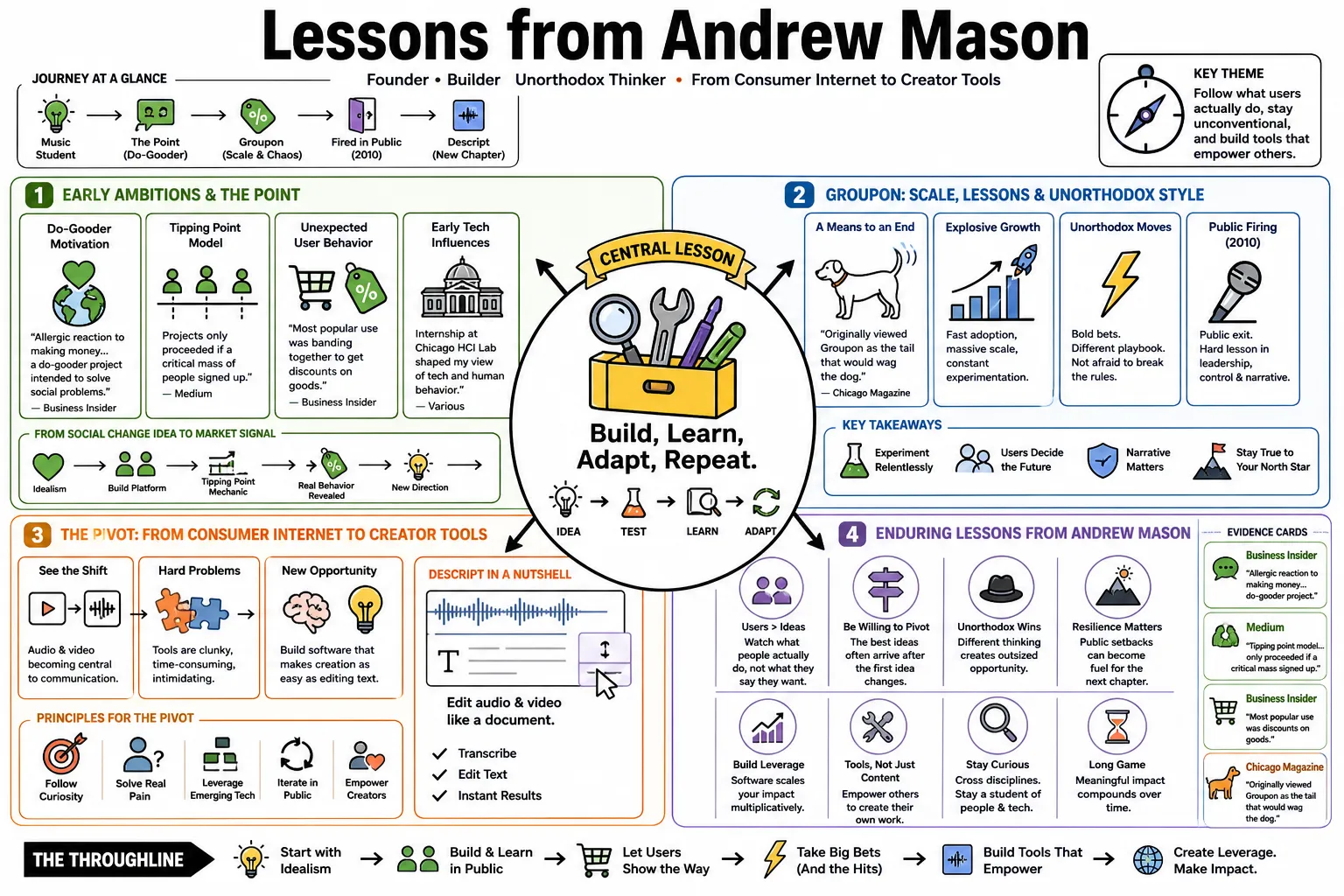
Part 1: Early Ambitions and The Point
- On early motivations: "I started The Point to empower the little guy and solve the world's unsolvable problems. A year later, I started Groupon to get Eric to stop bugging me to find a business model." — Reference: Business Insider, Andrew Mason's S-1 letter to potential Groupon investors (2011).
- On just starting: "The most important thing in considering pivoting to a new idea is just to do it. Get into the mess... the first idea doesn't matter if you stay nimble." — Reference: South Park Commons, "Andrew Mason shares what he's learned about setting company values and knowing when to pivot" (2018).
- On the pivot to Groupon: Groupon began as a side project in November 2008 that applied The Point's technology to group buying; by January 2009 its popularity had soared and the team shifted fully to it. — Reference: Business Insider, Andrew Mason's S-1 letter to potential Groupon investors (2011).
Part 2: The Groupon Explosion
- On rapid growth: "I think the big thing about Groupon is just people had never seen anything grow quite so fast." That, he said, "made people want to dig in and be skeptical." — Reference: 60 Minutes, "The real deal with Groupon" (2012).
- On breaking the corporate mold: "Life is too short to be a boring company." — Reference: Business Insider, Andrew Mason's S-1 letter to potential Groupon investors (2011).
Part 3: Management, Leadership, and Culture
- On customer focus: "If there's one piece of wisdom that this simple pilgrim would like to impart upon you: have the courage to start with the customer." — Reference: The Verge, full text of Andrew Mason's farewell memo to Groupon employees (2013).
- On data versus intuition: "My biggest regrets are the moments that I let a lack of data override my intuition on what's best for our customers." — Reference: The Verge, full text of Andrew Mason's farewell memo to Groupon employees (2013).
- On personal authenticity: "I think if there's any difference between me and a traditional CEO, it's that I've been unwilling to change myself or shape my personality around what's expected." — Reference: 60 Minutes, "The real deal with Groupon" (2012).
- On being yourself: "As long as you're fundamentally good, as long as you're not being bad to people, people give you a lot of room to be yourself, because being yourself is being honest." — Reference: The New York Times DealBook, "What's Next for Groupon's Founder" (2010).
- On sustainable happiness: His parting advice to Groupon was to use the leadership change to "break bad habits and deliver sustainable customer happiness." — Reference: The Verge, full text of Andrew Mason's farewell memo to Groupon employees (2013).
- On values as a scorecard: Values are "an articulation of behaviors that are rewarded at a company." Rather than "fairy tale, one-dimensional values," Descript scores itself against its values every month. — Reference: South Park Commons, "Andrew Mason shares what he's learned about setting company values and knowing when to pivot" (2018).
- On managing for the right reasons: Many people become managers "for completely the wrong reasons—not because they care about people or unlocking the best possible incarnation of their teams, but because they care about having their ideas listened to." — Reference: Pod Hunt, "The future of podcasting with Andrew Mason" (2019).
- On management as practice: "Managing people is not an innate skill. It's like learning to golf or something. It just takes practice and learning from better people." — Reference: Recode Decode, "Full transcript: Former Groupon CEO Andrew Mason" (2017).
Part 4: Dealing with Failure and Firing
- On getting fired: "After four and a half intense and wonderful years as CEO of Groupon, I've decided that I'd like to spend more time with my family. Just kidding – I was fired today." — Reference: The Verge, full text of Andrew Mason's farewell memo to Groupon employees (2013).
- On radical accountability: He named the reasons himself (controversial S-1 metrics, a material weakness, missed quarters, a stock at a quarter of its listing price) and concluded: "As CEO, I am accountable." — Reference: The Verge, full text of Andrew Mason's farewell memo to Groupon employees (2013).
- On surviving the startup game: "If Groupon was Battletoads, it would be like I made it all the way to the Terra Tubes without dying on my first ever play through." — Reference: The Verge, full text of Andrew Mason's farewell memo to Groupon employees (2013).
- On when to quit: After four years on Detour: "at some point it just clicked that it's not supposed to be this hard and we should move on." — Reference: Pod Hunt, "The future of podcasting with Andrew Mason" (2019).
- On his post-CEO plans: "I'll now take some time to decompress (FYI I'm looking for a good fat camp to lose my Groupon 40, if anyone has a suggestion), and then maybe I'll figure out how to channel this experience into something productive." — Reference: The Verge, full text of Andrew Mason's farewell memo to Groupon employees (2013).
Part 5: Creative Philosophy and "Hardly Workin'"
- On basic business wisdom: "I managed over 12,000 people at Groupon, most under the age of 25. One thing that surprised me was that many would arrive at orientation with minimal understanding of basic business wisdom." — Reference: Business Insider, "Ousted Groupon CEO Andrew Mason Reveals His Next Move" (2013).
- On accessible education: "I came to realize that there was a real need to present business wisdom in a format that is more accessible to the younger generation." — Reference: Business Insider, "Ousted Groupon CEO Andrew Mason Reveals His Next Move" (2013).
- On motivational business music: His answer was a week in LA recording "Hardly Workin'," a seven-song album of motivational business music "targeted at people newly entering the workforce." — Reference: Business Insider, "Ousted Groupon CEO Andrew Mason Reveals His Next Move" (2013).
- On physical social clubs: With Nabeel Hyatt, he opened a board-game social club in Berkeley, using Claude as a business partner for the plan, financials, space layout and permitting. — Reference: How I AI (Lenny's Podcast Network), Andrew Mason and Nabeel Hyatt episode (2025).
- On teaching young employees: "These songs will help young people understand some of the ideas that I've found to be a key part of becoming a productive and effective employee." — Reference: Business Insider, "Ousted Groupon CEO Andrew Mason Reveals His Next Move" (2013).
- On Making side projects viable: Leveraging AI lowers the barrier to building side projects by reducing the time constraints and specialized knowledge required to execute them. — Lenny's Newsletter
Part 6: Detour and Audio Experiences
- On the wreckage of an idea: Both his pivots came from "working through the wreckage of your idea to find some gem that's in there." His advice: be stubbornly persistent but open to "the idea that the thing is not the thing that you thought it was." — Reference: Software Engineering Daily, "Descript with Andrew Mason" transcript (2020).
- On acknowledging difficulty: He knew when he launched Detour that he faced "an uphill battle" to get people to go on audio tours for fun. — Reference: Business Insider, "Groupon Founder Andrew Mason Is Back With a Cool New Startup, Descript" (2017).
- On production bottlenecks: "We would be doing voice-over sessions in our studio and noticing that it took probably twice as long to edit the sessions as it took to actually record them." — Reference: Business Insider, "Groupon Founder Andrew Mason Is Back With a Cool New Startup, Descript" (2017).
- On the genesis of a pivot: That bottleneck led the team to hire a Berkeley PhD student working on AI transcription and build a tool that edits audio by editing its transcript, with no more wrestling with waveform editors. — Reference: Business Insider, "Groupon Founder Andrew Mason Is Back With a Cool New Startup, Descript" (2017).
Part 7: Descript and the Future of Media Editing
- On the word processor as the goal: "The word processor is the ultimate craftsman tool, you learn it early on and you're done." Descript set out to make editing audio as easy as rewriting a sentence. — Reference: TechCrunch, "Descript gets $5M to make sound editing like a Word document" (2017).
- On trust in synthetic media: On AI voice editing: "Basically what's happened to photos and print before will happen to audio and video, and society adjusts. The credibility of a piece of content comes down to the credibility of the source." — Reference: The Verge, "Groupon founder's new app Descript edits audio files directly from text" (2017).
- On high-judgment engineers: Early Descript had no product managers besides him: "we just have a lot of very creative, high-judgment engineers who are able to work directly with design to take a fairly high-level goal and work things out." — Reference: Software Engineering Daily, "Descript with Andrew Mason" transcript (2020).
- On tools versus new behaviors: After Detour, building a tool felt safer: "It's like a beautiful thing to be building just a tool that exists in the tool chain, instead of making a bet that, oh I'm going to invent this new consumer behavior." — Reference: Recode Decode, "Full transcript: Former Groupon CEO Andrew Mason" (2017).
- On the transition of leadership: In 2025 he became Executive Chairman and handed the CEO role to Laura Burkhauser, saying the nature of the CEO job changes as a company grows and that she was the better CEO for Descript at its scale. — Reference: Podcast News Daily, "Descript Founder Andrew Mason Steps Aside; Product Chief Laura Burkhauser New CEO" (2025).
Part 8: Artificial Intelligence and Product Design
- On the impact of GPT-4: When Descript raised its Series C from OpenAI, Sam Altman previewed GPT-4 and told him that the handful of people who had seen it had "completely changed their road map" as a result. — Reference: YouTube video: Generative Now (Lightspeed) interview with Andrew Mason.
- On AI assistants: Descript bundled its AI features into an assistant it calls Underlord. — Reference: YouTube video: Generative Now (Lightspeed) interview with Andrew Mason.
- On open world agents: He has discussed "open world agents" and how Descript is embracing agent-first workflows, including the idea of "rewiring" users for AI. — Reference: Hallway Chat, "Building Open World AI w/ Andrew Mason" (episode page).
- On AI as a business copilot: By using AI to generate a full business plan, model financials, and navigate local permitting, founders can streamline the daunting logistics of launching a physical business. — Lenny's Newsletter
- On Organizing physical assets with AI: AI can be deployed to structure real-world inventory, such as creating a customized Dewey Decimal–style system to intuitively organize hundreds of board games. — Lenny's Newsletter
- On AI-driven community matchmaking: Rather than relying on staff to manually match players, an AI concierge service can seamlessly handle scheduling and game recommendations via text message. — Lenny's Newsletter