Andrew McAfee, a principal research scientist at MIT, has become a prominent voice in understanding the impact of technology on business, society, and the economy. Through his extensive research and numerous books, he offers a compelling vision of our digital future. His work provides a roadmap for navigating the complexities of the second machine age, from the rise of artificial intelligence to the evolving nature of work and the surprising decoupling of economic growth from resource consumption.
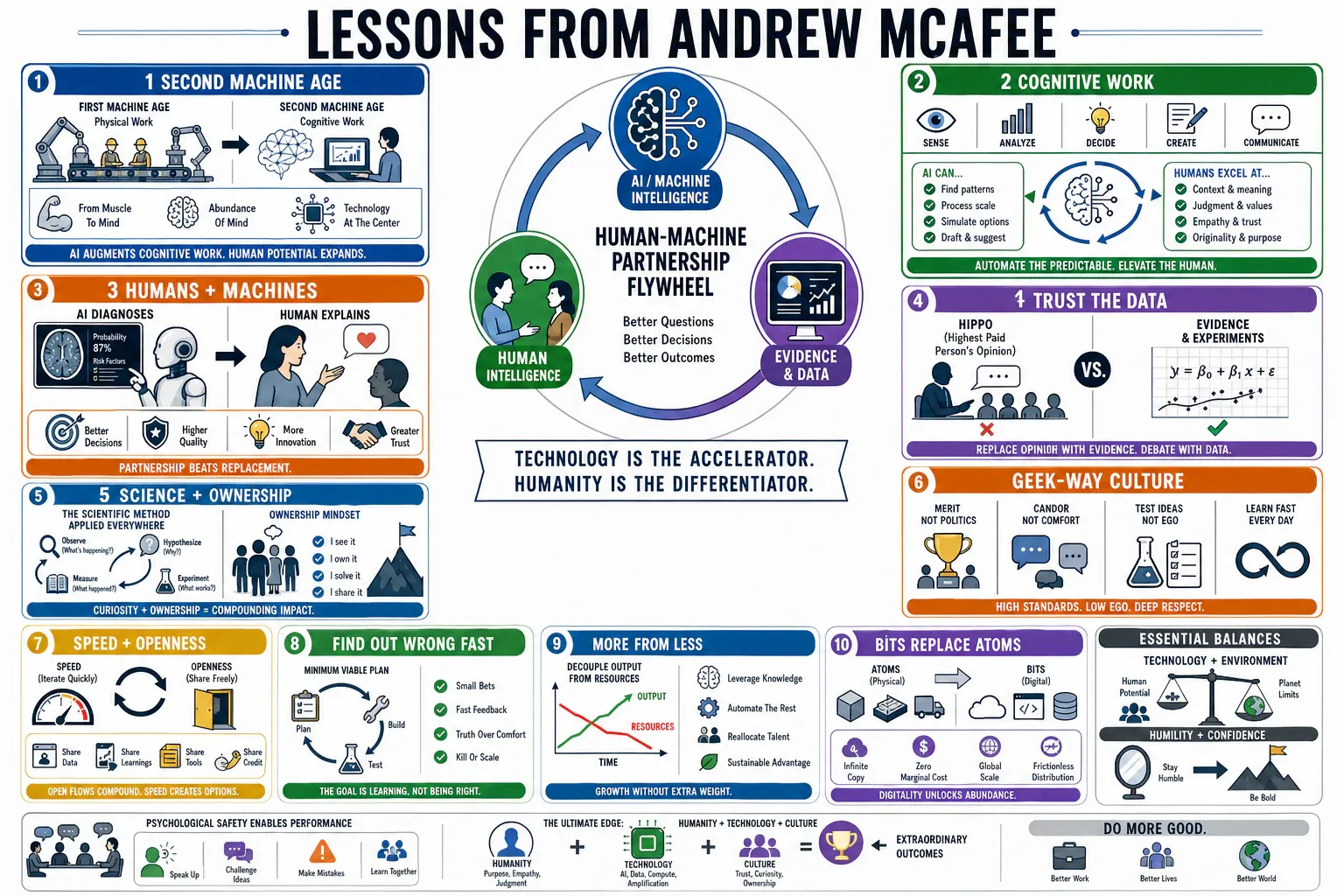
The Second Machine Age and Artificial Intelligence
The current technological wave, as McAfee argues, is a fundamental shift comparable to the Industrial Revolution, but instead of augmenting muscle power, it's augmenting our cognitive abilities.
Key Quotes:
- "We are doing for cognitive work what the industrial revolution did for manual work did for physical labor." [1]
- "Just in the past couple years, we've seen digital tools display skills and abilities that... eat deeply into what we human beings do for a living." [2]
- "Don't anthropomorphize computers—they hate it." [3][4]
- "AI is 'doing for cognitive work what the Industrial Revolution did for manual labor.'" [5]
- "Because we humans are so fond of our judgment, and so overconfident in it, many of us, if not most, will be too quick to override the computers, even when their answer is better." [3][7]
- "Getting rid of human judgments altogether – even those from highly experienced and credentialed people – and relying solely on numbers plugged into formulas, often yields better results." [3][7]
- "The raw technological horsepower is terrific, but it's not going to determine how quickly AI transforms the economy." [8]
- On Multiple approaches to AI: "The more shots on goal we get, the more likely we are to come up with very powerful things." — The Permanent Problem Podcast
Key Learnings:
- AI as a General-Purpose Technology: McAfee, along with his colleagues, views AI as a general-purpose technology, one that will have a profound and widespread impact on economic growth and prosperity. [1]
- Humans and Machines as Partners: The future of many professions will involve humans collaborating with AI, where AI handles diagnostics and data analysis, and humans focus on communication, empathy, and coaching. [9][10]
- Overcoming Human Bias: A significant challenge in the age of AI is overcoming our own cognitive biases and trusting data-driven insights, even when they contradict our intuition or the opinions of high-status individuals (HiPPOs - Highest Paid Person's Opinion). [3][10]
- The Need for Humility: We need to be more humble about our own cognitive abilities and recognize that AI can perform many judgment-based tasks better than we can. [10]
- Innovation is a Process of Failure: Early efforts in AI implementation may fall short, but this is a natural part of the innovation process. [8]
- On The pace of AI diffusion: The most aggressive predictions of AI's transformative impact often fail to account for the massive organizational friction required to figure out how to successfully deploy these tools in the real world. — The Permanent Problem Podcast
- On The speed of AI transformation: AI is a rapidly improving general-purpose technology that is poised to fundamentally alter nearly every sector of the global economy over the next ten years. — Where the Internet Lives Podcast
The "Geek Way": A New Culture of Work
McAfee's latest work introduces "The Geek Way," a set of cultural norms he argues are responsible for the success of today's most innovative companies.
Key Quotes:
- "A culture emerges that is freewheeling, fast-moving, egalitarian, evidence-driven, argumentative, and autonomous." [4]
- "How fast can you find out you are wrong? This is the predictive metric of success in Silicon Valley." [12]
- "Psychological safety is actually the opposite of a safe space, of freedom from being challenged." [13]
Key Learnings:
- The Four Norms of the Geek Way: McAfee identifies four key cultural pillars: science (relying on evidence over opinion), ownership (empowering individuals and teams), speed (prioritizing rapid iteration), and openness (fostering psychological safety and the free exchange of ideas). [3][7]
- Culture Eats Strategy for Breakfast: No matter how brilliant a company's strategy is, its culture will ultimately determine its success. [2]
- Embrace Minimum Viable Plans: Instead of extensive upfront planning, the "geek way" favors starting with a minimum viable plan and then iterating quickly based on feedback and data. [13]
- Devolve and Empower: Successful modern organizations distribute authority and responsibility, giving employees autonomy and trusting them to achieve their goals. [13]
- The Power of Openness: Creating an environment where people feel safe to speak truth to power is critical for learning and innovation. [13]
- On The scientific method: Science channels our natural human overconfidence into rigorous evidence-gathering, forcing us to present our ideas and let peers aggressively test them to find the truth. — unSILOed Podcast with Greg LaBlanc
More from Less: Capitalism, Technology, and the Environment
In a counter-intuitive argument, McAfee posits that capitalism and technological progress are now key drivers of environmental sustainability.
Key Quotes:
- "I've found that the book's fundamental concept—that capitalism and tech progress are now allowing us to tread more lightly on the earth instead of stripping it bare—is hard for many people to accept." [14]
- "For the first time in human history, we have decoupled output growth from resource consumption." [13]
- "We have finally figured out how to give ourselves more and more while taking less and less from the planet." [13]
- "Contested markets provide the motive, and tech progress the opportunity, to save money by swapping bits for atoms throughout the economy." [15]
- "I think America will use less total energy...in 2029 than it did in 2019...simply because energy is expensive, and our toolkit for saving energy just gets better and better every year." [16]
Key Learnings:
- The Four Horsemen of the Optimist: McAfee identifies four key drivers for a healthier planet: capitalism, technological progress, public awareness, and responsive government. [15][17]
- Dematerialization is Real: In many developed countries, economic growth is no longer coupled with increased consumption of resources like metals, fertilizer, and energy. [13][18]
- Capitalism as a Force for Good (in this context): The profit motive of capitalism incentivizes companies to use fewer resources, and technology provides the means to do so. [15][19]
- Government's Role is Crucial: While capitalism and technology are powerful forces, responsive government and public awareness are necessary to address issues like pollution and protect endangered species. [15][19]
- Economic Growth and Environmental Health are Not Mutually Exclusive: Contrary to some environmentalist narratives, economic growth can and is co-occurring with a reduction in our environmental footprint in developed nations. [13][18]
- On AI and the energy transition: AI is expected to accelerate the energy transition and enable efficiencies across the economy that far outweigh the resources the technology itself consumes. — Where the Internet Lives Podcast
- On AI's energy footprint: The technology industry is highly incentivized to make data centers more energy-efficient, meaning the energy consumption of AI is unlikely to grow at the same exponential rate as its capabilities. — Where the Internet Lives Podcast
The Future of Business and the Economy
McAfee's work provides a framework for understanding the new dynamics of competition and success in a digital world.
Key Quotes:
- "The successful companies of the second machine age will be those that bring together minds and machines, products and platforms, and the core and crowd very differently than most do today." [3]
- "Our world is increasingly complex, often chaotic, and always fast-flowing. This makes forecasting something between tremendously difficult and actually impossible..." [3]
- "Traditionally, it seemed like there was always a tradeoff in business. A company might be innovative but struggle with execution or agility... At these 'geek' companies, those tradeoffs have disappeared." [20]
- "The key factor that drives the success of tech giants... lies in their ability to leverage a digital operating model." [20]
- On European regulation and innovation: "I don’t think you can make a credible argument that the European approach to innovation and entrepreneurship, especially in this digital era, is better. I think it’s demonstrably worse." — The Permanent Problem Podcast
Key Learnings:
- The Three Worlds of IT: McAfee categorizes information technology into Function IT (like spreadsheets), Network IT (like email), and Enterprise IT (like CRM systems), each requiring different management approaches. [1]
- The Rise of Enterprise 2.0: This concept describes the use of emergent social software platforms within organizations to foster collaboration and knowledge sharing in a less structured, more organic way. [14][21]
- The Importance of Platforms: Digital platforms that connect different user groups (two-sided networks) have unique economic characteristics and are a powerful business model in the digital economy. [3]
- Digital Transformation is Imperative: Traditional companies must adopt a digital operating model to survive and compete in the new economy. [20]
- The Power of the Crowd: Harnessing the collective intelligence and labor of the crowd through digital platforms is a key strategy for modern businesses. [3]
- On Gen Z as a competitive advantage: Young workers are a company's greatest asset in the AI era because they are more willing to experiment with emerging technologies than older employees who are set in their routines. — Times of India
- On Bureaucracy and status: Bureaucracy is often driven by individuals seeking status by artificially inserting themselves into work processes, creating unnecessary organizational bottlenecks. — unSILOed Podcast with Greg LaBlanc
- On Legacy company bottlenecks: Legacy companies struggle to adopt AI quickly because their 20th-century leadership playbooks rely heavily on front-loaded planning, consensus, and a deep-seated fear of making mistakes. — The Permanent Problem Podcast
- On The nature of bureaucracy: Bureaucracy in legacy companies often emerges not from an explicit desire to ruin things, but from following traditional processes that distribute the power to block progress. — The Permanent Problem Podcast
- On Regulatory own goals: The European Union's tendency to continuously layer regulations like GDPR and the AI Act on the digital ecosystem acts as an "own goal" that stifles entrepreneurship and favors established American tech companies. — The Permanent Problem Podcast
- On Distributed veto power: Bureaucracy in legacy companies often resembles a state of organizational sclerosis where traditional processes distribute veto power too broadly. — The Permanent Problem Podcast
Society and the Individual
McAfee also reflects on the broader societal implications of these profound technological and economic shifts.
Key Quotes:
- "Once the androids start doing jobs, we don't have to do them anymore, and we get freed up from drudgery and toil." [10]
- "Good decisions are critical to well-functioning societies." [4][7]
- With Erik Brynjolfsson he wrote: "There is no economic law that says that everyone, or even most people, automatically benefit from technological progress." [22]
- On Debate in higher education: "If we're not training people about how to debate, disagree, argue, and do it without being jerks or without being completely thin-skinned about it, we're not doing people a service." — unSILOed Podcast with Greg LaBlanc
Key Learnings:
- On The cultural differences in innovation: A major cultural difference impacting European innovation is that Europeans generally oppose the idea of wealthy tech entrepreneurs acting with the kind of brashness seen in their American counterparts. — The Permanent Problem Podcast
Learn more:
- AI's Hidden Business Effects: MIT Principal Research Scientist Andrew McAfee on AI and Enterprise - YouTube
- 4 Key Lessons From The Geek Way. In his new book, MIT's Andrew McAfee… | by MIT IDE | MIT Initiative on the Digital Economy | Medium
- The Geek Way Summary of Key Ideas and Review | Andrew McAfee - Blinkist
- The Geek Way — Andrew McAfee
- AI's Hidden Business Effects: MIT Principal Research Scientist Andrew McAfee Explores how AI is Affecting Enterprise
- [PDF] The Geek Way Summary - Andrew McAfee - Shortform
- 4 Key Lessons From The Geek Way - MIT Initiative on the Digital Economy
- Companies are pouring billions into AI. It has yet to pay off. | The Star
- Quotes by Andrew McAfee (Author of Machine, Platform, Crowd) - Goodreads
- Andrew McAfee: Stop underestimating AI – it is better at human-judgment tasks than we are
- What defines Enterprise 2.0 - MIT Sloan Management Review
- Andrew McAfee: Dematerialization: Humanity's Biggest Surprise | TED Talk
- Why economic growth hasn't ruined the planet - MIT Sloan
- Unlocking Enterprise 2.0: Best Practices for a Connected Workplace
- Andrew McAfee: More From Less - Long Now
- Podcast: Andrew McAfee, How We're Getting “More From Less” - Working Capital Review
- The US Economy is Growing While Using Fewer Resources — Andrew McAfee at Long Now
- Capitalism Will Save the World - National Review
- Andrew McAfee: Why Capitalism & Technology Will Save the Planet
- Andrew McAfee - AI and Digital Economy Speaker and Advisor - Stern Strategy Group
- Adaptive Enterprise - Fogbeam Labs
- “We're Not Using Our Best Weapons To Fight Global Warming” - DLD News