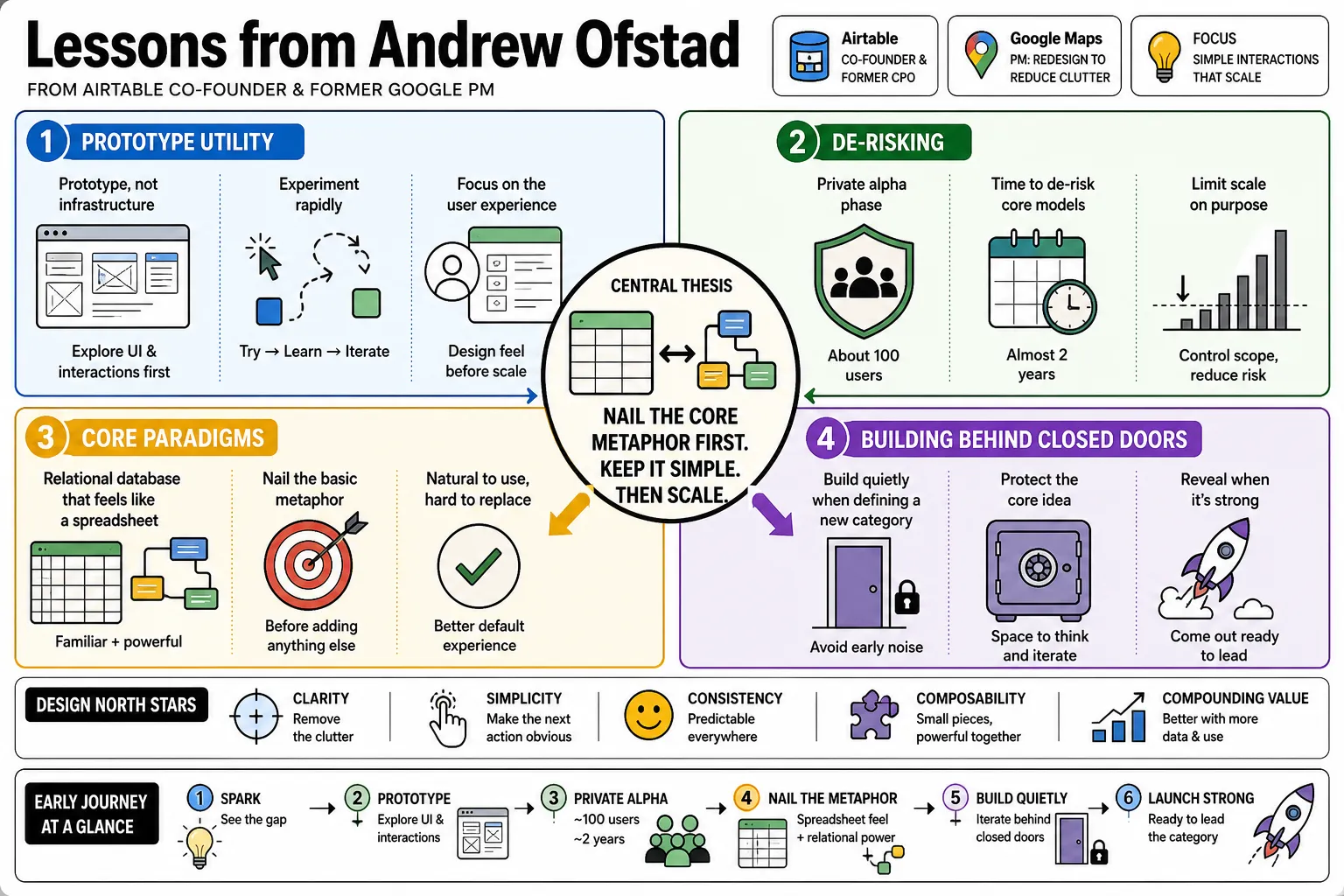
Lessons from Andrew Ofstad
Andrew Ofstad is the co-founder and former Chief Product Officer of Airtable, where he helped turn relational databases into accessible spreadsheets. He previously worked as a product manager at Google on Android and led the redesign of Google Maps. This profile collects his thoughts on product design, early-stage growth, and how to keep software simple as features multiply. — Mercury Series Tea, "Andrew Ofstad: Getting your product to market" (2020).
Part 1: Early Product Development and Prototyping
- On Prototype Utility: Airtable's first six months were a purely front-end prototype, with no backend and data persisted to browser storage, built to prove out the interaction paradigms and design. — Reference: Mercury Series Tea, "Andrew Ofstad: Getting your product to market" (2020).
- On De-risking: The private alpha was invite-only. "After maybe 100 people or so, eventually we felt like we were in a good place." Getting there took about two years. — Reference: First Round Review, "Airtable's Path to Product-Market Fit" (2022).
- On Building Behind Closed Doors: He advocates a "long gestation period" and separating customer feedback from the public launch: ask whether launching actually helps you retire the company's main risk. — Reference: First Round Review, "Airtable's Path to Product-Market Fit" (2022).
- On First Principles Thinking: While the Lean Startup era pushed rough prototypes and fast pivots, "we took more of a first principles approach," studying prior art from computing pioneers like Engelbart and Atkinson. — Reference: First Round Review, "Airtable's Path to Product-Market Fit" (2022).
- On User Feedback in Alpha: Keep the feedback loop tight: "We'd sit down with our customers to see what they were using the product for… the cool part is seeing how people use it." — Reference: First Round Review, "Airtable's Path to Product-Market Fit" (2022).
- On Patience in Development: Patience has limits. Looking back on the 2014 beta, "maybe we waited a bit too long. We probably could have launched earlier and cut some features." — Reference: First Round Review, "Airtable's Path to Product-Market Fit" (2022).
- On Tooling as a Medium: Video games showed him that with computers "you were really only limited by your imagination," which drew him to software as a medium for creativity. — Reference: Spaces (Lovers Magazine) interview with Andrew Ofstad.
Part 2: Product Design Philosophy
- On UI Simplification: In Mercury's interview, Ofstad says Airtable's early design problem was making a complex database accessible to end users through a simple table metaphor and spreadsheet-like interface. — Reference: Mercury interview on simplifying database complexity through Airtable's table metaphor
- On a kit of parts: "We are like a LEGO kit. You have all the LEGOs and it's easy to snap them together. But, one day, you want to build the Millennium Falcon." The design challenge is making the pieces plug together in very complex ways. — Reference: Fortune, "How Airtable mastered the art of the open-ended use case" (2022).
- On Meta-Design: Airtable is a "meta-design challenge": giving customers the right components and building blocks, simple on their own but expressive in combination, so they can build their own apps. — Reference: Spaces (Lovers Magazine) interview with Andrew Ofstad.
- On Visual Affordances: In Spaces, Ofstad says Airtable invested heavily up front in the core grid so relationships, views, and other database concepts would feel obvious to a broad audience. — Reference: Spaces interview on making Airtable's core grid and database concepts obvious
- On Aesthetics in Enterprise: Ofstad tells Spaces that Airtable's design needed to make the product click for first-time users, combining a friendly brand and visual polish with a foundation that made complex data work approachable. — Reference: Spaces interview on Airtable's friendly brand, visual polish, and accessible foundation
Part 3: Maintaining Simplicity at Scale
- On the pull toward complexity: "The gravitational pull of the business is to make it more complex and add more features." Airtable adds them, but not "at the cost of product simplicity: the low floor and the high ceiling." — Reference: Fortune, "How Airtable mastered the art of the open-ended use case" (2022).
- On building from the familiar: "We start with a known concept and build a bridge from it." Airtable opens looking like a spreadsheet so new users aren't overwhelmed. — Reference: Fortune, "How Airtable mastered the art of the open-ended use case" (2022).
- On Graceful Degradation: Aim for a product "simple enough that coming in for the first time, you get immediate value" without compromising how flexible or powerful it is; the value grows as users learn more. — Reference: Spaces (Lovers Magazine) interview with Andrew Ofstad.
- On His Google Maps Redesign: Before Airtable he led the redesign of Google Maps and worked as a product manager on Android. — Reference: Mercury Series Tea, "Andrew Ofstad: Getting your product to market" (2020).
- On mobile constraints for the desktop: Redesigning Google Maps, his team limited itself to a few UI components and applied mobile's small-screen constraints to the web, so the product was mostly map rather than chrome. — Reference: Inside Intercom, "Airtable's Andrew Ofstad on maintaining simplicity at scale" (2017).
- On learning in stages: "You don't learn Airtable in a day. You learn over time." Most users don't know what a database is, so features reveal themselves progressively. — Reference: Fortune, "How Airtable mastered the art of the open-ended use case" (2022).
Part 4: Empowering the Non-Technical User
- On new primitives: Inspired by how Sketch simplified product design compared with Photoshop, he looked for products where "you kind of come up with a new primitive, and that makes the product a lot simpler." — Reference: Antler, "Early Days—Episode 3: Airtable with Andrew Ofstad" (2022).
- On tools for non-experts: He had long been drawn to "creative tools that let normal people do things that previously only experts or programmers could do," which became Airtable's founding idea. — Reference: Inside Intercom, "Airtable's Andrew Ofstad on maintaining simplicity at scale" (2017).
- On Programming Without Code: In First Round Review, Ofstad frames Airtable's early vision as democratizing software creation by giving non-programmers a software stack they could build useful tools on top of. — Reference: First Round Review on democratizing software creation for non-programmers
- On Messaging a New Category: Early on, Airtable described itself as a way to build software and as "a spreadsheet database hybrid, or a spreadsheet with the power of a database," language borrowed from how customers described it. — Reference: First Round Review, "Airtable's Path to Product-Market Fit" (2022).
Part 5: Strategy and Market Positioning
- On Horizontal Growth: Investors urged a narrow use case, but they committed to a horizontal product, accepting the trade-offs: "It's harder to market… things like how you prioritize features becomes a lot harder." — Reference: Mercury Series Tea, "Andrew Ofstad: Getting your product to market" (2020).
- On Viral S-Curves: "It happened in a lot of different S-curves": word-of-mouth through industries, and people carrying the tool from one company to the next. It "wasn't until 2018 or so that it started to really inflect." — Reference: First Round Review, "Airtable's Path to Product-Market Fit" (2022).
- On Early Pricing Strategy: Price for the value you'll create: Airtable priced "against the Salesforces and ServiceNows of the world, as opposed to the Evernotes and Dropboxes," and showed a pricing page even in alpha. — Reference: First Round Review, "Airtable's Path to Product-Market Fit" (2022).
- On Use-Case Templates: Templates matter. People rarely use them verbatim, but they show what you could create and inspire new uses. — Reference: Mercury Series Tea, "Andrew Ofstad: Getting your product to market" (2020).
- On Platform Evangelism: Airtable needs to be configured before it clicks, but once users get over that hump, "people stay with the product and become huge evangelists." — Reference: Mercury Series Tea, "Andrew Ofstad: Getting your product to market" (2020).
- On Avoiding Niche Traps: Double down where users get value, but "you also don't want to take the first use case that pops up" if it won't grow or fit the longer-term vision. — Reference: First Round Review, "Airtable's Path to Product-Market Fit" (2022).
- On Sustained Growth: Growth came from "golden datasets" (critical shared tables like a product roadmap or marketing calendar) that pull more colleagues into a base. — Reference: First Round Review, "Airtable's Path to Product-Market Fit" (2022).
Part 6: Navigating Complexity and Scope
- On Handling Edge Cases: In Spaces, Ofstad describes Airtable as a flexible kit of components and building blocks, designed so customers can combine simple primitives into expressive apps for idiosyncratic workflows. — Reference: Spaces interview on components, building blocks, and idiosyncratic workflows
- On Managing Product Vision: Keep your own vision in front: quoting his cross-country coach, "Don't look behind you. You'll slow down." Learn from the ecosystem, but don't build something just because a competitor did. — Reference: First Round Review, "Airtable's Path to Product-Market Fit" (2022).
- On Iterating on Metaphors: Like the teams that invented the GUI and the early Mac, Airtable iterated through prototypes and metaphors, testing them with users and refining them daily. — Reference: Mercury Series Tea, "Andrew Ofstad: Getting your product to market" (2020).
Part 7: Team Building and Leadership
- On Keeping the Team Lean: Stay lean while the foundation is being laid: "You can't hire a bunch of engineers to make that go faster. It actually would've been counterproductive to try to scale it up." — Reference: First Round Review, "Airtable's Path to Product-Market Fit" (2022).
- On Cross-Functional Empathy: Don't be constrained by your title: designers should dive into code, marketing or copy. Most Airtable product designers build the interfaces they design. — Reference: Spaces (Lovers Magazine) interview with Andrew Ofstad.
Part 8: Personal Background and Journey
- On His Upbringing: He grew up in rural Montana, where he and his brothers built tree houses and snowboard jumps, which led him to want a career building things. — Reference: Spaces (Lovers Magazine) interview with Andrew Ofstad.
- On Meeting His Co-founders: The three co-founders were all engineers who knew each other in college (he studied at Duke) and worked on hack projects together. — Reference: Mercury Series Tea, "Andrew Ofstad: Getting your product to market" (2020).
- On Transitioning to Founder: After leaving Google, "We quit our jobs and within a couple of weeks had a very early prototype," showing it to investors three or four months later. — Reference: Mercury Series Tea, "Andrew Ofstad: Getting your product to market" (2020).
- On His Daily Routine: A few days a week he protects time for "introverted, creative work": reviewing user research and thinking strategically about a feature or area of the product. — Reference: Spaces (Lovers Magazine) interview with Andrew Ofstad.
- On Seeing It Work: His defining moment came when WeWork adopted Airtable wall-to-wall: visiting the office, he saw it on every monitor and thought, "Oh my God, this is actually a thing." — Reference: First Round Review, "Airtable's Path to Product-Market Fit" (2022).