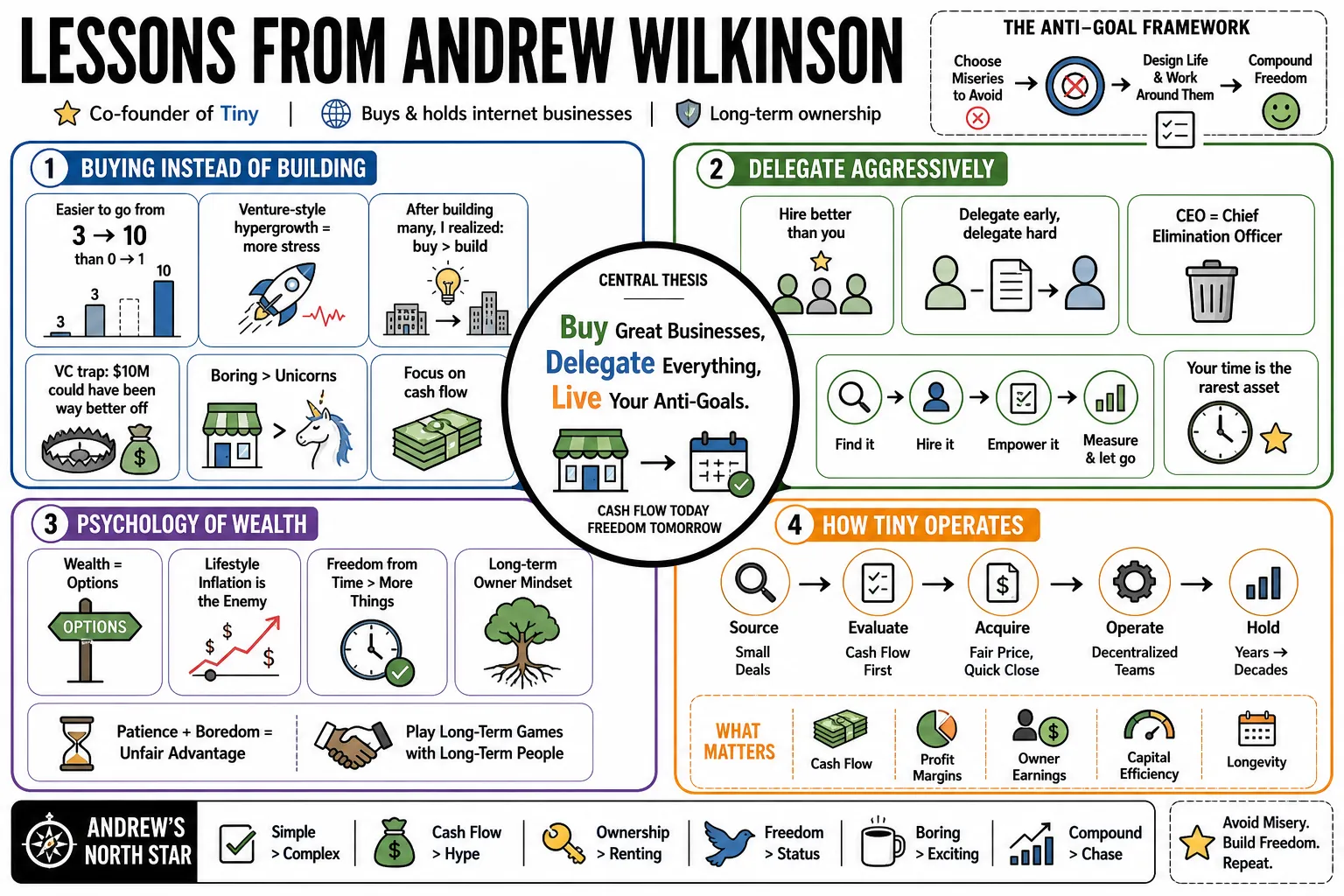
Lessons from Andrew Wilkinson
Andrew Wilkinson co-founded Tiny to acquire and hold internet businesses over the long term. He is known for his "anti-goal" framework, an approach that builds a career around avoiding specific miseries instead of chasing typical milestones. This profile covers his advice on buying companies rather than starting them, delegating aggressively, and the psychology of wealth. — Tiny, homepage letter from Andrew Wilkinson and Chris Sparling.
Part 1: Buying Instead of Building
- On the first win: His first agency worked immediately and gave him a narrative—"I'm good at business"—that carried him through a pizzeria, cat furniture and skin-cream failures. "It's so critical that people choose a business where they get that initial win." — Reference: Lenny's Podcast, "I've run 75+ businesses. Here's why you're probably chasing the wrong idea" (2025).
- On your unfair advantage: Ask "what's your unfair advantage and what are you great at?" His was selling: "ultimately my highest and best use my superpower was sales." — Reference: Lenny's Podcast, "I've run 75+ businesses. Here's why you're probably chasing the wrong idea" (2025).
- On early realizations: After starting a dozen businesses he found it "extremely hard" and stressful. Reading about Warren Buffett, he asked himself: "Why am I not just buying businesses and letting them run?" — Reference: Lenny's Podcast, "I've run 75+ businesses" with Andrew Wilkinson (2025).
- On the venture capital trap: He lost about $10 million of his own money trying to compete, bootstrapped, against venture-backed Asana, a lesson in not fighting companies that can burn far more capital. — Reference: Lenny's Podcast, "I've run 75+ businesses" with Andrew Wilkinson (2025).
- On following passions to a moat: He follows his interests, learns an industry for years, then finds the profitable niche: funding films mostly loses money, but Letterboxd had a network effect and a fair price. — Reference: Lenny's Podcast, "I've run 75+ businesses. Here's why you're probably chasing the wrong idea" (2025).
- On knowing what problems are worth: "In order to know what problems are valuable to solve, you kind of need to have valuable problems." At 20 he had no idea how little people would actually pay to fix his cat-furniture complaint. — Reference: Lenny's Podcast, "I've run 75+ businesses. Here's why you're probably chasing the wrong idea" (2025).
- On market selection: Borrowing Charlie Munger's advice to "fish where the fish are": avoid the crowded pond where every fisherman has the best lures, and find a small fishing hole with lots of fish and little competition. — Reference: Lenny's Podcast, "I've run 75+ businesses" with Andrew Wilkinson (2025).
Part 2: Holding Companies and Capital Allocation
- On long-term holds: Inspired by Buffett, Tiny uses permanent capital: it buys companies outright and holds them, so "nothing forces a sale." — Reference: Tiny, homepage letter from Andrew Wilkinson and Chris Sparling.
- On leaving founders alone: "Life is too short to hand your company to someone who sees your team as a cell in one of their spreadsheets." — Source: [Tiny]
- On post-acquisition interference: "We buy great companies and leave them alone." Teams keep their jobs, titles and culture after a sale. — Reference: Tiny, homepage letter from Andrew Wilkinson and Chris Sparling.
- On private equity pressure: Private equity typically flips companies in three to five years; Tiny's permanent capital means no forced flip. — Reference: Tiny, homepage letter from Andrew Wilkinson and Chris Sparling.
- On businesses that are hard to mess up: He looks for businesses "so good that it's hard to mess up"; most are fragile—"one person leaves and the whole business falls apart because it's held together with dental floss and duct tape." — Reference: Lenny's Podcast, "I've run 75+ businesses. Here's why you're probably chasing the wrong idea" (2025).
- On being the ideal buyer: "We started Tiny to be the buyer that we wish we'd had." — Reference: Tiny, homepage letter from Andrew Wilkinson and Chris Sparling.
- On bootstrapping versus venture: Tiny bootstrapped to almost $300 million in revenue across its companies. "The only difference between what we do and what a venture capitalist does is the level of tolerance of burning money on fire." — Reference: Lenny's Podcast, "I've run 75+ businesses. Here's why you're probably chasing the wrong idea" (2025).
Part 3: Delegation and Lazy Leadership
- On the definition of leadership: "Entrepreneurship is just delegation." — Reference: Colin Keeley, "Andrew Wilkinson & Tiny Operating Manual".
- On avoiding the grind: "Let someone else run the marathon and incentivize them." — Reference: Colin Keeley, "Andrew Wilkinson & Tiny Operating Manual".
Part 4: Anti-Goals and Lifestyle Design
- On inversion: Using Charlie Munger's inversion ("tell me where I'm going to die, so I'll never go there"), he and his partner designed their ideal workday by first describing the worst one. — Reference: Andrew Wilkinson, "The Power of Anti-Goals" (Medium, 2017).
- On protecting time: Their Anti-Goals include never holding an in-person meeting when email or phone will do, no more than two hours of scheduled time a day, and no morning meetings. — Reference: Andrew Wilkinson, "The Power of Anti-Goals" (Medium, 2017).
- On defining misery: Their worst day imaginable: full of long meetings, a packed calendar, dealing with people they don't like or trust, and owing people things. The Anti-Goals are built to avoid each one. — Reference: Andrew Wilkinson, "The Power of Anti-Goals" (Medium, 2017).
- On business relationships: No business or obligations with people they don't like: "even just a slight bad vibe and it's a hard no." — Reference: Andrew Wilkinson, "The Power of Anti-Goals" (Medium, 2017).
- On Upgrading your lifestyle: "I've witnessed this repeatedly: if you want to be liked, don't upgrade your lifestyle. Otherwise, best case, you get fewer invites. Worst case, you create envy and jealousy and people hate you." — Never Enough Blog
- On Building deep friendships: The most effective way to build genuine relationships is to organize regular, structured gatherings with strict rules that eliminate small talk and posturing. — Never Enough Blog
Part 5: The Reality of Wealth
- On what money couldn't fix: Starting an SSRI turned down "the nasty voice" inside him: "No amount of money or success or attention or anything else had done what this little tiny yellow pill could do for my mental state." — Reference: Lenny's Podcast, "I've run 75+ businesses. Here's why you're probably chasing the wrong idea" (2025).
- On ADHD and self-empathy: His ADHD diagnosis gave him "a lot more empathy for myself": at work you can delegate and build systems around it, but at home it plays out as forgotten promises that hurt people. — Reference: Lenny's Podcast, "I've run 75+ businesses. Here's why you're probably chasing the wrong idea" (2025).
- On True wealth: "I used to think becoming rich and successful was the goal. Now I think about how many people really know me and like me as a person." — Never Enough Blog
- On The isolating nature of wealth: "This is the great irony: you want to make money and turn it into the awesome life you want. And getting that awesome life—at least its physical manifestation that others can see—distances you from the very people you want to share it with." — Never Enough Blog
Part 6: Mental Models and Strategy
- On simple models: Buy what you can understand: "If your parents can't understand it over dinner, we probably can't either." — Reference: Tiny, homepage letter from Andrew Wilkinson and Chris Sparling.
Part 7: Hiring and Human Capital
- On the limits of interviewing: Hire for what people already are. Quoting "To a man with a hammer, everything looks like a nail," he recalls hiring a CEO steeped in enterprise sales for a business that needed organic marketing, and the CEO did enterprise sales anyway. — Reference: Lenny's Podcast, "I've run 75+ businesses" with Andrew Wilkinson (2025).
- On firing fast: His heuristic: "if I ever think, should I fire this person even once, I should fire them immediately." With superstars, firing is unimaginable. — Reference: Lenny's Podcast, "I've run 75+ businesses" with Andrew Wilkinson (2025).
Part 8: Technology and the Evolving Landscape
- On the long window of opportunity: "People generally overestimate things in the short term and underestimate them in the long term"; before robots can even rake leaves, there will be "a ton of opportunity" to spin up new businesses with AI. — Reference: Lenny's Podcast, "I've run 75+ businesses. Here's why you're probably chasing the wrong idea" (2025).
- On AI for administration: His AI agents now handle what a full-time assistant did, for roughly $200 a month. — Reference: Lenny's Podcast, "I've run 75+ businesses" with Andrew Wilkinson (2025).
- On The productivity of AI models: "It literally feels like I have like, 30 free employees and they're just working 24/7 and I'm paying them, like, $40 a day." — Wave Podcast: AI & I
- On The end of traditional programming: "There will be no programmers, not in the way that we understand them, in two or three years. The moat for software used to be that it's very expensive to hire them, and now it's basically free." — Wave Podcast: AI & I
- On AI infrastructure spending: "If you think AI companies are overspending on data centers, you don’t understand math or business." — Laffaz
- On Automated psychology tools: By consolidating clinically validated psychological assessments into a unified AI-powered application, it's possible to generate deep personality profiles and automated relationship coaching that previously required hours of human therapy. — Wave Podcast: AI & I
- On AI as a relationship counselor: When building his Deep Personality app, Wilkinson realized AI models can analyze the psychological tests of two partners to identify specific emotional triggers and predict recurring arguments before they even happen. — Riffon