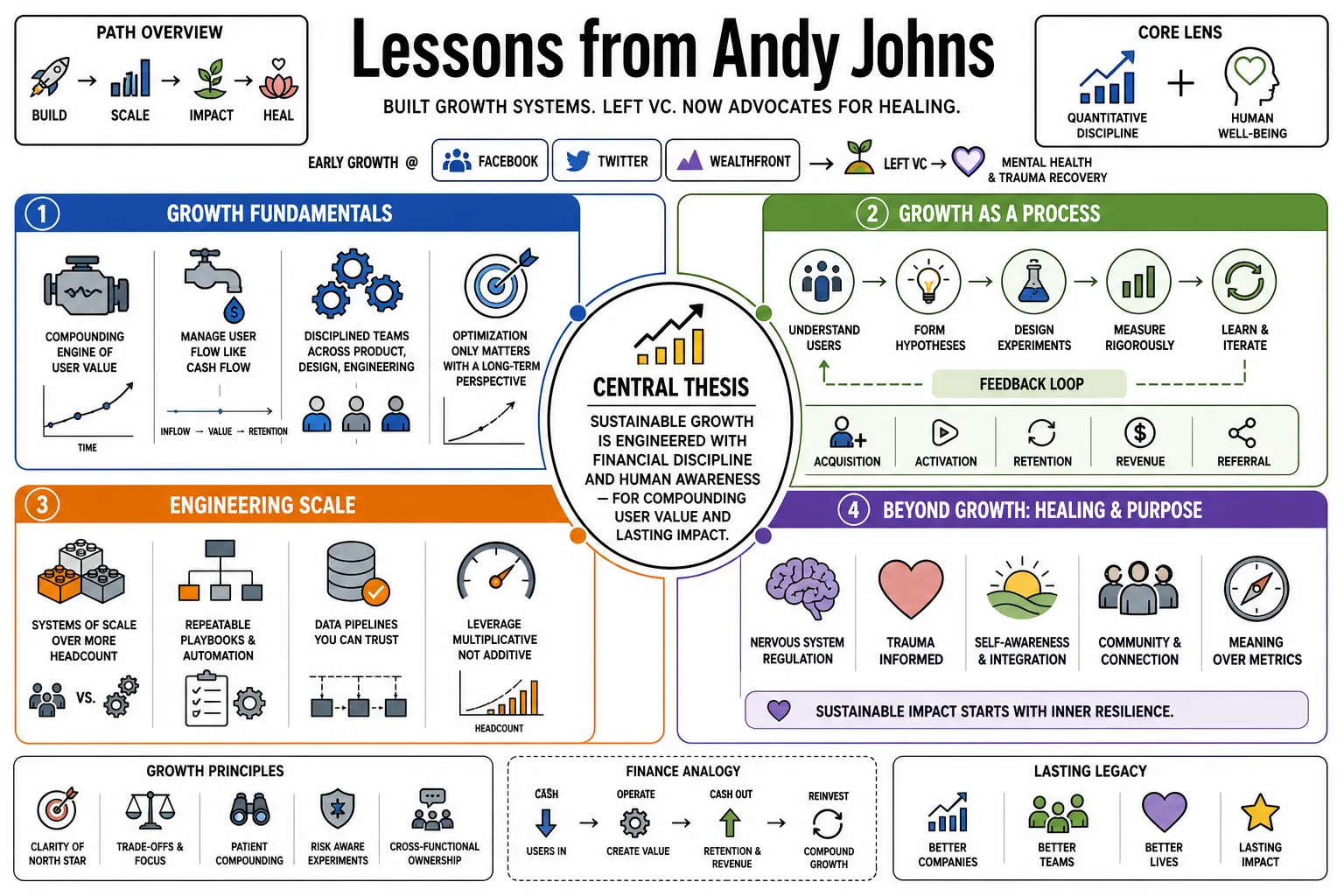
Lessons from Andy Johns
Andy Johns built early growth systems for Facebook, Twitter, and Wealthfront, treating user acquisition like quantitative finance. He later left venture capital to advocate for mental health and trauma recovery. This collection tracks his path from scaling tech companies to exploring nervous system regulation and personal healing. — First Round Review, "Indispensable Growth Frameworks from My Years at Facebook, Twitter and Wealthfront" (2015). — Lenny's Podcast, "When enough is enough | Andy Johns" (2023).
Part 1: The Philosophy of Growth
- On the Finance Analogy: Just as finance owns the flow of cash in and out of a company, growth owns "the flow of customers in and out of a product." Startups that build a robust finance team but no growth team have it backwards. — Reference: First Round Review, "Indispensable Growth Frameworks from My Years at Facebook, Twitter and Wealthfront" (2015).
- On the Role of a Growth Hacker: Don't hire a growth hacker to lead growth: "You wouldn't hire a finance hacker as your CFO, would you?" — Reference: First Round Review, "Indispensable Growth Frameworks from My Years at Facebook, Twitter and Wealthfront" (2015).
- On Facebook's Early Approach: Facebook ended 2008 with about 130 million monthly users, and the board set a 2009 goal of 300 million. It was growing about 1.5% week over week and needed 2%, so the team broke the goal down into experiments that could close that gap. — Reference: First Round Review, "Indispensable Growth Frameworks from My Years at Facebook, Twitter and Wealthfront" (2015).
- On Compound Interest: Small gains compound: a company with 10 million users growing 1% week over week ends the year at 16.8 million. If its growth team lifts that rate by 5% every four weeks, it ends at 30.5 million, beating a steady 2% rate. — Reference: First Round Review, "Indispensable Growth Frameworks from My Years at Facebook, Twitter and Wealthfront" (2015).
- On turning a goal into a weekly number: Facebook's 2009 goal of 100 to 300 million monthly users became one metric: lift growth from about 1.5% to 2% week over week and sustain it—"a pretty simple metric to orient around." — Reference: Sand Hill Road, "Unpacking growth with Andy Johns" (interview transcript, 2021)
- On growth not being one size fits all: "Growth isn't one size fits all." The approach depends on the product, the market and whether it is new or existing—Wealthfront grew "mostly through product innovation, and a little bit through product optimization." — Reference: Sand Hill Road, "Unpacking growth with Andy Johns" (interview transcript, 2021)
- On who runs growth: At Facebook, "who was hired to work on growth was arguably the most important decision being made"—the team was led by Chamath Palihapitiya. — Reference: Andy Johns on Quora, via Forbes: "How The Growth Team Helped Facebook Reach 500 Million Users" (2014)
- On Prioritization: Growth is "fundamentally… a prioritization problem." Define "very simple expressions of your growth" so everyone, including individual contributors, can make better decisions. — Reference: Index Ventures, "Growth 101: Wealthfront's Andy Johns on How to Build and Test a Sustainable Growth Framework" (2015).
Part 2: User Acquisition and Retention
- On Top of Funnel Marketing: Top of the funnel is the most tactical variable in the growth equation and "the least important parameter." When the magic moment and core product value are right, the top of the funnel fills naturally. — Reference: First Round Review, "Indispensable Growth Frameworks from My Years at Facebook, Twitter and Wealthfront" (2015).
- On User Understanding: The most meaningful product changes come from deep intuition and empathy for the user. At Wealthfront they were "derivatives of deeper behavioral finance understandings." — Reference: First Round Review, "Indispensable Growth Frameworks from My Years at Facebook, Twitter and Wealthfront" (2015).
Part 3: Data, Testing, and Measurement
- On Where to Test: Go deep in the funnel. Tests on committed users, such as in the purchase flow, resolve faster than homepage tests because of higher base conversion rates. — Reference: First Round Review, "Indispensable Growth Frameworks from My Years at Facebook, Twitter and Wealthfront" (2015).
- On Dramatic Experiments: Startups lack the traffic for tiny tests, so "be thoughtful but also be dramatic in the changes that you're willing to make." A 30% lift can be detected in days; a 5% lift can take months. — Reference: First Round Review, "Indispensable Growth Frameworks from My Years at Facebook, Twitter and Wealthfront" (2015).
- On Statistical Significance: Guard against false positives and false negatives: "Most of the time, I'm not going to make any decisions based on the first week or two of data." — Reference: Index Ventures, "Growth 101: Wealthfront's Andy Johns on How to Build and Test a Sustainable Growth Framework" (2015).
Part 4: Structuring Growth Teams
- On Hiring a Product-Minded Growth Lead: Your growth lead needs to be a product person. He would bet on the candidate who read a 30-page white paper on getting people to contribute to 401(k)s over one who just runs tests. — Reference: First Round Review, "Indispensable Growth Frameworks from My Years at Facebook, Twitter and Wealthfront" (2015).
- On Early Stage Growth: "Don't hire a head of growth unless you have healthy organic growth first." Without organic growth, you have a product challenge, and a growth leader is not the solution. — Reference: First Round Review, "Indispensable Growth Frameworks from My Years at Facebook, Twitter and Wealthfront" (2015).
- On the Growth Leader's Skills: Growth leaders need three skills: building growth models, developing experimentation programs and building acquisition channels. An executive hire should show "excellence in at least two of the three." — Reference: First Round Review, "Indispensable Growth Frameworks from My Years at Facebook, Twitter and Wealthfront" (2015).
Part 5: Product-Market Fit and Engagement
- On the Magic Moment: Growth depends on a magic moment, the user's emotional response to the product. At Wealthfront his came when he woke to find it had "harvested $3,000 in losses for me while I slept." — Reference: First Round Review, "Indispensable Growth Frameworks from My Years at Facebook, Twitter and Wealthfront" (2015).
- On the three components of durable growth: Sustainable growth needs a top of funnel, core value "10x better relative to the alternatives," and magic moments that delight users so much "they can't help but tell other people about it"—which solves the top of funnel. — Reference: Sand Hill Road, "Unpacking growth with Andy Johns" (interview transcript, 2021)
- On sharing playbooks: "Great knowledge and information shouldn't be kept private. Keep sharing useful knowledge and don't stop!" — Reference: Carta, "Growth and innovation: a Q&A with Andy Johns of Unusual Ventures"
- On the Limits of Optimization: "You can't sustainably grow something that sucks. Nothing replaces an incredible product." — Reference: First Round Review, "Indispensable Growth Frameworks from My Years at Facebook, Twitter and Wealthfront" (2015).
Part 6: Ambition, Burnout, and the Cost of Success
- On the Addiction to Achievement: "From the age of 10 to basically 35, I was switched on, constantly seeking to perform at the top of whatever my field was." He later saw even his ultramarathons as "another desperate attempt to feel worthy." — Reference: Lenny's Podcast, "When enough is enough | Andy Johns" (2023).
- On Knowing When to Stop: Watch the measurable signals: "If your sleep always sucks, if your relationships are constantly strained or frequently strained, if your physical health is failing," something needs to change. — Reference: Lenny's Podcast, "When enough is enough | Andy Johns" (2023).
- On Distress in Tech: Based on his surveys and conversations, he estimates that at least 50–60% of tech employees with five to seven or more years in the industry experience some form of psychological and emotional distress. — Reference: Lenny's Podcast, "When enough is enough | Andy Johns" (2023).
- On the Golden Handcuffs: He left a venture career paying "high six figures per year into early seven figures" after 45 days in a mental health institute. He realized he had kept pushing only because of what had happened to him when he was young. — Reference: Lenny's Podcast, "When enough is enough | Andy Johns" (2023).
Part 7: Trauma and Nervous System Regulation
- On Childhood Trauma: His childhood included disruption, neglect and the loss of "the most important female figure in my life when I was 10." As a child his mind buried the pain, which resurfaced under career pressure in adulthood. — Reference: Lenny's Podcast, "When enough is enough | Andy Johns" (2023).
- On Nervous System Regulation: He urges people to read Bessel van der Kolk's The Body Keeps the Score: "when mental health presents itself, look to the body because it's the body that is keeping the score." — Reference: Lenny's Podcast, "When enough is enough | Andy Johns" (2023).
- On Panic Attacks: In 2010 at Twitter, with his career going well, he was "suddenly hit with near constant panic, panic attacks, depression," and sometimes quietly walked out of the office mid-morning. — Reference: Lenny's Podcast, "When enough is enough | Andy Johns" (2023).
- On Psychedelic-Assisted Therapy: He sits on the board of the Heroic Hearts Project, which funds psychedelic-assisted psychotherapy for military veterans with PTSD. — Reference: Lenny's Podcast, "When enough is enough | Andy Johns" (2023).
- On the Four Steps of Transformation: Deep transformation has four steps: suffering, seeking the truth, living with compassion toward oneself, and then living with compassion toward others. — Reference: Lenny's Podcast, "When enough is enough | Andy Johns" (2023).
Part 8: Identity, Healing, and the Second Half of Life
- On Finding a Therapist: Finding a therapist is "like speed dating at first," because "the most important factor is that you feel safe." — Reference: Lenny's Podcast, "When enough is enough | Andy Johns" (2023).
- On Finding Your Own Path: Quoting a Buddhist friend: "Everyone's trying to make it to Bangkok. The problem is they're getting to Bangkok by following somebody else's road. The whole point is to find your own path to Bangkok." — Reference: Lenny's Podcast, "When enough is enough | Andy Johns" (2023).
- On Mountains and Rivers: Most people who die on Everest die on the way down. Instead of climbing mountain after mountain, he is "trying to float down river." — Reference: Lenny's Podcast, "When enough is enough | Andy Johns" (2023).