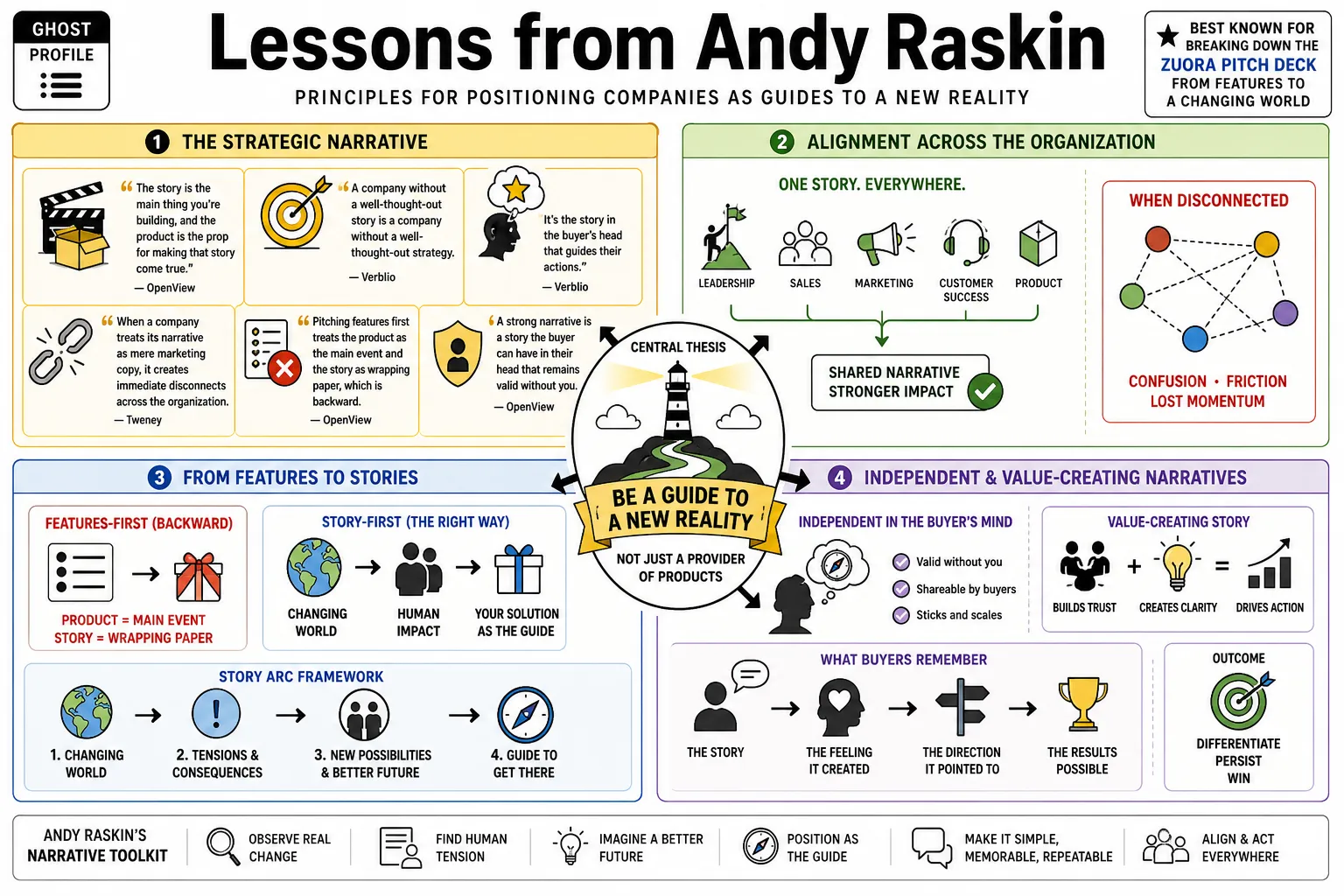
Lessons from Andy Raskin
Andy Raskin is a messaging consultant who helps leadership teams align around a single story. He is best known for breaking down the Zuora pitch deck into a framework that trades feature lists for narratives about a changing world. This profile examines his principles for positioning companies as guides to a new reality. — Andy Raskin, "The Greatest Sales Deck I've Ever Seen" (2016). — Lenny's Podcast, "The power of strategic narrative | Andy Raskin" (2023).
Part 1: The Strategic Narrative
- On the primary asset: "In a way you're not pitching product. Product is like a prop for making the story come true. Very important prop, but there's this higher level overlay that becomes the focus of the conversation." — Reference: Lenny's Podcast, "The power of strategic narrative | Andy Raskin" (2023).
- On story before product: "Story should dictate product — not the other way around": successful teams "view their customer's transformation story as the primary thing they're building," with the product as its medium. — Reference: Andy Raskin, "What I Learned Positioning 40 Companies" (2016)
- On leaving things out: "The hardest thing about messaging is (still) leaving things out." Your product does many things: "Which do you most want to be known for?" — Reference: Andy Raskin, "What I Learned Positioning 40 Companies" (2016)
- On studying other stories: On any company's site, ask two questions: who is the main character whose life it says it can transform, and what Promised Land is it conveying? — Reference: Andy Raskin, "What I Learned Positioning 40 Companies" (2016)
- On beyond marketing: A strategic narrative is "this one story that the CEO uses to drive success in marketing, sales, but also product," a "strategic north star for product roadmap, for fundraising, for recruiting, really everything." — Reference: Lenny's Podcast, "The power of strategic narrative | Andy Raskin" (2023).
- On the CEO's Story: The Zuora example worked because it was "really about this story that Tien, the CEO is telling everywhere," which then showed up in the sales deck. — Reference: Lenny's Podcast, "The power of strategic narrative | Andy Raskin" (2023).
Part 2: The Old Game vs. The New Game
- On naming the past: Every movie starts with a shift in the world, which he calls the shift "from the old game to a new game." His archetype is Benioff at Salesforce: "software is over," and there is a new world called the cloud with new rules. — Reference: Lenny's Podcast, "The power of strategic narrative | Andy Raskin" (2023).
- On the Drift example: Drift launched what "might be the 30th chatbot for your website." Instead of claiming the best chatbot, it contrasted the old "world of forms," where buyers waited, with a new "world of now." — Reference: Lenny's Podcast, "The power of strategic narrative | Andy Raskin" (2023).
Part 3: Naming the Undeniable Shift
- On opening the pitch: "Don't kick off a sales presentation by talking about your product, your headquarters locations, your investors, your clients, or anything about yourself. Instead, name the undeniable shift in the world that creates both (a) big stakes and (b) huge urgency for your prospect." — Reference: Andy Raskin, "The Greatest Sales Deck I've Ever Seen" (2016).
- On the Subscription Economy: Zuora coined "subscription economy" to name the trend of buyers choosing recurring service payments over outright purchases. Nearly every Zuora deck opens with that shift. — Reference: Andy Raskin, "The Greatest Sales Deck I've Ever Seen" (2016).
- On the arrogant doctor: The standard pitch is "what I call the arrogant doctor. So you have a problem, a pain, I have a solution, a treatment." Defining a movement "is very different from, 'Hey, I'm going to solve your problem.'" — Reference: Lenny's Podcast, "The power of strategic narrative | Andy Raskin" (2023).
- On narrative rationality: When buying decisions get complex, buyers stop scoring alternatives and use "narrative rationality": they tease out a simple story about how people are winning now and act on it. — Reference: Andy Raskin, "Metaphors We Sell By" (2023)
- On the Movement Champion: A strategic narrative is "a story that transforms the act of buying into the act of joining a movement"—differentiating by a new goal state rather than by claiming to be "better." — Reference: Andy Raskin, "Metaphors We Sell By" (2023)
Part 4: Creating Stakes: Winners and Losers
- On establishing consequences: To combat loss aversion, show that the shift will create big winners and big losers: adapting leads to a highly positive future, and not adapting to an unacceptably negative one. — Reference: Andy Raskin, "The Greatest Sales Deck I've Ever Seen" (2016).
- On avoiding pain points: Don't start with "the problem": "When you assert that your prospects have a problem, you put them on the defensive." A shift in the world gets them to open up instead. — Reference: Andy Raskin, "The Greatest Sales Deck I've Ever Seen" (2016).
Part 5: Teasing the Promised Land
- On defining the future: Tease the Promised Land, the happily-ever-after your product helps achieve. It should be "both desirable (obviously) and difficult for the prospect to achieve without outside help. Otherwise, why does your company exist?" — Reference: Andy Raskin, "The Greatest Sales Deck I've Ever Seen" (2016).
- On keeping it product-free: "The Promised Land is not having your technology, but what life is like thanks to having your technology." — Reference: Andy Raskin, "The Greatest Sales Deck I've Ever Seen" (2016).
- On Spreading the Story: A compelling Promised Land helps prospects pitch your solution to colleagues after the meeting, when someone asks, "What do those guys do again?" — Reference: Andy Raskin, "The Greatest Sales Deck I've Ever Seen" (2016).
Part 6: Positioning Features as Magic Gifts
- On the role of the vendor: "Your prospect is Luke, and you're Obi Wan, furnishing a lightsaber to help him defeat the Empire." — Reference: Andy Raskin, "The Greatest Sales Deck I've Ever Seen" (2016).
- On introducing the product: Introduce capabilities as "magic gifts" that help the main character, your prospect, overcome obstacles to the Promised Land. — Reference: Andy Raskin, "The Greatest Sales Deck I've Ever Seen" (2016).
- On delaying the reveal: Resist jumping into product details: "If you introduce product/service details too soon, prospects won't yet have enough context for why those details are important, and they'll tune out." — Reference: Andy Raskin, "The Greatest Sales Deck I've Ever Seen" (2016).
- On context for features: Zuora's customer-record slide shows the point: "Out of context, this detail would likely bore even the most technical prospect." Framed as the move from an old world to a new world, it starts an engaging conversation. — Reference: Andy Raskin, "The Greatest Sales Deck I've Ever Seen" (2016).
Part 7: Evidence and Delivering the Promise
- On the necessity of proof: The road to the Promised Land is full of obstacles, so prospects are rightly skeptical. End with the best evidence you can offer "that you can make the story you're telling come true." — Reference: Andy Raskin, "The Greatest Sales Deck I've Ever Seen" (2016).
- On the role of case studies: "By far, the most effective type of evidence is a success story about how you've already helped someone else (who is similar to the prospect) reach the Promised Land." — Reference: Andy Raskin, "The Greatest Sales Deck I've Ever Seen" (2016).
Part 8: Leadership and Internal Alignment
- On Air Cover: A sales narrative works best when everyone tells it. At Zuora, marketing and the CEO pushed the subscription-economy story, which one salesperson called "like air cover for my in-person sales ground attack." — Reference: Andy Raskin, "The Greatest Sales Deck I've Ever Seen" (2016).
- On why the CEO must lead: Only the CEO "has the cross-functional authority to tell everyone, 'This is who we are,'" and can empower the "big, hairy choices" great messaging requires—so he declines messaging work the CEO won't lead. — Reference: Andy Raskin, "Why Story Is the CEO's Job" (2016)
- On story backlash: A clear story lays strategic choices bare, so expect "story backlash"; the CEO can say, "This is our best shot at the strategic story for the next X months, and we'll hone it after that as we learn more." — Reference: Andy Raskin, "Why Story Is the CEO's Job" (2016)
- On alignment over crafting: From a CEO client: "the hard part is the aligning, not the crafting"—what CEOs value most is getting their teams bought in. — Reference: Andy Raskin, "What I Learned Crafting Strategic Narratives for 100+ Companies" (2018)
- On customer input: "Customer input is SO not optional": shift interviews from what customers think of your product to what is changing in their lives that gives rise to stakes. — Reference: Andy Raskin, "What I Learned Crafting Strategic Narratives for 100+ Companies" (2018)