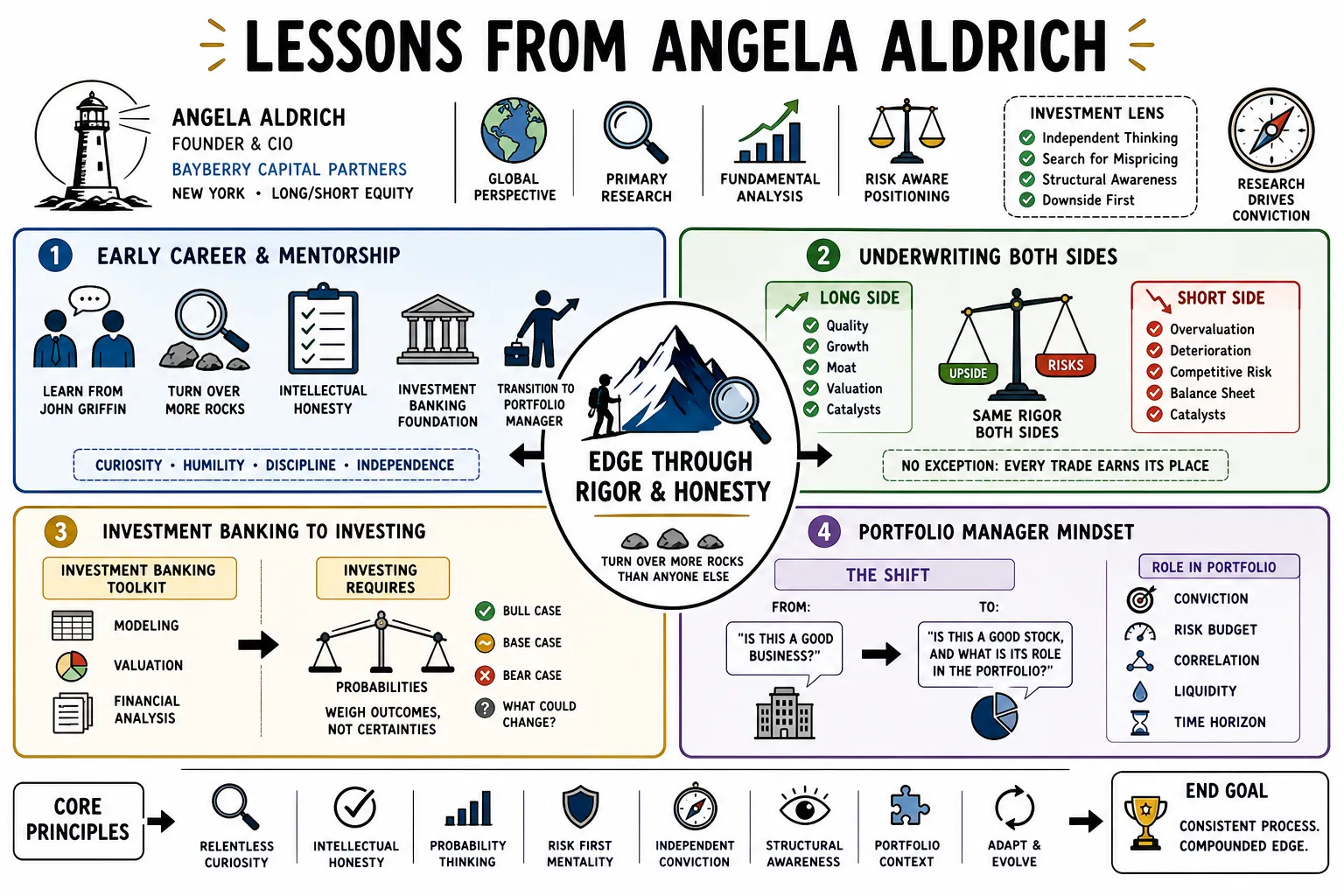
Lessons from Angela Aldrich
Angela Aldrich is the founder and CIO of Bayberry Capital Partners, a New York-based long/short equity fund. A former managing director at Blue Ridge Capital, she grounds her global equity investments in primary research and fundamental analysis. This collection outlines her approach to portfolio construction, short selling, and spotting structural market shifts. — Value Investing with Legends, "Angela Aldrich - Developing A Differentiated View" (Columbia Business School, 2023).
Part 1: Early Career and Mentorship
- On learning from John Griffin: The most important lesson from John Griffin at Blue Ridge: "his true ability to watch volatility unemotionally." — Reference: Sohn Hearts & Minds, "'Volatility is opportunity': why this manager loves shorting stocks" (2023).
- On Both Sides of the Book: "I definitely caught the short-selling virus from John." Griffin "believed he could make money for investors on both sides of the portfolio." — Reference: Sohn Hearts & Minds, "'Volatility is opportunity': why this manager loves shorting stocks" (2023).
- On Her Path: Before co-founding Bayberry she studied economics at Duke, earned an MBA at Stanford GSB, and worked at Goldman Sachs, BDT Capital Partners, Scout Capital and Blue Ridge Capital. — Reference: Value Investing with Legends, "Angela Aldrich - Developing A Differentiated View" (Columbia Business School, 2023).
Part 2: The Foundation of Bayberry Capital
- On launching her own fund: Bayberry launched with outside capital on April 1, 2019, so the March 2020 crash hit less than a year into the fund's life: "It was baptism by fire, to say the least." — Reference: Value Investing with Legends, "Angela Aldrich - Developing A Differentiated View" (Columbia Business School, 2023).
- On staying small: She planned to keep Bayberry small so she could keep playing "in the most exciting space"—small- and mid-cap companies. — Reference: Business Insider, "Meet the 5 Founders Who Are the 'Next Wave' of Hedge-Fund Talent" (2019)
- On contrarian timing: Launching amid industry headwinds, she argued: "It's a particularly exciting time to be in long-short equity, especially after such a long bull run." — Reference: Business Insider, "Meet the 5 Founders Who Are the 'Next Wave' of Hedge-Fund Talent" (2019)
- On an entire lifetime of cycles: Looking back on the years since launch: "The past few years have been an entire lifetime of economic cycles." — Reference: Sohn Hearts & Minds, "'Volatility is opportunity': why this manager loves shorting stocks" (2023)
- On a long-term capital base: "You cannot make a long-term decision when you have daily liquidity sort of breathing down your neck." Aligned investors let Bayberry keep adding to its largest position when it fell 60% peak to trough in March 2020. — Reference: Value Investing with Legends, "Angela Aldrich - Developing A Differentiated View" (Columbia Business School, 2023)
- On building a short thesis: Her Treasury Wine Estates short combined a secular shift—the largest generational cohort preferring liquor, and more millennials choosing marijuana over alcohol—with company-specific cracks: trouble retaining top talent and oversaturated distribution channels. — Reference: Business Insider, "A Rising Hedge Fund Star Shorts Australian Wine Company" (2019)
Part 4: Developing a Differentiated View
- On idea generation: "We like the weird businesses where there's no sort of pure-play competitor peer that you can look at." — Reference: Sohn Hearts & Minds, "'Volatility is opportunity': why this manager loves shorting stocks" (2023).
- On surprisingly high business quality: She hunts for businesses that sound "lower quality, more capital intensive, more cyclical than it actually is in reality," where earnings and free cash flow can come in well ahead of consensus over three to five years. — Reference: Value Investing with Legends, "Angela Aldrich - Developing A Differentiated View" (Columbia Business School, 2023)
- On understanding the other side: "There are smart people on the other side." If you can't understand why others don't share your view and what will change their minds, "it's really hard to unlock value from a thesis." — Reference: Value Investing with Legends, "Angela Aldrich - Developing A Differentiated View" (Columbia Business School, 2023)
- On preventing thesis creep: Every call note opens with bull and bear takeaways, and each thesis and its opposing thesis are written down at entry and not revised. A stock that works while the thesis doesn't is a signal to "get out and completely reevaluate." — Reference: Value Investing with Legends, "Angela Aldrich - Developing A Differentiated View" (Columbia Business School, 2023)
- On two or three things that matter: Early on she built 80-item work lists. The lesson: be "comfortable with imperfect information" and focus on the "two to three things max" that will make a stock double or get cut in half. — Reference: Value Investing with Legends, "Angela Aldrich - Developing A Differentiated View" (Columbia Business School, 2023)
Part 5: The Art of Short Selling
- On shorting Treasury Wine Estates: On shorting Treasury Wine Estates: "Our view wasn't that TWE was a bad company or that they were doing something nefarious. It had been such a good stock for such a long period, but it started to look like cracks were showing." — Reference: Sohn Hearts & Minds, "'Volatility is opportunity': why this manager loves shorting stocks" (2023).
- On Priced-for-Perfection Shorts: "At some point, everything that's priced for perfection reaches a point where expectations get too far ahead of themselves." — Reference: Sohn Hearts & Minds, "'Volatility is opportunity': why this manager loves shorting stocks" (2023).
- On the Appeal of Shorting: Why she loves the short side: when you see cracks with high conviction, "it tends to be quicker for that information to reach the broader investment community and result in a share price decline." — Reference: Sohn Hearts & Minds, "'Volatility is opportunity': why this manager loves shorting stocks" (2023).
- On Volatility in the Short Book: "We need irrational moves in our shorts to get as much juice out of every position as possible." The violent post-COVID rebound gave Bayberry a second and third chance on shorts it had already covered. — Reference: Sohn Hearts & Minds, "'Volatility is opportunity': why this manager loves shorting stocks" (2023).
- On what earns a short: A short needs a low-quality, declining business with "a tangible, trackable reason" earnings will fall. "If there is salacious management stories, that's a really fun headline, not enough to get us involved on the short side." — Reference: Value Investing with Legends, "Angela Aldrich - Developing A Differentiated View" (Columbia Business School, 2023)
Part 7: Finding Growth and Value in Transition
- On Patience for a Target: WillScot, an early large long, "had been on my fantasy list since I was a junior analyst." It sold off like a travel business during COVID, yet ended up over-earning. — Reference: Sohn Hearts & Minds, "'Volatility is opportunity': why this manager loves shorting stocks" (2023).
- On evidence over prediction: WillScot turned up on a short screen before launch; by launch it was Bayberry's largest long. "We invest on evidence, not prediction." — Reference: Value Investing with Legends, "Angela Aldrich - Developing A Differentiated View" (Columbia Business School, 2023)
- On uncovering hidden assets: Burford Capital had litigation tied to about half its stated book value when Bayberry bought in, and "people thought we were insane." The thesis was that once the overhang cleared, buyers would return. — Reference: Sohn Hearts & Minds, "'Volatility is opportunity': why this manager loves shorting stocks" (2023).
Part 8: Navigating the Hedge Fund Landscape
- On market volatility: "I think there is a bad habit going around of viewing volatility as risk. There's risk in everything. Volatility is the opportunity." — Reference: Sohn Hearts & Minds, "'Volatility is opportunity': why this manager loves shorting stocks" (2023).
- On concentration: Spreading capital across names you don't know well is "playing not to lose rather than playing to win"—and you will trade those names poorly. — Reference: Value Investing with Legends, "Angela Aldrich - Developing A Differentiated View" (Columbia Business School, 2023)
- On sizing and trimming: The largest risk-weighted go-forward IRR should be the largest position. As the market comes around to the thesis, the view is less variant and the position should shrink: "It's almost the opposite of momentum." — Reference: Value Investing with Legends, "Angela Aldrich - Developing A Differentiated View" (Columbia Business School, 2023)
- On learning from mistakes: Her favorite book is Carol Dweck's Mindset, for treating failure as a lesson "in a business where we are wrong so often." Her advice: put mistakes "in your investing journal, view them as a lesson." — Reference: Value Investing with Legends, "Angela Aldrich - Developing A Differentiated View" (Columbia Business School, 2023)