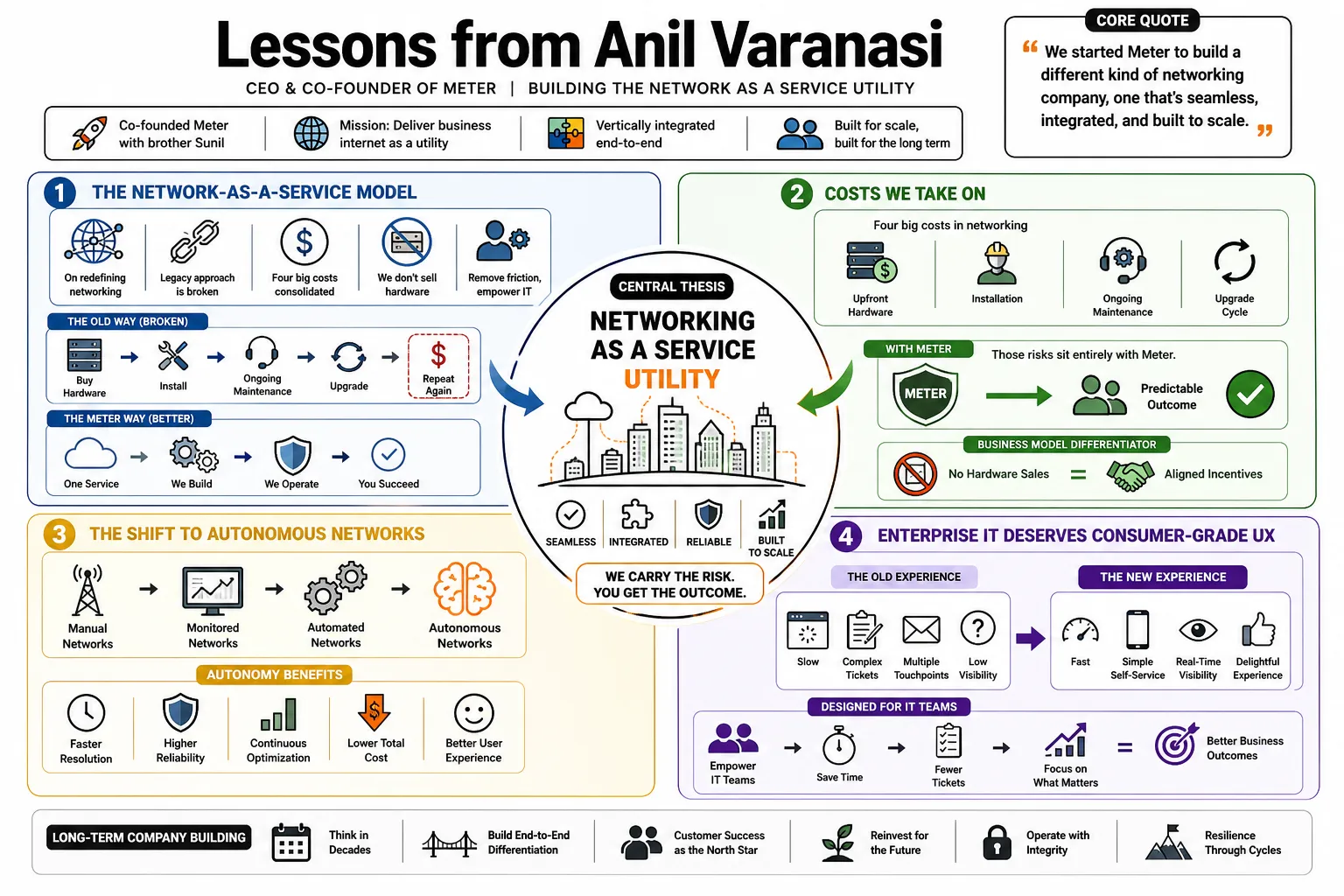
Lessons from Anil Varanasi
Anil Varanasi is the CEO of Meter, a company he co-founded with his brother Sunil to deliver business internet infrastructure as a vertically integrated utility rather than a collection of disparate parts. This profile organizes his arguments on long-term company building, the shift toward autonomous networks, and why enterprise IT requires a consumer-grade user experience.
Part 1: The Network-as-a-Service Model
- On redefining networking: Meter began "with the simple premise of building the entire stack and vertically integrating it across hardware software operations." — Reference: Packet Pushers, "TNO005: Making Networking Cool Again with Meter" (2024).
- On the legacy IT market: Legacy vendors "made a box, sold the box, then washed their hands of it. We thought that was also wrong." — Reference: CRN, "Meter CEO On Microsoft Partnership And Disrupting The Legacy Networking Market Through NaaS" (2025).
- On capital expenditure: "There are four big costs in networking: Upfront hardware, installation, ongoing maintenance, and then doing it all again when you upgrade… With us, those risks sit entirely with Meter." — Reference: ChannelWeb (CRN UK), "Meter's CEO on the component crisis, profitability, and…" (2026).
- On business models: "We don't sell hardware at all – and that's never happened in networking." — Reference: ChannelWeb (CRN UK), "Meter's CEO on the component crisis, profitability, and…" (2026).
- On Pricing by the Square Foot: "We take on all the risk for the hardware and installation costs ourselves and just charge by the square footage per month." — Reference: IT Europa, "Meter's Anil Varanasi on the 'zero CapEx' NaaS revolution" (2026).
- On shifting risk: The subscription model aligns incentives: "don't pay us unless the network works." — Reference: First Round Review podcast, "Building Meter for decades, not an exit" (2025).
- On market stagnation: Networking has "multiple $200 billion market cap businesses, yet no new companies come in at all. It's probably the most scathing review against the efficient market hypothesis." — Reference: CRN, "Meter CEO On Microsoft Partnership And Disrupting The Legacy Networking Market Through NaaS" (2025).
- On instant procurement: Meter Connect is "Kayak or Expedia but for ISPs," built on the premise: "I'm able to buy everything on the internet except the internet itself." — Reference: Packet Pushers, "TNO005: Making Networking Cool Again with Meter" (2024).
Part 2: Vertical Integration
- On building the full stack: Meter delivers "one hardware platform, one operating system, one API, one application for the entire rack"—something that, "in these 40 years of networking, nobody has done." — Reference: IT Europa, "Meter's Anil Varanasi on the 'zero CapEx' NaaS revolution" (2026).
- On customer empathy: The brothers tried networking products while running another business and "thought all of them were just remarkably subpar." — Reference: First Round Review podcast, "Building Meter for decades, not an exit" (2025).
- On multi-vendor sprawl: A typical rack has been "different companies, different hardware platforms, different firmware images, different operating systems, different APIs." — Reference: IT Europa, "Meter's Anil Varanasi on the 'zero CapEx' NaaS revolution" (2026).
- On controlling the experience: Acquiring and combining companies is not vertical integration. Vertical integration is "a single hardware platform, single operating stack, single data pipeline and a single application all built together." — Reference: CRN, "Meter CEO On Microsoft Partnership And Disrupting The Legacy Networking Market Through NaaS" (2025).
- On packet processing: Data centers had far better packet processing for speed, reliability and security, while local networks were still "all based on text files." — Reference: Packet Pushers, "TNO005: Making Networking Cool Again with Meter" (2024).
- On monopolistic markets: Startups that attack a slice of networking "end up being a point solution, and the only exit out of that is getting acquired," which is why Meter built the whole stack. — Reference: First Round Review podcast, "Building Meter for decades, not an exit" (2025).
Part 3: The Multi-Decade Time Horizon
- On long-term planning: "I don't care about where Meter ends up in five. I care about where it ends up in 25. But at the same time, the next few hours also really matter to me." — Reference: First Round Review podcast, "Building Meter for decades, not an exit" (2025).
- On heads-down R&D: Getting to a sales-ready product took about four and a half years, including a year of operating-system work they had to scrap entirely. — Reference: First Round Review podcast, "Building Meter for decades, not an exit" (2025).
- On the barbell time horizon: A "barbell approach": "I don't care about where Meter ends up in five. I care about where it ends up in 25. But at the same time, the next few hours also really matter to me." — Reference: First Round In Depth, "Building Meter for decades, not an exit" (transcript)
- On wasting time: After scrapping a year of operating-system work: "you want to be able to waste anything when starting a company except time." — Reference: First Round In Depth, "Building Meter for decades, not an exit" (transcript)
- On contrarian management: "We don't do OKRs." In his view, OKRs are good for Google, a money-printing machine, and "for everybody else, it's different." — Reference: First Round Review podcast, "Building Meter for decades, not an exit" (2025).
- On meta-work: As companies scale, "the meta work ends up being way more than the actual work." Process and tracking feel like work—"The real work is actually the work itself." — Reference: First Round In Depth, "Building Meter for decades, not an exit" (transcript)
- On decoupling management and authority: "Somehow people have bundled management and authority together in one. We're trying to decouple that as much as possible," so great people who don't want to manage can still hold power. — Reference: First Round In Depth, "Building Meter for decades, not an exit" (transcript)
- On management as context: Management matters—"Management actually works"—but it should be coordination and context, not authority: "It is context that is scarce." — Reference: First Round In Depth, "Building Meter for decades, not an exit" (transcript)
- On Enduring Bad Stretches: When Apple's M1 Macs had Wi-Fi issues, "every single one of our customers hated us for a period of about six to eight months." Meter rewrote its stack before the fault turned out to be Apple's implementation. — Reference: First Round Review podcast, "Building Meter for decades, not an exit" (2025).
Part 4: Autonomous Networks and Automation
- On generative UI: Even if models stopped improving, software would become "something that happened on the fly, rather than an artisanal handmade product." — Reference: The Aarthi and Sriram Show, "EP 89 Understanding Anil Varanasi" (2024).
- On replacing the CLI: With Command, Meter wanted "to take the best of the dashboards and best of command line. And smash it together." — Reference: The Aarthi and Sriram Show, "EP 89 Understanding Anil Varanasi" (2024).
Part 5: Rethinking Hardware and Software
- On soft software: "We think software should be soft… it should be malleable." — Reference: The Aarthi and Sriram Show, "EP 89 Understanding Anil Varanasi" (2024).
- On Better Components: Because Meter manages its own hardware, it can choose components "20%, 30%, 40% more expensive than a traditional vendor might," which costs little relative to legacy vendors' margins. — Reference: First Round Review podcast, "Building Meter for decades, not an exit" (2025).
Part 6: Talent and Hiring
- On identifying talent early: His talent rule: when he and Sunil find work online with "some spark of genius" from someone who doesn't yet have an audience, they email to ask what the person needs. — Reference: The Aarthi and Sriram Show, "EP 89 Understanding Anil Varanasi" (2024).
- On funding people early: When he and Sunil find promising work online from someone without an audience, they email one question: "how much money do you need to do this full time for six months?" — Reference: The Aarthi and Sriram Show, EP 89 "Understanding Anil Varanasi" (transcript)
- On people over projects: Following HHMI's model: "it's much better to fund people rather than projects… fund people and let them fly." — Reference: The Aarthi and Sriram Show, EP 89 "Understanding Anil Varanasi" (transcript)
- On global perspectives: They moved to Shenzhen to learn hardware because it "had gone from 30,000 to 30 million people in 30 years." — Reference: The Aarthi and Sriram Show, "EP 89 Understanding Anil Varanasi" (2024).
Part 8: Building a Company During Crises
- On surviving macro shocks: When COVID hit, "100% of our customers went to zero." Warehouses and manufacturers automating during the pandemic then drove much of Meter's growth. — Reference: First Round Review podcast, "Building Meter for decades, not an exit" (2025).
- On supply chain resilience: During the pandemic, Meter was too small to get hardware out of Taiwan because production capacity went to larger companies. — Reference: First Round Review podcast, "Building Meter for decades, not an exit" (2025).
- On channel expansion: On the Microsoft relationship: "We anticipate it will be the biggest channel we have over the next few years." — Reference: CRN, "Meter CEO On Microsoft Relationship: We Expect It To Be 'The Biggest Channel We Have'" (2025).
- On co-founding with family: Building with his brother Sunil: "it's like we have one brain, but two bodies." — Reference: ChannelWeb (CRN UK), "Meter's CEO on the component crisis, profitability, and…" (2026).