Lessons from Anique Drumright
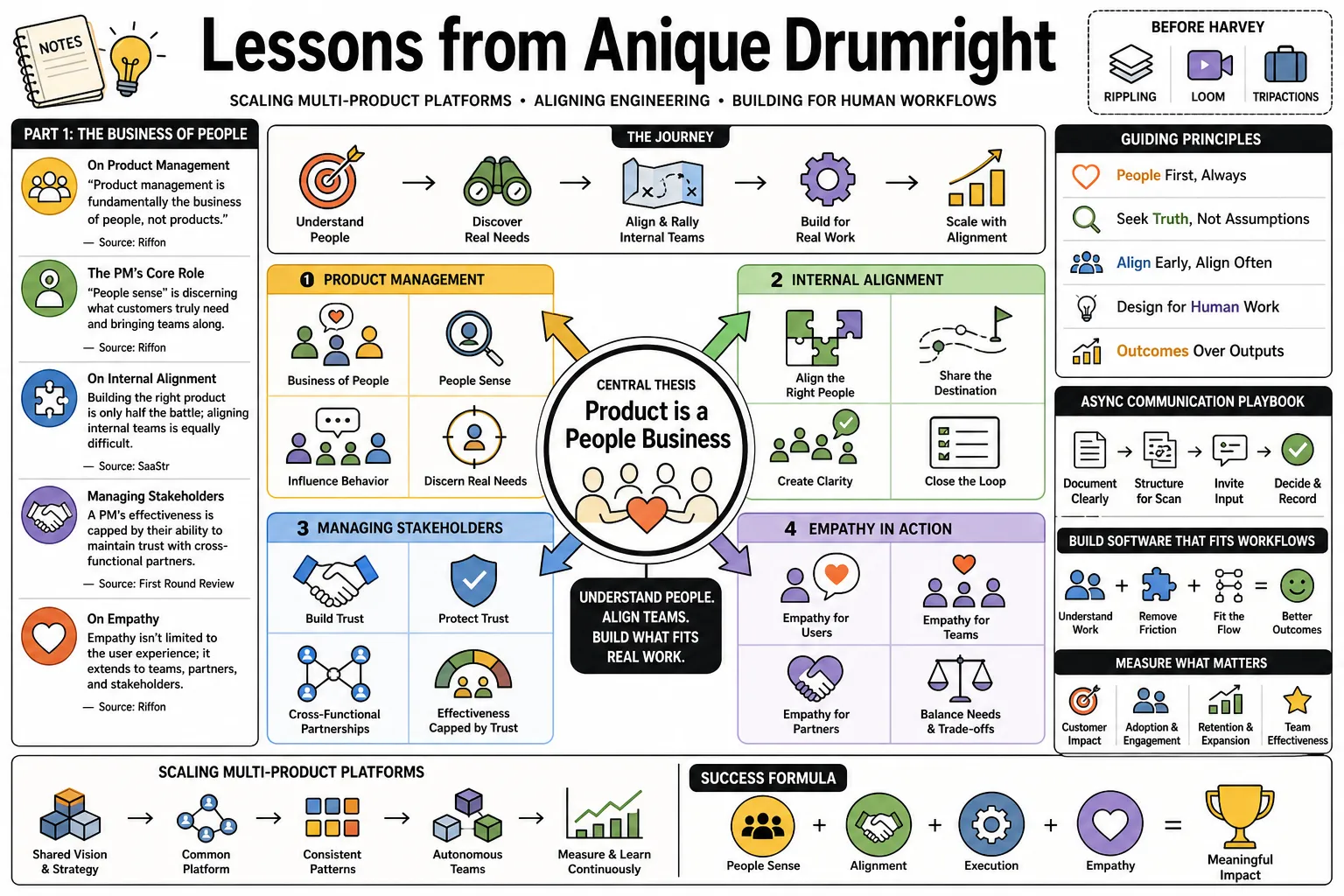
Before taking over as Chief Product Officer at Harvey, Anique Drumright led product teams at Rippling, Loom, and TripActions. This profile breaks down her approach to scaling multi-product platforms and keeping engineering aligned with product strategy. It is a practical look at how she handles asynchronous communication and builds software that actually fits human workflows.
Part 1: The Business of People
- On Managing Stakeholders: Drumright treats stakeholder management as part of product craft: the PM has to create enough shared context that product, design, engineering, marketing, and customer-facing teams can move together. — Reference: First Round podcast on cross-functional product leadership at Loom
- On Organizational Design: Drumright links product outcomes to organizational design: if engineering managers are underpowered, product and engineering teams end up misaligned no matter how good the roadmap looks. — Reference: SFELC session summary on why engineering managers matter in hypergrowth
- On Team Dynamics: Drumright sees strong team dynamics as an operating system: functional leads need shared goals, rituals, and enough trust to keep cross-functional performance from becoming accidental. — Reference: First Round podcast on alignment at scale and cross-functional performance
Part 2: Asynchronous Work and Communication
- On Communication Preferences: "Everyone communicates and shows up differently depending on the communication channel." — Reference: Lucid, "Asynchronous collaboration: expert tips".
- On Attention Spans: One person may keep clarity of thought in a live conversation, while "another's attention span or personal expertise excels in a more controlled, asynchronous channel." — Reference: Lucid, "Asynchronous collaboration: expert tips".
- On Choosing the Channel: Loom decided that explanation and presentation belong in async channels, while group decision-making and prioritization belong in synchronous conversation. — Reference: Lucid, "Asynchronous collaboration: expert tips".
- On Humanizing Feedback: Loom solved a problem she had at TripActions: giving design feedback over Slack, she "would sometimes sound overly harsh." Video restored the human voice. — Reference: CTech, "In terms of great product management, I think it comes down to curiosity, leadership, and execution" (2021).
- On Inclusion: Drumright makes async work a team design choice: teams should define which work belongs in sync or async channels so participation is not limited to the loudest meeting room. — Reference: Lucid article quoting Drumright on async collaboration frameworks
Part 3: Hiring, Culture, and Leadership
- On Reference Checks: Drumright uses reference checks to look past polished interview performance and understand how a leader actually behaves when they own difficult work. — Reference: First Round podcast on interviews and reference checks
- On Defining Greatness: "In terms of great product management, I think it comes down to curiosity, leadership, and execution." — Reference: CTech, "In terms of great product management, I think it comes down to curiosity, leadership, and execution" (2021).
- On Backgrounds: Teach for America's core belief that "teaching is leadership" prepared her for product: getting people excited about big goals, breaking them into medium goals, and building a culture. — Reference: CTech, "In terms of great product management, I think it comes down to curiosity, leadership, and execution" (2021).
- On Managing Change: Drumright connects change management to teaching: leaders need to rally people around goals, break those goals down, and adjust course without losing the team's belief in the work. — Reference: Calcalist interview on Teach for America lessons carrying into product leadership
- On Culture Building: Drumright treats culture as something leaders actively shape through goals, communication patterns, and the tools teams use to make distributed work feel human. — Reference: Calcalist interview on culture, teaching, and Loom's distributed-work mission
Part 4: The Compound Startup and Platform Strategy
- On Data Consistency: Drumright's Rippling platform lesson is that shared data and common components let adjacent products feel connected instead of becoming another pile of disconnected point tools. — Reference: SaaStr article on Rippling's employee graph and platform components
- On Go-To-Market: Drumright frames platform adoption around business ownership: product leaders have to prove ROI, understand the P&L, and make the platform valuable enough for enterprise buyers to consolidate around it. — Reference: Product School podcast notes on GM mindset and platform adoption at Rippling
Part 5: Fostering Engineering and Product Alignment
- On Engineering Leadership: Companies underinvest in front-line engineering managers. She argues for supercharging engineering leaders so they "play an equally dominant role alongside product managers." — Reference: SF Engineering Leadership Community, "Why the EM Matters in Hypergrowth Companies" (2022).
- On Joint Roadmapping: Drumright starts roadmap work with shared problem framing: PM, design, research, and product marketing should agree on the customer value before feature execution takes over. — Reference: First Round podcast on PRDs, design, user research, and product marketing collaboration
- On Goal Setting: Drumright uses goals to bind functions together; functional leaders need a common view of what matters so execution does not splinter into local priorities. — Reference: First Round podcast on goal-setting with functional leads
Part 6: Navigating Trade-offs and Decision Making
- On Decision Velocity: Drumright's Rippling example turns speed into an operating habit: name the owner, name the date, and escalate blockers instead of letting decisions drift. — Reference: SaaStr article on Rippling's MMDD culture and ownership norms
- On Prioritization: Drumright prioritizes by the value story: what customer moment are we trying to create, how will we explain it, and why does it matter to the business? — Reference: First Round podcast on starting product reviews with value and customer impact
Part 7: Customer Empathy and Curiosity
- On User Workflows: Ask open-ended questions: "'Do you use X tool?' versus 'Tell me about how you edit your videos.' You're gonna get so much more information." — Reference: CTech, "In terms of great product management, I think it comes down to curiosity, leadership, and execution" (2021).
- On AI Design: "Our agents aren't designed by prompt engineers. They're designed by lawyers who've done the work these agents handle." — Reference: Harvey, "Built by Lawyers, Tailored by You" (2026).
- On Observation: Drumright keeps customer empathy concrete by joining customer and sales calls herself, especially when a deal is at risk and the team has something important to learn. — Reference: Calcalist interview on staying in front of customers
- On Unstated Needs: Drumright gets better product insight from open-ended questions that expose workflows, context, and hidden friction instead of confirming a prewritten feature idea. — Reference: Calcalist interview on open-ended customer questions
Part 8: Scaling Through Hypergrowth
- On Process: Drumright's Rippling example shows process as a speed system, not bureaucracy: the useful process is the one that keeps teams close to customers, clear on ownership, and moving with urgency. — Reference: SaaStr article on Rippling operational hyperfocus
- On Onboarding: Drumright treats scaling the team as a system problem: hiring, onboarding, role clarity, and the warning signs of failed internal or external hires all need deliberate design. — Reference: First Round podcast on hiring patterns and scaling leadership roles
- On the GM Mindset: As a GM at Rippling, the product leader's job shifts from managing a backlog to owning a P&L. — Reference: Product School podcast E283, "Rippling GM on Running a $16B+ Company Like a Product at Scale" (2026).
- On Managing Up: Drumright's COO role expanded the communication surface: leadership meant connecting strategy, functional health, executive cadence, and employee energy rather than only managing the team below her. — Reference: First Round podcast on the COO role and executive leadership dynamics