Anjney Midha is a General Partner at Andreessen Horowitz (a16z), former founder and CEO of Ubiquity6, and a pivotal figure in the venture capital and AI ecosystems. Known for his deep insights into AI sovereignty, open-source infrastructure, and spatial computing, Midha's career spans seed-stage investing at Kleiner Perkins to leading platform ecosystems at Discord. The following compilation distills his most profound observations on the future of technology, the shift from models to products, and the geopolitical race for algorithmic independence. — "From Investor to Founder | Ubiquity6 Co-founder Anjney Midha" (video).
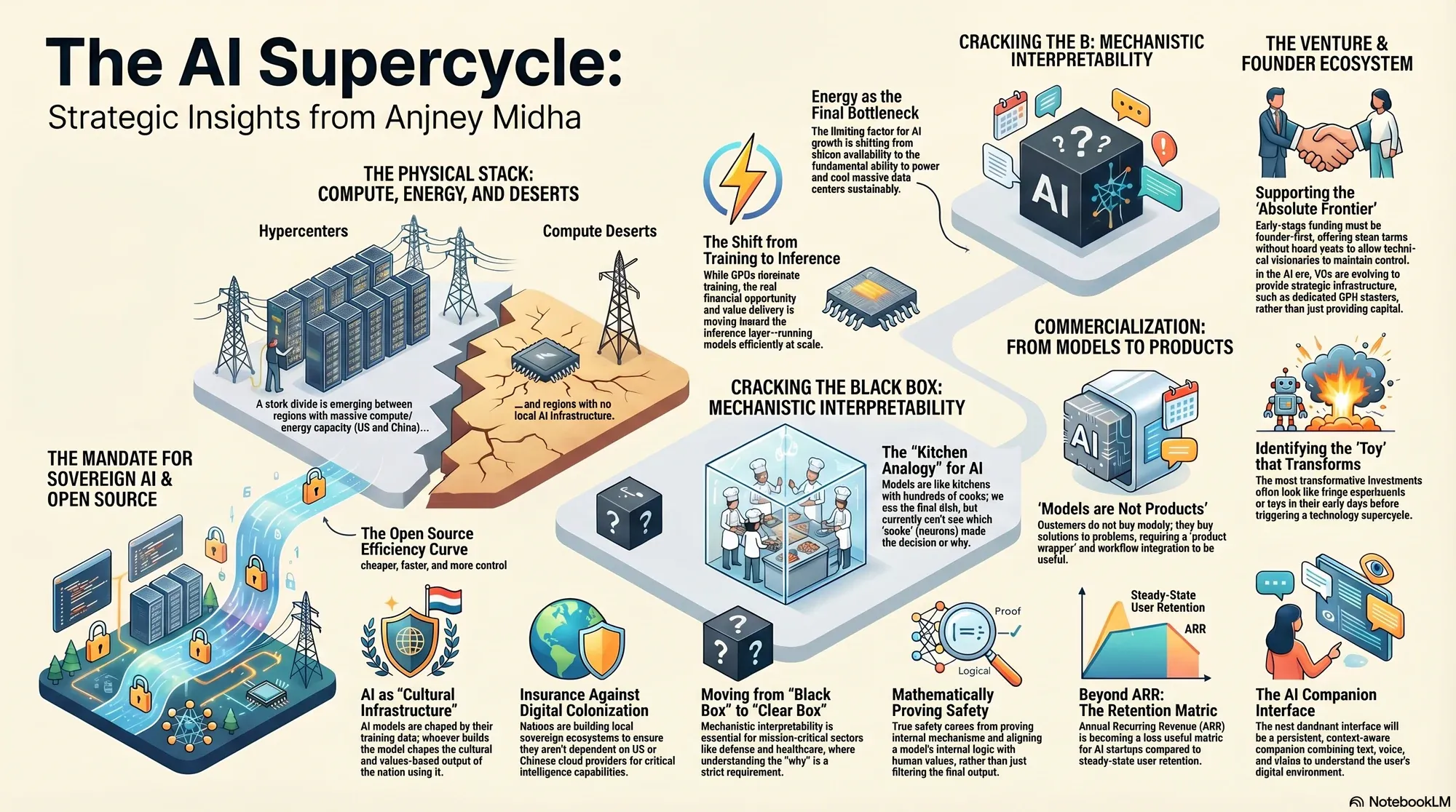
Part 1: The Open Source Renaissance
- On the Computing Arc: Backing open source was "always very much about cheaper, faster, more control being the arc of open source adoption" in the enterprise—an arc geopolitics has since accelerated. — Reference: Anjney Midha of a16z, "Algorithmic Independence: The Next Frontier in National Infrastructure" (video).
- On European Adoption: "The most urgent bottleneck to progress in Europe, or to the startup ecosystem, is not necessarily policymakers or regulators. I think it is inaction on the part of the CEOs and executives of Europe's largest companies, who are being slow to adopt the productivity renaissance that's exploding because of AI." — Reference: Sifted, "A16z's Anjney Midha on backing Mistral, Black Forest Labs, and why Europe's biggest problem isn't regulation" (2025).
- On Corporate Culture: "It's a cultural issue… If you're running some of Europe's largest enterprises, it can be comfortable to keep doing things the way you always have, right? Until it's too late." — Reference: Sifted, "A16z's Anjney Midha on backing Mistral, Black Forest Labs, and why Europe's biggest problem isn't regulation" (2025).
- On Algorithmic Independence: Sovereignty means independence—from being locked into one AI provider, or from AI "that doesn't reflect their values"—and "almost all roads that start with sovereign lead to open source." — Reference: Anjney Midha of a16z, "Algorithmic Independence: The Next Frontier in National Infrastructure" (video).
Part 2: Sovereign AI and National Infrastructure
- On AI Sovereignty: Frontier nations now want "infrastructure independence": their own infrastructure running their own models, rather than the cloud era's concentration in the US and China. — Reference: The a16z Show, "Sovereign AI: Why Nations Are Building Their Own Models" (transcript).
- On Digital Colonization: "Nation state leaders are viewing the adoption of or build out of a local sovereign ecosystem as sort of insurance against being digitally colonized." — YouTube: Anjney Midha Keynote & Interviews]
- On Cultural Infrastructure: Governments are concluding that AI "is critical national infrastructure. It's also critical cultural infrastructure," and they don't want those workloads processed outside their borders. — Reference: Anjney Midha of a16z, "Algorithmic Independence: The Next Frontier in National Infrastructure" (video).
- On Embedded Values: Unlike electricity, "there's a fundamental encoding of human values in AI models because they're trained on data," so a model trained on US internet data comes out broadly American. — Reference: a16z, "AI Is Becoming a Regional Race" with Anjney Midha (transcript).
- On the AI Race: After DeepSeek, "the only way to win is build the best technology and out-export anybody else"—the question becomes whose math the world is using. — Reference: The a16z Show, "Sovereign AI: Why Nations Are Building Their Own Models" (transcript).
- On Global Competition: DeepSeek landed "26 days after OpenAI puts out the frontier," shattering confident testimony that China was five to six years behind. — Reference: The a16z Show, "Sovereign AI: Why Nations Are Building Their Own Models" (transcript).
Part 3: Compute, Energy, and the "Hypercenters"
- On Global Power Centers: He calls countries able to "develop, train, build and host their own frontier models" hypercenters—an homage to hyperscalers. — Reference: a16z, "AI Is Becoming a Regional Race" with Anjney Midha (transcript).
- On Compute Deserts: Opposite the hypercenters are "compute deserts": places with "literally no install base of compute capacity to even be relevant," which must choose a hypercenter to align with. — Reference: a16z, "AI Is Becoming a Regional Race" with Anjney Midha (transcript).
- On the Three Ingredients: There are "only three or four ingredients here that really matter": compute, abundant low-cost energy, high-quality data, and regulation. — Reference: a16z, "AI Is Becoming a Regional Race" with Anjney Midha (transcript).
- On Hardware Utilization: "Compute is not fungible. There are no standards for fungibility and there are no institutions enforcing standardization of compute enough." We are in the pre-standardization era of compute. — Reference: 20VC, "Anj Midha on Investing $300M into Anthropic… The Four Bottlenecks to Compute" (2026)
- On the Alignment Problem: Frontier progress has four bottlenecks: context feedback, compute, capital, and culture, which "actually might be the most important bottleneck of all." — Reference: 20VC, "Anj Midha on Investing $300M into Anthropic… The Four Bottlenecks to Compute" (2026)
- On Human Incentives: Algorithmic innovation "is a function of culture": the right mission-driven culture attracts the best researchers, and without it "the whole thing falls apart." — Reference: 20VC, "Anj Midha on Investing $300M into Anthropic… The Four Bottlenecks to Compute" (2026)
- On Edge Computing: Sovereign data matters. Under the US Cloud Act, workloads on American-managed infrastructure must be accessible to the US government, a problem for Europe's mission-critical workloads. — Reference: 20VC, "Anj Midha on Investing $300M into Anthropic… The Four Bottlenecks to Compute" (2026)
- On Media Synthesis: China runs "adversarial distillation at scale" on Western models, so he argues frontier inference needs a "coordinated Iron Dome" to stay ahead. — Reference: 20VC, "Anj Midha on Investing $300M into Anthropic… The Four Bottlenecks to Compute" (2026)
- On Compute as a Grid: Today's frontier labs are like 1885 factories "running their own generators in their backyards at half capacity," which is why compute needs a shared grid. — Reference: 20VC, "Anj Midha on Investing $300M into Anthropic… The Four Bottlenecks to Compute" (2026)
- On Competition: Updating Peter Thiel: "perfect competition is for losers." Fifty companies all training LLMs is like restaurants, with no defensibility. — Reference: 20VC, "Anj Midha on Investing $300M into Anthropic… The Four Bottlenecks to Compute" (2026)
Part 4: The Black Box and Mechanistic Interpretability
- On the Kitchen Analogy: "If you pretend one of these AI models is like a big kitchen with hundreds of cooks... each cook knows how to make certain foods, and they all debate about what to finally make." — YouTube: Anjney Midha Keynote & Interviews]
- On Mission-Critical AI: As models are deployed in "mission critical situations like health care and finance and in defense applications you need to be able to control these models very very precisely," which today "just isn't the case." — Reference: a16z Big Ideas 2024, "AI Interpretability: From Black Box to Clear Box" with Anjney Midha (transcript).
Part 6: Next-Generation Interfaces and Agents
- On the Next Interface: "I think we have really good reasons to believe that the next interface will be an AI companion that's some combination of text, voice, and vision that can understand the world." — YouTube: Anjney Midha Keynote & Interviews]
- On Hardware Evolution: "The history of computing so far [has] shown that whichever one of those lineages is undergoing a moment of resonance with customers ends up dominating for the kinds of workloads that then get to scale for the next 10-15 years." — Reference: a16z Podcast, "Remaking the UI for AI" (2024).
Part 7: AR, Virtual Spaces, and Ubiquity6
- On Shared Reality: Ubiquity6 bet on "shared persistent AR," a phase of spatial computing he framed as one where "we're all in this together." — Reference: "Anjney Midha (Ubiquity6): Creating More Accessible Massive Multiplayer AR Experiences" (video).
- On the AR Cloud: Ubiquity6 took "the 2D image data coming off of the smart phone you already own," turned it into a precise 3D representation of the space, and continuously merged spaces for people to share. — Reference: "Anjney Midha (Ubiquity6): Creating More Accessible Massive Multiplayer AR Experiences" (video).
Part 8: Venture Capital and Supporting Founders
- On Early-Stage Risk: When most VCs were moving to later, larger checks, "I was lucky enough… to start a fund that was solely focused on investing in the earliest, most risky types of entrepreneurs." — Reference: "From Investor to Founder | Ubiquity6 Co-founder Anjney Midha" (video).