Anna Binder served as the Head of People at Asana from 2016 to 2025, where she scaled the company from 100 to over 2,000 employees. She is known for her framework of treating company culture like a product—applying user research, beta testing, and iteration to HR practices. This compilation organizes her practical frameworks for building aligned, high-performance teams.
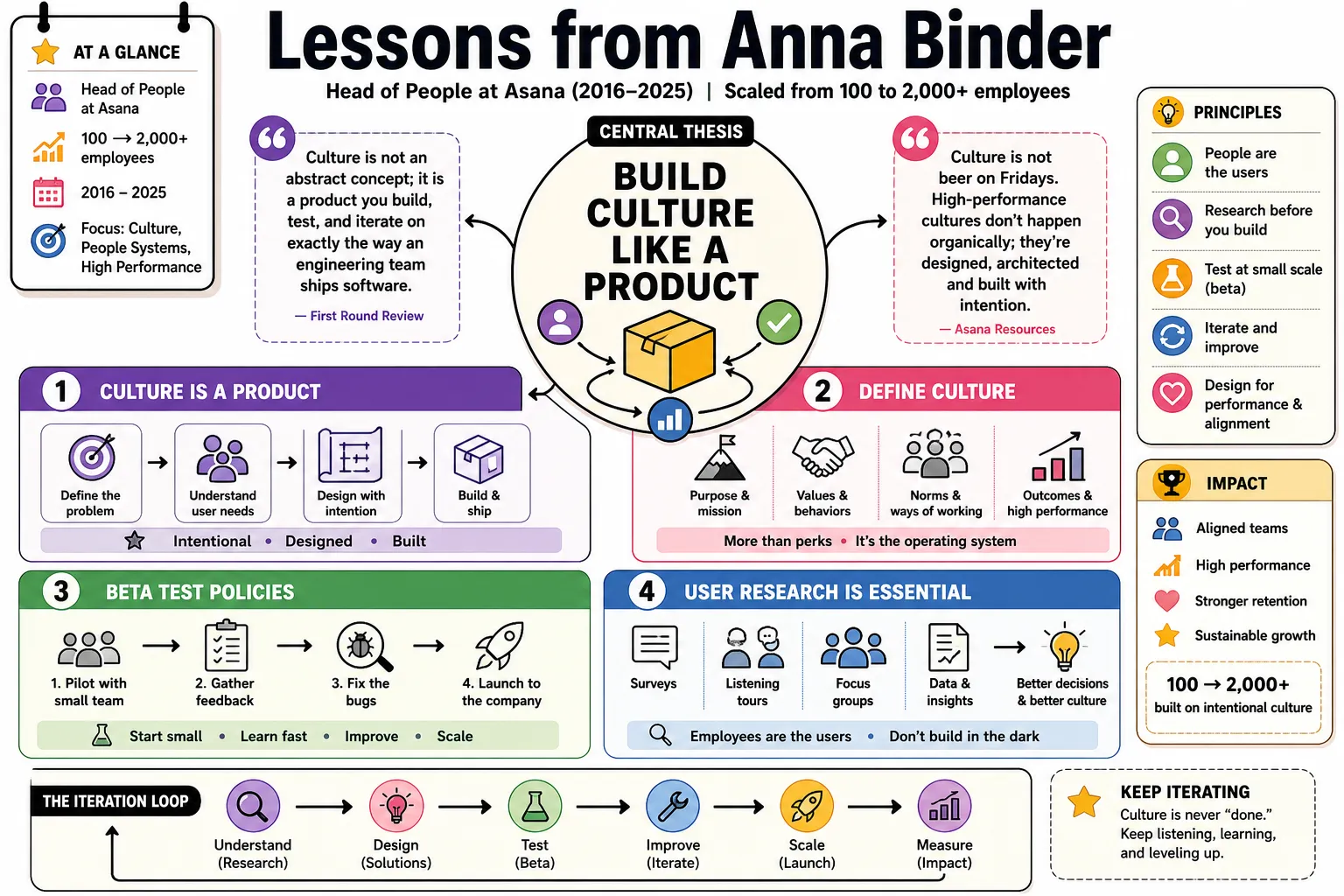
Visual summary of operating lessons from Anna Binder.

Part 1: Building Culture Like a Product

  1. On treating culture as a product: "Culture is not an abstract concept; it is a product you build, test, and iterate on exactly the way an engineering team ships software." — Source: First Round Review
  2. On defining culture: "Culture is not beer on Fridays. High-performance cultures don't happen organically; they're designed, architected and built with intention." — Source: Asana Resources
  3. On beta testing policies: "When rolling out a new performance review process, beta test it with a small team first. Gather feedback, fix the bugs, and then launch it to the whole company." — Source: First Round Review
  4. On user research: "Your employees are the users of your culture. If you aren't doing user research through surveys and listening tours, you are building in the dark." — Source: Culture Amp Podcast
  5. On alignment: "Programs should support the business and enable us to achieve our mission. If an HR initiative doesn't do that, it shouldn't exist." — Source: Asana Resources
  6. On continuous iteration: "A company's culture is never 'done.' It requires constant maintenance and updates as the organization scales." — Source: Scaling Up Podcast
  7. On tracking metrics: "Measure employee engagement with the same rigor and cadence that a product team measures daily active users." — Source: First Round Review
  8. On product management in HR: "HR teams need product managers. They need people who understand how to take a complex organizational problem and design a systemic solution." — Source: Culture Conversations
  9. On early intentionality: "The culture you establish at 50 people becomes the operating system for when you are 500 people. You cannot bolt it on later." — Source: First Round Review
  10. On taking responsibility: "Leadership must view themselves as the architects of the environment. If the environment is toxic, the architects failed." — Source: Asana Resources

Part 2: Diversity, Equity, and Inclusion

  1. On systemic DEI: "DEI cannot be a side project managed by a task force. It has to be embedded into how you hire, how you promote, and how you pay." — Source: First Round Review
  2. On belonging: "In order for all of our employees to do their best work, everyone must feel respected, valued, and that they belong." — Source: Asana Resources
  3. On interview equity: "Standardizing interview questions and rubrics is the most basic, yet most effective, way to reduce bias in the hiring process." — Source: Culture Amp Podcast
  4. On measuring inclusion: "You can measure diversity by looking at a spreadsheet, but you can only measure inclusion by listening to the lived experiences of your employees." — Source: Scaling Up Podcast
  5. On compensation: "Pay transparency forces accountability. When you know compensation bands are public internally, you stop making ad-hoc exceptions." — Source: First Round Review
  6. On executive diversity: "If your executive team is homogenous, it sends a clear message to the rest of the company about who gets to be a leader here." — Source: Culture Conversations
  7. On accountability: "Tie diversity metrics to business goals. If a leader misses their sales target, there are consequences; the same should apply to representation goals." — Source: First Round Review
  8. On ERGs: "Employee Resource Groups are critical for community building, but they should never be asked to do the unpaid labor of fixing systemic HR issues." — Source: Culture Amp Podcast
  9. On intersectionality: "When designing policies, you have to consider how they impact employees at the intersections of different marginalized identities." — Source: Asana Resources

Part 3: Hiring and Assessment

  1. On culture add: "Stop hiring for 'culture fit.' Hire for 'culture add.' Ask what this person brings that is currently missing from the team." — Source: First Round Review
  2. On clear scorecards: "Before opening a role, define exactly what success looks like in the first 90 days, and build the interview process to test for those specific outcomes." — Source: First Round Review
  3. On reference checks: "Reference checks are not background checks. They are an opportunity to learn how to manage the incoming employee effectively." — Source: Scaling Up Podcast
  4. On interview training: "An untrained interviewer is a liability. Everyone who interviews candidates must be trained on how to assess skills and avoid bias." — Source: Culture Amp Podcast
  5. On candidate experience: "The way you treat candidates during the interview process is the first indicator of how you will treat them as employees." — Source: First Round Review
  6. On onboarding: "Onboarding doesn't end after week one. It takes months for a new hire to become fully integrated and productive." — Source: Asana Resources
  7. On hiring managers: "The recruiter is the partner, but the hiring manager owns the outcome. They must be deeply involved in sourcing and closing." — Source: Scaling Up Podcast
  8. On technical screens: "Make technical assessments mirror the actual day-to-day work as closely as possible, rather than using abstract brain teasers." — Source: First Round Review
  9. On rejecting candidates: "Provide timely, respectful feedback to candidates who don't get the job. They are still part of your employer brand ecosystem." — Source: Culture Amp Podcast
  10. On internal mobility: "Your best candidates are often already in the building. Build clear paths for internal transfers and promotions." — Source: Asana Resources

Part 4: Remote and Hybrid Dynamics

  1. On hybrid meetings: "We made a decision that all executive meetings going forward will be in person. Or they will be fully remote. We're not doing the in-between." — Source: Where's Your Ed At
  2. On synchronous work: "Identify which types of work require synchronous collaboration and which can be done asynchronously. Do not default to meetings for everything." — Source: Asana Resources
  3. On documentation: "Remote work forces a discipline of writing things down. Documentation becomes the single source of truth when you can't tap someone on the shoulder." — Source: First Round Review
  4. On connection: "In a distributed environment, you have to engineer moments of connection that used to happen naturally in the hallway." — Source: Culture Conversations
  5. On location strategy: "Be explicit about your location strategy. Ambiguity about where people are expected to work causes unnecessary anxiety." — Source: Scaling Up Podcast
  6. On evaluating performance: "When managers cannot see their employees working, they are forced to evaluate them on actual output rather than time spent at a desk." — Source: Culture Amp Podcast
  7. On remote onboarding: "Onboarding remote employees requires double the communication and explicit check-ins compared to in-person onboarding." — Source: First Round Review
  8. On timezone alignment: "Establish core working hours where teams agree to overlap. Outside of those hours, respect boundaries and allow for asynchronous progress." — Source: Asana Resources
  9. On tool fatigue: "Consolidate your communication tools. When information is scattered across five different platforms, productivity collapses." — Source: Scaling Up Podcast

Part 5: Leadership and Executive Alignment

  1. On calendar alignment: "If someone tells you in an interview that they really care about the learning, development and mentorship of their employees, their calendar should reflect that." — Source: First Round Review
  2. On executive dysfunction: "A misaligned executive team will create chaos throughout the entire organization. You have to fix the top first." — Source: First Round Review
  3. On leading by example: "Leaders set the ceiling for vulnerability in an organization. If leaders never admit mistakes, employees will hide theirs." — Source: Culture Amp Podcast
  4. On founder transitions: "As companies scale, founders must transition from doing the work to building the machine that does the work." — Source: Scaling Up Podcast
  5. On difficult decisions: "When making a hard call, state the decision clearly, explain the rationale, and own the consequences. Do not hide behind corporate speak." — Source: First Round Review
  6. On trust: "Trust is not built through team-building exercises. It is built through consistent, reliable execution over time." — Source: Asana Resources
  7. On managing managers: "The skills required to manage individual contributors are completely different from the skills required to manage managers. Train for the transition." — Source: Culture Amp Podcast
  8. On feedback for executives: "Create safe channels for employees to give upward feedback to the executive team, and make sure the executives actually act on it." — Source: First Round Review
  9. On role clarity: "Use frameworks like Areas of Responsibility (AoRs) so everyone knows exactly who owns what decision." — Source: First Round Review
  10. On self-awareness: "The best leaders have a high degree of self-awareness. They know their blind spots and hire people who complement their weaknesses." — Source: Scaling Up Podcast

Part 6: Communication and Transparency

  1. On clarity: "If you create channels of communication internally, where people can get their questions answered and have clarity, they will—even if they don't like the answer—be satisfied, and they will feel heard." — Source: Asana Resources
  2. On financial transparency: "Hey, just a lot easier for everyone to manage your budget if they understand how it works, and so the more people know about you, the better." — Source: The Tim Ferriss Show
  3. On town halls: "Use all-hands meetings to share context and strategy, not just to read out metrics that could have been an email." — Source: Culture Conversations
  4. On bad news: "Communicate bad news early and honestly. The rumor mill is always worse than the reality." — Source: First Round Review
  5. On repetitive messaging: "As a leader, you have to repeat the vision and goals until you are sick of hearing yourself say them. Only then will people start to internalize it." — Source: Scaling Up Podcast
  6. On context setting: "Never give an employee a task without explaining how it fits into the broader company strategy." — Source: Asana Resources
  7. On feedback loops: "Establish continuous feedback loops so that communication flows up, down, and sideways." — Source: Culture Amp Podcast
  8. On listening: "The most underutilized communication skill in leadership is active listening. Stop waiting for your turn to speak." — Source: First Round Review
  9. On written communication: "Clear writing reflects clear thinking. Encourage teams to write memos instead of defaulting to presentations." — Source: First Round Review

Part 7: Employee Growth and Performance

  1. On career paths: "Not everyone wants to be a manager. You must build parallel tracks for individual contributors to grow in compensation and influence without managing people." — Source: First Round Review
  2. On performance reviews: "Performance reviews should never contain surprises. If an employee is surprised by their rating, the manager has failed." — Source: Culture Amp Podcast
  3. On continuous feedback: "Feedback is a daily practice, not a biannual event. Give small course corrections continuously." — Source: Asana Resources
  4. On underperformance: "Address underperformance quickly. Tolerating poor performance drags down the morale of the high performers." — Source: First Round Review
  5. On coaching: "Managers need to shift from being taskmasters to being coaches who unlock the potential of their team members." — Source: Scaling Up Podcast
  6. On sabbaticals: "Extended time off prevents burnout and allows employees to return with renewed perspective and energy." — Source: Asana Resources
  7. On internal mobility: "When an employee outgrows their role, help them find a new one internally before they start looking externally." — Source: First Round Review
  8. On goal setting: "Use frameworks like OKRs to ensure individual goals map directly to company objectives." — Source: Asana Resources
  9. On learning budgets: "Provide employees with a dedicated budget for learning and development, and trust them to spend it on resources that will actually help them grow." — Source: Culture Amp Podcast

Part 8: The Future of People Operations

  1. On the HR function: "The HR department is transitioning from an administrative compliance center to a strategic business partner." — Source: First Round Review
  2. On employee experience: "We have to design the employee experience with the same care and attention we give to the customer experience." — Source: Culture Conversations
  3. On data-driven HR: "People decisions should be made with data, not just intuition. Track retention, engagement, and promotion velocity." — Source: Culture Amp Podcast
  4. On adapting to change: "The structures that got you to 100 employees will break at 500. You have to be willing to tear down and rebuild HR systems regularly." — Source: Scaling Up Podcast
  5. On empathy in leadership: "Empathy is no longer a soft skill; it is a hard requirement for modern leadership." — Source: First Round Review
  6. On well-being: "Burnout is an organizational problem, not an individual one. You cannot fix systemic overwork with a meditation app." — Source: Asana Resources
  7. On the purpose of work: "Employees want more than a paycheck; they want to understand how their daily work connects to a meaningful mission." — Source: First Round Review
  8. On agile HR: "Apply agile methodologies to people operations. Ship policies fast, gather feedback, and iterate." — Source: Culture Amp Podcast
  9. On the role of a People leader: "My job is to remove the friction so that our employees can focus entirely on solving problems for our customers." — Source: First Round Review