Anna Fang is the founding partner and CEO of ZhenFund. After starting in investment banking and working in corporate development in China, she joined ZhenFund in 2011 and became a leading early-stage investor, ranking first on the 2022 Forbes Midas Seed list. — Stanford GSB Alumni Voices.
Her interviews center on evaluating founders, supporting companies through difficult moments, learning to trust her judgment, and staying close to emerging technology and consumer shifts. — Stanford GSB Alumni Voices.
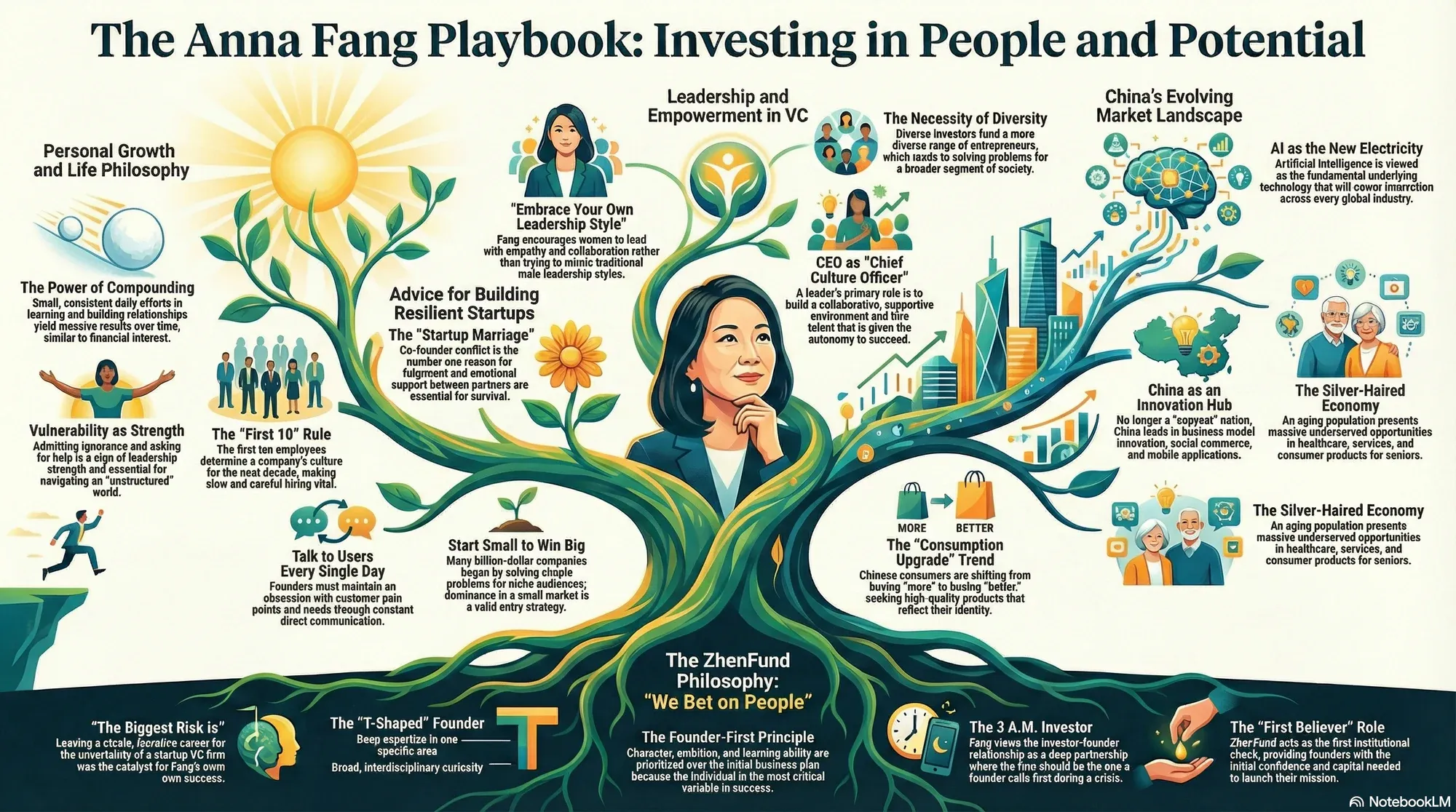
On Investment Philosophy & ZhenFund's Approach
- Invest in People, Not Just the Model: Fang says an investor needs an independent philosophy; hers starts with the person behind the company. — Stanford GSB Alumni Voices.
- Look for a 100-Point Strength: Rather than requiring a founder to be uniformly strong, ZhenFund looks for an exceptional spike: 100 points in one defining trait. — Analyse Asia Podcast.
- Search for Standout Talent: Fang compares reviewing a team page to admissions work: the goal is to spot the equivalent of Yao Ming in a crowd of already tall people. — Asian Hustle Network Interview.
- Be the First Believer: Fang values seed investing because capital and support can help a founder turn an idea into a real company. — Stanford GSB Alumni Voices.
- Evaluate Technical Depth and Personal Force: Fang’s early Mobvoi decision rested on three observed traits in its founder: a scientist’s temperament, deep industry expertise, and personal charm. — ZhenFund’s Mobvoi Retrospective.
- Make the Investment Process Founder-First: ZhenFund differentiates through a simple, transparent process and thoughtful feedback even when it passes. — Asian Hustle Network Interview.
- Strong Founders Matter in Copycat Markets: Fang has argued that when successful ideas quickly attract imitators, founder quality becomes a decisive filter. — CNBC Street Signs Asia.
- Expect Near-Failure and Build Support: Fang says successful companies often nearly fail through regulation, cash constraints, or founder conflict; resilience and mentorship help teams work through those moments. — Asian Hustle Network Interview.
- Let Exceptional Founders Reveal the Trend: Fang says the strongest entrepreneurs often identify promising fields before investors do, which is why ZhenFund begins with the person rather than a sector forecast. — TechNode China Interview.
- Build a Founder Community: ZhenFund pairs funding with programs such as EIR and Ostrich Club to identify and support potential founders. — Asian Hustle Network Interview.
Advice for Entrepreneurs
- Founder Conflict Is One of Several Existential Risks: Fang places founder conflict alongside regulatory and cash-flow crises—not above every other cause of failure. — Asian Hustle Network Interview.
- Re-Evaluate the Founder as the Company Scales: Fang notes that later-stage growth demands new management capacity and strategy as teams expand and competitors become much larger. — TechNode China Interview.
- Build Around the Gaps You Can Admit: Fang argues that strong founders recognize what they do not know, recruit experts in those areas, and assemble a stronger team around complementary knowledge. — Entrepreneur Magazine Essay.
- Pivot Before You Give Up: Fang distinguishes a failed business model from a failed founder: when the model breaks, the company can change direction rather than abandon the effort. — Entrepreneur Magazine Essay.
On Market Trends & China
- Consumption and Innovation Remain Long-Term Drivers: A Caixin panel featuring Fang identified rising consumption power and a sustained focus on innovation as fundamental reasons investors remained committed to China despite greater complexity. — Caixin’s China Finance Panel.
- Chinese Business Models Are Traveling: Fang points to international adaptations of Luckin Coffee and China’s online-education infrastructure as signs of growing cross-border influence. — Asian Hustle Network Interview.
- A Slower Market Can Improve Selection: Fang says the 2014–2020 funding hype cycle put too much money behind deals; the later VC winter created room for a more selective pace. — Asian Hustle Network Interview.
- Follow Entrepreneurs Instead of Pretending to Predict: Rather than forecasting the next platform shift, Fang watches what unusually early founders are building; by the time a category is broadly popular, she considers it late. — Stanford GSB Alumni Voices.
- Policy and Innovation Shape the China Opportunity: The Caixin discussion emphasized that investors must follow long-term policy direction while assessing China’s shift toward innovation-powered growth. — Caixin’s China Finance Panel.
- Watch Social Commerce: Fang identified social commerce as the most interesting consumer segment she was watching in China. — Bloomberg Markets Interview.
- Raise the Bar for AI Founders: Fang says AI founders must understand the underlying technology deeply; she is also interested in foundational models moving into robotics and human–AI copilot applications. — Asian Hustle Network Interview.
On Her Career, Leadership, and Women in VC
- Take the Unfamiliar Opportunity: Fang moved from the precision and pressure of investment banking into ZhenFund even though she initially did not know what an incubator was. — Stanford GSB Alumni Voices.
- Turn Investor Instinct into a Teachable Process: Fang says she learned founder judgment from Bob Xu and has tried to institutionalize those instincts into a method the team can teach. — Stanford GSB Alumni Voices.
- Stay Close to Emerging Ideas: Fang describes the thrill of angel investing as being an early adopter and remaining alert to new trends. — Asian Hustle Network Interview.
- Seek Role Models in the Field: Fang says China’s venture industry gave her several senior women to seek out as informal mentors early in her career. — Stanford GSB Alumni Voices.
- Practice Speaking Up: At Stanford, Fang deliberately pushed herself to contribute in class and express her own point of view, building confidence through repetition. — Stanford GSB Alumni Voices.
- Create Conditions Where Women Can Build: Fang argues that the industry changes when women have an environment that supports their success rather than discouraging them before they begin. — Entrepreneur Magazine Essay.
- Find Informal Mentors: Fang actively sought experienced women investors for informal mentorship rather than waiting for a formal program. — Stanford GSB Alumni Voices.
- Look for Working-Parent Models: When starting a family, Fang looked to women who combined motherhood with demanding investing careers for practical examples. — Stanford GSB Alumni Voices.
- Set the Standard Instead of Following It: Fang encourages women founders to trust their market intuition and define a new standard rather than defaulting to an industry consensus. — Entrepreneur Magazine Essay.
On Personal Growth & Life Philosophy
- Keep Learning Across Domains: Fang values early-stage investing partly because it lets her move among fields such as robotics, consumer products, and emerging technology while continually learning. — ZhenFund Republished Interview.
- Create Deal Flow Through Genuine Outreach: Fang attributes founder success partly to hustle and networking; early in her own career, she explicitly invited people to send her deals. — Asian Hustle Network Interview.
- Work With People Who Want Change: Fang frames her work around meeting interesting people who want to make a meaningful change. — Stanford GSB Alumni Voices.
- Ask for Help Without Treating It as Weakness: Fang argues that admitting a knowledge gap and seeking help are strengths when they lead a founder to better expertise and decisions. — Entrepreneur Magazine Essay.
- Let Purpose Guide Career Choices: Fang says her father’s desire to help change China influenced her own wish to make change through her career. — Stanford GSB Alumni Voices.
- Take a Role Before You Know the Whole Field: At 29, Fang accepted the opportunity to help build ZhenFund despite not yet understanding the incubator model; the work became the career she wanted to keep. — Stanford GSB Alumni Voices.
- Give Back Through Direct Involvement: Before venture capital, Fang sought a community where she could help and spent several months supporting a rural school in Gansu. — Stanford GSB Alumni Voices.
- Value the Milestones Along the Way: Fang finds meaning in watching an idea become a product, gain validation, and reach users—each stage is its own exciting goalpost. — Stanford GSB Alumni Voices.
Learn more:
- Stanford GSB Alumni Voices: Anna Fang
- Asian Hustle Network: Candid Conversations on Venture Capital and Entrepreneurship with Anna Fang
- Analyse Asia Podcast: ZhenFund in China with Anna Fang
- ZhenFund: How Anna Fang Built a Leading Seed Portfolio
- ZhenFund: Anna Fang’s 12-Year Journey with Mobvoi
- Caixin: China’s Primary Market and VC/PE
- Bloomberg Markets: Social Commerce in China
- Entrepreneur Magazine: Anna Fang on Women Founders and Trusting Intuition
- TechNode China: Anna Fang on Founder Evaluation and Scaling