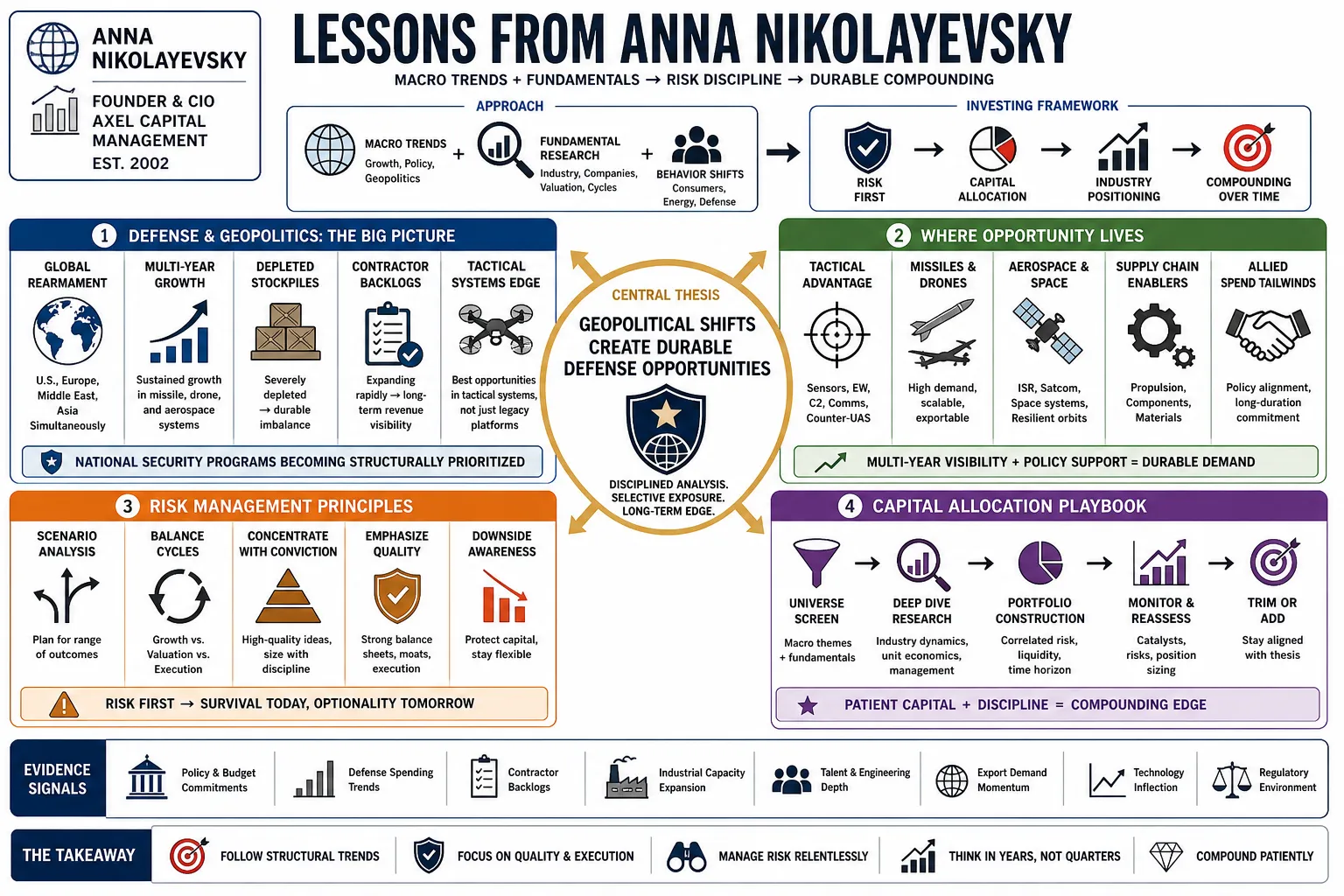
Lessons from Anna Nikolayevsky
Anna Nikolayevsky founded the hedge fund Axel Capital Management in 2002. As CIO, she pairs macroeconomic trends with fundamental research to track shifts in consumer behavior, energy markets, and global defense. This collection covers her approach to managing risk and allocating capital across changing industries.
Part 1: Defense and Geopolitics
- On global rearmament: "The current rearmament cycle is not isolated; it spans the United States, Europe, the Middle East, and Asia simultaneously." — Source: [Capitalize for Kids Investors Conference]
- On multi-year growth: "We are entering a sustained period of multi-year growth specifically within missile, drone, and aerospace systems." — Source: [Capitalize for Kids Investors Conference]
- On depleted stockpiles: "Global defense stockpiles remain severely depleted, creating a durable supply and demand imbalance." — Source: [Capitalize for Kids Investors Conference]
- On contractor backlogs: "The backlogs for major defense contractors are expanding at a rapid pace, signaling long-term revenue visibility." — Source: [Capitalize for Kids Investors Conference]
- On tactical systems: "Investment opportunities are particularly acute in companies focused on tactical systems rather than solely legacy platforms." — Source: [Capitalize for Kids Investors Conference]
- On national security programs: "National security spending is becoming less cyclical and more structural as geopolitical tensions rise." — Source: [Capitalize for Kids Investors Conference]
- On the defense supercycle: "The defense supercycle is driven by a fundamental shift in how nations assess baseline security needs." — Source: [Capitalize for Kids Investors Conference]
- On aerospace integration: "Aerospace capabilities are increasingly converging with traditional defense systems, broadening the scope of the sector." — Source: [Capitalize for Kids Investors Conference]
- On regional demand: "Demand from European and Asian allies is compounding the domestic requirements of the United States." — Source: [Capitalize for Kids Investors Conference]
- On long-term tailwinds: "The geopolitical environment has fundamentally altered the terminal value of defense focused businesses." — Source: [Capitalize for Kids Investors Conference]
Part 2: Macroeconomics and Consumer Behavior
- On consumer slowdown: "We are observing a distinct migration toward cost-saving behaviors among consumers." — Source: [Bloomberg Surveillance]
- On the impact of inflation: "The cumulative effect of inflation has forced a structural shift in household budget allocation." — Source: [Bloomberg Surveillance]
- On economic resilience: "Headline economic data can often mask underlying fragility in lower-income consumer segments." — Source: [Bloomberg Surveillance]
- On discretionary spending: "There is a noticeable contraction in discretionary spending as essentials consume a larger share of the wallet." — Source: [Bloomberg Surveillance]
- On the retail environment: "Retailers are facing a more discerning consumer who is prioritizing value over convenience." — Source: [Bloomberg Surveillance]
- On cost-saving behaviors: "The shift towards discount and off-price retail channels is a structural adjustment, rather than a temporary blip." — Source: [Bloomberg Surveillance]
- On interest rate sensitivity: "Consumer balance sheets are increasingly sensitive to prolonged periods of elevated interest rates." — Source: [Bloomberg Surveillance]
- On wages versus prices: "Even with wage growth, the perceived purchasing power of the average consumer has diminished." — Source: [Bloomberg Surveillance]
- On macroeconomic crosscurrents: "Investors must reconcile strong aggregate employment figures with deteriorating consumer sentiment at the micro level." — Source: [Bloomberg Surveillance]
Part 3: Risk Management and Structural Shocks
- On defining risk: "Risk is the probability of a permanent impairment of capital, rather than simple volatility." — Source: [Value Investing with Legends]
- On structural shocks: "Portfolios must be constructed to withstand structural shocks instead of merely cyclical downturns." — Source: [Value Investing with Legends]
- On the hedge fund model: "The true utility of a hedge fund is its ability to provide absolute returns irrespective of broader market dislocation." — Source: [Value Investing with Legends]
- On tail risks: "Identifying underpriced tail risks is as important as finding undervalued assets." — Source: [Value Investing with Legends]
- On adaptability: "A rigid investment framework is a liability when market structures themselves are changing." — Source: [Value Investing with Legends]
- On independent thought: "Consensus positioning often embeds the greatest amount of unrecognized risk." — Source: [Value Investing with Legends]
- On macro awareness: "Even fundamentally driven, bottom-up investors must maintain an acute awareness of macroeconomic vulnerabilities." — Source: [Value Investing with Legends]
- On downside protection: "Preserving capital during structural market shifts dictates long-term compounding success." — Source: [Value Investing with Legends]
- On systemic vulnerabilities: "We look for areas where the market has entirely priced out the possibility of a negative outcome." — Source: [Value Investing with Legends]
- On portfolio construction: "A sound portfolio balances highly convicted idiosyncratic ideas with broader macro hedges." — Source: [Value Investing with Legends]
Part 4: Energy Markets and Commodities
- On oil pricing: "The structural dynamics of energy markets can lead to prolonged periods of depressed prices." — Source: [Sohn Canada Conference]
- On lower oil forever: "Technological advancements in extraction and shifting global demand challenge the assumption of perpetually rising energy costs." — Source: [Sohn Canada Conference]
- On energy transition: "The shift away from traditional fossil fuels creates a cap on long-term oil price appreciation." — Source: [Sohn Canada Conference]
- On capital allocation in energy: "Energy companies must shift from aggressive growth to disciplined capital return models in a lower-price environment." — Source: [Sohn Canada Conference]
- On supply gluts: "The ability of shale producers to rapidly scale output acts as a natural ceiling on global crude prices." — Source: [Sohn Canada Conference]
- On commodity cycles: "Investors often mistake cyclical rebounds in commodities for new structural bull markets." — Source: [Sohn Canada Conference]
- On operational efficiency: "In a low-price commodity regime, cost-curve positioning becomes the primary determinant of equity performance." — Source: [Sohn Canada Conference]
- On geopolitical premiums: "The geopolitical premium in oil prices is frequently transient and should not be confused with fundamental demand." — Source: [Sohn Canada Conference]
- On energy demand decoupling: "Economic growth is becoming increasingly less energy-intensive, fundamentally altering historical demand models." — Source: [Sohn Canada Conference]
Part 5: Investment Strategy and Philosophy
- On tactical versus structural: "A successful strategy requires a balance between tactical trading and long-term structural positioning." — Source: [Value Investing with Legends]
- On the evolution of value: "Value investing must evolve beyond simple statistical cheapness to incorporate business quality and growth durability." — Source: [Value Investing with Legends]
- On bottom-up analysis: "Fundamental company research remains the bedrock of generating idiosyncratic alpha." — Source: [Value Investing with Legends]
- On independent analysis: "Relying on sell-side research frequently leads to crowded trades and diminished returns." — Source: [Value Investing with Legends]
- On the democratization of trading: "The influx of retail capital requires institutional investors to adapt to faster sentiment shifts and varied market mechanics." — Source: [Value Investing with Legends]
- On finding edge: "Information edge has largely dissipated; analytical edge and behavioral discipline are the remaining sources of outperformance." — Source: [Value Investing with Legends]
- On long and short equity: "The short side of the portfolio should generate absolute alpha, instead of merely acting as a market hedge." — Source: [Value Investing with Legends]
- On intellectual flexibility: "Investors must be willing to aggressively revise their thesis when presented with disconfirming evidence." — Source: [Value Investing with Legends]
- On catalyst paths: "Identifying a cheap asset is insufficient without a clear path to value realization." — Source: [Value Investing with Legends]
- On fundamental drivers: "Over the long term, equity prices will invariably tether back to underlying fundamental earnings power." — Source: [Value Investing with Legends]
Part 6: Digital Assets and the Evolution of Capital
- On digital capital: "Bitcoin is increasingly being viewed by institutional actors as a form of non-sovereign digital capital." — Source: [Economic Club of New York]
- On value proposition: "The long-term value of digital assets hinges on their utility as an immutable store of wealth." — Source: [Economic Club of New York]
- On institutional adoption: "We are moving past the speculative phase of crypto into a period of serious institutional integration." — Source: [Economic Club of New York]
- On monetary policy hedges: "Decentralized assets offer a novel mechanism to hedge against the debasement of fiat currencies." — Source: [Economic Club of New York]
- On network effects: "The resilience of major digital assets is underpinned by massive, decentralized network effects." — Source: [Economic Club of New York]
- On asset allocation: "Digital capital is slowly carving out a distinct sleeve in modern portfolio construction." — Source: [Economic Club of New York]
- On regulatory clarity: "The maturation of the digital asset class is heavily dependent on the establishment of clear regulatory frameworks." — Source: [Economic Club of New York]
- On technological disruption: "Blockchain technology represents a fundamental infrastructure shift for the traditional financial system." — Source: [Economic Club of New York]
- On the asymmetry of returns: "Early stage digital assets present a highly asymmetric return profile for risk-tolerant capital." — Source: [Economic Club of New York]
Part 7: Gender, Meritocracy, and Industry Dynamics
- On performance over gender: "Capital is ultimately directed toward investors based on performance, a metric that is implicitly dissociated from gender." — Source: [National Council for Research on Women]
- On industry representation: "The underrepresentation of women in hedge fund management is a structural issue that will naturally decrease over time." — Source: [National Council for Research on Women]
- On meritocracy in finance: "The hedge fund industry, at its core, is one of the purest meritocracies because the scoreboard is objective." — Source: [National Council for Research on Women]
- On pipeline development: "Encouraging early interest in finance and trading is essential for building a diverse pipeline of future fund managers." — Source: [National Council for Research on Women]
- On diversity of thought: "A diversity of backgrounds on an investment team directly translates to a wider recognition of mispriced risks and opportunities." — Source: [National Council for Research on Women]
- On institutional allocators: "Institutional allocators are increasingly recognizing that diverse investment teams offer distinct analytical advantages." — Source: [National Council for Research on Women]
- On overcoming bias: "A track record of absolute returns is the most effective tool for dismantling preconceived industry biases." — Source: [National Council for Research on Women]
- On female leadership: "Visibility of female CIOs is necessary for normalizing the presence of women in top capital allocation roles." — Source: [National Council for Research on Women]
- On problem solving: "Fields such as intelligence are realizing that complex problem-solving requires diverse cognitive approaches." — Source: [Economic Club of New York]
Part 8: The Hedge Fund Industry
- On founding a firm: "Starting a firm requires investment acumen and the entrepreneurial resilience to build institutional infrastructure." — Source: [Value Investing with Legends]
- On early career lessons: "Working at established firms provides a foundational understanding of market mechanics and risk." — Source: [Value Investing with Legends]
- On fund size: "There is an optimal capacity for certain strategies where asset bloat begins to actively erode the ability to generate returns." — Source: [Value Investing with Legends]
- On institutionalization: "The hedge fund industry has transformed from a cottage industry of stock pickers into a highly institutionalized asset class." — Source: [Value Investing with Legends]
- On fee structures: "The justification for premium fees relies entirely on the consistent delivery of truly uncorrelated returns." — Source: [Value Investing with Legends]
- On operational excellence: "For emerging managers, operational infrastructure and compliance are as important as the investment strategy." — Source: [Value Investing with Legends]
- On the role of a CIO: "A Chief Investment Officer must balance the micro-level task of security selection with the macro-level mandate of portfolio risk." — Source: [Value Investing with Legends]
- On continuous learning: "The markets are a continuous feedback loop that aggressively punishes intellectual complacency." — Source: [Value Investing with Legends]
- On legacy and impact: "The ultimate measure of a firm is its ability to compound capital responsibly across multiple market cycles." — Source: [Value Investing with Legends]