Lessons from Anneka Gupta
Anneka Gupta is the Chief Product Officer at Rubrik and former President and Head of Product at LiveRamp, where she helped scale the startup into a public company. Drawn from her interviews and podcasts, this collection outlines her straightforward approach to product strategy and leadership. It offers specific advice on managing founder intensity without losing speed and using meeting summaries to keep teams aligned. — Lenny's Podcast, "Becoming more strategic, navigating difficult colleagues, founder mode, more | Anneka Gupta" (2024).
Part 1: Product Strategy & Summarization
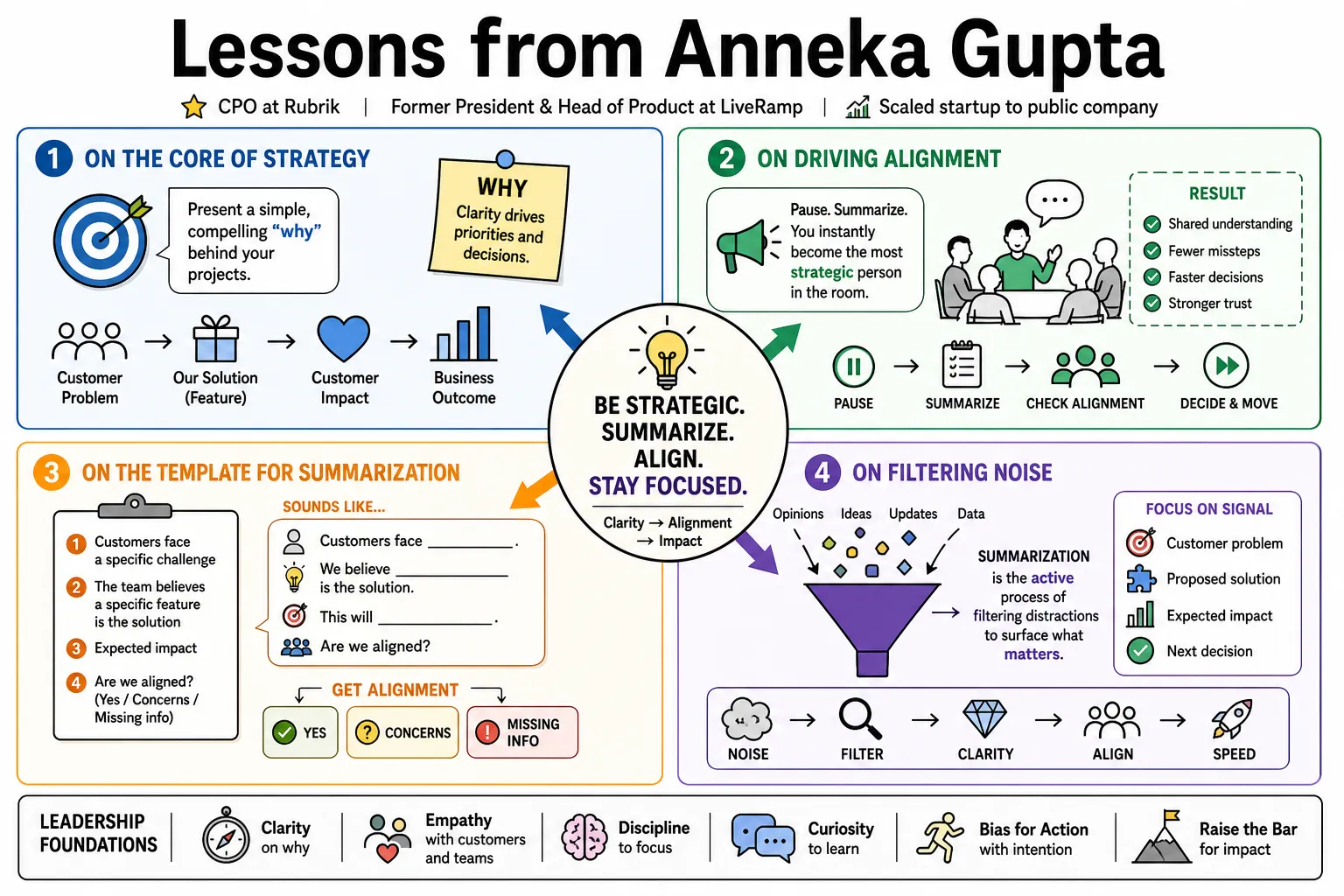
- On the core of strategy: Being strategic means being able to "articulate a compelling and simple why behind the decisions and the direction of the company and product." — Reference: Lenny's Podcast, "Becoming more strategic, navigating difficult colleagues, founder mode, more | Anneka Gupta" (2024).
- On driving alignment: Her most-used tactic, "every single day in meetings, is just summarization": hearing many voices and, at points in the conversation, summarizing what people are saying and what it means for the direction you could go. — Reference: Lenny's Podcast, "Becoming more strategic, navigating difficult colleagues, founder mode, more | Anneka Gupta" (2024).
- On filtering noise: Summarizing makes people feel heard, and when valid viewpoints conflict, "the diverse perspectives are going to yield better insights and better decisions"; it is a way to move beyond the conflict "and get to the heart of an issue." — Reference: Lenny's Podcast, "Becoming more strategic, navigating difficult colleagues, founder mode, more | Anneka Gupta" (2024).
- On the outside-in perspective: Big ideas come from an "outside-in perspective of what are the customer problems we're trying to solve and how are we going to take this to market," before worrying about technical difficulty. — Reference: Lenny's Podcast, "Becoming more strategic, navigating difficult colleagues, founder mode, more | Anneka Gupta" (2024).
- On strategic planning: Each summary is a checkpoint: "Okay, this is how I've synthesized what is happening. Is this correct or do we actually need to do another turn…?" — Reference: Lenny's Podcast, "Becoming more strategic, navigating difficult colleagues, founder mode, more | Anneka Gupta" (2024).
- On acting as a change agent: The second half of being strategic is being someone who will "champion and be a change agent to do things that may be hard but actually best for the long-term interest of the product or company." — Reference: Lenny's Podcast, "Becoming more strategic, navigating difficult colleagues, founder mode, more | Anneka Gupta" (2024).
Part 2: Navigating Founder Mode & Leadership
- On founder intensity: A founder operating well in founder mode is a resource: "recognize that they have that power to figure out how to use that power to get the things done that you know are best for the company." — Reference: Lenny's Podcast, "Becoming more strategic, navigating difficult colleagues, founder mode, more | Anneka Gupta" (2024).
- On knowing the details: Rather than staying high-level to "empower people," she finds that "understanding the details of the business and asking questions… what's working, what's not, what are the financial goals of the business" is what lets a leader decide where to intervene. — Reference: Lenny's Podcast, "Becoming more strategic, navigating difficult colleagues, founder mode, more | Anneka Gupta" (2024).
- On leading through influence: To lead without dictating, "you can't always lead someone somewhere with asking questions. It's also sharing a hypothesis"—such as feedback heard from customers—and letting others respond. — Reference: Lenny's Podcast, "Becoming more strategic, navigating difficult colleagues, founder mode, more | Anneka Gupta" (2024).
Part 3: Career Growth & Transitions
- On the non-linear path: She went "from a software engineer to becoming a chief product officer, all at the same company," driven by being "an intensely curious person" who loves "experimenting and trying new things." — Reference: Women in Product, Episode 38: Anneka Gupta, Chief Product Officer, Rubrik (public transcript).
- On the value of peer coaching: She has kept working with an executive coach because "getting an outside voice, an outside perspective, and really understanding different frameworks" helped her prepare for larger roles. — Reference: Women in Product, Episode 38: Anneka Gupta, Chief Product Officer, Rubrik (public transcript).
- On cross-functional experience: To break into product, "join a product adjacent function"—sales or engineering bring valuable knowledge of the business or technology—"and then… find your way into the product world from there." — Reference: Lenny's Podcast, "Becoming more strategic, navigating difficult colleagues, founder mode, more | Anneka Gupta" (2024).
- On the danger of specialization: After becoming LiveRamp's first PM, she took a "detour into running marketing and recruiting" because she knew the technical side of product but "didn't really know the outward marketing side of it." — Reference: Women in Product, Episode 38: Anneka Gupta, Chief Product Officer, Rubrik (public transcript).
- On reinventing yourself: Over 11 years at LiveRamp she "had to constantly reinvent myself as a leader"; whenever she got stuck, she had to "let go of what was done in the past and really look at this with fresh eyes." — Reference: Women in Product, Episode 38: Anneka Gupta, Chief Product Officer, Rubrik (public transcript).
- On asking for help: Her lesson from hard moments: ask "for help early and often from anyone, from everyone in my network." When she waited, "I was struggling on my own for too long." — Reference: Women in Product, Episode 38: Anneka Gupta, Chief Product Officer, Rubrik (public transcript).
- On managing energy: Much comes down to "the amount of emotional and mental energy I can bring to solving a problem," so she tries to "architect my day and time to maximize my energy." — Reference: Lenny's Podcast, "Becoming more strategic, navigating difficult colleagues, founder mode, more | Anneka Gupta" (2024).
- On interviewing for PM roles: Aspiring PMs often think they need to learn tools or process, when what matters is "the mindset and the skills required to clarify ambiguity." — Reference: Lenny's Podcast, "Becoming more strategic, navigating difficult colleagues, founder mode, more | Anneka Gupta" (2024).
Part 6: Navigating Difficult Personalities & Feedback
- On giving hard feedback: "The worst feedback is the kind of passive-aggressive feedback versus saying directly this is what you are doing or this is how you are being perceived in the organization," followed by concrete things the person can change. — Reference: Lenny's Podcast, "Becoming more strategic, navigating difficult colleagues, founder mode, more | Anneka Gupta" (2024).
- On difficult colleagues: With a difficult colleague, replace frustration with curiosity and gratitude by asking "what can I learn?"—"everyone has something that they can teach you." — Reference: Lenny's Podcast, "Becoming more strategic, navigating difficult colleagues, founder mode, more | Anneka Gupta" (2024).
Part 8: Cybersecurity, AI, & The Future
- On data security: "Traditional cybersecurity products have been focused on how to keep attackers out of the systems, not how to recover after someone has broken through your walls." — Reference: CIO Influence, interview with Anneka Gupta, CPO at Rubrik (2024).
- On cyber-resilience: Cyber resilience starts from the question "How do I confidently recover after an attack?"—paired with posture: "How do I prepare for an attack and prevent data exfiltration?" — Reference: CIO Influence, interview with Anneka Gupta, CPO at Rubrik (2024).
- On leveraging AI in PM: Her team uses AI to summarize and tag user research calls; "that kind of summarization of information for PMs is a big unlock," though still very early. — Reference: Lenny's Podcast, "Becoming more strategic, navigating difficult colleagues, founder mode, more | Anneka Gupta" (2024).