Annie Lamont, co-founder of Oak HC/FT, built her venture capital career by focusing exclusively on healthcare and fintech. She enforces a hard rule for healthcare startups: they only get funded if they improve patient outcomes while cutting system costs. This profile details her approach to evaluating founders, handling industry incumbents, and navigating the economics of American medicine.
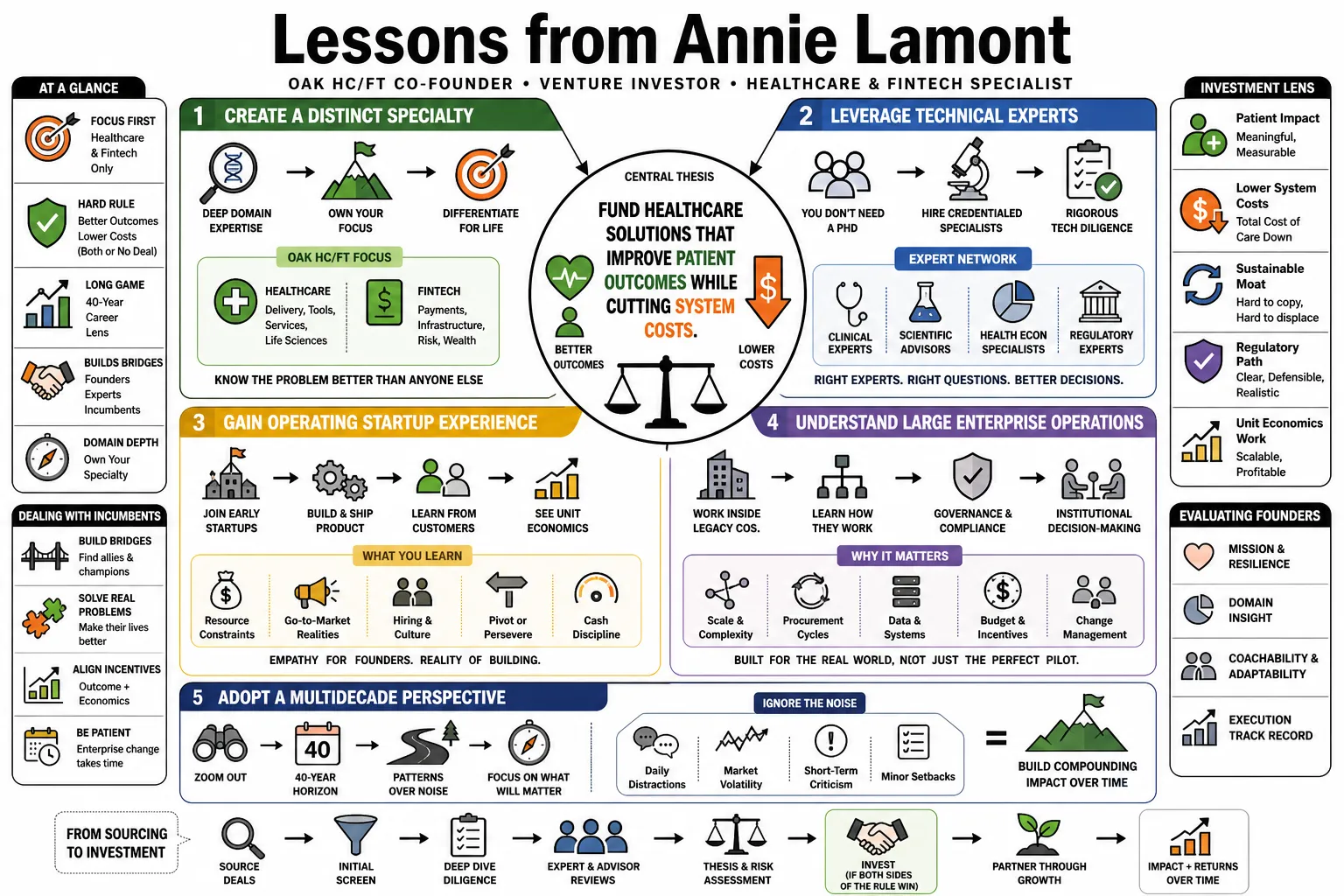
Career and Specialization
- On Creating a Distinct Specialty: Lamont emphasizes that professionals must establish their own deep domain expertise and distinct focus area to differentiate themselves from peers across their careers. — Reference: Masters in Business — Annie Lamont interview transcript
- On Leveraging Technical Experts: Lamont observes that investors entering emerging scientific domains do not need advanced technical degrees themselves because they can hire specialized credentialed experts for technical diligence. — Reference: Masters in Business — Annie Lamont interview transcript
- On Gaining Operating Startup Experience: Lamont advises aspiring venture investors to gain firsthand operational experience by working inside early-stage and growth-stage startup companies to grasp day-to-day business realities. — Reference: Masters in Business — Annie Lamont interview transcript
- On Understanding Large Enterprise Operations: Lamont recommends spending time inside established legacy corporations to understand large-scale business operations, corporate governance, and institutional decision-making. — Reference: Masters in Business — Annie Lamont interview transcript
- On Adopting a Multidecade Perspective: Lamont counsels professionals to disregard minor daily complications and evaluate current challenges through the lens of what will truly matter across a forty-year career horizon. — Reference: Masters in Business — Annie Lamont interview transcript
- On Avoiding Toxic Relationships: Lamont stresses actively distancing oneself from toxic individuals and intentionally collaborating only with colleagues and partners who are deeply trusted and respected. — Reference: Masters in Business — Annie Lamont interview transcript
Founder Partnership
- On Prioritizing Executive Talent over Concepts: Lamont highlights early mentorship demonstrating that investors must focus primarily on evaluating the chief executive and leadership talent rather than becoming overly enamored with business concepts. — Reference: Masters in Business — Annie Lamont interview transcript
- On Backing Repeat Entrepreneurs: Lamont explains that building enduring relationships with proven entrepreneurs enables venture firms to back exceptional founders repeatedly across multiple successful ventures. — Reference: Masters in Business — Annie Lamont interview transcript
- On Providing Holistic Founder Support: Lamont views the venture investor role as offering comprehensive assistance to founders, serving variously as an editor, strategic advisor, and supportive sounding board. — Reference: Masters in Business — Annie Lamont interview transcript
- On Evaluating Talent Magnetism and Culture: Lamont asserts that business outcomes ultimately depend on the chief executive's ability to attract world-class talent and foster an environment where people are treated properly. — Reference: Masters in Business — Annie Lamont interview transcript
- On Balancing Kindness with Directness: From her mentor Jerry Gallagher she took an "old fashioned" message that keeps cycling back with entrepreneurs: "very much golden rule… just obviously do the right thing and… treat people like you'd like to be treated." — Reference: Masters in Business, "Transcript: Annie Lamont" (2024).
Healthcare Investment
- On Core Healthcare Investment Objectives: Lamont articulates a core investing thesis centered strictly on supporting companies that lower systemic healthcare costs while improving clinical outcomes and patient experience. — Reference: Masters in Business — Annie Lamont interview transcript
- On Pivot to Tech-Enabled Healthcare Services: Lamont describes the strategic transition away from traditional biotechnology toward software and technology-enabled services designed to optimize healthcare administration and delivery. — Reference: Masters in Business — Annie Lamont interview transcript
- On Integrating Direct Care with Payers: Lamont explains that because medical care comprises eighty-five percent of healthcare costs, health plans must directly manage and own clinical care delivery to control total expenditures. — Reference: Masters in Business — Annie Lamont interview transcript
- On Keeping Patients Out of Acute Facilities: Lamont defines successful healthcare innovation as delivering superior preventative and home-based care that keeps patients out of expensive hospital environments. — Reference: Masters in Business — Annie Lamont interview transcript
- On Aligning Incentives via Value-Based Risk: Lamont indicates that assuming full financial responsibility for total care costs strongly aligns provider incentives to deliver proactive, high-quality preventative treatment. — Reference: Masters in Business — Annie Lamont interview transcript
- On Longitudinal Chronic Disease Management: Lamont highlights that proactive longitudinal care management for chronically ill populations effectively prevents high-cost emergency room visits and hospitalizations. — Reference: Masters in Business — Annie Lamont interview transcript
- On Navigating Incumbent Hospital Monopolies: Lamont explains the firm's caution toward investing in direct hospital software given the entrenched market power and walled-garden dominance of legacy incumbents like Epic. — Reference: Masters in Business — Annie Lamont interview transcript
- On Virtualizing Specialist Access for Rural Areas: Lamont notes that virtual and wraparound clinical models allow top urban specialists to extend high-level medical expertise directly into underserved rural healthcare deserts. — Reference: Masters in Business — Annie Lamont interview transcript
- On embedded workflow as a moat: While data is highly valuable, true durable advantage comes from creating tools that embed so deeply into daily clinical or operational workflows that they become the workflow itself. — Reference: J.P. Morgan
- On point solutions: Standalone product features will inevitably lose their value over time, whereas integrated workflows offer lasting differentiation. — Reference: J.P. Morgan Insights
Value Creation and Markets
- On Differentiating in Capital-Abundant Markets: Lamont explains that capital abundance shifted bargaining power to founders, compelling top venture firms to differentiate through comprehensive operational services and strategic support. — Reference: Masters in Business — Annie Lamont interview transcript
- On Scale Thresholds for Public Offerings: Lamont points out that public equity markets now require technology companies to achieve greater operational maturity and exceed a billion-dollar valuation before conducting an IPO. — Reference: Masters in Business — Annie Lamont interview transcript
- On Profitability Focus for Buyout Exits: Lamont notes that while private equity buyers actively acquire venture-backed companies, those businesses must demonstrate profitability to achieve successful sponsor exits. — Reference: Masters in Business — Annie Lamont interview transcript
- On Positioning on Macro Secular Waves: Lamont stresses identifying major macro technological shifts and positioning early, while cautioning that arriving too far ahead of market readiness is fatal for investments. — Reference: Masters in Business — Annie Lamont interview transcript
- On Refining Business Models on Secular Trends: Lamont explains that capitalizing on a correct macro trend still requires careful iteration to establish a viable underlying business model and unit economics. — Reference: Masters in Business — Annie Lamont interview transcript
- On Democratizing Access for the Underbanked: Lamont illustrates how fintech innovations like prepaid cards created massive economic value by bringing basic financial transactions to unbanked consumers. — Reference: Masters in Business — Annie Lamont interview transcript
- On Leapfrogging Legacy Payment Infrastructure: Lamont explains that emerging markets can turn their lack of legacy financial infrastructure into an advantage by leapfrogging older systems. — Reference: Masters in Business — Annie Lamont interview transcript
- On creating durable competitive advantage: Data alone is insufficient for a durable advantage; true defensibility comes when a company's tools are fully integrated into daily operations. — Reference: J.P. Morgan Insights
Building a Venture Firm
- On Instituting Collaborative Firm Support: Lamont describes replacing individual solo venture investors with an integrated team model that marshals firmwide resources to support entrepreneurs across every operational function. — Reference: Masters in Business — Annie Lamont interview transcript
- On Deploying Dedicated Executive Talent Teams: Lamont emphasizes the strategic advantage of maintaining dedicated internal recruiting partners to source executive leadership for portfolio companies and surface repeat founders. — Reference: Masters in Business — Annie Lamont interview transcript
- On Concentrating Capital in High-Conviction Theses: Lamont details the firm's approach of writing large checks to make concentrated, high-conviction thematic investments alongside top-tier operators. — Reference: Masters in Business — Annie Lamont interview transcript
Technology and AI
- On Harnessing Unstructured Healthcare Data: Lamont highlights that generative AI can extract value from healthcare's abundant unstructured clinical data to streamline workflows without demanding friction-heavy user behavioral change. — Reference: Masters in Business — Annie Lamont interview transcript
- On Unifying Fragmented Enterprise Logistics: Lamont discusses backing native generative AI architectures that integrate fragmented point solutions across enterprise supply chains into a cohesive end-to-end platform. — Reference: Masters in Business — Annie Lamont interview transcript
- On Addressing Evolving Synthetic Fraud: Lamont characterizes cybersecurity and fraud prevention as an endless technological arms race where new generative fraud methods require continuous advances in identity verification. — Reference: Masters in Business — Annie Lamont interview transcript
- On predictive AI beyond LLMs: Deep learning models trained specifically on tabular data have the potential to unlock enterprise value by accurately predicting complex outcomes like financial fraud and hospital readmissions. — Reference: Oak HC/FT
- On drug development: Artificial intelligence is critically needed to transform drug development, as traditional methods are too slow, costly, and imprecise. — Reference: Business Wire