Anthony Casalena is the founder and CEO of Squarespace, which he began in 2003 as a University of Maryland student after becoming frustrated with the fragmented tools required to build a website. He bootstrapped the company through its early years, combining engineering with a strong design point of view before building the team and platform around it. His experience offers practical lessons about product coherence, capital discipline, learning to lead, customer feedback, and scaling without losing the original idea.
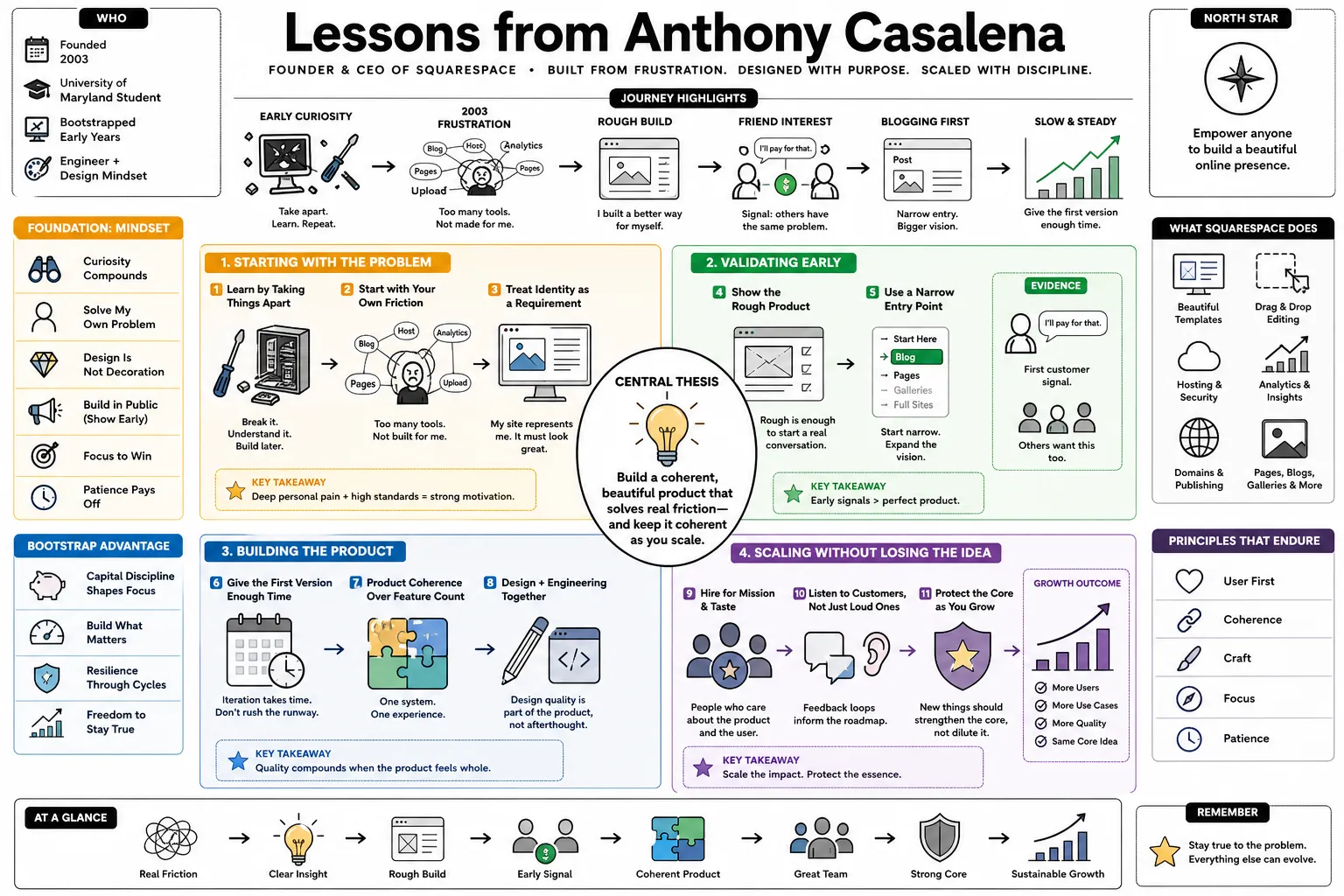
Starting with the Problem
- On Learn by Taking Things Apart: Early curiosity compounds: breaking computers, learning basic programming, and exploring interfaces gave Casalena the practical vocabulary to build later products. — Reference: How I Built This — Squarespace: Anthony Casalena
- On Start with Your Own Friction: Squarespace began with Casalena's frustration that building one website required separate tools for blogging, pages, analytics, uploading, and hosting. — Reference: How I Built This — Squarespace: Anthony Casalena
- On Treat Identity as a Product Requirement: He cared about how the site looked because it represented him online; visual quality was part of the problem, not decoration added afterward. — Reference: How I Built This — Squarespace: Anthony Casalena
- On Show the Rough Product: A friend's offer to pay for the tool helped reveal that a personal project could solve the same problem for other people. — Reference: How I Built This — Squarespace: Anthony Casalena
- On Use a Narrow Entry Point: Blogging was Squarespace's initial anchor, but the larger product vision was to let nontechnical users publish pages, galleries, and complete sites. — Reference: How I Built This — Squarespace: Anthony Casalena
- On Give the First Version Enough Time: The original architecture took roughly eight months to build; useful self-service products often require sustained work before launch. — Reference: How I Built This — Squarespace: Anthony Casalena
- On Cover the Whole Surface Early: With little capital, Casalena wrote the software, interface, homepage, and marketing copy himself, learning the complete system before specializing the team. — Reference: How I Built This — Squarespace: Anthony Casalena
Bootstrapping and Operating Discipline
- On Fund the Irreducible Constraints: Casalena sought outside money only for what he could not create himself: the physical servers and infrastructure required to launch. — Reference: How I Built This — Squarespace: Anthony Casalena
- On Design for Failure Before Scale: He bought two servers because he already understood that hardware fails and the service needed redundancy from the beginning. — Reference: How I Built This — Squarespace: Anthony Casalena
- On Choose a Name You Can Own: Squarespace was selected partly because the key domains were available and the phrase had no existing Google results, giving the company a clean starting point. — Reference: How I Built This — Squarespace: Anthony Casalena
- On Test Acquisition Cheaply: The first Google AdWords experiment cost only a few hundred dollars and brought just a handful of users, but it created a measurable learning loop. — Reference: How I Built This — Squarespace: Anthony Casalena
- On Serve the Customers Who Sustain the Product: After seeing that many free users would never upgrade, Casalena removed the free plan and focused scarce infrastructure on paying customers. — Reference: How I Built This — Squarespace: Anthony Casalena
- On Buy Yourself Runway: He extended college with a lighter workload so the business could compound before he had to make a conventional career decision. — Reference: How I Built This — Squarespace: Anthony Casalena
- On Let Real Revenue Build Conviction: Squarespace grew from roughly a $50,000 first-year run rate to about $200,000 in year two, evidence that helped justify committing full time. — Reference: How I Built This — Squarespace: Anthony Casalena
- On Take Reliability Personally: Early outages made the responsibility tangible: a small founder-run service still holds customers' work and trust, so resilience cannot wait for a larger team. — Reference: How I Built This — Squarespace: Anthony Casalena
Product Architecture and Design
- On Rebuild Only for a Real Platform Shift: The mobile web exposed a structural limit in Squarespace's existing product, making a difficult rewrite necessary rather than merely fashionable. — Reference: How I Built This — Squarespace: Anthony Casalena
- On Respect Rewrite Risk: Casalena describes rewriting a core platform as one of the most dangerous engineering moves because it routinely takes far longer than expected. — Reference: How I Built This — Squarespace: Anthony Casalena
- On Use Capital to Raise the Product Ceiling: The 2010 investment was not an excuse to stop; its purpose was to build a better product and organization for the next stage. — Reference: How I Built This — Squarespace: Anthony Casalena
- On Make the Product Change the Metrics: Squarespace 6 became the true growth inflection because it improved what users could create, not simply because the company spent more on marketing. — Reference: How I Built This — Squarespace: Anthony Casalena
- On Remove Responsive Work from the Customer: The new platform made high-fidelity portfolio and business sites work on mobile without users needing to manually adapt them. — Reference: How I Built This — Squarespace: Anthony Casalena
- On Scale the Ambition in Layers: The product expanded from one personal site to blogs, broader websites, commerce, and tools for entrepreneurial success without abandoning publishing as its core. — Reference: How I Built This — Squarespace: Anthony Casalena
- On Combine New Technology with the Design Thesis: Squarespace frames innovation as integrating current technologies with its long-standing focus on design, rather than treating novelty as a substitute for product coherence. — Reference: Squarespace — Design Intelligence
Learning to Lead
- On Know When Engineering Becomes the Bottleneck: A founder's instinct to solve every problem personally can become a limitation once the organization needs specialized leadership and leverage. — Reference: How I Built This — Squarespace: Anthony Casalena
- On Hire the Manager Who Changes the System: Squarespace's first vice president of engineering reduced founder stress by introducing stronger management, one-on-ones, and obstacle removal. — Reference: How I Built This — Squarespace: Anthony Casalena
- On Let Support Train Your Judgment: Years of direct customer support taught Casalena that feedback arrives whether or not it is comfortable, and that the useful response is to build a way to hear it. — Reference: How I Built This — Squarespace: Anthony Casalena
- On Do Not Require Agreement to Listen: A leader can create an environment where criticism is heard without automatically accepting every recommendation. — Reference: How I Built This — Squarespace: Anthony Casalena
- On Fear Silence More Than Criticism: Closing off feedback is dangerous because ignored problems can accumulate until they become a seismic break. — Reference: How I Built This — Squarespace: Anthony Casalena
- On Resolve Mistakes Faster: Maturity does not eliminate mistakes; it improves awareness and shortens the time between recognizing and correcting them. — Reference: How I Built This — Squarespace: Anthony Casalena
Brand, Distribution, and Growth
- On Treat New Channels as Experiments: Squarespace's first podcast sponsorship consumed a meaningful share of its ad budget, but the measured response justified expanding the channel. — Reference: How I Built This — Squarespace: Anthony Casalena
- On Borrow Trust Transparently: Podcast advertising worked because hosts had authentic relationships with listeners and the sponsorship openly supported the content. — Reference: How I Built This — Squarespace: Anthony Casalena
- On Align Distribution with the Customer: Supporting independent podcasts fit Squarespace because the company itself served independent creators with voices and projects that needed a home online. — Reference: How I Built This — Squarespace: Anthony Casalena
- On Let Product Lead Capital: Casalena rejects the idea that funding alone drove growth; the decisive force was a product release that materially improved customer outcomes. — Reference: How I Built This — Squarespace: Anthony Casalena
Long-Term Product Stewardship
- On Separate AI's Long Horizon from Its Short-Term Pace: Casalena expects AI to transform the landscape over a decade while remaining skeptical that every product or behavior changes within one or two years. — Reference: SilvaBokis — Squarespace Refresh 2024 Recap
- On Keep the Customer Mission Through Ownership Changes: After Squarespace returned to private ownership, Casalena reiterated the commitment to give customers more tools to build and grow online. — Reference: Permira — Acquisition of Squarespace
- On Credit Adaptability and Luck: Casalena attributes endurance to perseverance, pain tolerance, adaptability, and self-awareness, while insisting that long-term success also contains substantial luck. — Reference: How I Built This — Squarespace: Anthony Casalena