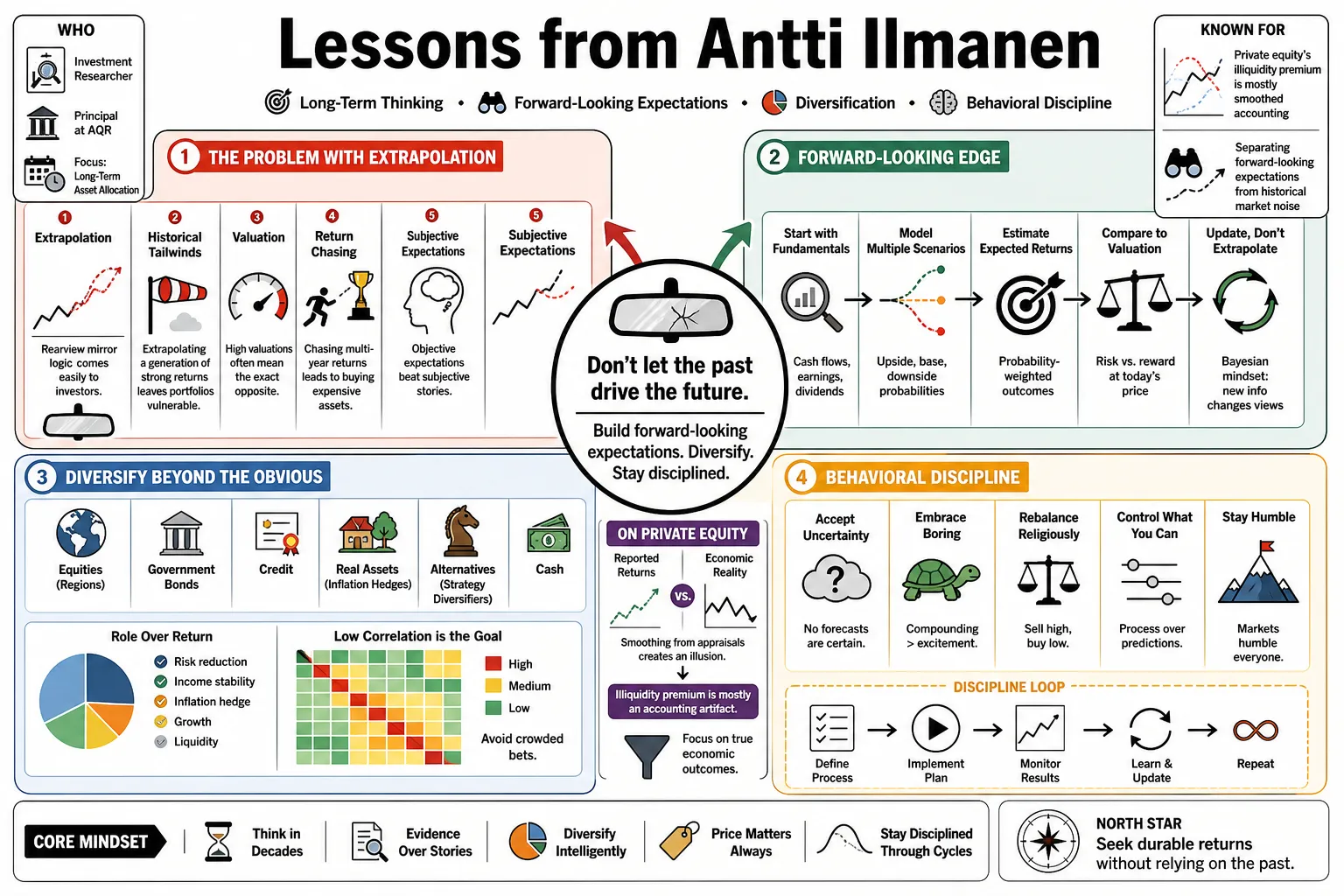
Lessons from Antti Ilmanen
Antti Ilmanen is an investment researcher at AQR Capital Management and the author of Expected Returns and Investing Amid Low Expected Returns. His work distinguishes forward-looking return estimates from realized performance, examines the economic risks hidden by smooth private-asset reporting, and emphasizes portfolio diversification and investor patience. — Rational Reminder — Antti Ilmanen.
Part 1: The Problem with Extrapolation
- On Extrapolation: Ilmanen warns that extrapolating strong realized returns can obscure the lower forward-looking returns implied by richer valuations. — Bogleheads on Investing — Antti Ilmanen.
- On Historical Tailwinds: Falling discount rates can raise asset prices and boost realized returns while leaving lower starting yields for the next investor. Those valuation gains should not simply be projected forward. — Investing Amid Low Expected Returns.
- On Valuation: Strong past returns caused by rising valuations are not evidence of equally strong future returns: paying a higher price for the same cash flows reduces the prospective yield. — The Meb Faber Show — Antti Ilmanen.
- On Return Chasing: Chasing several years of strong returns or selling after several weak years can be costly, especially at horizons where historical returns have tended to reverse. This is a tendency, not a promise of an imminent rebound. — Bogleheads on Investing — Antti Ilmanen.
- On Subjective Expectations: Ilmanen distinguishes yield-based return estimates from investors’ subjective expectations. Surveys often show optimism following strong performance, even when higher prices imply lower forward-looking yields. — How Do Investors Form Long-Run Return Expectations?.
- On Changing Environments: A systematic approach needs discipline, but it can still be vulnerable to structural change. Ilmanen favors probabilistic judgment rather than treating a once-successful rule as permanently reliable. — Investing Amid Low Expected Returns.
- On Structural Assumptions: A strategy’s long history does not rule out structural change, and recent success or failure alone does not settle whether its underlying premium persists. Ilmanen weighs both the historical evidence and the economic explanation. — Rational Reminder — Antti Ilmanen.
- On Data and Evidence: Ilmanen describes his Chicago education as an empirical approach in which competing ideas should be judged by data, rather than accepted as a fixed market-efficiency dogma. — Expected Returns — Acknowledgments.
Part 2: Managing Expectations and Serenity
- On The Serenity Prayer: Ilmanen adapts the Serenity Prayer, credited in his book to Reinhold Niebuhr, into an investing framework: accept what markets offer, improve the choices within your control, and distinguish between the two. — Investing Amid Low Expected Returns.
- On Controllable Factors: Investors cannot make markets offer their desired return. They can adjust spending and saving, choose how much risk to bear, or improve the portfolio’s construction. — Investing Amid Low Expected Returns.
- On Accepting Reality: If expected returns fall, a financial plan may need more saving or less spending. Ilmanen treats accepting what markets offer as a legitimate alternative to increasing portfolio risk. — Bogleheads on Investing — Antti Ilmanen.
- On Reaching for Yield: Taking more risk may raise expected returns, but it also raises the losses an investor must tolerate. Ilmanen cautions against increasing risk merely to preserve a familiar return target. — Bogleheads on Investing — Antti Ilmanen.
- On Building Resilience: Ilmanen prefers portfolios designed to withstand different macroeconomic scenarios over portfolios that succeed only if one forecast is right. Survival and risk control come before maximizing an optimistic return projection. — Investing Amid Low Expected Returns.
- On Resisting Fads: Ilmanen cautions that speculative, get-rich-quick opportunities are not a dependable solution to low expected returns and can distract investors from long-term saving. — Investing Amid Low Expected Returns.
- On Tailwinds: Low expected returns are a forecast, not a guarantee of low or negative realized returns. The book separates the yields observed when it was written from the uncertain returns that would subsequently occur. — Investing Amid Low Expected Returns.
- On Courage: Ilmanen questions home-country concentration and extrapolating recent US outperformance. International diversification can broaden exposure, although it does not ensure protection in a global market decline. — The Meb Faber Show — Antti Ilmanen.
Part 3: The Mechanics of Diversification
- On the 60/40 Portfolio: A portfolio split between stocks and bonds by capital can still be dominated by equity risk. In Ilmanen and his coauthors’ historical analysis, the 60/40 portfolio was particularly vulnerable to weak growth combined with rising inflation. — Exploring Macroeconomic Sensitivities.
- On The Cube Framework: Ilmanen’s cube examines a portfolio through asset classes, strategy styles and underlying risk factors. These are complementary perspectives on the same portfolio, not three independent sets of investable assets. — Thinking Outside Asset Classes: Style Premia.
- On Bold Diversification: Diversifying beyond familiar equity exposure can add different return sources, but unfamiliar strategies bring implementation constraints and a greater challenge to investor patience. Ilmanen does not present them as appropriate for everyone. — Bogleheads on Investing — Antti Ilmanen.
- On the Cost of Diversification: The diversification benefit of an unconventional strategy can be difficult to live with when that strategy performs poorly. Ilmanen treats the patience required to hold it as a practical cost, not just a statistical question. — Bogleheads on Investing — Antti Ilmanen.
- On Narrow Framing: Evaluate an investment’s contribution to the overall portfolio rather than judging it in isolation. Ilmanen favors portfolio-level diversification over narrow framing of individual positions. — Investing Amid Low Expected Returns.
- On Risk Exposures: Asset-class labels are only one view of risk. Ilmanen and his coauthors also map investments to growth, inflation, real-yield, volatility and liquidity exposures, while noting that these macro factors are not directly investable. — Exploring Macroeconomic Sensitivities.
- On Correlation: Combining return sources with low or negative correlations can improve diversification. Ilmanen highlights the historical complementarity of value and momentum, without claiming that diversification eliminates losses. — Bogleheads on Investing — Antti Ilmanen.
- On Equity Beta: Adding private equity does not necessarily diversify away equity-market risk. Ilmanen and his coauthors explain that buyout leverage can increase economic equity exposure even when smoothed reported returns make that exposure look smaller. — Demystifying Illiquid Assets: Private Equity.
- On Source of Volatility: Capital weights and risk contributions are not the same. Ilmanen’s discussion of an unconstrained portfolio uses risk allocation across return sources rather than assuming equal dollar allocations produce equal diversification. — The Meb Faber Show — Antti Ilmanen.
Part 4: Harvesting Alternative Premia
- On Risk Premia: Separate broad market exposure, systematic style premia and manager-specific alpha when assessing a return stream. A systematic premium should not automatically be counted as unique manager skill. — Thinking Outside Asset Classes: Style Premia.
- On Value: Value strategies favor assets that are cheap relative to a fundamental anchor. Ilmanen cites a long historical record while acknowledging structural-change risks; cheapness does not guarantee that every asset will recover. — Rational Reminder — Antti Ilmanen.
- On Momentum: Cross-sectional momentum buys assets that have outperformed their peers and sells relative laggards. It differs from trend following, which considers each asset’s own direction of price movement. — Exploring Macroeconomic Sensitivities.
- On Carry: Carry strategies favor higher-yielding assets over lower-yielding ones. Ilmanen presents their historical premium alongside the risk of large losses in bad times, not as a reliable coupon-like profit. — Thinking Outside Asset Classes: Style Premia.
- On Defensiveness: Defensive investing favors lower-risk or higher-quality assets over more speculative ones. Ilmanen discusses a historical risk-adjusted premium, rather than promising superior returns in every volatile period. — Bogleheads on Investing — Antti Ilmanen.
- On Structural Diversification: In Ilmanen and his coauthors’ historical study, diversified long–short style composites had less macroeconomic sensitivity than traditional asset classes. The results were simulated and gross of costs, and did not make the strategies immune to macro shocks. — Exploring Macroeconomic Sensitivities.
- On Factor Timing: A valuation signal can be useful for long-horizon expectations without being a good market-timing tool. Ilmanen emphasizes noisy forecasts and the cost of being early, rather than assuming an attractive valuation identifies the next turning point. — Rational Reminder — Antti Ilmanen.
- On Borrowed Capital: Shorting and leverage can make some return sources accessible and improve diversification, but they introduce constraints and risks. Ilmanen distinguishes using leverage to diversify from simply increasing concentrated market risk. — Rational Reminder — Antti Ilmanen.
- On Behavioral Biases: Ilmanen considers both risk-based and behavioral explanations for style premia. Asking who bears the opposite exposure helps assess a premium’s economic rationale; a behavioral explanation alone does not guarantee future returns. — Rational Reminder — Antti Ilmanen.
Part 5: The Illiquidity Premium Debate
- On the Illiquidity Mirage: Ilmanen and his coauthors find a much smaller historical private-equity edge when public benchmarks better reflect leverage and size exposures. They describe limited evidence for an extra illiquidity premium, not proof that private equity can never outperform. — Demystifying Illiquid Assets: Private Equity.
- On Return Smoothing: The authors propose that investors’ preference for smoothed reported returns can offset some of the compensation they would otherwise demand for locking up capital. They present this as an explanation, not a proven universal cause. — Demystifying Illiquid Assets: Private Equity.
- On Artificial Volatility: Infrequent valuations can make private-equity returns appear less volatile and less correlated with public markets. The authors warn that reported smoothness can understate economic risk and inflate apparent risk-adjusted performance. — Demystifying Illiquid Assets: Private Equity.
- On Low Expected Returns: Private equity is not automatically an escape from low expected returns elsewhere. Ilmanen and his coauthors’ framework links its prospective returns to starting valuations, earnings growth, financing and fees. — Demystifying Illiquid Assets: Private Equity.
- On Fee Drag: Fees reduce the return that reaches private-equity investors. In their study, the authors also associate a narrowing return edge with richer valuations and growing demand, rather than assuming the industry’s older outperformance will persist. — Demystifying Illiquid Assets: Private Equity.
- On Naïve Comparisons: Assess private-equity performance against public alternatives with comparable leverage and factor exposures. Comparing buyout returns only with an unlevered large-cap index can overstate the apparent alpha or illiquidity premium. — Demystifying Illiquid Assets: Private Equity.
- On Behavioral Crutches: Smoothed private-asset returns may help investors remain patient through a difficult period. Ilmanen acknowledges that behavioral benefit while warning that smooth reporting is not evidence of lower underlying investment risk. — Bogleheads on Investing — Antti Ilmanen.
Part 6: Macroeconomic Sensitivities
- On Regime Sensitivities: Different investments have different historical sensitivities to growth, inflation, real yields, volatility and liquidity. Mapping those exposures can reveal vulnerabilities hidden by asset-class labels, although the relationships need not remain stable. — Exploring Macroeconomic Sensitivities.
- On Inflation Hedges: In the authors’ historical sample, rising inflation hurt stock-and-bond diversification, while commodities were relatively more resilient. This supports examining inflation exposure, not assuming commodities will reliably offset every loss. — Exploring Macroeconomic Sensitivities.
- On the Bond Premium: The prospective bond premium depends on starting yields, term risk and the value of bonds as a hedge. Ilmanen also discusses how monetary tightening can create near-term headwinds; strong historical bond returns are not a fixed forward-looking premium. — Bogleheads on Investing — Antti Ilmanen.
- On Commodity Volatility: A diversified commodity-futures basket can reduce the volatility drag that depresses the compound return of an individual commodity. Ilmanen’s historical explanation is about diversification, not a guarantee that any single commodity will earn an inflation premium. — Bogleheads on Investing — Antti Ilmanen.
- On Growth Sensitivities: Stocks and high-quality government bonds showed different historical sensitivities to growth in the authors’ study. That can help diversify a portfolio, but inflation conditions and changing correlations matter. — Exploring Macroeconomic Sensitivities.
- On Balanced Exposures: The authors identify historically opposing inflation exposures in bonds and commodities. Balancing such exposures can improve macro resilience; the paper does not require every investor to hold both assets in a fixed proportion. — Exploring Macroeconomic Sensitivities.
- On Regime Shifts: Building a portfolio for one favored economic forecast leaves it exposed if another environment occurs. Ilmanen and his coauthors emphasize strategic balance across macro exposures rather than confidence in predicting the next regime. — Exploring Macroeconomic Sensitivities.
- On High-Quality Bonds: High-quality bonds can be useful recession hedges even when their expected premium is modest. Ilmanen separates that diversification role from a forecast of bond returns; bonds are not a universal hedge against inflation-driven equity losses. — Rational Reminder — Antti Ilmanen.
Part 7: Behavioral Pitfalls and Patience
- On Outcome Bias: A short-term outcome is not a reliable measure of decision quality. Ilmanen urges attention to the investment process because luck can make a sound decision look bad, or an unsound one look good. — Investing Amid Low Expected Returns.
- On Short-Term Noise: A few years of exceptional or disappointing performance can reflect random luck rather than skill. Ilmanen cautions against treating that short record as decisive evidence about a manager or strategy. — Bogleheads on Investing — Antti Ilmanen.
- On Strategy Execution: Choose strategies that fit your beliefs and size unfamiliar exposures modestly enough to hold them through difficulty. Ilmanen treats the ability to stay invested as part of implementation, not an assumption that every investor has unlimited patience. — Rational Reminder — Antti Ilmanen.
- On Assuming Discipline: In the foreword to Ilmanen’s book, Cliff Asness warns that enduring a strategy’s losses in real time is harder than looking back at its recovered historical record. The relevant strategy is one an investor can actually stick with. — Investing Amid Low Expected Returns.
- On Bad Decades: Even a good investment can go through a bad decade. Ilmanen uses that possibility to caution against rushing to judgment, while acknowledging that genuine structural changes still deserve scrutiny. — Investing Amid Low Expected Returns.
Part 8: Ex-Ante vs. Ex-Post
- On Compensation vs. Reality: Expected return is a forward-looking estimate; realized return is the outcome that actually occurs. Ilmanen emphasizes the uncertainty around estimates rather than equating the expected premium with compensation an investor is sure to receive. — Rational Reminder — Antti Ilmanen.
- On Valuation Changes: Changes in valuations can make historical realized returns a biased guide to the return expected from a different starting point. Ilmanen therefore considers the sample’s valuation change when interpreting past averages. — Rational Reminder — Antti Ilmanen.
- On Planning Errors: Retirement plans should not assume that a favorable historical return will repeat. Ilmanen connects lower forward-looking estimates with the need to revisit saving requirements and recognize a wide range of possible outcomes. — Rational Reminder — Antti Ilmanen.
- On Flawed Expectations: Disappointing returns over several years do not, by themselves, establish that an earlier expected-return estimate or investment process was wrong. Ilmanen argues for separating noisy outcomes from evidence about the underlying decision. — Investing Amid Low Expected Returns.
- On Anchoring to Yields: When expected returns vary with market conditions, current yields and valuations can be better anchors than an unadjusted historical average. Ilmanen still stresses substantial forecast uncertainty, even over a decade. — Rational Reminder — Antti Ilmanen.
- On Borrowing from the Future: If asset prices rise without a corresponding increase in cash flows, current holders gain while prospective yields fall. Ilmanen describes this repricing effect as bringing some future returns forward. — Bogleheads on Investing — Antti Ilmanen.