Anu Bradford is the Henry L. Moses Professor of Law and International Organization at Columbia Law School, director of its European Legal Studies Center, and a Special Advisor for the Executive Vice President of the European Commission. She coined the Brussels Effect to explain how European rules shape global markets and later developed the Digital Empires framework for comparing American, Chinese, and European technology governance. These lessons cover regulatory power, digital capitalism, innovation, sovereignty, and the struggle to govern AI.
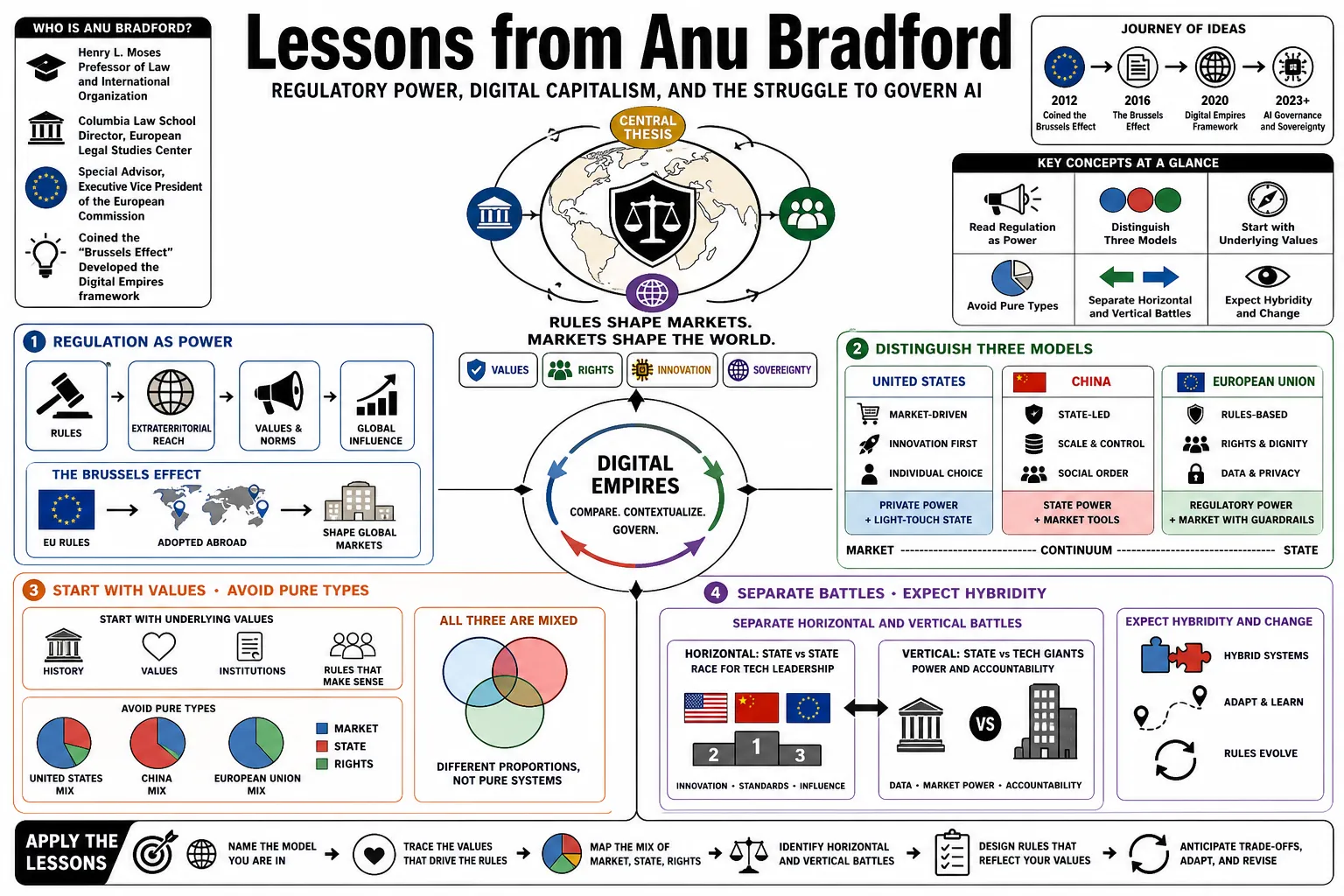
Digital Empires and Regulatory Power
- On Read Regulation as Power: Technology rules do more than constrain firms; they project a jurisdiction's values and influence beyond its borders. — Reference: Groupe d'études géopolitiques — Anu Bradford on Digital Empires
- On Distinguish Three Models: The United States, China, and the European Union organize digital capitalism around different relationships among markets, states, and individuals. — Reference: Tech Policy Press — A Conversation with Anu Bradford
- On Start with Underlying Values: A regulatory system makes more sense when its rules are traced back to the deeper values and historical commitments of the jurisdiction. — Reference: Tech Policy Press — A Conversation with Anu Bradford
- On Avoid Pure Types: No digital governance model is pure; market, state, and rights-based elements appear in different proportions across all three systems. — Reference: Groupe d'études géopolitiques — Anu Bradford on Digital Empires
- On Separate Horizontal and Vertical Battles: Competition among governments over technological leadership interacts with the struggle between governments and powerful technology companies. — Reference: Groupe d'études géopolitiques — Anu Bradford on Digital Empires
- On Expect Models to Travel: Large jurisdictions export governance through firms, infrastructure, standards, and market access, drawing other countries toward their preferred model. — Reference: Groupe d'études géopolitiques — Anu Bradford on Digital Empires
- On Judge Influence by Outcomes: Regulatory leadership is hollow when rules do not change concrete market behavior or deliver the values they promise. — Reference: Groupe d'études géopolitiques — Anu Bradford on Digital Empires
The American Market-Driven Model
- On See the Model's Original Strength: American commitments to open markets, free expression, and innovation helped its technology companies expand worldwide. — Reference: Groupe d'études géopolitiques — Anu Bradford on Digital Empires
- On Do Not Confuse Private Power with Freedom: Leaving technology companies alone does not automatically produce democracy or individual liberty. — Reference: Groupe d'études géopolitiques — Anu Bradford on Digital Empires
- On Recognize the Techlash: Market power, privacy violations, disinformation, hate speech, and democratic instability created demand for governments to re-enter digital markets. — Reference: Groupe d'études géopolitiques — Anu Bradford on Digital Empires
- On Account for Political Friction: Awareness of market failure does not guarantee legislation when industry lobbying, congressional dysfunction, and judicial caution block reform. — Reference: Groupe d'études géopolitiques — Anu Bradford on Digital Empires
- On Treat Scale as Political Power: Technology firms can accumulate economic, political, informational, and cultural power that societies are unwilling to leave unchecked. — Reference: Tech Policy Press — A Conversation with Anu Bradford
- On Balance Reform with Rivalry: The United States hesitates to regulate its firms when it fears that stronger rules could weaken its competition with China. — Reference: Groupe d'études géopolitiques — Anu Bradford on Digital Empires
- On Do Not Outsource Governance: Corporate incentives center on growth, so democratic societies must retain responsibility for defining the public interest in technology. — Reference: American Bazaar — Anu Bradford on Hybrid AI Governance
The Chinese State-Driven Model
- On See Both Market and State: China's technology sector combines state direction with market incentives and has also benefited from American venture capital. — Reference: Groupe d'études géopolitiques — Anu Bradford on Digital Empires
- On Understand Technology as Political Control: The Chinese state uses digital systems for censorship, surveillance, propaganda, and the preservation of party authority. — Reference: Groupe d'études géopolitiques — Anu Bradford on Digital Empires
- On Notice State-Firm Interdependence: Large-scale censorship requires the cooperation of technology companies, secured through both rewards and threatened punishment. — Reference: Groupe d'études géopolitiques — Anu Bradford on Digital Empires
- On Treat Industrial Policy as Part of Governance: Subsidies, state enterprises, and technology-transfer policies are used to accelerate domestic capability and reduce strategic dependence. — Reference: Groupe d'études géopolitiques — Anu Bradford on Digital Empires
- On Separate State Access from Corporate Access: China can permit government use of data while restricting how private companies exploit consumer information. — Reference: Groupe d'études géopolitiques — Anu Bradford on Digital Empires
- On Expect Strategic Rebalancing: When technology firms become too powerful, the state can tighten control and redirect the sector toward politically preferred industries. — Reference: Groupe d'études géopolitiques — Anu Bradford on Digital Empires
- On Avoid Equating Scale with Empowerment: A centralized model may deliver speed and scale without strengthening democratic institutions or empowering citizens. — Reference: American Bazaar — Anu Bradford on Hybrid AI Governance
The European Rights-Driven Model
- On Put Rights Inside the Market Design: Europe treats privacy, fairness, democratic integrity, and individual rights as design constraints for the digital economy. — Reference: Groupe d'études géopolitiques — Anu Bradford on Digital Empires
- On Use Regulation to Steer Markets: The European model gives government a central role in shaping digital markets and distributing their benefits fairly. — Reference: Groupe d'études géopolitiques — Anu Bradford on Digital Empires
- On Move Earlier When Enforcement Is Too Slow: After-the-fact competition cases can take so long that smaller rivals disappear before a remedy arrives. — Reference: Groupe d'études géopolitiques — Anu Bradford on Digital Empires
- On Protect the Model's Core Strength: Europe should not discard its leadership in privacy, online safety, competition, and democratic oversight while pursuing competitiveness. — Reference: Capgemini — Anu Bradford on Tech Sovereignty
- On Look Beyond Regulation for the Innovation Gap: Fragmented markets, shallow growth capital, risk aversion, and talent gaps explain more of Europe's technology weakness than regulation alone. — Reference: Capgemini — Anu Bradford on Tech Sovereignty
- On Complete the Digital Single Market: European startups need a genuinely unified home market if they are to scale before confronting global competitors. — Reference: Capgemini — Anu Bradford on Tech Sovereignty
- On Make Failure Less Punitive: Innovation policy should reform insolvency rules and cultural attitudes so entrepreneurs can take risks and try again. — Reference: Capgemini — Anu Bradford on Tech Sovereignty
- On Attract Technical Talent: A durable competitiveness strategy includes immigration policies that attract and retain global technology talent. — Reference: Capgemini — Anu Bradford on Tech Sovereignty
Technology Sovereignty and Fragmentation
- On Reject Total Sovereignty: Genuine end-to-end technology sovereignty is nearly impossible because modern supply chains are deeply interdependent. — Reference: Capgemini — Anu Bradford on Tech Sovereignty
- On Map the Full Supply Chain: Semiconductor power is distributed across chip design, lithography, chemicals, fabrication, and critical minerals rather than owned by one country. — Reference: Capgemini — Anu Bradford on Tech Sovereignty
- On Expect Conflicting Rulebooks: Multinational firms increasingly face incompatible requirements on content, data, and AI instead of one global compliance standard. — Reference: Capgemini — Anu Bradford on Tech Sovereignty
- On Prepare Regional Product Variants: Diverging laws may require separate systems, policies, or product versions for different markets. — Reference: Capgemini — Anu Bradford on Tech Sovereignty
- On Treat Trust as a Jurisdictional Question: Customers now ask whether foreign providers will obey local law or ultimately follow the demands of their home government. — Reference: Capgemini — Anu Bradford on Tech Sovereignty
- On Build Contingency Plans: Firms should diversify supply chains and prepare to localize operations when geopolitical fractures threaten service continuity. — Reference: Capgemini — Anu Bradford on Tech Sovereignty
- On Know When Divergence Breaks a Market: If legal regimes become irreconcilable, leaving a market may be safer than operating under mutually impossible obligations. — Reference: Capgemini — Anu Bradford on Tech Sovereignty
AI Governance and Emerging Markets
- On Build a Hybrid Model: India can combine innovation, rights, capital, and digital infrastructure instead of copying the American, Chinese, or European model wholesale. — Reference: American Bazaar — Anu Bradford on Hybrid AI Governance
- On Treat Digital Infrastructure as Exportable Power: India can turn its experience with digital public infrastructure into a governance contribution rather than remaining a rule taker. — Reference: American Bazaar — Anu Bradford on Hybrid AI Governance
- On Use Coalitions When Great Powers Stall: Middle powers can form practical coalitions when rivalry between the United States and China blocks universal AI governance. — Reference: American Bazaar — Anu Bradford on Hybrid AI Governance
- On Correct Language Imbalances: AI systems and content moderation fail communities when platforms underinvest in smaller languages and non-Western cultural contexts. — Reference: American Bazaar — Anu Bradford on Hybrid AI Governance
- On Keep Governance Close to Innovation: Agentic AI should not advance without safeguards, especially where vulnerable people rely on systems for consequential advice. — Reference: American Bazaar — Anu Bradford on Hybrid AI Governance
- On Find Islands of Agreement: Even during geopolitical conflict, countries should identify narrow areas of AI cooperation that can protect humanity and share benefits. — Reference: American Bazaar — Anu Bradford on Hybrid AI Governance