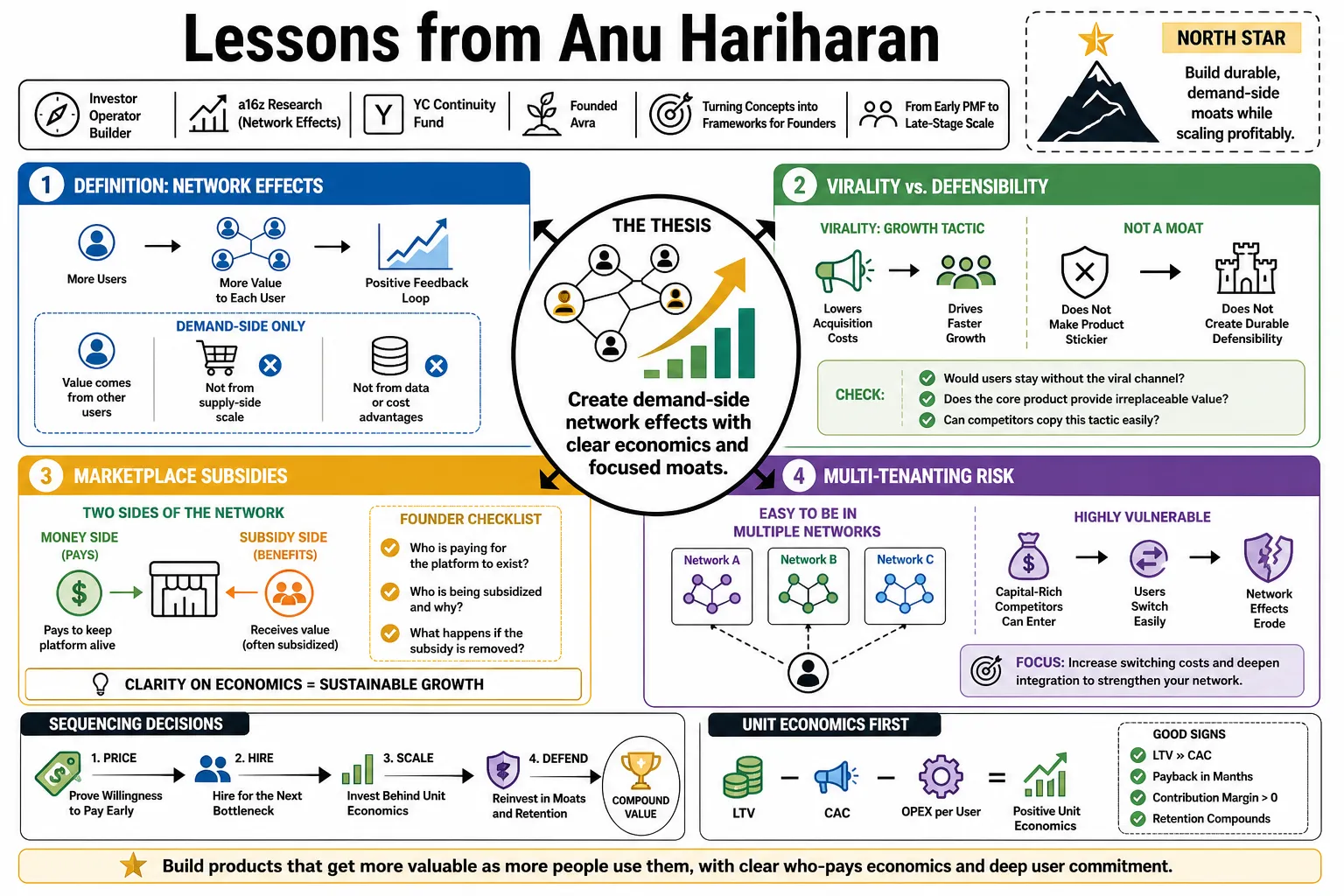
Lessons from Anu Hariharan
Anu Hariharan is an investor who went from leading Andreessen Horowitz’s research on network effects to managing Y Combinator's Continuity fund and founding Avra. She turns concepts like demand-side scale and unit economics into plain frameworks for founders scaling from early product-market fit to late-stage growth. This profile collects her observations on how startups should sequence their pricing, hiring, and scaling decisions.
Part 1: Network Effects
- On Definition: "Network effects are present when a product becomes more valuable to its users as more people use it, operating strictly on the demand side of the equation." — Source: [a16z/Future: All About Network Effects]
- On Virality vs. Defensibility: "Virality is a growth tactic that lowers acquisition costs, but it does not inherently create a moat or make the core product stickier." — Source: [Future/a16z: All About Network Effects]
- On Marketplace Subsidies: "Founders must identify the money side and the subsidy side of their network, understanding exactly who is paying for the platform to exist." — Source: [Future/a16z: All About Network Effects]
- On Multi-tenanting: "If your users can easily participate in multiple competing networks simultaneously, your network effect is highly vulnerable to capital-rich competitors." — Source: [a16z/Future: All About Network Effects]
- On The Cold Start: "Solving the chicken-and-egg problem requires doing unscalable things to artificially constrain the initial market until liquidity is reached." — Source: [NFX: Network Effects Archives]
- On Data Networks: "Simply accumulating data is an incomplete moat; the data must autonomously improve the predictive value of the product in real time." — Source: [Future/a16z: All About Network Effects]
- On Exit Barriers: "True network effects create high barriers to exit for users, where leaving the platform means losing significant accumulated value or status." — Source: [Future/a16z: All About Network Effects]
- On Supply-Side Scale: "Do not confuse supply-side economies of scale, like purchasing power, with demand-side network effects that compound user value." — Source: [a16z/Future: All About Network Effects]
- On Localized Networks: "City-by-city models like ride-sharing have asymptotic network effects where adding the ten-thousandth driver adds less marginal value than the tenth." — Source: [Future/a16z: All About Network Effects]
- On Platform Shifts: "Incumbents rarely survive major platform shifts because their existing network effects tie them to an outdated hardware or distribution paradigm." — Source: [a16z/Future: All About Network Effects]
Part 2: Growth Metrics and Unit Economics
- On Early Metrics: "Healthy unit economics are the clearest primary indicator of strong product-market fit when assessing a company at the growth stage." — Source: [a16z: 16 Startup Metrics]
- On Dollar Churn: "Dollar churn can mask underlying product issues if you are raising prices on a shrinking base of power users." — Source: [a16z: 16 Startup Metrics]
- On Unit Churn: "Founders must obsess over unit churn and user retention instead of focusing solely on top-line revenue to understand the true health of the business." — Source: [a16z: 16 Startup Metrics]
- On Contextual Benchmarks: "Investors look for different indicators depending on the business type, and founders should tailor their metrics to reflect their specific model rather than generic averages." — Source: [Startup School: Business Models and Pricing]
- On CAC Payback: "Understanding your customer acquisition cost payback period by segment reveals whether your sales motion is actually scalable." — Source: [a16z/Future: All About Network Effects]
- On Contribution Margin: "Growth stage companies must prove they have a path to positive contribution margin on their core transactions, independent of fixed overhead." — Source: [a16z: 16 Startup Metrics]
- On Vanity Metrics: "Cumulative user counts and gross merchandise value tell you nothing about the underlying profitability or retention dynamics of the customer base." — Source: [a16z: 16 Startup Metrics]
- On Blended Margins: "Software businesses with heavy services components often hide weak gross margins by blending them with high-margin recurring revenue." — Source: [a16z: 16 Startup Metrics]
- On Cohort Degradation: "Later cohorts often perform worse than early adopters, meaning your unit economics will likely decay as you penetrate deeper into the market." — Source: [a16z: 16 Startup Metrics]
- On Pricing Power: "The ultimate test of product-market fit is whether you can raise prices without causing a corresponding spike in churn." — Source: [SaaStr: 5 Critical B2B Learnings]
Part 3: The Builder Mentality and Hiring
- On Builders vs. Managers: "If I had to err on the side of always hiring a builder who can also be a manager, I'd choose that path versus hiring a manager who cannot be a builder." — Source: [Permanent Equity: Builders vs Managers]
- On Executive Hiring: "Do not hire executives for the scale you hope to be at in five years; hire them for the exact problems you need to solve in the next eighteen months." — Source: [YC Library: How to Build and Manage Teams]
- On Promoting from Within: "Internal promotions for early employees often fail when the company scales past their operational experience, requiring the founder to have difficult conversations early." — Source: [YC Library: How to Build and Manage Teams]
- On Communication Skills: "Clarity of thought is as important or even more important than performance today, and it has to be well articulated too." — Source: [YC Library: Growth Strategy & Teams]
- On Reference Checks: "Back-channel references are more predictive of executive success than the formal interview process, provided you ask specific behavioral questions." — Source: [Village Global Venture Stories]
- On Generalists: "Early-stage startups need generalists who can switch contexts rapidly, but growth-stage companies die if they fail to transition to specialists." — Source: [YC Library: How to Build and Manage Teams]
- On Firing Fast: "The cost of keeping the wrong executive hire compounds daily, destroying culture and slowing down the entire organization." — Source: [The Takeoff: Interview with Anu Hariharan]
- On Interview Assignments: "Give candidates real work assignments during the interview process to see how they think rather than how they present themselves." — Source: [SaaStr: B2B Operational Learnings]
- On Founder Involvement: "The CEO should remain heavily involved in hiring for the first hundred employees to ensure the cultural baseline is set correctly." — Source: [Permanent Equity: Builders vs Managers]
- On Setting Expectations: "Clear role definitions prevent turf wars and ensure that builders focus on shipping rather than defending their territory." — Source: [YC Library: How to Build and Manage Teams]
Part 4: Early Stage Survival and Crisis Management
- On Grit: "Number one is grit. You cannot get caught up by tough days because the only thing that's going to be certain as you scale a startup is challenges." — Source: [The Takeoff: Interview with Anu Hariharan]
- On Seizing Opportunity: "The thing about YC is we are always experimenting. Never let a crisis go to waste." — Source: [The Takeoff: Interview with Anu Hariharan]
- On Default Alive: "Startups must understand exactly what it takes to become default alive so they are not entirely dependent on the next funding round." — Source: [YC Library: Growth Strategy & Teams]
- On Speed of Execution: "Iterating quickly based on user feedback is the only structural advantage a startup has against an incumbent with more resources." — Source: [TechCrunch Equity Podcast]
- On Focus: "Founders often fail by trying to build too many features at once instead of making their core use case undeniably excellent." — Source: [YC Library: Growth Strategy & Teams]
- On Down Rounds: "Accepting a down round is far better than taking toxic structure that misaligns incentives and blocks future capital." — Source: [TechCrunch Equity]
- On Rationing Cash: "In a downturn, extending runway by cutting discretionary spend is an immediate necessity rather than a strategic debate." — Source: [YC Library: Growth Strategy & Teams]
- On Ignoring Noise: "Pay attention to your users and your bank account, skipping the press releases of your competitors." — Source: [Village Global Venture Stories]
- On Founder Alignment: "Co-founder disputes during early crises kill more startups than running out of money." — Source: [The Takeoff: Interview with Anu Hariharan]
Part 5: Navigating the Growth Stage
- On Breaking Systems: "The processes that got a company to ten million in revenue will actively break the company on the way to fifty million." — Source: [YC Library: How to Build and Manage Teams]
- On Founder-led Sales: "Transitioning away from founder-led sales requires systematizing the narrative so reps can sell the vision without the founder in the room." — Source: [SaaStr: 5 Critical B2B Learnings]
- On Institutionalizing Knowledge: "Growth requires moving knowledge out of the founder's head and into documentation, playbooks, and transparent data dashboards." — Source: [YC Blog: Managing a Board]
- On Reporting Structures: "Reorganizing the management structure is painful but necessary to prevent the CEO from becoming the primary bottleneck to decision making." — Source: [Permanent Equity: Builders vs Managers]
- On Board Management: "A functioning board should be a resource for identifying blind spots, rather than a reporting exercise for the founder." — Source: [YC Blog: Managing a Board]
- On New Markets: "Entering a secondary market before achieving dominance in the primary market splits resources and risks failure in both." — Source: [a16z: 16 Startup Metrics]
- On International Expansion: "Expanding internationally introduces operational complexity that often outweighs the immediate revenue benefits for early growth companies." — Source: [Village Global Venture Stories]
- On Continuous Experimentation: "The best growth stage companies treat their organizational structure as an experiment that is subject to iteration." — Source: [YC Library: Growth Strategy & Teams]
- On Capital Deployment: "Raising a large growth round does not mean you should immediately double headcount; deploy capital only where you have high conviction on the return." — Source: [YC Library: Growth Strategy & Teams]
Part 6: B2B Strategy and Pricing
- On Chronic Underpricing: "Most early-stage B2B startups severely underprice their products, leaving money on the table and signaling low value to enterprise buyers." — Source: [SaaStr: 5 Critical B2B Learnings]
- On Product Value: "Measure how disappointed customers would be if the product disappeared to determine your true pricing power." — Source: [SaaStr: 5 Critical B2B Learnings]
- On Premature Scaling: "Scaling a sales team before the product is ready and the pricing is validated leads to high burn and missed quotas." — Source: [a16z/Future: All About Network Effects]
- On ROI Alignment: "Pricing should be directly tied to the measurable return on investment the software provides to the customer's business." — Source: [YC Library: Growth Strategy & Teams]
- On Upfront Payments: "Securing annual upfront payments from enterprise customers is the cheapest form of working capital a startup can get." — Source: [YC Library: Growth Strategy & Teams]
- On Custom Features: "Building custom features for specific enterprise clients distracts the engineering team and prevents the development of a unified product." — Source: [YC Library: Growth Strategy & Teams]
- On Customer Success: "Customer success should be treated as a revenue-generating function focused on retention and expansion, rather than acting as standard support." — Source: [SaaStr: 5 Critical B2B Learnings]
- On Switching Costs: "Increasing the switching costs through deeper integration with the customer's workflow reduces churn naturally." — Source: [SaaStr: 5 Critical B2B Learnings]
- On Enterprise vs SMB: "Selling to SMBs requires a highly automated, self-serve motion, while enterprise sales rely on relationship building and navigating procurement." — Source: [a16z: 16 Startup Metrics]
Part 7: Leadership and Founder Psychology
- On Perspective: "When you know less, you step back, and you think about the big picture." — Source: [The Takeoff: Interview with Anu Hariharan]
- On Asking Questions: "Take the time to get to know your classmates deeply. Ask them questions like how did you grow up and what brought you here." — Source: [Virginia Tech: Alumni Spotlight]
- On Learning from Failure: "Founders who can objectively analyze their failures without tying them to their self-worth iterate much faster." — Source: [YC Library: Growth Strategy & Teams]
- On CEO Loneliness: "The job of the CEO becomes increasingly isolating as the company scales, requiring external peer networks for support." — Source: [Village Global Venture Stories]
- On Delegation: "Delegating tasks is easy, but delegating authority requires a level of trust that many founders struggle to develop." — Source: [Permanent Equity: Builders vs Managers]
- On Burnout: "Managing your own psychology and preventing burnout is a fiduciary duty of the founder." — Source: [YC Library: Growth Strategy & Teams]
- On Vision vs Tactics: "A strong leader holds the long-term vision rigidly while remaining highly flexible on the tactics used to get there." — Source: [YC Library: Growth Strategy & Teams]
- On Transparent Communication: "Sharing bad news early builds trust with employees and investors, while hiding it creates paranoia." — Source: [YC Library: Growth Strategy & Teams]
- On Self-Awareness: "The best founders know their own limitations and actively hire executives who compensate for their weaknesses." — Source: [Permanent Equity: Builders vs Managers]
Part 8: Scale and Capital Efficiency
- On Raising the Right Amount: "Raise enough capital to reach your next major milestone with a buffer, but avoid taking so much that you lose operational discipline." — Source: [TechCrunch Equity Podcast]
- On Valuation Traps: "Optimizing strictly for the highest valuation in a funding round can trap a company if they fail to grow into those expectations." — Source: [TechCrunch Equity]
- On Capital as a Tool: "Capital is a tool to accelerate growth in a working business model, rarely serving as a substitute for product-market fit." — Source: [YC Library: Growth Strategy & Teams]
- On False Security: "A large bank balance often creates a false sense of security, leading to bloated teams and slower execution." — Source: [YC Library: Growth Strategy & Teams]
- On Generational Companies: "Building a generational company requires prioritizing long-term market capture instead of short-term optimization." — Source: [YC Library: Growth Strategy & Teams]
- On Operational Discipline: "Capital efficiency is fundamentally about unit economics; if it costs too much to acquire a dollar of revenue, no amount of funding will save you." — Source: [a16z: 16 Startup Metrics]
- On Secondary Liquidity: "Allowing early employees and founders to take some chips off the table through secondary sales aligns their long-term focus with the company." — Source: [Avra Capital: Model & Insights]
- On Dilution: "Founders must calculate the true cost of dilution over multiple rounds, realizing that taking on too much capital early cedes control." — Source: [a16z: 16 Startup Metrics]
- On Capital Allocation: "As a company matures, the CEO's primary job shifts from product management to capital allocation and executive hiring." — Source: [Village Global Venture Stories]