Anupam Mittal founded People Group and Shaadi.com and became an investor on Shark Tank India. — Entrepreneur India — The Bull Shark.
His advice emphasizes founder commitment, understanding customers, and choosing funding that fits the business and the life a founder wants to build. — Think School — CEO Blueprint.
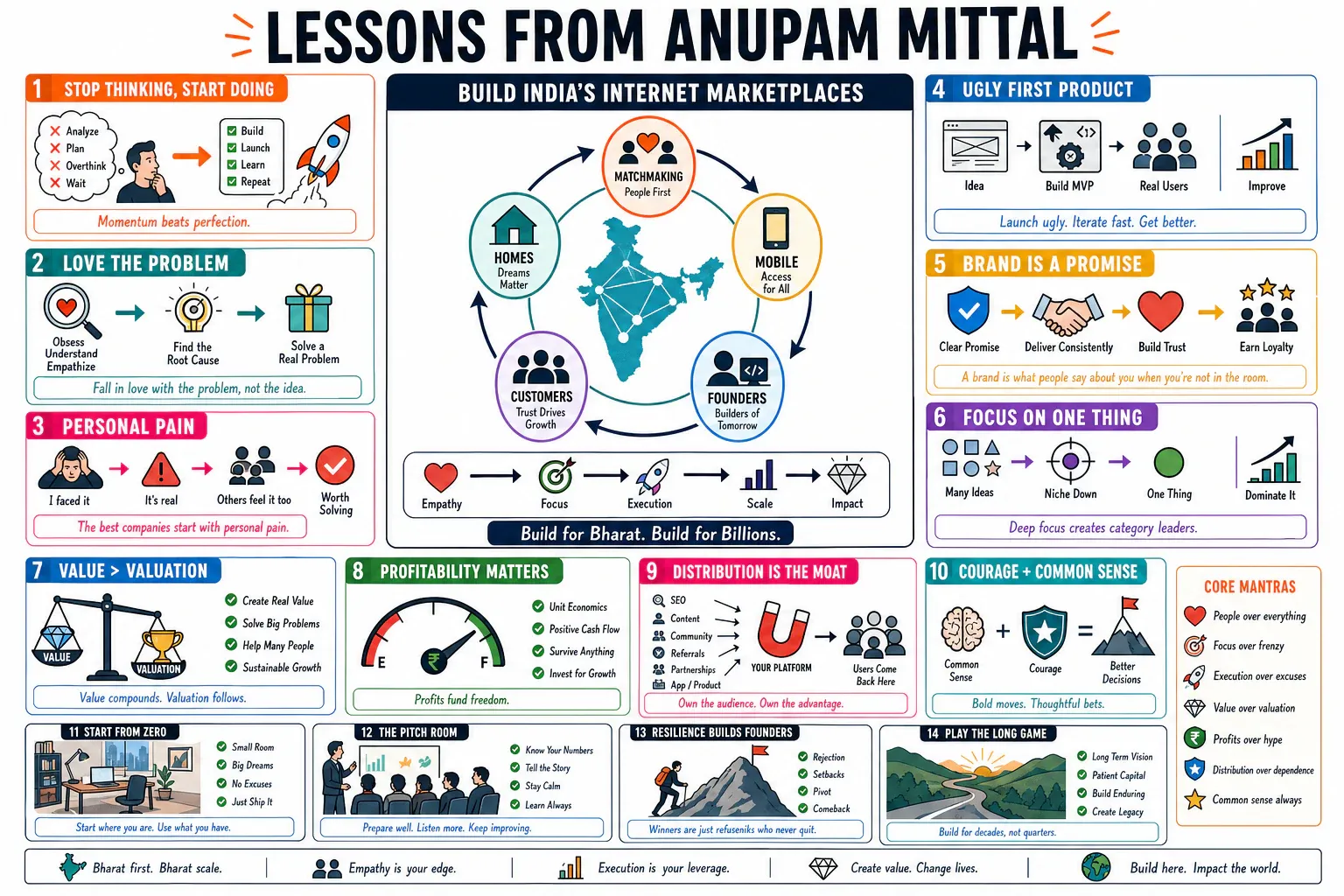
On Entrepreneurship and Getting Started
- Commitment When Others Disagree: Building a business can require sustained focus on a problem even when other people do not yet understand the opportunity. — Anupam Mittal — Sell and Build.
- Mittal's own advice: you don't need permission to start. Just start -- stop hiding behind no time and more research, and test your idea in the real world before you've built anything close to a finished product. — Anupam Mittal — Start and Test.
- Understand the Problem Before Fixing the Solution: Keep the customer’s problem at the center of product decisions. At Shaadi.com, customer research and testing helped Mittal’s team change features rather than assume their first design was right. — Mixergy — Shaadi.com Interview.
- Notice Constraints in Everyday Markets: Mittal traces Shaadi.com’s original opportunity to an encounter with a traditional matchmaker and the limited choices available through personal networks. An overlooked constraint can reveal a problem worth solving. — Mixergy — Shaadi.com Interview.
- Build Around a Mission You Care About: Mittal distinguishes founders motivated by creating a product or changing something in a market from those primarily seeking a quick exit. He favors a mission that makes the work itself worth pursuing. — Think School — CEO Blueprint.
- Look Beyond Credentials: Mittal treats a prestigious degree as a possible signal of ability, not a requirement. He looks for exceptional capability, business judgment, and insight into the market a founder wants to serve. — Think School — CEO Blueprint.
On Building a Business and Strategy
- Test Demand Before Building the Whole Product: Use a mock-up and a relevant community to test whether strangers show real interest. If a test accepts payment for a product that is not ready, Mittal says to refund the money and tell buyers it is not yet available. — Think School — CEO Blueprint.
- Keep the Brand Promise: A brand depends on keeping its implicit promise to customers, not merely on promotion. Mittal links that promise with what people perceive and feel about the business. — Anupam Mittal — Brand Promise.
- Protect the Core Business: Mittal describes spreading attention across new ventures and neglecting Shaadi.com’s core before refocusing. Expansion should not starve the business that already serves customers. — Mixergy — Shaadi.com Interview.
- Serve a Specific Customer Segment: Shaadi.com focused on South Asian matchmaking needs rather than trying to serve every dating customer. A clear segment helps determine which product choices matter and which competitors are relevant. — Mixergy — Shaadi.com Interview.
- Do Not Confuse Valuation with Business Quality: Mittal describes startup valuations as influenced by funding supply, demand, and hype cycles. A high headline valuation is not by itself evidence of a healthy business. — Think School — CEO Blueprint.
- Let Customer Revenue Support the Business: Shaadi.com grew without outside equity for years and was profitable before its first external funding, according to Mittal’s account. Customer revenue can help build a business before deciding whether outside capital is needed. — Mixergy — Shaadi.com Interview.
- Reach the Customers Who Need You: Shaadi.com initially reached overseas South Asian communities through targeted media and publicity. Distribution mattered because the business had to reach people whose matchmaking needs it could serve. — Mixergy — Shaadi.com Interview.
On Investment Philosophy
- Evaluate TAM, Team, Timing, and Traction: In his 2022 Entrepreneur India interview, Mittal describes a T4 framework: total addressable market, team, timing, and traction. For businesses that have not yet launched, he emphasizes the first three. — Entrepreneur India — The Bull Shark.
- Back Teams That Can Pivot: Mittal says many successful companies in his portfolio changed the model he originally invested in. Strong teams helped them pivot quickly. — Entrepreneur India — The Bull Shark.
- Explain Your Right to Win: A founder should understand the market well enough to offer a non-obvious insight into the opportunity. Mittal asks what makes the team especially well placed to build this business. — Think School — CEO Blueprint.
- Use Traction Where It Exists: Mittal includes traction in his T4 framework, while acknowledging that it is unavailable for some pre-product businesses. Judge evidence of progress in the context of the company’s stage. — Entrepreneur India — The Bull Shark.
- Coach Rather Than Merely Reassure: In his leadership advice, Mittal favors candid feedback that helps people develop their capabilities, rather than reassurance that avoids difficult conversations. — Anupam Mittal — Leadership and Feedback.
- Look for Underserved Category Opportunities: Mittal points to underbranded consumer spaces as opportunities for new businesses. Look for a gap in what customers are offered rather than assume an established category has no room for a new entrant. — Think School — CEO Blueprint.
Advice from Shark Tank
- Treat Integrity as an Investment Criterion: Mittal places integrity alongside business acumen and persistence when assessing founders. An attractive business opportunity does not remove the need to trust the people building it. — Entrepreneur India — The Bull Shark.
- Learn to Sell as Well as Build: Founders need to persuade customers to buy, people to join, and investors to back a vision. Mittal encourages aspiring entrepreneurs to develop selling and building skills together. — Anupam Mittal — Sell and Build.
- Listen to Customers Systematically: At Shaadi.com, Mittal’s team used surveys, focus groups, and testing to learn what customers needed. Customer understanding should come from a feedback process, not only a founder’s assumptions. — Mixergy — Shaadi.com Interview.
- Understand the Commitment Behind Equity: Mittal compares taking equity investment to a long-term commitment: outside investors bring expectations for growth and returns. Consider whether that path fits the business and the life you want to build. — Think School — CEO Blueprint.
On Personal Mindset and Philosophy
- Find Motivation Beyond Fear: Mittal says fear drove him for a long time but left him increasingly anxious. He describes inspiration and passion as more lasting reasons to keep building. — Anupam Mittal — Fear and Inspiration.
- Keep Passion, Persistence, and Curiosity: Mittal describes the qualities he looks for in founders through junoon, jidd, and jigyasa: passion, persistence, and curiosity. Keep learning while staying committed to the work. — Entrepreneur India — The Bull Shark.
- Question Conventions Without Breaking the Law: Mittal encourages learning the rules before challenging conventional ways of working. His argument is for creating opportunities rather than waiting for acceptance—not for illegal shortcuts or guaranteed returns. — Anupam Mittal — Questioning Conventions.
- Use Networks to Connect Concrete Needs: Mittal uses his professional network to connect founders with funding, mentorship, and hiring help. Relationships become useful when people can identify a need and make a relevant introduction. — Anupam Mittal — Opening Doors for Founders.
- Combine Humility with Hunger to Learn: Mittal endorses humility and hunger as a combination that keeps the learning curve going. Ambition need not mean assuming you already have the answers. — Anupam Mittal — Humility and Hunger.
- Adapt Through Fast Learning: Mittal looks for teams that respond to changing conditions by iterating quickly. After a discussion, a prototype or thoughtful follow-up can show whether learning turns into action. — Anupam Mittal — What Makes a Great Team.
Additional Key Learnings
- On The Indian Market: Mittal distinguishes consumer segments with different disposable incomes and spending needs. A product and brand should fit the customers it is actually trying to reach. — Think School — CEO Blueprint.
- On Hiring: For senior hires, Mittal recommends getting to know the person over multiple meetings and checking references for track record and integrity. Look beyond an impressive interview. — Think School — CEO Blueprint.
- On Failure: Mittal treats setbacks as occasions to examine his own decisions rather than blame other people. Learning from failure requires taking responsibility, not assuming failure automatically leads to success. — Anupam Mittal — Learning from Failure.
- On Technology: Mittal’s Astrolife experience showed him that an automated service could miss what customers valued about dealing with a person. Technology must fit the customer’s need, not just make a process technically possible. — Mixergy — Shaadi.com Interview.
- On The Long Game: Mittal looks for teams willing to stay focused on a few important things over years, rather than switch to each new distraction. Building something meaningful requires sustained commitment. — Anupam Mittal — What Makes a Great Team.
- On Capital: When choosing an investor, Mittal considers reputation and fit with the founder’s capital needs and goals—not only the highest offered valuation. — Think School — CEO Blueprint.
- On Unit Economics: Mittal tests commercial understanding through conversations about profit-and-loss statements and raising capital. A polished product experience is not enough without understanding the business behind it. — Anupam Mittal — What Makes a Great Team.
- On The Team: Mittal looks for co-founders who have worked together, share a compatible outlook, and bring complementary building and selling skills. Team chemistry matters as well as individual ability. — Anupam Mittal — What Makes a Great Team.
- On Simplicity: Shaadi.com’s team explored learning users’ preferences without requiring them to fill out every detail themselves. Reduce friction where it prevents customers from getting the result they came for. — Mixergy — Shaadi.com Interview.
- On Storytelling: A pitch must engage the listener and explain the opportunity clearly. Mittal advises founders to communicate effectively without simply agreeing to every suggestion they hear. — Think School — CEO Blueprint.
- On Giving Back: Mittal uses his reach to open doors for founders seeking funding, mentors, or people to hire. Supporting the next generation can mean making useful connections rather than only offering encouragement. — Anupam Mittal — Opening Doors for Founders.
- On Work-Life Balance: Mittal argues that working hours should reflect what someone wants from life and the trade-offs they are willing to make. He distinguishes his own choice to work long hours from employers imposing the same choice on everyone. — Anupam Mittal — Work-Life Choices.
- On The Power of a Platform: Mittal explains that a matchmaking network becomes more useful as it offers more people and a wider range of possible matches. Platform value depends on the benefit participants get from that network. — Mixergy — Shaadi.com Interview.
- On The Future: Mittal encourages aspiring professionals to learn by building products: understanding customers, working backwards from an outcome, and influencing others. He sees hands-on building as preparation for future leadership. — Anupam Mittal — Learning by Building.
- On The 'Why': Mittal argues that polished visuals and fashionable branding are not enough without genuine intent. A brand should communicate what it stands for, not merely tell a story that sounds impressive. — Anupam Mittal — Brand Intent.
- On Courage: Mittal advises taking a step in a direction that excites you even when you are afraid. In his account, action can bring clarity that waiting for certainty does not. — Anupam Mittal — Taking the First Step.
- On Legacy: In his tribute to Ratan Tata, Mittal connects lasting impact with empathy, authenticity, and kindness. The way a leader treats people can be part of the legacy they leave. — Anupam Mittal — Ratan Tata’s Legacy.
Learn more: