Aparna Chennapragada led product development for Google Now, Google Lens, and Robinhood, and is currently the Chief Product Officer for AI Experiences at Microsoft. Her work focuses on translating new technical capabilities into products people can understand, trust, and use. These lessons cover AI interfaces, agents, product judgment, leadership, deep work, and building through major technology shifts.
AI Interfaces and Agents
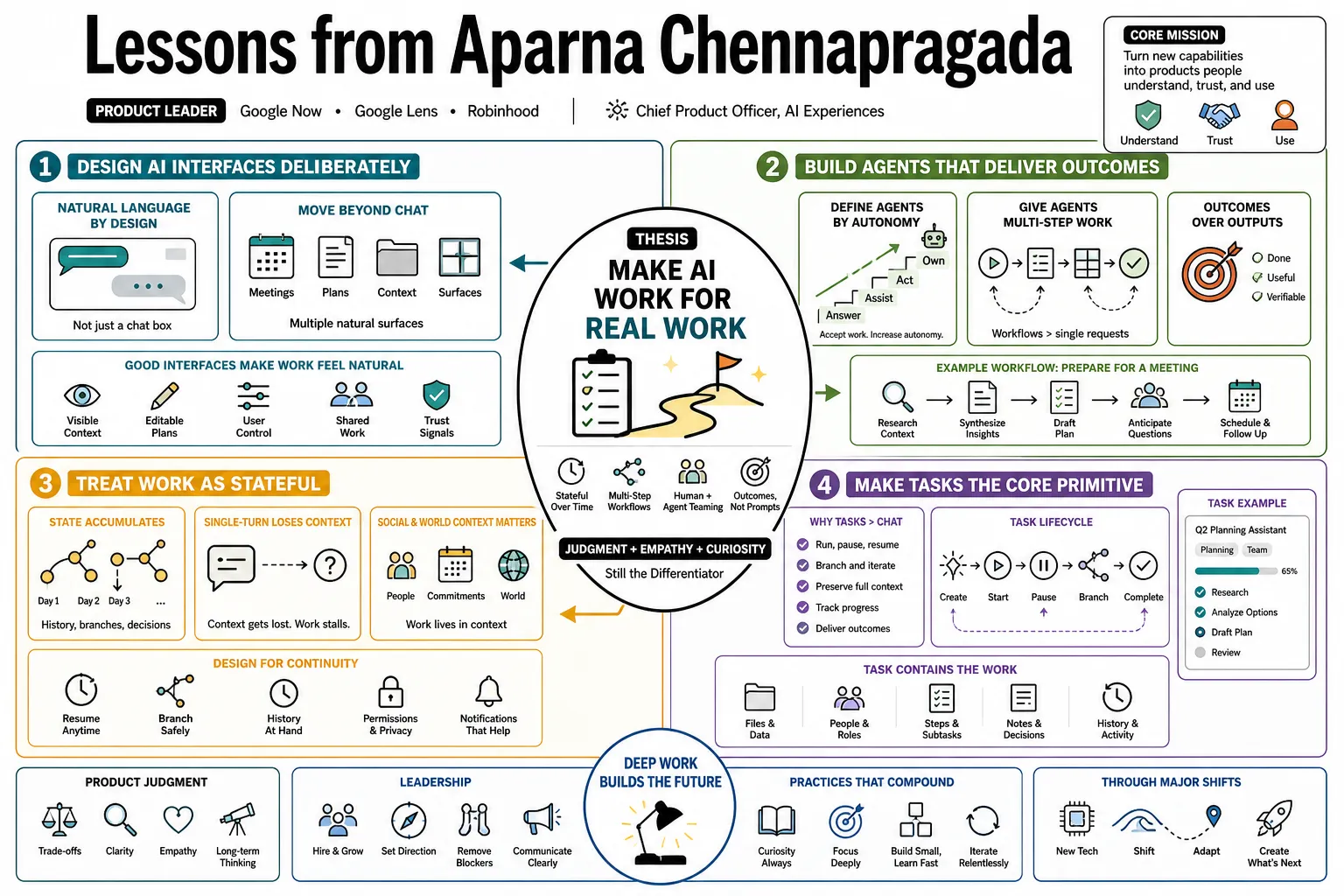
- On Design Natural Language Deliberately: Natural-language experiences need intentional interaction design; putting a chat box around a model is not a complete product strategy. — Reference: Lenny's Podcast — Aparna Chennapragada on Building AI Products
- On Define Agents by Autonomy: An agent becomes useful when it can accept delegated work and operate with increasing autonomy instead of returning only a single answer. — Reference: Lenny's Podcast — Aparna Chennapragada on Building AI Products
- On Give Agents Multi-Step Work: The meaningful unit of agent value is a nontrivial workflow such as preparing for a meeting, not an isolated summarization request. — Reference: Lenny's Podcast — Aparna Chennapragada on Building AI Products
- On Move Beyond Chat: Agent interaction should include editable plans, meetings, context, and other natural surfaces rather than forcing every activity through a message thread. — Reference: Lenny's Podcast — Aparna Chennapragada on Building AI Products
- On Treat Work as Stateful: Real knowledge work accumulates history, branches, and social obligations, so isolated single-turn interactions lose essential context. — Reference: ACD — 2026: Year of Deep Work
- On Make Tasks the Core Primitive: A task is a stronger organizing unit than a chat because it can run, pause, resume, and branch while preserving the work around it. — Reference: ACD — 2026: Year of Deep Work
- On Build an Environment for Deep Work: Complex knowledge work needs a persistent environment comparable to an IDE, not a loose collection of inboxes, spreadsheets, and disconnected queries. — Reference: ACD — 2026: Year of Deep Work
Product Strategy and Prototyping
- On Prototype Before You Specify: When AI makes prototypes cheap, building a working interaction is often the fastest way to discover and communicate what the product should become. — Reference: Lenny's Podcast — Aparna Chennapragada on Building AI Products
- On Use Prompt Sets as Product Specifications: A well-designed set of prompts can define and test a product's core interactions more concretely than a static requirements document. — Reference: Lenny's Podcast — Aparna Chennapragada on Building AI Products
- On Prefer Demos to Memos: Teams should show the intended behavior early and use the demo to sharpen judgment before investing in polished documentation. — Reference: Lenny's Podcast — Aparna Chennapragada on Building AI Products
- On Look for Multiple Inflection Points: A promising zero-to-one opportunity usually combines shifts in at least two of technology, consumer behavior, and business model. — Reference: Lenny's Podcast — Aparna Chennapragada on Building AI Products
- On Create Early-Adopter Laboratories: Organizations can work one year in the future by giving pioneers controlled access to advanced rough-cut tools before broad deployment. — Reference: Lenny's Podcast — Aparna Chennapragada on Building AI Products
- On Build Two Enterprise Products at Once: Enterprise AI needs both a compelling user experience and an administrative system for governance, security, and auditability. — Reference: Lenny's Podcast — Aparna Chennapragada on Building AI Products
- On Bridge Capability and Adoption: Product leaders must serve fast-moving early adopters without ignoring the slower pace of habit change, trust, and organizational rollout. — Reference: Lenny's Podcast — Aparna Chennapragada on Building AI Products
- On Solve the User Problem First: New technical capabilities should begin with a real user problem rather than with a premature decision about monetization or platform mechanics. — Reference: WIRED — Google's Latest Message: We're Just Here to Help
The Evolving Work of Product Leaders
- On Become a Tastemaker and Editor: As AI expands the supply of ideas and prototypes, product leadership shifts toward judgment, curation, and the ability to shape a coherent outcome. — Reference: Lenny's Podcast — Aparna Chennapragada on Building AI Products
- On Earn Influence Through Judgment: In an abundant production environment, a title is less persuasive than a demonstrated ability to choose, refine, and guide what should survive. — Reference: Lenny's Podcast — Aparna Chennapragada on Building AI Products
- On Expect Makers to Become Managers: Working with agents moves makers partly outside the flow of execution and into supervising output, setting direction, and deciding when to intervene. — Reference: ACD — Every Maker Is Now a Manager of AI
- On Design Calmer Human-AI Loops: A chat-centered workflow can become a long, inconclusive message thread that holds attention without offering a natural stopping point. — Reference: ACD — Every Maker Is Now a Manager of AI
- On Track the Moving Domain: Expertise now includes following how a field is being redefined, because mastery of a fixed body of knowledge decays faster during a platform shift. — Reference: ACD — Every Maker Is Now a Manager of AI
- On Watch Constraints Move Downstream: When AI makes early production steps cheap, later steps such as evaluation, coordination, and integration absorb more of the difficulty. — Reference: ACD — Thick Steps and Thin Steps in the AI Era
- On Invest in Verification: Faster drafting increases the need for review, grounding, policy checks, and architectural alignment rather than eliminating those responsibilities. — Reference: ACD — Thick Steps and Thin Steps in the AI Era
Leadership, Learning, and Culture
- On Do Not Overfit to Early Success: An early breakthrough can become the default lens through which a leader or company forces every later signal to justify itself. — Reference: ACD — What Is Your Golden Gate Bridge?
- On Keep Updating After Being Right: Praise for correctness can reduce learning when it teaches someone to listen only for flaws instead of evidence that should change the model. — Reference: ACD — What Is Your Golden Gate Bridge?
- On Combine High Expectations with High Support: People who get more from AI agents tend to steer and coach them with demanding standards while supplying enough guidance to improve. — Reference: Microsoft Bay Area — Better Together Leadership Summit
- On Enter the Technology Shift: During a major platform transition, leaders learn fastest by getting close to the work instead of observing it from a safe distance. — Reference: Microsoft Bay Area — Better Together Leadership Summit
- On Protect White Space for Creativity: Creative work needs unstructured maker time; it cannot reliably be squeezed into a sequence of short meetings. — Reference: Forbes — Peeking Around the Corner with Aparna Chennapragada
- On Use AI to Think Asynchronously: Distributed teams can preserve context across time zones by using meeting agents and personal assistants to summarize, prioritize, and follow up. — Reference: Forbes — Peeking Around the Corner with Aparna Chennapragada
- On Learn from Unplanned Uses: A product becomes more valuable when teams pay attention to uses they did not predict, especially when those uses remove embarrassment or access barriers. — Reference: Forbes — Peeking Around the Corner with Aparna Chennapragada
- On Treat Failure as Timing Evidence: A technically impressive product can still arrive before the technology and market are ready; the lesson is to study which ingredients failed to converge. — Reference: Forbes — Peeking Around the Corner with Aparna Chennapragada
- On Keep the Human at the Center: Tools should be judged by whether they improve life for customers, employees, and communities rather than by technical novelty alone. — Reference: Forbes — Peeking Around the Corner with Aparna Chennapragada
Google Now, Lens, and Building Through Platform Shifts
- On Assist Instead of Merely Answering: The deeper opportunity in mobile computing was to help people act in context, not merely place a smaller search box on a phone. — Reference: Business Insider — Aparna Chennapragada on the Future of Smartphones
- On Design for the Device's Context: On a phone, users need concise help while moving and cannot be expected to navigate the same sequence of screens as on a desktop. — Reference: Business Insider — Aparna Chennapragada on the Future of Smartphones
- On Use Vision as an Input: Visual interfaces let people express needs that are difficult to translate into words, including style, products, places, and unfamiliar text. — Reference: VentureBeat — Google Lens Recognizes More Than One Billion Products
- On Train on Real-World Inputs: Recognition systems improve when training data resembles the imperfect images people actually capture rather than idealized catalog photography. — Reference: VentureBeat — Google Lens Recognizes More Than One Billion Products
- On Put Answers Where Questions Appear: A useful visual system can overlay information directly on the object or scene that prompted the question, reducing translation between world and interface. — Reference: VentureBeat — Google Lens Recognizes More Than One Billion Products
- On Preserve Privacy While Expanding Help: As assistants become more proactive and visual, privacy and user control must be designed into the service rather than treated as an afterthought. — Reference: WIRED — Google's Latest Message: We're Just Here to Help
Human Potential and a Durable Career
- On Amplify Rather Than Erase Human Work: The strongest use of AI is to expand what people can do, not simply automate away every part of their contribution. — Reference: Microsoft Source — How Aparna Chennapragada Is Shaping AI
- On Translate the Frontier into Useful Products: Product leadership connects cutting-edge research with experiences that people can understand, trust, and want to use. — Reference: Microsoft Source — How Aparna Chennapragada Is Shaping AI
- On Give Mundane Work to the Machine: AI should carry repetitive operational work so people can spend more attention on judgment, creativity, and meaningful activity. — Reference: Forbes — Peeking Around the Corner with Aparna Chennapragada
- On Use Curiosity as Fuel: A durable career is easier to sustain when it stays connected to the kind of work that genuinely generates curiosity and joy. — Reference: Forbes — Peeking Around the Corner with Aparna Chennapragada
- On Keep Products Interactive with Customers: A compelling demo is irrelevant if it is not useful; product development remains an interaction with customers rather than a performance in a vacuum. — Reference: Forbes — Peeking Around the Corner with Aparna Chennapragada