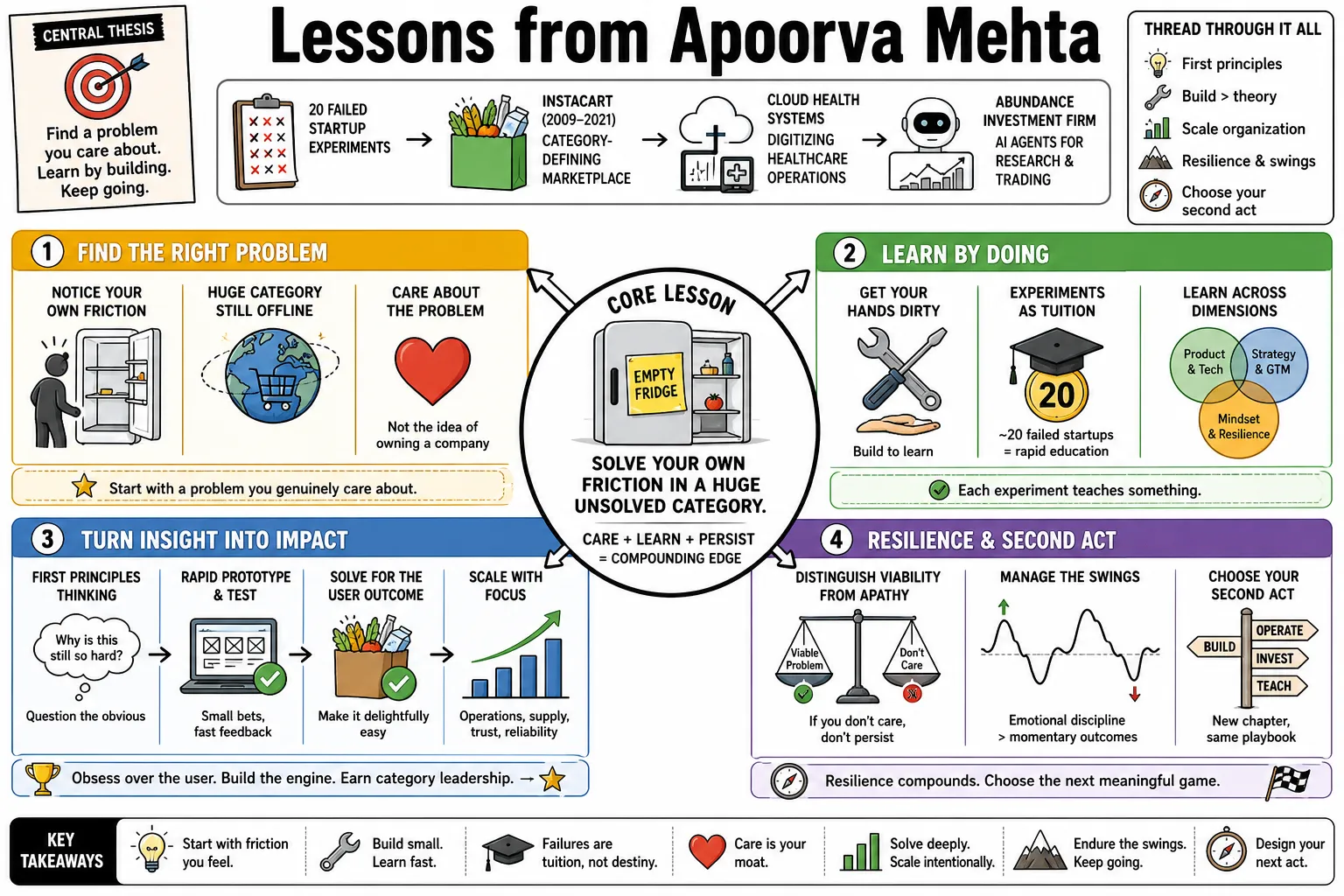
Apoorva Mehta is the founder and former CEO of Instacart. In 2023 he described his new company, Cloud Health Systems; in April 2026 Bloomberg reported the launch of Abundance, an investment firm using AI agents to research and execute trades. His path from roughly twenty failed startup experiments to a category-defining marketplace offers lessons in first-principles reasoning, manual execution, organizational scaling, resilience, and choosing a second act. — Forbes — Instacart’s IPO and Mehta’s Exit. — Y Combinator — Apoorva Mehta Q&A. — Economic Times — Bloomberg’s Abundance Interview.
Finding a Problem Worth Solving
- On Get Your Hands Dirty: Mehta concluded that entrepreneurship is learned through direct building, not by waiting until the theory feels complete. — Elad Gil — Apoorva Mehta Fireside Chat.
- On Use Experiments as Tuition: Mehta describes roughly twenty failed startup experiments as part of learning to build a company, rather than as a reason to stop trying. — Y Combinator — Apoorva Mehta Q&A.
- On Learn Across Several Dimensions: Those failures taught him rapid prototyping, business strategy, and how to manage his psychology through a startup's inevitable swings. — Y Combinator — Apoorva Mehta Q&A.
- On Care About the Problem: A startup should begin with a problem the founder genuinely cares about, not with the abstract desire to own a company. — Entrepreneur — After Many Strikeouts.
- On Distinguish Viability from Apathy: Mehta realized he did not care about connecting lawyers while building LegalReach. That experience changed how he chose the next problem to pursue. — Entrepreneur — After Many Strikeouts.
- On Notice Your Own Friction: The founding insight for Instacart came from a mundane personal problem: an empty refrigerator in a huge category that remained offline. — Elad Gil — Apoorva Mehta Fireside Chat.
- On Look for Large Offline Categories: He saw groceries as a trillion-dollar market whose consumer experience had not caught up with online commerce. — Elad Gil — Apoorva Mehta Fireside Chat.
Reasoning from First Principles
- On Revisit Failed Categories: A notorious predecessor does not prove a category is impossible; it may show that an earlier model met the wrong technological moment. — Elad Gil — Apoorva Mehta Fireside Chat.
- On Identify What Changed: Smartphones, internet access, and GPS changed grocery delivery economics by connecting orders with nearby shoppers in real time. — Elad Gil — Apoorva Mehta Fireside Chat.
- On Remove the Old Cost Structure: Instacart avoided Webvan's capital burden by using existing stores, independent fulfillment, and no owned trucks or inventory. — Elad Gil — Apoorva Mehta Fireside Chat.
- On Challenge Stale Conventional Wisdom: The world can change faster than the lessons investors carry forward from a prior failure. — Elad Gil — Apoorva Mehta Fireside Chat.
- On Break the Right Rule: Mehta argues that startups can distinguish themselves by breaking an accepted rule that does not fit their market, rather than treating conventional advice as universally applicable. — Elad Gil — Apoorva Mehta Fireside Chat.
- On Evaluate Advice in Context: Founder advice should be tested against the company's own mechanics rather than applied as a universal playbook. — Elad Gil — Apoorva Mehta Fireside Chat.
- On Take Category-Defining Shots: An enormous market with a tractable new approach can justify taking a difficult shot at transforming a category. — Elad Gil — Apoorva Mehta Fireside Chat.
Proving Demand Before Scaling
- On Build the Core Quickly: Mehta recalls coding the first Instacart version in three weeks and then testing it by placing an order himself. — Elad Gil — Apoorva Mehta Fireside Chat.
- On Be the First User and Operator: He placed the first order, shopped for it, delivered it to himself, and experienced the complete workflow firsthand. — Elad Gil — Apoorva Mehta Fireside Chat.
- On Bootstrap Missing Supply: When retailers lacked usable catalogs, the team bought one of every item, photographed it, and uploaded the data themselves. — Elad Gil — Apoorva Mehta Fireside Chat.
- On Spend to Unlock a Real Test: Mehta recalls spending about fifty thousand dollars to create an initial store catalog, allowing customers to browse items that had not been available online. — Elad Gil — Apoorva Mehta Fireside Chat.
- On Train Corporate Teams in the Field: Instacart trained corporate employees as in-store shoppers so engineers and operators could feel customer and frontline friction directly. — Y Combinator — Apoorva Mehta Q&A.
- On Design the Whole Marketplace: The product eventually had to coordinate customers, retailers, shoppers, and advertisers rather than optimize only the consumer app. — Y Combinator — Apoorva Mehta Q&A.
- On Turn Operations into Software: Retailer software brought inventory online, configured efficient picking, and powered e-commerce instead of treating stores as passive suppliers. — Y Combinator — Apoorva Mehta Q&A.
Building an Organization That Can Scale
- On The Team Becomes the Company: Mehta came to see team design as the most scalable way to determine what the organization could repeatedly accomplish. — Elad Gil — Apoorva Mehta Fireside Chat.
- On Hire for Durable Ownership: Personally fixing a process can leave the same problem to recur as the company grows. Mehta's more scalable response was to hire a team capable of owning and improving it. — Elad Gil — Apoorva Mehta Fireside Chat.
- On Value Intellectual Honesty: Early teams need enough intellectual honesty to see past hype and vanity metrics and reach the answer the evidence supports. — Elad Gil — Apoorva Mehta Fireside Chat.
- On Combine Urgency with Excellence: Relentless execution is not haste alone; Mehta describes it as the combination of urgency and excellence. — Elad Gil — Apoorva Mehta Fireside Chat.
- On Hire People Who Can Scale: An early-stage leader must grow as rapidly as the company because the organization can be materially different every quarter. — Elad Gil — Apoorva Mehta Fireside Chat.
- On Prefer Senior People Who Can Still Build: In his second company, Mehta favored experienced leaders willing to operate as individual contributors, combining judgment with detail-level work. — Elad Gil — Apoorva Mehta Fireside Chat.
Responding to Shocks and Transitions
- On Expect Failure Without Normalizing Passivity: Mehta expected early startup attempts to fail, but continued trying new ideas until he found Instacart. — Forbes — Instacart Survived Covid Chaos.
- On Turn an Existential Loss into a Deadline: After Amazon acquired Whole Foods, Instacart used the partnership's wind-down period to win major grocers rather than accept the loss of its largest partner as fatal. — Forbes — Instacart Survived Covid Chaos.
- On Visit the Market Directly: After the Whole Foods shock, Mehta went on the road to speak with major grocers and convert urgency into partnerships. — Forbes — Instacart Survived Covid Chaos.
- On Recognize When the Product's Role Changes: During Covid, grocery delivery shifted almost overnight from convenience to lifeline, requiring the company to respond to a different level of responsibility. — Elad Gil — Apoorva Mehta Fireside Chat.
- On Do Not Stack Complexity at the Wrong Time: Mehta said an IPO was too much to add when pandemic growth had strained infrastructure and the finance organization was changing. — Forbes — Instacart’s IPO and Mehta’s Exit.
- On Judge an IPO Over the Long Term: He argues that a company's long-term value matters more than its first-day trading price. — Forbes — Instacart’s IPO and Mehta’s Exit.
Choosing a Second Act
- On Require Singular Focus: Mehta described his new company as requiring singular focus and explained his decision to leave Instacart in those terms. — Forbes — Instacart’s IPO and Mehta’s Exit.
- On Question the Identity You Have Earned: A mentor's challenge about remaining the grocery founder pushed him to ask whether past success was still his calling. — Forbes — Instacart’s IPO and Mehta’s Exit.
- On Evaluate Business Before Romance: For a second act, Mehta first asks whether the idea can become a good business, then whether it will be enjoyable and mission-worthy. — Elad Gil — Apoorva Mehta Fireside Chat.
- On Test Several Mission Areas: He explored climate, space, robotics, and other fields before deciding where business quality, personal energy, and mission aligned. — Elad Gil — Apoorva Mehta Fireside Chat.
- On See Human Attention as a Bottleneck: In investing, he argues that people can track only so many opportunities and process each only so deeply. — Economic Times — Bloomberg’s Abundance Interview.
- On Let Agents Cover the Full Workflow: Bloomberg reported in April 2026 that Abundance's AI agents covered idea generation, research, stock selection, position sizing, and trade execution. — Economic Times — Bloomberg’s Abundance Interview.
- On Automate Gradually: In April 2026, Mehta said some stock-picking strategies were AI-run while strategies still in development retained human involvement. — Economic Times — Bloomberg’s Abundance Interview.
- On Test with Proprietary Capital First: In April 2026, Abundance was reported to trade mostly its own capital, with outside money described as a future plan. — Economic Times — Bloomberg’s Abundance Interview.
- On Start with One Asset Class: By April 2026, Abundance was making long and short stock bets, with other asset classes described as future expansion rather than established strategies. — Economic Times — Bloomberg’s Abundance Interview.