Arash Ferdowsi co-founded Dropbox with Drew Houston after leaving MIT. His work spanned engineering, recruiting, design and company culture, with a particular concern for product quality and making work more human. — Dropbox — Thank You, Arash.
On Entrepreneurship and Startups
- On the "shotgun marriage" of co-founding Dropbox: Ferdowsi recalled that he and Houston spent about five hours together before deciding to build Dropbox, a partnership Houston called a “shotgun marriage.” — TMC / Kansas City Star — Ferdowsi Interview.
- On the early days: "I met Drew at the student center at MIT, and he had this early prototype of Dropbox, which I was blown away by. It was really simple and elegant, and I was impressed that he had sort of put it together so quickly." — Sequoia — Dropbox: Crucible Moments.
- On the difficulty of convincing his parents about dropping out of MIT: "The most difficult part of the process, honestly, was, was convincing my parents to, to let me drop out. They were, uh, definitely concerned at first." — Sequoia — Dropbox: Crucible Moments.
- On the importance of a co-founder: Ferdowsi endorsed Houston’s comparison of running a company alone to raising a child as a single parent: possible, but much harder. — TMC / Kansas City Star — Ferdowsi Interview.
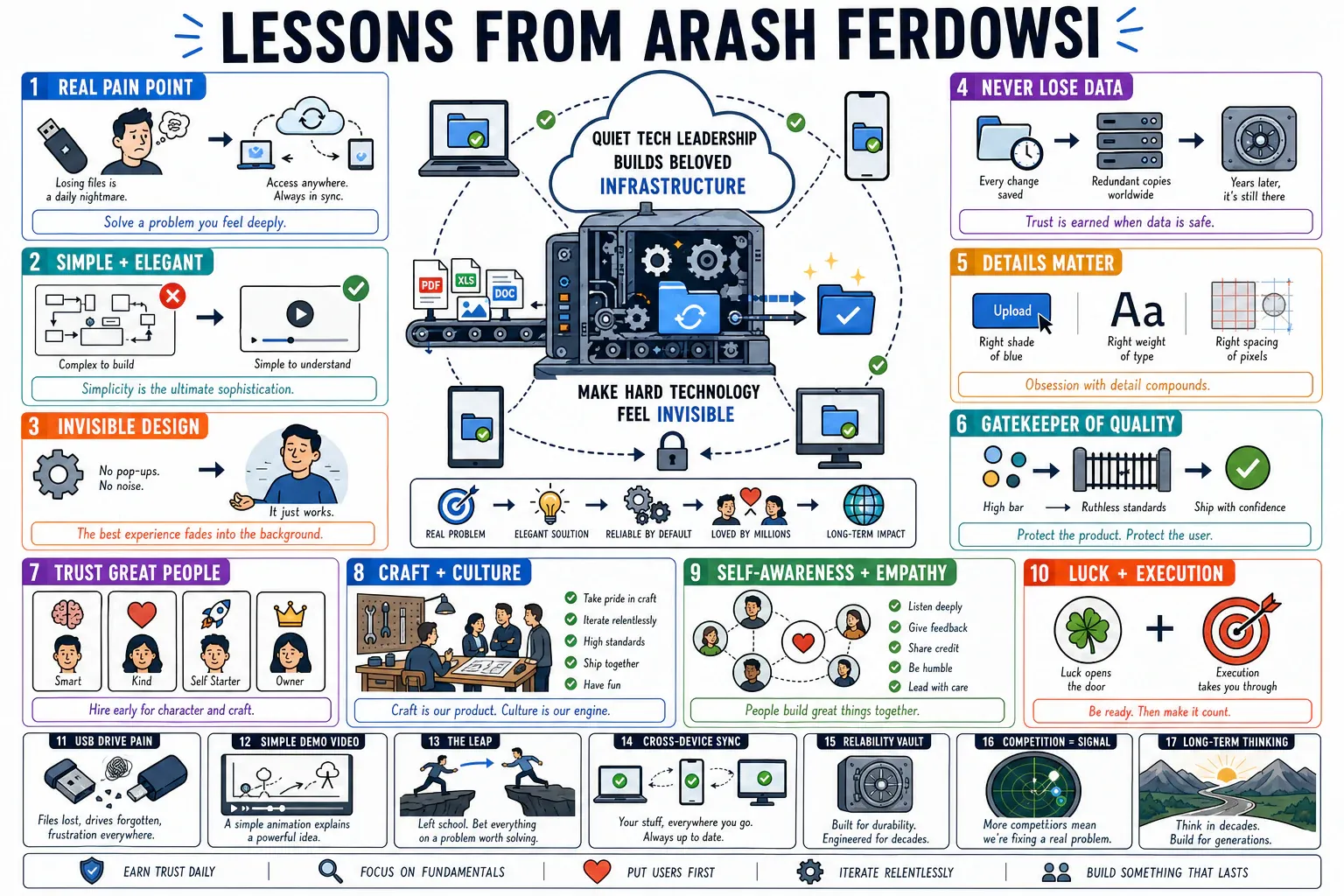
- On luck's role in success: "Clearly Dropbox is a good idea. And we clearly did a good job in executing it. But we got lucky on so many, in so many different ways... There is a lot of luck in this." — TMC / Kansas City Star — Ferdowsi Interview.
- On competition: With numerous backup, synchronization and version-control products already available, Ferdowsi recalled needing to explain what made Dropbox different. — Sequoia — Dropbox: Crucible Moments.
- On solving a real problem: Dropbox began with Houston’s frustration at forgetting a USB drive. Ferdowsi joined him to build a simpler way to access files across computers. — Forbes — Dropbox’s Inside Story.
- On the power of a simple demo: In the early days, a simple explainer video was crucial in demonstrating Dropbox's value and attracting its first users and investors. — Sequoia — Dropbox: Crucible Moments.
- On not needing a business degree: Ferdowsi left MIT before graduating to build Dropbox, believing he could return if the company failed. His experience is a personal example, not a rule that formal education is irrelevant. — TMC / Kansas City Star — Ferdowsi Interview.
- On the value of Y Combinator: The accelerator provided crucial early funding and, importantly, the push to find a co-founder. — Forbes — Dropbox’s Inside Story.
On Product and Design
- On simplicity: Ferdowsi described making Dropbox easier to use as a continuing priority, keeping the complexity of synchronization out of the user’s way. — WIRED — With Sync Solved.
- On user experience: Dropbox aimed for a consistent experience across Mac, Windows and Linux, despite differences among the operating systems. — WIRED — With Sync Solved.
- On the difficulty of getting it right: “The problem [consumer cloud storage] is hard to get right,” because “the challenge is a very technical one and that is why we have such a rigorous hiring process.” — TNW — Dropbox Founder Interview.
- On the invisibility of good design: For non-technical users, the fact that Dropbox is so "invisible and behind the scenes" can be a challenge, yet for many, they "love Dropbox because it is invisible." — TNW — Dropbox Founder Interview.
- On the importance of details: Ferdowsi once had a designer spend hours tweaking the shade of a Dropbox button on a Mac because it was a touch darker than Apple's, a detail that "drove him 'crazy' for weeks." — Forbes — Dropbox’s Inside Story.
- On being the gatekeeper of quality: "I am the gatekeeper here. Everything has to be just so." — Forbes — Dropbox’s Inside Story.
- On continuous improvement: When Dennis Woodside criticized Dropbox’s pace of innovation, Ferdowsi changed the product-release approach. The response was to improve how the company shipped, rather than dismiss the criticism. — Forbes — Dropbox Under Siege (2015).
- On when a product is "good enough": "When it comes to building products, people say something needs to be 10 times better than the alternative before someone will switch to it, but I wish there were a way to be more scientific about that. How do you truly know when a product is sufficiently better?" — Sequoia — Seven Questions (2019).
- On the importance of reliability: "People were entrusting us with their most important information... And we viewed it as, as completely unacceptable, you know, to ever lose data, to ever lose a change to an important file." — Sequoia — Dropbox: Crucible Moments.
- On focusing on real people's problems: Ferdowsi resisted making any folder a Dropbox folder because the feature could confuse people—for example, by mixing home and work documents. — WIRED — With Sync Solved.
On Leadership and Company Culture
- On hiring: "Much of what is special about Dropbox can be traced to some of our earliest hires. At that stage, you have to find people you'll trust to make the right decisions, because if you micromanage great people, they're not going to want to work for you for long." — Sequoia — Seven Questions (2019).
- On hiring for craft and culture: "Part of it is just hiring brilliant people, but it's also about hiring people who have experience and truly know their craft... We had some key early hires at the senior level who Drew and I fully trusted and who were great cultural fits." — Sequoia — Seven Questions (2019).
- On the importance of self-awareness and empathy: "When you're growing as quickly as we are, it gets both more difficult and more important to collaborate effectively, and I think a culture of self-awareness and empathy is key." — Sequoia — Seven Questions (2019).
- On using the Enneagram for self-awareness: "The Enneagram has helped me understand not only my strengths and weaknesses, but also my gaps in self-awareness, and it's made me better at empathizing with people who are wired differently than me." — Sequoia — Seven Questions (2019).
- On his Enneagram type: "For example, my dominant type is individualist. I tend to value authenticity and doing things differently." — Sequoia — Seven Questions (2019).
- On overcoming biases: "We were too sensitive to confrontation. But we've learned to be more conscious of our biases and to understand that when someone's direct, that doesn't mean they're upset or a mean person." — Sequoia — Seven Questions (2019).
- On the value of direct communication: "You need people who aren't afraid to speak up when something's not working. Without them, we probably wouldn't have some tough, important conversations." — Sequoia — Seven Questions (2019).
- On fostering a caring culture: Houston credits Ferdowsi with making Dropbox a place where people cared about one another and where success was measured by how results were achieved, not just what was achieved. Houston called making work human Ferdowsi’s proudest and most enduring contribution. — Dropbox — Thank You, Arash.
- On the fragility of innovation: "I think it's important to understand how fragile innovation is. It's especially tough at scale... we need to be mindful of protecting teams from dynamics that can starve innovation." — Sequoia — Seven Questions (2019).
- On giving ideas room to grow: "Especially when an idea is in its earliest stages, you need to give people room to explore without too much fear of failure. If you're reporting on it to the entire company from the beginning, for example, that's a recipe for disaster." — Sequoia — Seven Questions (2019).
- On the pressure of early-stage ideas: "There are too many eyes on it, and people will feel like they have to rigorously prove that the path they're pursuing is going to work. But in reality, there's always going to be a lot of failing and learning before you get to the right answer." — Sequoia — Seven Questions (2019).
- On his internal focus: Forbes described Ferdowsi reviewing products, filing bug reports and improving hiring processes, while protecting simplicity and ease of use across Dropbox’s products. — Forbes — Dropbox Under Siege (2015).
- On ambitious goals: In 2015, Ferdowsi described the opportunity ahead of Dropbox as much larger than what the company had already captured. — Forbes — Dropbox Under Siege (2015).
On Personal Growth and Life
- On being an introvert: "I'm pretty introverted, so recharge time feels particularly valuable to me." — Sequoia — Seven Questions (2019).
- On recharging: "There are lots of different charge cycles—a year is one... I think a day is a cycle, too. If you're fried and stuck at the end, a good night's sleep can make a big difference." — Sequoia — Seven Questions (2019).
- On active recharging: "And recharge time doesn't necessarily have to be downtime. One thing I like to do is have a full day where I focus on something I'm passionate about." — Sequoia — Seven Questions (2019).
- On meditation: "Meditation. It's so easy to get distracted by the unrelenting stream of text messages and Gchats and emails... I'm up to about 20 minutes of meditation a day now, and it definitely helps me to be more measured and less emotionally reactive." — Sequoia — Seven Questions (2019).
- On starting meditation when burnt out: "I started about three years ago, at a time when I was feeling pretty burnt out. I took a little break to work on getting healthier—I started eating better and exercising, as well as meditating." — Sequoia — Seven Questions (2019).
- On embracing security: In a 2011 interview, Ferdowsi highlighted deleted-file recovery and version history as ways to help users restore their work. — TNW — Dropbox Founder Interview.
- On active listening: Ferdowsi redesigned hiring feedback so debrief moderators gathered interviewers’ concerns rather than letting them go unheard. — Forbes — Dropbox Under Siege (2015).
- On personal connections: Ferdowsi’s childhood friend Jon Ying became a Dropbox colleague. Their work together included Ferdowsi’s guidance on the drawings that gave the product a more approachable feel. — AllThingsD — Dropbox’s Company Culture.
- On his childhood interest in computers: His mother recalled that he assembled a computer from parts at around nine or ten. — TMC / Kansas City Star — Ferdowsi Interview.
- On the unexpected uses of his creation: "Dropbox is being used to coordinate multiple tractors on a farm. So that they stop crashing into each other. I never thought Dropbox would be used for that!” — TNW — Dropbox Founder Interview.
- On being recognized: He once ran into high school kids at an arcade in his hometown who were excited to see someone from Dropbox. He recalls, "I generally get shy or embarrassed in situations like that. I try to downplay it a bit." — TMC / Kansas City Star — Ferdowsi Interview.
Learn more:
- Seven Questions with Arash Ferdowsi — Sequoia
- Meet the richest area native you’ve probably never heard of — Kansas City Star, syndicated by McClatchy-Tribune on TMC
- Dropbox ft. Drew Houston — How the Cloud Pioneer Reinvented Itself — Sequoia
- With Sync Solved, Dropbox Squares Off With Apple’s iCloud — WIRED
- Dropbox: The Inside Story Of Tech’s Hottest Startup — Forbes
- Thank you, Arash — Drew Houston, Dropbox
- Dropbox Founder on New Features and Global Expansion — The Next Web
- Dropbox Is Under Siege -- But It’s Not Slowing Down — Forbes
- Inside Dropbox’s Reverse-Engineered Company Culture — AllThingsD